← All women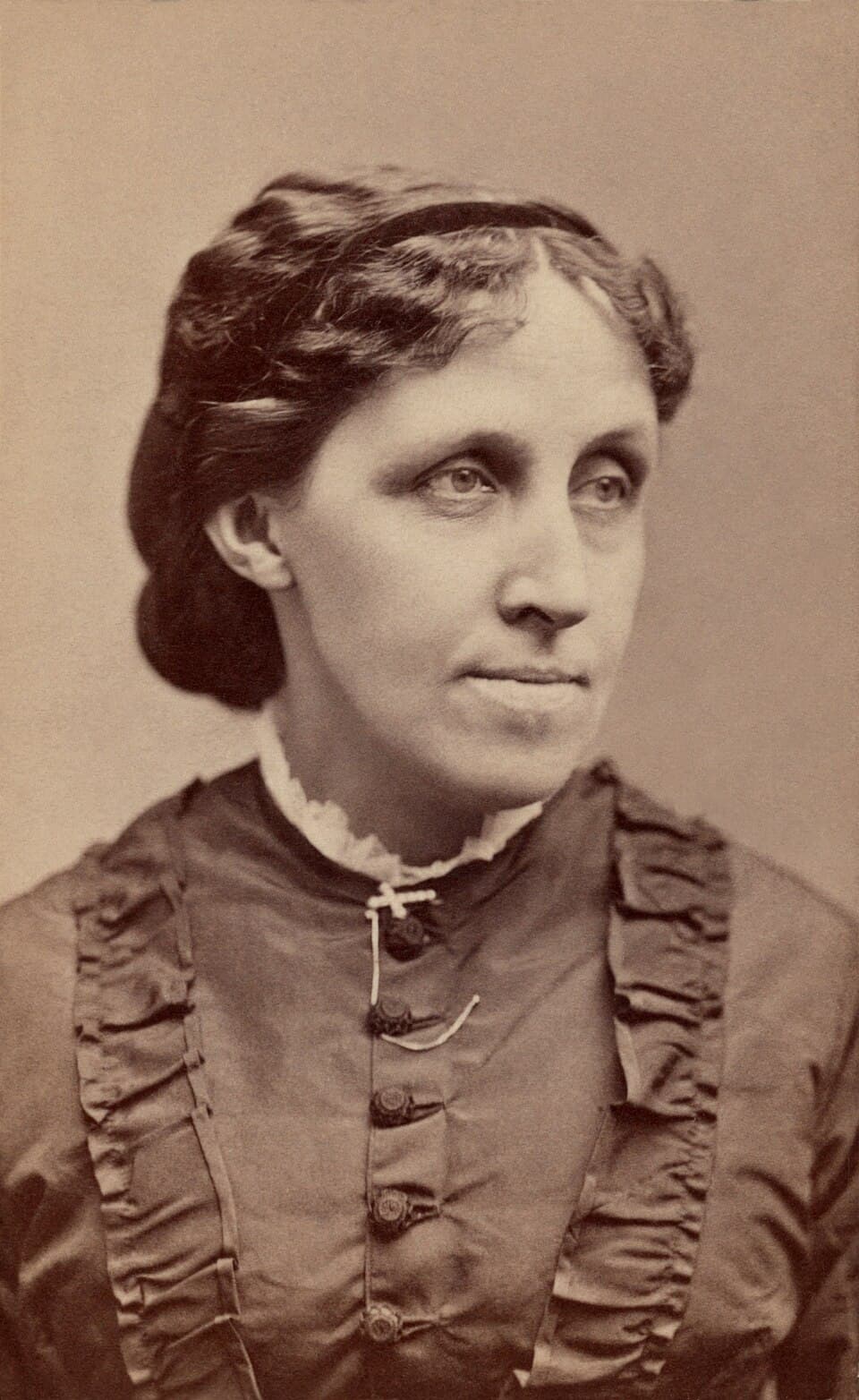
American · Literature · Activism
Louisa May Alcott
November 29, 1832 – March 6, 1888
Early Life and Background
Louisa May Alcott was born on November 29, 1832, in Germantown, Pennsylvania, then a village outside Philadelphia and now part of the city. She was the second of four daughters born to Amos Bronson Alcott and Abigail May Alcott, a couple deeply engaged in the intellectual and reform movements of their time.[2][3][9] Bronson Alcott was a Transcendentalist philosopher and educational reformer whose experimental schools and utopian schemes often failed financially. Abigail, known as "Abba," combined strong abolitionist and feminist convictions with the practical work of keeping the family afloat.
The Alcotts moved frequently in Louisa’s childhood, living in Boston and Concord, Massachusetts, and briefly at the communal experiment Fruitlands, which collapsed within months.[3][5] Chronic financial instability meant that Louisa grew up acutely aware of poverty and economic insecurity. At the same time, she was immersed in a rich intellectual milieu. Her family’s close ties with leading Transcendentalists brought her into contact with figures such as Ralph Waldo Emerson, Henry David Thoreau, Nathaniel Hawthorne, and reformers including Theodore Parker.[3][9][11] Emerson’s library and Thoreau’s nature walks offered an informal education, while her father’s unconventional teaching nurtured her imagination and moral seriousness.
Alcott received little formal schooling; instead, she was largely educated at home by Bronson and through self-directed reading.[3][10] She began writing stories and poems at a young age, using writing as both emotional outlet and potential livelihood. The contrast between her family’s ideals and their material hardship became a central tension in her life and later in her fiction, informing her recurring focus on work, duty, and the struggle for female independence.
Early Work and Career Beginnings
From adolescence onward, Louisa undertook a wide range of paid work to help support her parents and sisters. She worked as a seamstress, governess, teacher, and domestic servant in Boston and Concord, gaining close knowledge of working women’s lives.[3][9][18] In parallel, she wrote steadily, hoping that literary success might provide a path out of debt.
Alcott’s first successful publication came with the poem "Sunlight," printed in Peterson’s Magazine in 1851 under the pseudonym Flora Fairchild.[1][3] The specific day is not firmly documented, but sources agree that this September 1851 appearance marked a turning point by proving she could sell her writing. In 1852, her story "The Rival Painters: A Tale of Rome" was published in the temperance paper The Olive Branch.[2] Throughout the early 1850s she produced tales and sketches for various periodicals, often under pseudonyms, experimenting with different genres while earning modest fees.
In 1854, at age twenty‑two, she published her first book, "Flower Fables", a collection of fairy stories originally written years earlier for the daughter of family friend Ralph Waldo Emerson.[3][9][10] The volume drew on her imaginative, moralizing style and demonstrated that she could produce longer works. While "Flower Fables" brought some recognition, it did not yet solve her financial problems. Alcott continued to write anonymously and pseudonymously, especially sensational and Gothic tales that paid better in popular magazines than more serious or didactic pieces.
Civil War Service and "Hospital Sketches"
The American Civil War profoundly shaped Alcott’s life and career. Committed to abolition, she had already engaged in antislavery work; in 1847, the Alcott family assisted the Underground Railroad by sheltering a fugitive enslaved person in their home for a week.[8] In 1862 she volunteered as a nurse in a Union hospital in Georgetown, near Washington, D.C., caring for wounded soldiers.[9] The harsh conditions, long hours, and emotional strain exhausted her, and she contracted typhoid pneumonia during her service.
Alcott’s health never fully recovered; she is believed to have been treated with calomel, a mercury‑based compound that likely caused long‑term illness.[9] Yet her experiences as a nurse became the basis for one of her first widely acclaimed books. She began publishing a series of letters and sketches about her hospital work in the abolitionist newspaper The Boston Commonwealth in 1863. These were collected and expanded into "Hospital Sketches", published later that year.[5][9][16]
"Hospital Sketches" offered vivid, compassionate portraits of soldiers and staff, mixing humor and sentiment with sharp observations of military bureaucracy and suffering. It resonated with readers in the Union states, solidifying Alcott’s reputation as an author and providing important income. The book demonstrated her talent for transforming personal experience into compelling narrative and previewed the realistic, character‑driven style that would define her later fiction.
Sensational Fiction and Literary Development
Alongside her more respectable juvenile and moral fiction, Alcott wrote a body of sensation and Gothic tales aimed at the burgeoning market for cheap, thrilling literature. Many were published anonymously or under the pseudonym A. M. Barnard.[9][18] One notable work, "Pauline’s Passion and Punishment," appeared in Frank Leslie’s Illustrated Newspaper in 1863 and reportedly earned her $100—a substantial sum at the time.[5][18]
These stories explored themes of passion, revenge, madness, and female transgression, in stark contrast to the domestic ideals often associated with Alcott’s name. For decades, much of this work remained obscure, leading to an image of Alcott primarily as a wholesome children’s author. Later scholarship revealed the full range of her literary interests and the economic pressures that led her to write sensation fiction to support her family.
In the early 1860s she also placed more conventional stories in respected venues. Her tale "Love and Self‑Love" appeared in The Atlantic Monthly in 1860, marking her entrance into an elite literary magazine.[10][16] In 1864 she published the novel "Moods", a psychologically ambitious work that reflected her ongoing exploration of women’s inner lives and social constraints.
"Little Women" and Major Works
Alcott’s breakthrough came with "Little Women", the work that would secure her place in literary history. In 1868, her publisher Thomas Niles urged her to write "a girls’ story."[3] Although initially reluctant—she preferred more adventurous or adult material—Alcott drew heavily on her own family experiences with her sisters Anna, Elizabeth, and May to craft the March sisters: Meg, Jo, Beth, and Amy.
She reportedly drafted Part I of "Little Women" rapidly, within about three months, at a small desk her father built in her room at Orchard House in Concord.[3] The novel was published in 1868, with Part II (often titled "Good Wives") following in 1869.[2][3][9] Exact day‑by‑day publication details are not consistently documented in the cited sources, but the two‑part release from 1868–69 is well established.
"Little Women" was an immediate and phenomenal success, praised for its realistic depiction of ordinary girls, its moral but not moralistic tone, and its portrayal of a heroine, Jo March, who valued intellectual ambition and personal independence.[1][3][9] The book brought Alcott fame and, crucially, substantial royalties, finally providing financial stability for the family.
She continued the March family saga with "Little Men" in 1871 and "Jo’s Boys" in 1886, exploring themes of education, work, and community through the Plumfield school and its students.[2][9][11] Other successful juvenile novels included "An Old‑Fashioned Girl" (1870), "Eight Cousins" (1875), and its sequel "Rose in Bloom" (1876).[9] For adult readers, she published novels such as "Work: A Story of Experience" (1873), inspired by her own varied employment history.
In all, Alcott wrote over thirty books and collections of short stories and poems, along with nearly three hundred shorter works across genres.[3][4] Her fiction consistently engaged with questions of gender, class, moral development, and the possibilities for women’s self‑support and self‑expression.
Activism, Suffrage, and Recognition
Beyond her literary achievements, Alcott was deeply involved in social reform. She was a committed abolitionist, supporting antislavery causes, and a strong feminist who advocated for women’s education, employment, and political rights.[10][13][17] Her participation in the women’s suffrage movement intensified in the 1870s.
In 1879, when Massachusetts granted women the right to vote in school committee elections and certain tax and bond matters, Alcott became the first woman to register to vote in Concord, Massachusetts.[10][17] Multiple reputable secondary sources, including the National Women’s History Museum and Pennsylvania Center for the Book, affirm this local "first," though the specific calendar day has not been documented in the cited materials.[1][10] She not only registered but also actively encouraged other women to exercise their new voting rights, demonstrating her belief that political participation was essential to broader equality.
Alcott used her influence and connections to support other women’s work. In 1881 she persuaded her publisher to bring out Harriett Hanson Robinson’s "Massachusetts in the Woman Suffrage Movement," a key text in documenting the state’s activism for voting rights.[6] Her writing often featured strong, capable girls and women, subtly challenging traditional gender roles.
During her lifetime, Alcott was widely recognized as a popular author. Posthumously, her reputation grew further as scholars and readers appreciated both her juvenile classics and her more complex adult and sensation fiction. She has been honored by institutions such as the National Women’s Hall of Fame for her literary contributions and her role in women’s history.[1]
Personal Life
Louisa May Alcott never married, a fact that has intrigued biographers and readers given the emphasis on marriage in much nineteenth‑century women’s fiction.[9][17] She expressed skepticism about conventional marriage and a preference for independence. A widely quoted remark attributed to her suggests that she "fell in love with so many pretty girls and never once the least bit with any man," though modern scholars debate its precise context and implications.[17]
Alcott’s primary emotional commitments were to her family, particularly her sisters and her mother. She took on the role of chief breadwinner early in life and remained financially responsible for the family even after achieving success. Her sister Elizabeth’s early death and May’s later marriage and relocation to Europe deeply affected her. Alcott also had close friendships, including with female contemporaries, but the historical record does not establish a formal long‑term romantic partnership.
Persistent ill health shadowed her later years. Many accounts link her chronic problems to the typhoid pneumonia and possible mercury poisoning she suffered during the Civil War, compounded by relentless overwork at the writing desk.[5][9] Despite these challenges, she continued to write and to participate in reform causes as much as her strength allowed.
Later Life and Death
In her final decade, Alcott balanced declining health with ongoing literary production and activism. She managed family affairs, assisted her nieces, and oversaw her works’ publication and royalties. She remained intellectually engaged, corresponding with readers and associates and following developments in suffrage and other movements.
Her father, Bronson Alcott, died in early March 1888. Louisa herself died on March 6, 1888, in Boston, Massachusetts, only two days after his death, at the age of fifty‑five.[2][3][5] Some sources note that she died on the day of his funeral.[9] She was buried with other members of her family in Sleepy Hollow Cemetery in Concord, on Authors’ Ridge, near the graves of Emerson, Thoreau, and Hawthorne.[3][5]
Her death ended a life marked by intense dedication to family, literature, and reform. The juxtaposition of her father’s passing and her own underscores how intertwined their lives were, from the utopian experiments of her childhood through the hard‑won literary success that eventually sustained the family.
Legacy and Historical Impact
Louisa May Alcott’s legacy is both literary and social. As the author of "Little Women" and its sequels, she reshaped juvenile fiction by centering realistic, psychologically nuanced girls whose ambitions and frustrations reflected many readers’ own experiences.[1][2][9] Jo March, in particular, became a cultural icon: a tomboyish, aspiring writer who resists conventional femininity and dreams of independence. Generations of authors and readers have cited Jo as a formative influence.
Alcott also advanced a vision of women as workers and professionals. Her novels "Work" and "Little Men" explore women’s labor, education, and caregiving in ways that affirm their value beyond the domestic sphere. Even when her plots ultimately accommodate some traditional norms, her characters often negotiate those norms critically, suggesting that self‑respect and personal vocation are essential components of a good life.
Her involvement in abolition and suffrage movements ties her literary career to broader struggles for rights. By becoming the first woman to register to vote in Concord and by actively encouraging other women voters, she helped normalize women’s political participation at a time when full suffrage was still decades away.[10][17] Her support for documenting the suffrage movement, such as backing Harriett Hanson Robinson’s work, indicates her awareness of the importance of historical record in sustaining reform.
Scholarly reassessment in the twentieth and twenty‑first centuries has highlighted the breadth of Alcott’s writing, including her sensation stories and darker, more experimental works. These texts complicate the image of Alcott as solely a domestic moralist and reveal her engagement with themes of desire, power, and gender transgression. Modern criticism often situates her within feminist literary history and studies of popular culture.
Today, Alcott’s home, Orchard House in Concord, is preserved as a museum, and her papers are held in major research collections, including the Library of Congress and Harvard’s Houghton Library.[3][8] Adaptations of "Little Women"—in film, television, theater, and other media—continue to reinterpret her characters for new audiences, attesting to the enduring resonance of her work.
In the context of women’s history, Louisa May Alcott stands as a key figure who demonstrated that a woman could be a successful professional writer, a family breadwinner, and an engaged reformer, while producing stories that continue to shape cultural understandings of girlhood and womanhood.
Dated achievements
6 indexed.
- Nov291832Literature
Birth of Louisa May Alcott
Louisa May Alcott was born in Germantown, Pennsylvania on November 29, 1832.
View details Wikipedia - Sep011851Literature
First successful publication: poem "Sunlight"
Alcott's poem "Sunlight" was published in Peterson’s Magazine in September 1851.
View details