← All women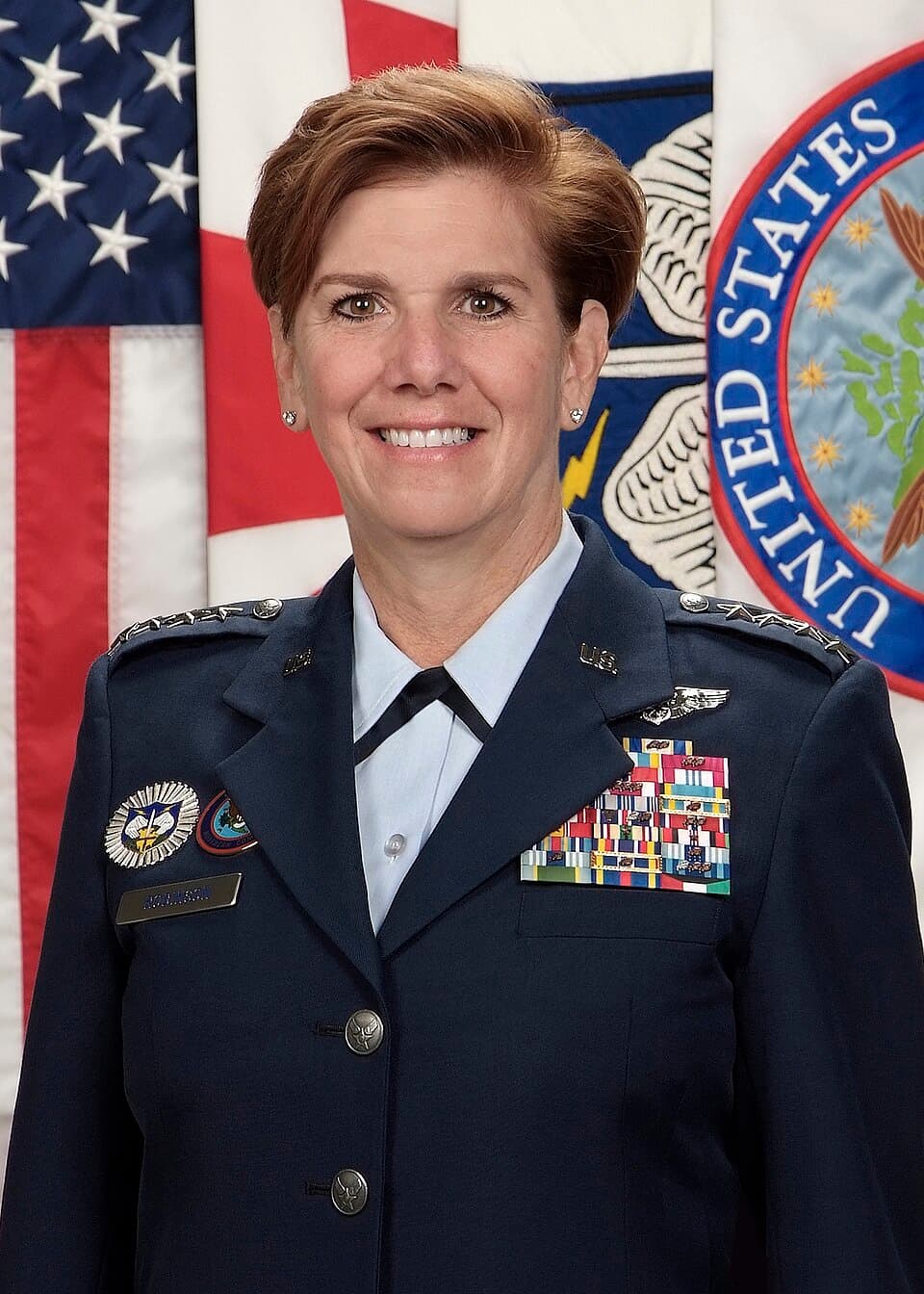
United States · Aviation · Politics · Activism
Lori Robinson
January 27, 1959 – present
Early Life and Background
Lori Jean Robinson was born on January 27, 1959, in Big Spring, Texas, United States.[2] She grew up as the eldest of five children in a military family; her father served for thirty years in the U.S. Air Force, exposing her from an early age to the realities of military life, frequent moves, and the sacrifices demanded of service members and their families.[13] This environment instilled in her a sense of responsibility, resilience, and respect for the burdens borne by military families—themes that later shaped her leadership philosophy.
Robinson’s childhood in a service household meant that she experienced first-hand the stresses and expectations placed on both uniformed personnel and their loved ones. She has frequently cited the impact of watching her father’s career and understanding the strain deployments placed on families as central to her later commitment to servant leadership and caring for people in uniform.[5][13] These formative experiences helped her see military service not merely as a profession but as a vocation rooted in duty and community.
After completing secondary school, Robinson attended the University of New Hampshire (UNH), where she studied English and enrolled in the Air Force Reserve Officer Training Corps (AFROTC) program.[1][9][13] UNH would later celebrate her as one of its most distinguished alumni, noting that she combined academic study in the humanities with preparation for a career in military command.[10] The choice of English as a major reflected her interest in communication and critical thinking, skills that would prove essential in high‑pressure command and control environments.
Education and Commissioning
On May 1, 1981, Robinson graduated from the University of New Hampshire with a Bachelor of Arts in English and received her commission through the AFROTC program.[1][9][13] This date marks the formal beginning of her Air Force career. At a time when women were still underrepresented in operational and leadership roles, Robinson’s commissioning signaled her intent to enter the mainstream of military service rather than remain confined to traditional support specialties.
Following commissioning, Robinson attended the Air Weapons Controller School at Tyndall Air Force Base, Florida, where she trained as an air battle manager.[3][13] Air battle managers are responsible for directing fighter and bomber aircraft in combat, managing airspace, and integrating multiple sensor platforms—roles requiring rapid decision‑making and precise communication. Robinson’s choice of this demanding, operational specialty positioned her squarely in the heart of modern air warfare.
Her early training and assignments gave her firsthand experience in the technical and tactical dimensions of air operations. Over the next several years, she served in a variety of positions as an air battle manager, including instructor and commander of the Command and Control Operations Division at the Air Force Fighter Weapons School and chief of tactics in the 965th Airborne Warning and Control Squadron.[3] These roles built her reputation as a highly competent operator and leader within the command‑and‑control community.
Career Beginnings and Development
Robinson entered active duty in 1982, beginning what would become a 37‑year military career.[3][5] Her early assignments immersed her in the complex world of airborne command and control, particularly through work on the E‑3 Airborne Warning and Control System (AWACS) aircraft. AWACS platforms provide long‑range surveillance, airspace management, and battle management functions essential to U.S. and allied air operations.
Over time, Robinson progressed through increasingly responsible positions in the AWACS and command‑and‑control community. She served as an instructor, tactics chief, and commander in units tasked with translating strategic directives into tactical execution.[3][12] Her technical expertise and ability to lead teams in stressful operational environments distinguished her within a community that, though central to modern warfare, was not traditionally a main pipeline to general officer rank.
Robinson’s career also included significant joint and staff experience. She served on the Joint Staff, including as Director of Joint Capabilities Development (J‑8), where she reported to the Chairman of the Joint Chiefs of Staff and helped shape long‑term capability development for the U.S. military.[12] She worked on Capitol Hill as Director of Air Force Legislative Liaison, reporting directly to the Secretary of the Air Force and managing the service’s relationship with the U.S. House of Representatives and Senate on budget and policy issues.[6][12] These assignments broadened her perspective beyond tactical operations to encompass strategic planning, inter‑service coordination, and civil‑military relations.
In the early 2000s, Robinson’s operational leadership extended to combat theaters. In 2003, she served as vice commander of the 405th Air Expeditionary Wing during Operation Iraqi Freedom, contributing to combat air operations in the Middle East.[1][7] She later deployed in support of multiple operations, including Operation Northern Watch, Operation Southern Watch, Operation Enduring Freedom, Operation Iraqi Freedom, and Operation Resolute Support.[6] These experiences further solidified her credibility as a commander who understood the realities of war firsthand.
Rise to Senior Command
Robinson’s ascent to senior command accelerated in the 2000s and early 2010s. A major milestone came on September 21, 2007, when, while serving at Tinker Air Force Base, Oklahoma, she was frocked to brigadier general.[1][9] This made her the first air battle manager and the first woman 552nd Air Control Wing commander to be frocked to brigadier general in that wing’s history.[1] The 552nd Air Control Wing operates AWACS aircraft, and her elevation from wing commander to one‑star general signaled institutional recognition of both her leadership and the importance of the AWACS mission.
Frocking to brigadier general allowed Robinson to assume general officer responsibilities before formal promotion, placing her in high‑level command and staff roles. Her success in these positions paved the way for further advancement. She later commanded the Air Force’s only AWACS wing, overseeing combat units engaged in Middle East operations.[12]
In 2013, Robinson served as deputy commander for U.S. Air Forces Central Command and deputy combined forces air component commander at U.S. Central Command in Southwest Asia.[1][6][13] In these roles, she helped direct air operations over a broad region and coordinated complex multinational efforts, further deepening her experience in large‑scale air campaigns.
By 2014, Robinson had become vice commander of Air Combat Command (ACC), one of the Air Force’s largest major commands, responsible for organizing, training, and equipping combat air forces.[1][7] This assignment positioned her within the core of U.S. airpower management and set the stage for her next historic promotion.
Four‑Star Rank and Command of Pacific Air Forces
On May 16, 2014, Robinson was promoted to four‑star general, receiving her fourth star as she took on duties associated with senior combat forces command.[1] Although she was not the first woman in U.S. military history to attain four‑star rank, her promotion was notable for her operational background in air battle management and combat air forces, distinguishing her from earlier female four‑stars whose careers had often been rooted in more administrative or support functions.[12]
Later that year, on October 16, 2014, Robinson assumed command of Pacific Air Forces (PACAF), headquartered at Joint Base Pearl Harbor–Hickam, Hawaii.[1][9][13] In this role, she became the first United States female four‑star commander of combat forces and served as the air component commander for U.S. Pacific Command.[1][13] PACAF oversees tens of thousands of airmen and extensive aircraft fleets, responsible for delivering combat air power across the Indo‑Pacific region.
As PACAF commander, Robinson’s portfolio included deterrence and defense responsibilities related to North Korea, regional alliances with countries such as Japan and South Korea, and broader Indo‑Pacific security dynamics. Her appointment to this position marked a significant expansion of women’s roles in front‑line warfighting commands. She demonstrated that a woman could not only hold four‑star rank but also lead a major operational command central to U.S. strategic interests.
Command of USNORTHCOM and NORAD
Robinson’s most historically significant appointment came in 2016. On April 21, 2016, TIME named her to its TIME 100 list of the world’s most influential people, noting that she was poised to become the first woman to serve as a combatant commander as head of U.S. Northern Command.[5][12] The profile underscored her blend of operational experience and inclusive leadership and framed her ascent as emblematic of broader changes in military culture.
On May 13, 2016, Robinson officially assumed command of both the United States Northern Command (USNORTHCOM) and the North American Aerospace Defense Command (NORAD), headquartered in Colorado Springs.[1][2][9] In doing so, she became the first female officer in U.S. history to command a major unified combatant command and the highest‑ranking woman in the history of the United States military.[1][2][8][10] USNORTHCOM is responsible for homeland defense and coordinating military assistance to civil authorities, while NORAD is a binational U.S.–Canadian command charged with aerospace warning and control for North America.
Robinson’s leadership of these commands, which she held from May 2016 to May 2018, placed her at the center of continental defense. She oversaw planning and operations related to threats such as ballistic missiles, terrorism, and natural disasters, as well as coordination with Canadian counterparts.[2][8] Her tenure included large‑scale exercises and ongoing adaptation to evolving security challenges, such as emerging cyber threats.
Media coverage of her appointment emphasized the historic nature of her achievement. TIME, Business Insider, and other outlets described her as the first woman to lead a U.S. combatant command and highlighted her role as a symbol of progress for women in the armed forces.[5][10][14] She appeared on the cover of TIME as part of its "Firsts" collection, which profiled women who were the first in their fields to achieve major milestones.[8][12]
Awards, Honors, and Recognition
Throughout her career, Robinson received numerous awards and decorations, reflecting both valor in operational contexts and excellence in leadership. Her decorations include the Air Force Distinguished Service Medal, among other high‑level recognitions.[11] While many of these awards are typical of officers who reach four‑star rank, for women’s history they represent acknowledgment of a female officer’s sustained impact across multiple domains of military operations.
In the civilian sphere, Robinson’s honors underscore her broader influence. She was named one of TIME’s 100 Most Influential People in 2016, just before assuming command of USNORTHCOM.[5][12] In 2017, TIME included her in its "Firsts: Women Leaders" project, highlighting her achievement as the first woman to lead a major U.S. combatant command.[8][12] These recognitions placed her alongside political leaders, business executives, and activists, reinforcing the idea that military leadership is a key part of contemporary debates about gender and power.
Robinson has also been honored by academic and civic institutions. The University of New Hampshire celebrated her accomplishments, presenting her as a model alumnus whose career demonstrates the impact of public education combined with military service.[10] Organizations such as the Daughters of the American Revolution invited her as a keynote speaker, situating her within a long tradition of American patriots and public servants.[6]
Leadership Philosophy and Public Voice
Robinson is widely noted for her emphasis on servant leadership. In interviews and public talks, including a feature by Harvard Kennedy School, she has described leadership as fundamentally about listening, valuing diverse perspectives, and recognizing that "every single person around you brings something to the fight that you don’t".[5][15] She has acknowledged that early in her career she "had a lot of opinions" and had to learn to temper those with humility and attentiveness to others.[5]
Her approach prioritizes taking care of people, building trust, and ensuring that team members feel respected and heard. Robinson often stresses that high‑performing organizations depend on leaders who understand their own biases, remain open to feedback, and recognize the central role of families and support structures in sustaining service members.[5][6]
In podcasts and speaking engagements, such as her appearance on The Leadership Podcast, Robinson has discussed balancing career and family responsibilities, mentoring younger officers, and encouraging women to pursue ambitious leadership roles without sacrificing personal commitments.[14] She frames work‑life balance as a dynamic challenge that requires institutional flexibility and supportive leadership, not solely individual endurance.
Personal Life
Robinson is married to Major General (ret.) David Robinson, himself a senior U.S. Air Force officer.[6] Their shared experience in the military has given her deep insight into dual‑career challenges in uniformed service. According to biographical notes from LCWINS and other sources, the couple has two children and three grandchildren.[6]
Robinson has frequently spoken about the importance of family support in enabling long careers in demanding fields such as the military. She credits her husband, children, and extended family with sustaining her through frequent moves, deployments, and long hours, and she emphasizes that leaders must recognize the sacrifices made by families as integral to mission success.[5][6]
Her openness about family life and its challenges has made her a relatable figure for many service members and professionals who struggle with similar pressures. She uses her platform to affirm that ambitious leadership and robust family commitments are not mutually exclusive, advocating for organizational cultures that respect and accommodate both.
Legacy and Historical Impact
Robinson’s legacy in women’s and military history is profound. She is broadly recognized as the first female officer in the history of the United States armed forces to command a major unified combatant command and as the highest‑ranking woman in U.S. military history.[1][2][8][9] Her leadership of USNORTHCOM and NORAD from 2016 to 2018 symbolized the culmination of decades of gradual institutional change that allowed women to move from limited roles to the pinnacle of military command.
Her earlier achievement as the first U.S. female four‑star commander of combat forces, through her command of Pacific Air Forces, further extended the range of roles seen as accessible to women.[1][9][13] Robinson demonstrated that women could lead large operational commands responsible for combat readiness and warfighting in critical theaters, not just institutional or support organizations.
Beyond these "firsts," Robinson’s legacy includes her contributions to leadership culture. She championed servant leadership, empathy, and inclusivity, arguing that effective commanders must care deeply about their people and families. Her public voice on work‑life balance and diversity has influenced broader conversations on how the military and other institutions can retain talent while respecting individual and family needs.[5][14]
In the context of women’s history, Robinson’s career marks a transition from symbolic inclusion to substantive authority. She did not simply occupy positions; she exercised real command power over large forces and critical missions, reshaping expectations of what women could do in national security organizations. Her trajectory offers a powerful example for future generations of women considering careers in the military or other traditionally male‑dominated fields.
Later Life and Post‑Retirement Roles
On May 24, 2018, Robinson concluded her command of USNORTHCOM and NORAD and retired from the U.S. Air Force after 37 years of service.[1][2][6][9] Retirement did not mark an end to her public engagement. She became a nonresident senior fellow at the Brookings Institution, working in the Center for Security, Strategy, and Technology, and also took on roles at Harvard’s Belfer Center.[5][6][12] These positions allow her to contribute to policy debates on defense, strategy, and technology.
Robinson is also involved with initiatives aimed at increasing women’s representation in national security leadership, including work with LCWINS (the Leadership Council for Women in National Security).[6] She mentors aspiring leaders, speaks on leadership and diversity, and participates in public events that highlight the importance of inclusion in security institutions.
Her post‑retirement activities continue to extend her influence beyond the military. By combining academic, policy, and advocacy roles, Robinson shapes discussions about how future defense structures should evolve and how they can better reflect and leverage the full diversity of the societies they protect.
Historical Significance
In the long arc of women’s history, Lori Robinson stands as a pivotal figure in the integration of women into the highest levels of military command. Her career charts the path from early participation in ROTC and operational command‑and‑control roles to the pinnacle of unified combatant command leadership. She has become a touchstone in discussions about gender, leadership, and institutional change.
Robinson’s achievements did not emerge in a vacuum; they were made possible by earlier generations who fought for women’s inclusion in the armed forces and by policy changes that gradually opened combat and command roles to women. Yet her personal accomplishments—becoming the first female combatant commander and highest‑ranking woman in U.S. military history—represent a qualitative shift in what is possible for women in uniform.[1][2][8]
Her life story, from her birth in Big Spring and upbringing in a military family to commanding USNORTHCOM and NORAD, offers a narrative of persistence, competence, and principled leadership. For historians and activists alike, Robinson’s career illustrates both the progress achieved and the ongoing work required to ensure that leadership positions are genuinely open to all, regardless of gender.
Dated achievements
10 indexed.
- Jan271959Aviation
Birth in Big Spring, Texas
Lori Jean Robinson was born in Big Spring, Texas, later becoming the highest-ranking woman in U.S. military history.
View details Britannica: Lori Robinson - May011981Aviation
Graduated from University of New Hampshire, commissioned via AFROTC
Robinson graduated UNH with a B.A. in English and was commissioned through AFROTC, beginning her Air Force career.