← All women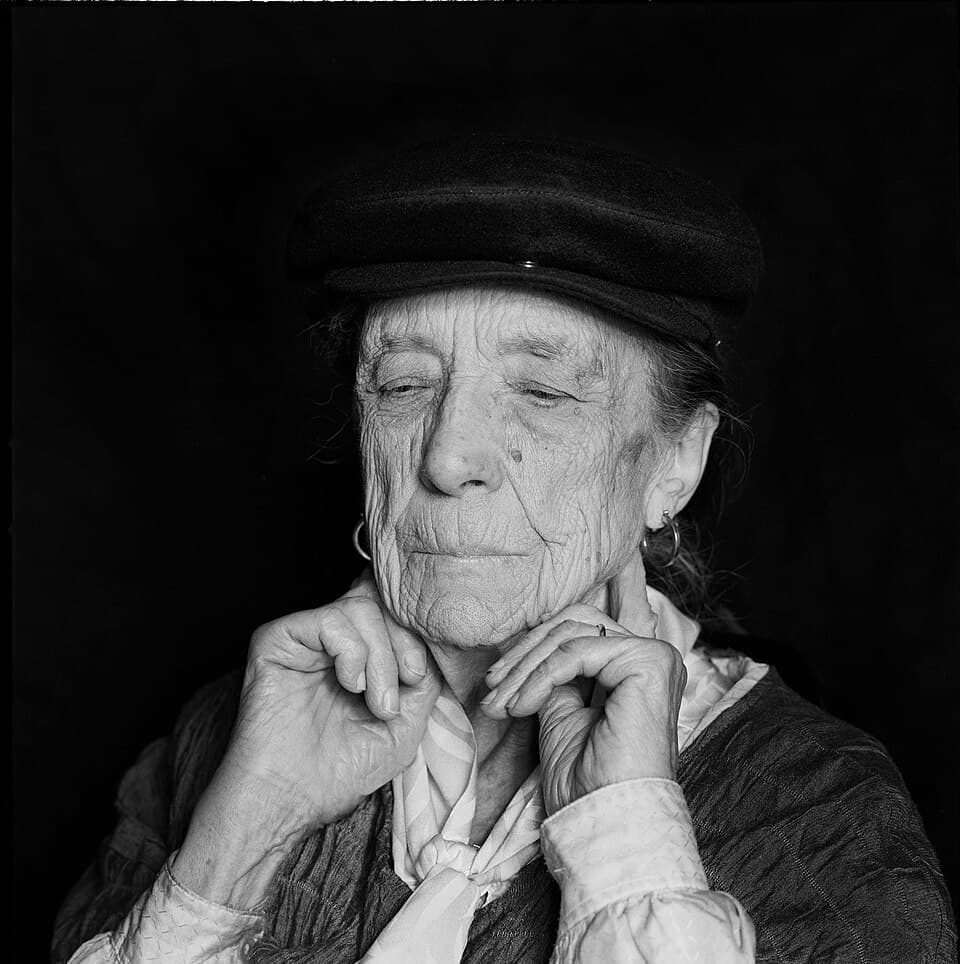
French, American · Arts
Loius Bourgeois
December 25, 1911 – May 31, 2010
Early Life and Background
Louise Joséphine Bourgeois was born on 25 December 1911 in Paris, France, to Joséphine Fauriaux and Louis Bourgeois.[3][11][15] She grew up in the suburb of Choisy-le-Roi, where her family ran a tapestry restoration business. From a young age, she assisted in the workshop, drawing missing sections of designs to guide weavers’ repairs.[16] This early exposure to craft, pattern, and the physical handling of textiles deeply informed her later artistic vocabulary, visible in the fabric sculptures and stitched works that recur throughout her career.
Bourgeois’s childhood was marked not only by artisanal labor but also by emotional turbulence. Her father maintained a long-term affair with her English governess, a betrayal that Bourgeois experienced as profoundly destabilizing.[3][18] The complex emotional dynamics among parents, children, and the governess left enduring psychological traces. Bourgeois later described her art as a way of "exorcising" these memories; themes of family conflict, sexuality, betrayal, and vulnerability permeate her sculptures and installations.
Academically gifted, Bourgeois initially pursued mathematics. Around 1932, she enrolled at the Sorbonne, studying math with the intention of becoming a researcher or teacher.[3][16] She later said that mathematics appealed to her for its stability and clarity, providing an order that contrasted with the chaos of her family life. Over time, however, she turned increasingly toward art, finding in drawing a different means of confronting and organizing experience.
In the mid-1930s, Bourgeois studied art at various Paris institutions, including the École des Beaux-Arts and private academies, and took classes with artists such as Roger Bissière and Paul Colin.[3][12][18] Around 1936, she worked briefly as an assistant in the studio of Fernand Léger, a key figure of modernism.[3][18] Léger reportedly advised her that her interests lay more in three-dimensional form than in traditional painting; his comment helped orient her toward sculpture, though she continued to draw and paint throughout her life.
Career Beginnings and Development
In 1938, Bourgeois opened a small gallery on the Rue de Seine in Paris, where she showed works by contemporaries and sold prints.[3] That same year, she met Robert Goldwater, an American art historian specializing in primitivism and modern art, who was then in Paris researching his dissertation. They married on 12 September 1938, and soon afterward moved to New York City, where Goldwater held academic and museum positions.[3][11]
Bourgeois arrived in New York on 25 October 1939, traveling aboard the SS Paris to join Goldwater.[3] The move profoundly changed her trajectory. In New York, she enrolled at the Art Students League, studied printmaking and painting, and continued to develop her own work while raising three sons—Michel, Jean-Louis, and Alain.[3][7][11] As an immigrant adjusting to a new language and culture, she experienced isolation and dislocation that fed her interest in themes of exile, absence, and psychic fragmentation.
During the 1940s, Bourgeois produced paintings and sculptures that she referred to as "Personages", abstracted standing figures representing friends and family left behind in France.[3][11][18] Her first solo exhibition, "Paintings by Louise Bourgeois", opened at the Bertha Schaefer Gallery in New York on 12 April 1945, featuring personage-like works that translated personal memory into austere, totemic forms.[3] In these works, she began to explore sculptural presence, even when working on canvas.
By the late 1940s, Bourgeois shifted decisively toward sculpture. On 19 April 1949, the Peridot Gallery mounted "Louise Bourgeois: Recent Work", her first solo sculpture exhibition.[3] The show presented wooden "Personages" installed directly on the floor, rather than on pedestals, creating an environment of upright forms that surrounded viewers. This spatial arrangement foreshadowed later installation art and set her apart from more conventional sculptural practices.
Throughout the 1950s and 1960s, Bourgeois continued to work while also teaching and engaging with the New York art community. She taught at the Brooklyn Museum’s art school starting around 1951, and held informal salons and critique sessions in her home, mentoring younger artists.[3][12] Her work remained somewhat peripheral to dominant movements such as Abstract Expressionism and Minimalism, yet she maintained a distinctive practice focused on psychological content and the body.
A significant milestone in her personal and legal status came on 6 October 1955, when Bourgeois became a naturalized citizen of the United States.[3][12] This formalized her identity as a French-American artist and positioned her more firmly within the U.S. cultural sphere, even as she maintained strong ties to France.
In 1964, Bourgeois presented an important solo exhibition at the Stable Gallery in New York.[3] This show included works that engaged more explicitly with sexuality, fragmentation, and architectural structures, such as torqued, biomorphic forms and cage-like constructions. The exhibition is often cited as a precursor to her later large-scale installations, articulating an enclosed, psychologically charged space rather than isolated objects.
Major Works and Artistic Themes
Bourgeois’s oeuvre spans sculpture, installation, drawing, painting, and printmaking, unified by persistent themes rather than a single signature style. In 1947, she created her first known prints and produced the artist’s book "He Disappeared into Complete Silence", a sequence of enigmatic texts and images reflecting isolation and existential anxiety.[3][11] The book demonstrates her early interest in narrative and in combining visual and verbal language to explore inner states.
During the late 1960s and 1970s, Bourgeois produced some of her most influential works, including "Fillette" (1968), a phallic, flesh-like sculpture that challenged conventional gendered symbolism, and "Destruction of the Father" (1974), an installation evoking a grotesque, sacrificial family dinner.[3][11][18] These works translate personal memories—often of her father—into visceral spatial experiences, implicating viewers in scenes of domination, rebellion, and psychological conflict.
One of Bourgeois’s most iconic motifs is the spider, which appears in drawings, small sculptures, and massive public works. She associated spiders with her mother, describing them as patient, protective, and skilled at mending, much like a tapestry restorer.[11][18] The monumental spider sculpture "Maman", unveiled outside Tate Modern’s Turbine Hall on 5 July 1999, epitomizes this imagery.[21] Standing over nine meters high, "Maman" embodies the ambivalence of motherhood—simultaneously nurturing and frightening—and has become one of the most recognizable works of contemporary sculpture.
Throughout her career, Bourgeois explored architectural structures such as cells, cages, and towers. In the 1980s and 1990s, she created a series of installations called "Cells", enclosed spaces containing objects, textiles, and body fragments that evoke memories, fears, and psychological states.[11][18] These works highlight her interest in the relationship between interior and exterior, both in physical space and in the psyche.
Although she is best known as a sculptor, Bourgeois was also a prolific printmaker and draftsman. Her prints often feature spirals, organic shapes, and text fragments, while her drawings range from geometric abstractions to figurative studies. Across media, she used repetition and variation to work through emotional material, describing art as a process of daily "self-analysis."[11][16][18]
Awards, Honors, and Recognition
For much of her career, Bourgeois’s work was recognized by a relatively small circle of artists and critics. Wider institutional recognition came later, particularly from the 1980s onward. A pivotal event was the major retrospective at the Museum of Modern Art (MoMA) in New York, which opened on 29 April 1982.[3] Multiple sources identify this exhibition as MoMA’s first full-scale sculpture retrospective devoted to a woman artist, a landmark in both her career and the museum’s history.[16][18] The show surveyed her work from the 1940s to the early 1980s, consolidating her reputation and introducing her to a broader audience.
In subsequent years, Bourgeois’s work was the subject of major exhibitions worldwide, including retrospectives at institutions such as the Centre Pompidou, the Guggenheim Museum, and the Moderna Museet in Stockholm.[8][20] In 1993, she represented the United States at the Venice Biennale, a significant acknowledgment of her status within contemporary art.[3][18]
Bourgeois received numerous awards and honors. On 24 October 1990, the French Ministry of Culture awarded her the Grand Prix National de la Sculpture, recognizing her contributions to the medium.[12] On 22 October 1997, she was inducted into the National Women’s Hall of Fame in Seneca Falls, New York, for her contributions to the history of the United States through art.[12] On 9 June 1999, President Jacques Chirac named her an Officer of the Légion d’honneur, France’s highest order of merit.[12]
International recognition continued with the announcement on 7 June 2000 that Bourgeois had been selected as the Praemium Imperiale laureate in sculpture for 1999–2000, an honor awarded by the Japan Art Association and often compared to a Nobel Prize in the arts.[12] She also received honorary doctorates and other distinctions from universities and cultural institutions, underscoring her influence across artistic and intellectual communities.
Personal Life
Bourgeois’s marriage to Robert Goldwater profoundly shaped her personal and professional life. Goldwater, a respected art historian and curator, provided intellectual companionship and introduced her to networks in the New York art world.[3][11] Their relationship, however, did not shield her from the gendered expectations and constraints of mid-20th-century domestic life. As a mother of three sons, Bourgeois balanced childcare and household responsibilities with studio work, often using late-night hours for artistic production.
The family home—a townhouse in Chelsea, Manhattan—served multiple roles as residence, studio, archive, and gathering place. Bourgeois held regular Sunday salons there, inviting younger artists for critique and discussion.[3][18] These sessions, sometimes rigorous and confrontational, contributed to her reputation as a demanding yet influential mentor. Her son Jean-Louis Bourgeois later became a historian and activist, occasionally speaking about his mother’s life and work.[7]
Bourgeois’s personal experiences—her difficult relationship with her father, her complex feelings about motherhood, and her struggles with anxiety and depression—were never far from her art. She openly acknowledged using artistic practice as a form of therapy or self-analysis, stating that "art is a guarantee of sanity."[11][18] This perspective would later resonate with feminist and psychoanalytic approaches to art-making.
Later Life, Documentary, and Death
In her later decades, Bourgeois continued to produce new work, often in collaboration with assistants who helped realize large-scale pieces. She explored materials such as fabric and glass, creating stitched sculptures and installations that revisited childhood motifs in new forms.[8][18] Her diaries and writings, some of which have been published posthumously, reveal a daily practice of reflection that paralleled her studio activity.
In 2009, the documentary film "Louise Bourgeois: The Spider, the Mistress and the Tangerine" brought her story to a wider public audience.[3] Combining interviews, archival footage, and close looks at key works, the film emphasized the intimate connection between her life experiences and her art, further cementing her public legacy.
Bourgeois died on 31 May 2010 in New York City after suffering a heart attack, at the age of 98.[3][11] She left behind a substantial estate of artworks and writings that have been catalogued and studied by scholars, museums, and galleries. Her death was widely noted in the international press, and memorial exhibitions were organized in several countries, reflecting the breadth of her influence.[8][15]
Legacy and Historical Impact
Louise Bourgeois is widely regarded as one of the most important sculptors and installation artists of the 20th and early 21st centuries.[11][18] Her work bridges and complicates multiple movements—Surrealism, Abstract Expressionism, Minimalism, and feminist art—without fitting neatly into any single category. Instead, she is often described as a singular figure whose practice centers on personal narrative and psychological exploration.
For women’s history, Bourgeois’s impact is particularly significant. She demonstrated that a woman artist could place intensely personal experiences, including trauma and sexuality, at the heart of serious, institutionally recognized art. Her career challenges assumptions that women’s work is secondary or domestic; instead, she turned domestic materials and spaces into sites of monumental artistic inquiry. Works such as "Maman" and the "Cells" series have become touchstones for discussions of motherhood, memory, and the body in contemporary art.[11][18][21]
Bourgeois also influenced the structure of the art world itself. Her 1982 MoMA retrospective is frequently cited as a breakthrough for women in major museum programming, contributing to ongoing debates about representation and equity.[16] Her recognition by institutions such as the National Women’s Hall of Fame and the Praemium Imperiale underscores the growing acknowledgment of women’s contributions to cultural history.
Her legacy extends through the work of numerous artists who cite her as an inspiration, including Eva Hesse, Kiki Smith, Tracey Emin, and Sarah Lucas, among others.[18] These artists’ engagements with the body, trauma, and autobiography resonate strongly with Bourgeois’s example. Scholars in art history, gender studies, and psychoanalysis continue to study her oeuvre, drawing on her diaries and writings to understand the relationship between creativity and psychological life.
In the years following her death, major institutions—including the Tate, the National Gallery of Scotland, and the Moderna Museet—have produced learning resources and educational exhibitions that position Bourgeois as a key figure for teaching modern and contemporary art.[8][15][21] These materials emphasize her innovative approaches to sculpture and installation, as well as her relevance to discussions of gender, memory, and identity.
Louise Bourgeois’s life and work thus occupy a central place in both art history and women’s history. Her ability to transform deeply personal experience into universally resonant forms, and to sustain an experimental practice over seven decades, has made her a model of artistic resilience and innovation. She stands as a testament to how an individual woman’s story—rooted in specific family and cultural contexts—can reshape global understandings of what art is and what it can address.
Dated achievements
13 indexed.
- Dec251911Arts
Birth of Louise Bourgeois
Born in Paris, France to Josephine Fauriaux and Louis Bourgeois.
View details Wikipedia - Louise Bourgeois - Sep121938Arts
Marriage to Robert Goldwater
Married art historian Robert Goldwater, soon moving to New York.
View details