← All women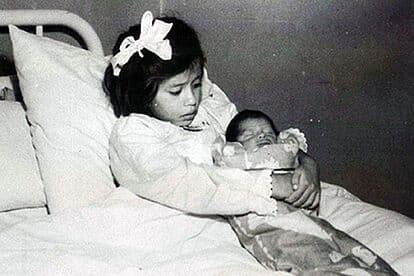
Peruvian · Medicine
Lina Medina
September 23, 1933 – present
Early life and background
Lina Marcela Medina de Jurado was born in Peru in 1933, most commonly dated to 23 September 1933, though some sources report 27 September 1933 or give only the year. She was born in Ticrapo, in the Huancavelica region, and later became known worldwide because of an exceptional medical case rather than a public career. Her family life, like that of many rural Peruvian families of the period, was lived far from major urban medical centers and with limited access to specialist care. Sources generally identify her by her married name, Lina Medina de Jurado, but her historical significance is associated with the name Lina Medina.[1][16]
Publicly available accounts of her childhood are sparse, in part because the case became famous for the wrong reasons: her privacy was repeatedly protected, and the family did not maintain a public profile. What is documented is that she was taken for medical attention after the unusual enlargement of her abdomen, which led doctors to discover that she was pregnant. Later medical assessments described her condition as an extreme example of precocious puberty, meaning that her body developed reproductive capability far earlier than normal.[1][4][8]
The 1939 pregnancy and birth
In 1939, physicians in Peru confirmed that Medina was pregnant while still a small child. The pregnancy was extraordinary because it occurred at an age when puberty should not yet have begun, let alone progressed to fertility. The identity of the father was never publicly confirmed in reliable sources, and the case has long remained associated with questions about sexual abuse, family silence, and the limits of contemporary criminal investigation.[4][12][13]
On 14 May 1939, Medina gave birth by caesarean section to a son named Gerardo. The infant was reported as healthy, and Medina's age at delivery was later described as five years, seven months, and 21 days. This made her the youngest confirmed mother in history, a distinction that has remained part of medical history for decades.[1][4][12][15]
The case drew international attention because it seemed to defy normal human development. In medical terms, it became one of the most cited examples of how precocious puberty can produce fertility far earlier than expected. In social terms, it exposed how deeply vulnerable children could be when abuse was hidden by poverty, geography, or social norms. The case has continued to be discussed in pediatrics, endocrinology, medical ethics, and the history of child protection.[1][4][8][10]
Medical and historical significance
Medina's case is not famous because she chose public life or built a career in the usual sense; rather, it became historically significant because it created a benchmark for understanding the biological extremes of puberty and pregnancy. It was one of the earliest and best-documented examples of a child giving birth, and it remains the most frequently cited case of a confirmed mother at such a young age.[1][2][8][12]
The case also mattered because it showed how medicine in the early twentieth century could document an extraordinary event while still lacking the social and forensic tools needed to fully protect a child. Physicians could identify the pregnancy and perform surgery, but the broader legal and ethical response to the circumstances surrounding the conception was limited by the era's institutional weaknesses. That imbalance between medical recognition and social protection is one reason her story continues to appear in discussions of child welfare and reproductive rights.[4][5][8]
Personal life
Medina later married and was known as Lina Medina de Jurado. Reliable public sources state that she had at least one child, Gerardo, whose birth in 1939 made history. Later accounts report that Gerardo died in 1979 at about 40 years of age, but without a consistently documented exact date.[7] Beyond that, her adult life has remained largely private, and she did not pursue a public career that generated awards, publications, or institutional honors. That privacy is one reason the surviving record emphasizes the 1939 event rather than a broader public biography.
Legacy
Lina Medina's legacy is unusual among historically significant women: she is remembered not for formal achievement in politics, science, literature, or the arts, but for a single medical event that became historically unforgettable. The case has persisted in public memory because it sits at the intersection of medicine, ethics, and social history. It raises enduring questions about childhood vulnerability, the responsibilities of medical professionals, and the silence that can surround abuse.[1][4][8][12]
Her story is also often used to illustrate the phenomenon of precocious puberty in clinical teaching and popular medical history. In that sense, Medina's experience contributed to a broader public understanding of human development even though she herself did not seek fame. The fact that her case remains the standard reference point for the youngest confirmed mother in history shows how a single documented event can shape historical memory for generations.[1][4][10][12]
Because the exact birth day is disputed in some sources and the details of her later life are deliberately private, any biographical account must be careful not to overstate certainty. What is beyond dispute is that Lina Medina's 1939 childbirth remains one of the most extraordinary and disturbing documented events in twentieth-century medical history.[1][4][16]
Dated achievements
1 indexed.
- May141939Science
Becomes the Youngest Confirmed Mother in Recorded Medical History
At age five years, seven months and 21 days, Lina Medina gave birth via caesarean section to a son, Gerardo, in Lima, Peru — the youngest confirmed motherhood on record.
View details Lina Medina - Wikipedia