← All women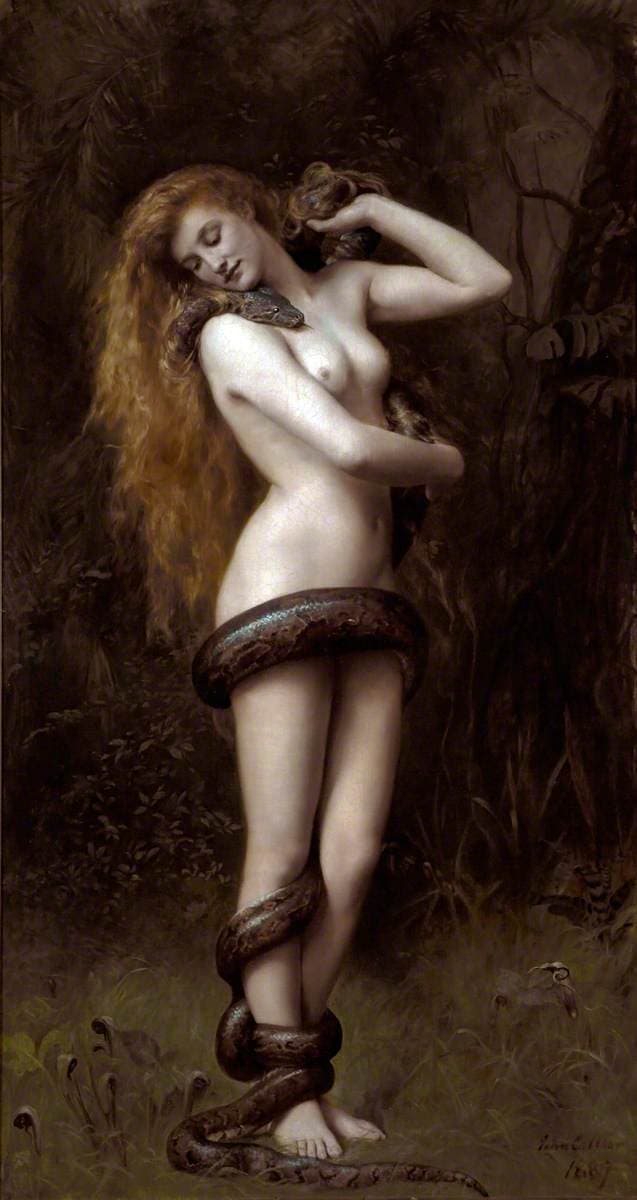
Mesopotamian, Jewish · Arts · Literature · Activism
Lilith
Unknown – present
Overview
Lilith is a feminine figure in Jewish mythology and related Near Eastern traditions, not a historical woman with a recoverable biography. She is known through religious texts, folklore, demonological traditions, and modern literary and feminist reinterpretations. Her identity has changed over time: in some sources she is a night demon or wind spirit associated with danger to infants and pregnant women; in later Jewish tradition she becomes the supposed first wife of Adam; and in modern culture she is often reclaimed as a symbol of female independence and resistance to patriarchal authority.
Early origins in Mesopotamian tradition
The earliest background associated with Lilith lies in Mesopotamian demonology. Scholars generally connect her name to a class of spirits called lilû and lilītu, terms linked to wind or night demons. In this earliest phase, Lilith was not a single fully formed character but part of a broader ancient Near Eastern pattern of protective and threatening spirits. These beings were especially associated with sexuality, childbirth, illness, and infant mortality, areas of life that carried enormous fear in the ancient world. Amulets and incantations were used to ward off such forces, reflecting the practical religious role these spirits played in everyday life.
Her ancient profile seems to have been shaped by social vulnerability. Pregnancy and childbirth were perilous, infant survival was uncertain, and death could be sudden and unexplained. Female demon figures in Mesopotamian and later Jewish tradition often carried these anxieties. In this setting, Lilith became a personification of danger, especially the kind that could not be seen or controlled. That background helps explain why her later symbolism remained so powerful: she embodied both fear of female power and fears surrounding reproduction, sexuality, and the night.
Entry into Jewish literature
Lilith appears in the Hebrew Bible in Isaiah 34:14, where the Hebrew term is usually rendered in translation as a night creature or night monster. Over time, Jewish interpretive tradition expanded that brief reference into a much richer figure. In rabbinic and medieval Jewish sources, she is increasingly described as a demon who harms children, seduces men, and endangers pregnant women and newborns. Incantation bowls and amulets from late antiquity reflect popular concern with such beings, showing that Lilith was not only a literary figure but also part of lived religious practice.
By the medieval period, Lilith had become more sharply individualized. Jewish folklore and mystical literature often associated her with Samael, a figure linked to evil, and imagined her as a queen of demonic forces. This development reflected broader medieval efforts to explain suffering and disorder in the world through spiritual hierarchies. Lilith’s menace was therefore moral, sexual, and social: she stood for nocturnal danger, uncontrolled desire, and the disruption of domestic and maternal life.
The Alphabet of Ben Sira and the Adam’s first wife tradition
The most influential transformation of Lilith came through the medieval text Alphabet of Ben Sira, which presents her as Adam’s first wife. In that story, Lilith was created as Adam’s equal, but she refused to submit to him sexually or socially, insisting on parity. When she left Eden, she was cast as rebellious and then demonized. This narrative became one of the most durable versions of her story, because it gave the myth a human drama centered on gender hierarchy, autonomy, and resistance.
This reinterpretation was historically important because it shifted Lilith from a generalized demon into a symbolic woman who refuses subordination. Although the text itself cast her defiance negatively, later readers saw in her departure an assertion of dignity. The story also served as an origin tale for demonic behavior, explaining why she was imagined to threaten children and childbirth after her exile. In the context of medieval society, where women’s legal and religious power was limited, the tale encoded anxieties about female equality and marital authority.
Kabbalistic and later religious traditions
In Kabbalistic writings, Lilith continued to evolve as a powerful and dangerous feminine presence, sometimes described as an evil counterpart or opposite of the divine feminine. These texts deepened the symbolic contrast between holiness and impurity, order and chaos, fertility and sterility. Lilith’s association with sexual temptation, demonic reproduction, and harm to infants made her a central figure in protective rituals. Parents and communities used charms and protective inscriptions to guard newborns against her influence, which shows how folklore and religious practice intersected in daily life.
Her persistence across centuries demonstrates the durability of myth in societies facing uncertainty. Lilith was never confined to a single religious text; she survived because she served multiple functions at once. She explained misfortune, represented forbidden desire, and gave shape to social fears about women outside patriarchal control. That flexibility helped her remain relevant long after the particular world that produced the earliest myths had disappeared.
Modern literary revival
In the nineteenth century and especially the twentieth, writers began to revisit Lilith in new ways. George MacDonald’s 1895 fantasy novel Lilith is one of the best-known examples of this revival, using the name for a central supernatural figure in an allegorical narrative. The broader modern literary tradition transformed Lilith from a demon of fear into a character of ambiguity, depth, and symbolic power. Authors, poets, and dramatists used her to explore themes of exile, desire, temptation, female autonomy, and spiritual transformation.
This revival mattered because it brought Lilith into modern literary canons and beyond strictly religious settings. Once the preserve of folklore and demonology, she became a flexible cultural symbol. Writers could invoke her to question social norms, critique gender relations, or dramatize the costs of rebellion. Her appeal grew precisely because she was already layered with centuries of conflicting meanings.
Feminist reclamation
One of the most significant modern developments in Lilith’s history has been her reclamation by feminist thinkers and Jewish women’s organizations. By the late twentieth century, Lilith was increasingly read not as a warning against disobedience but as a figure of refusal, independence, and self-definition. The Jewish feminist magazine Lilith, founded in the 1970s, is a prominent example of this reclamation. In that context, the name was chosen to challenge inherited narratives that treated powerful women as monstrous or dangerous.
This reinterpretation was historically significant because it reversed the moral logic of the older tradition. Instead of seeing Lilith’s refusal as evidence of evil, modern readers used it to symbolize equality and autonomy. That shift mirrored broader changes in women’s history and feminist thought, especially the effort to recover women who had been excluded or demonized by patriarchal storytelling. Lilith became a cultural shorthand for female agency, sexual self-possession, and resistance to imposed roles.
Legacy
Lilith’s historical importance lies not in a verifiable life story but in her extraordinary afterlife. Few mythic figures have moved so fluidly across ancient religion, medieval folklore, modern literature, and feminist politics. Her image has been used to frighten, to explain, to moralize, and to empower. That very instability has made her enduringly useful. She remains a figure through whom different generations have negotiated ideas about women, power, sexuality, and the boundaries between order and rebellion.
Today, Lilith is best understood as a composite cultural symbol rather than a single fixed character. Her long history reveals how myths can outlive their original settings and acquire new meanings in new eras. From ancient demon to literary archetype to feminist icon, Lilith continues to occupy a unique place in the history of women’s representations.
Dated achievements
2 indexed.
- Jan011883Literature
Publication of George MacDonald’s *Lilith*
Publication date of George MacDonald’s *Lilith*, a major modern literary reworking of the figure.
View details Wikipedia: Lilith (novel) - Jan011976Arts
Launch of *Lilith* magazine
Launch date of *Lilith* magazine, a landmark Jewish feminist publication that reclaimed the mythic name.