← All women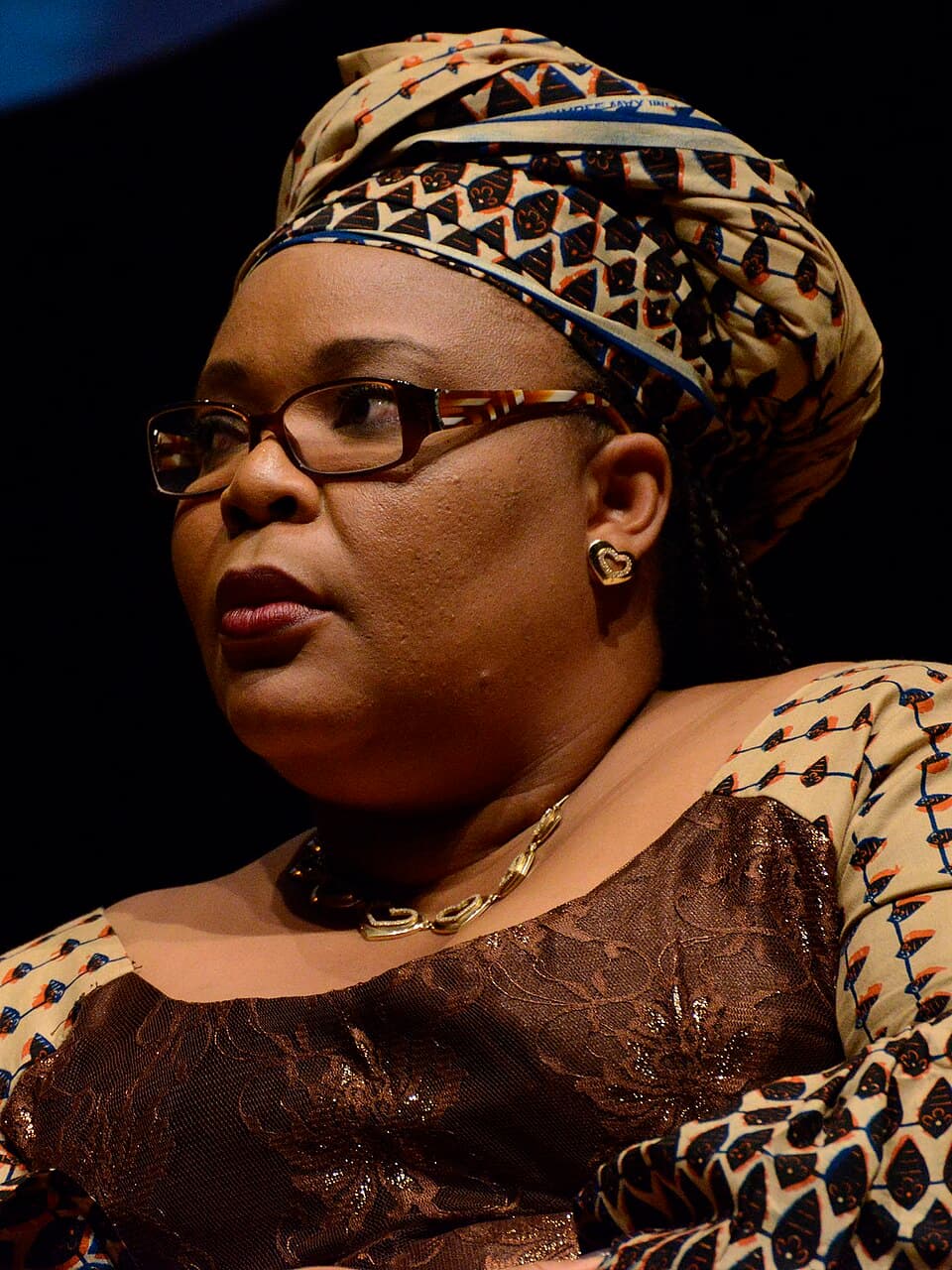
Liberian · Activism · Politics
Leymah Gbowee
February 1, 1972 – present
Early life and background
Leymah Roberta Gbowee was born on 1 February 1972 in central Liberia, then a relatively stable West African republic with deep historical ties to the African diaspora.[2][11][12] Some biographical references describe her birthplace more specifically as Monrovia, the capital, while others refer more generally to a village in central Liberia, reflecting the limited documentation typical of many mid‑20th‑century African births.[2][3][5][6][8][12] She grew up in a close-knit family that valued education and Christian faith, influences that later shaped both her moral outlook and organizing style.[2][11]
As a teenager, Gbowee aspired to study medicine, a common path for academically promising students in Liberia’s urban centers.[7] However, in 1989, when she was about seventeen, the First Liberian Civil War erupted. She and her family were living in Monrovia when armed conflict spread, transforming everyday life into a struggle for survival.[2][7] The war forced them to seek refuge, at times in Ghana and at times back in Liberia, exposing her to displacement, hunger, fear, and the breakdown of state institutions.[7][11]
During the early 1990s, Gbowee began training as a social worker and trauma counselor, working with ex‑combatants and war-affected children, including former child soldiers associated with Charles Taylor’s forces.[6][9][11] This experience introduced her to the psychological dimensions of war and the specific vulnerabilities of women and children. It also convinced her that any lasting peace would have to address the trauma, humiliation, and material losses borne disproportionately by women.
Career beginnings and development
Gbowee’s formal trajectory into peace work began through humanitarian and church-based networks. She became involved with the Lutheran Church in Liberia, where she worked on trauma healing programs for women and children and received training in conflict transformation.[2][11] Her work put her in regular contact with women who had lost family members, been displaced, or survived sexual violence. These encounters deepened her conviction that women needed a collective political voice, not just charitable assistance or counseling.
In the late 1990s and early 2000s, she became connected to the West Africa Network for Peacebuilding (WANEP), a regional civil society platform that promotes nonviolent conflict resolution.[9][14] Within this framework, Gbowee helped to establish the Women in Peacebuilding Network (WIPNET)
At the same time, Gbowee pursued formal education to complement her practical experience. She enrolled in the Center for Justice and Peacebuilding at Eastern Mennonite University (EMU) in Harrisonburg, Virginia, a program rooted in Christian pacifist traditions and restorative justice. She completed a master’s degree in conflict transformation in 2007, gaining theoretical and methodological perspectives that later informed her approach to grassroots organizing, mediation, and international advocacy.[1][4][10] Gbowee is most widely known for her leadership of the Women of Liberia Mass Action for Peace, a movement that played a decisive role in ending Liberia’s second civil war in the early 2000s.[1][2][9][12][14] By 2002, the country had endured nearly continuous fighting since 1989. Armed factions controlled territory, and both government and rebel forces were implicated in atrocities, including sexual violence, mass displacement, and the recruitment of child soldiers.[2][3][5][12] In response, Gbowee and other women activists began organizing interfaith, nonviolent protests that brought together Christian and Muslim women—an alliance that was unusual and symbolically powerful in a society fractured along ethnic, political, and religious lines.[1][2][9][12] They staged sit‑ins, prayer meetings, and silent demonstrations in public spaces, including fish markets and roadways leading to government offices. Many women wore simple white clothing to signify peace, a visual marker that made their presence both visible and resonant with religious imagery.[2][9] The movement coalesced under the name Women of Liberia Mass Action for Peace and grew to include thousands of participants from various social strata.[1][2][12][14] The women’s tactics combined moral pressure with strategic noncooperation. They confronted warlords and government officials, insisting that a peace agreement be reached. They also used the leverage of public opinion and international attention, engaging both local media and foreign diplomats to amplify their demands.[9][13][14] In 2003, their persistent actions helped to create the political conditions that led President Charles Taylor and rebel leaders to attend peace talks in Accra, Ghana. At one key moment during the negotiations, Gbowee and other women famously formed a human barricade around the meeting hall, effectively preventing the delegations from leaving until they made substantial progress toward agreement.[1][2][11][12] Though the image is often dramatized, it reflects a real strategy of using nonviolent physical presence to constrain elites who had long treated negotiations as a venue for delay and posturing. The pressure exerted by the women’s movement contributed to the signing of a comprehensive peace agreement later that year, which effectively ended major hostilities in Liberia’s 14‑year civil war.[1][2][12][14] While many actors, including regional governments and international organizations, were involved, numerous observers credit Gbowee and her colleagues with changing the political calculus by demonstrating that ordinary citizens—particularly women—would no longer tolerate continued war. Following the 2003 peace agreement, Liberia embarked on a transition toward democratic governance. Gbowee and other women activists remained engaged, recognizing that peace would remain fragile without political reform and inclusive participation. They mobilized women to register and vote in the 2005 national elections, contributing significantly to the campaign of Ellen Johnson Sirleaf, who became Africa’s first elected female head of state when she won the presidency.[2][6][12][14] The election of Johnson Sirleaf was widely interpreted as a triumph for the women’s movement that had challenged both warlords and patriarchal political structures. Gbowee’s efforts in this period illustrate her shift from primarily antiwar activism to a broader agenda of peacebuilding, democratization, and women’s political empowerment. She supported civic education, advocated for women’s rights, and helped build organizational capacity among grassroots groups. In parallel, Gbowee’s international profile grew. She became a sought‑after speaker at conferences on conflict resolution, women’s rights, and faith-based activism. Her story was featured in the documentary film "Pray the Devil Back to Hell", which highlighted the Women of Liberia Mass Action for Peace and helped make their tactics and achievements known to global audiences.[2] By sharing detailed narratives of women’s organizing, the film and Gbowee’s subsequent lectures influenced practitioners and scholars in the fields of gender, peace, and security. To sustain and expand her work beyond Liberia’s immediate postwar period, Gbowee founded the Gbowee Peace Foundation Africa, based in Monrovia.[1][4][8][9][12] The foundation focuses on girls’ education, leadership development, and community-based peacebuilding across Liberia and the wider West African region. It provides scholarships for girls and young women, supports grassroots initiatives, and promotes civic engagement among youth, aiming to address structural inequalities that fuel conflict. Gbowee also established or co‑founded other initiatives, including the Liberia Reconciliation Initiative, and continued to be involved with WIPNET and WANEP.[1][9][14] These organizations engage in early warning systems, dialogue facilitation, and advocacy for women’s inclusion in peace processes, reflecting her belief that peace must be proactive rather than reactive. Her expertise led to academic and policy appointments worldwide. She served as the executive director of the Women, Peace and Security Program at the Earth Institute at Columbia University, a role that placed her at the intersection of research, teaching, and policy advocacy.[4] In this capacity, she worked to integrate women’s grassroots experiences into high-level discussions on security and development, and to mentor a new generation of scholars and practitioners. On 1 January 2014, Gbowee joined the Board of Trustees of the Carnegie Corporation of New York, one of the United States’ most prominent philanthropic foundations.[8] Her presence on the board signaled a growing recognition that leaders from conflict-affected societies should help shape global funding priorities in education, democracy, and peacebuilding. She has also served as a juror for the Hilton Humanitarian Prize and held positions with other international organizations, further extending her influence across the humanitarian and philanthropy sectors.[4] Gbowee’s life and work reached wider audiences through her memoir, "Mighty Be Our Powers" (often cited as Mighty Be Our Powers: How Sisterhood, Prayer, and Sex Changed a Nation at War), which chronicles her personal journey from war‑affected young woman to internationally recognized peace activist.[1][7][10] The book offers insight into the emotional and spiritual dimensions of activism, including the toll that leadership placed on her family life and mental health. It also foregrounds the role of religious faith, both Christian and Muslim, in sustaining women’s resilience during the war. Throughout the 2010s, Gbowee delivered numerous keynote addresses and TED‑style talks on women’s leadership in peace processes, conflict transformation, and community organizing.[1][15][18] In these talks, she often emphasized the importance of transforming personal trauma into collective action, urging audiences to see themselves as potential agents of change regardless of formal titles or positions. Her speeches combined narrative storytelling with pointed critique of international policy failures, particularly the marginalization of women in peace negotiations. Her leadership style is notable for its blend of humor, moral clarity, and willingness to confront power. She has frequently challenged both African leaders and international donors about corruption, militarized security approaches, and tokenistic inclusion of women. This critical stance sometimes placed her at odds with governments, including Liberia’s, but also solidified her reputation as an independent voice committed to principled peacebuilding. On 7 October 2011, the Norwegian Nobel Committee announced that Leymah Gbowee, Ellen Johnson Sirleaf, and Yemeni journalist and activist Tawakkol Karman would jointly receive the Nobel Peace Prize for 2011.[1][2][3][7][12][13][14] The committee praised their "non-violent struggle for the safety of women and for women’s rights to full participation in peace-building work."[12] Gbowee thus became one of the very few African women Nobel laureates and one of the first to be recognized specifically for mobilizing women as a peace constituency. The formal award ceremony took place in Oslo on 10 December 2011, where Gbowee delivered a Nobel lecture that highlighted the continuing challenges faced by women and girls in conflict zones.[1][10][12] She used the platform to call for increased representation of women at negotiating tables, in security institutions, and in national leadership. Her speech drew on the Liberian experience to argue that sustainable peace cannot be achieved if half the population is excluded from decisions concerning war and peace. The Nobel Prize consolidated Gbowee’s global stature and opened additional avenues for advocacy. She became part of transnational networks of Nobel laureates and high‑level panels on women, peace, and security. International coverage of the prize—by outlets such as the BBC, Al Jazeera, and major newspapers—spotlighted Liberia’s women’s movement as a model for other societies emerging from conflict.[5][9][10][13] For many readers and viewers, these stories were their first exposure to the idea that ordinary women, using largely nonviolent tactics, had been instrumental in ending a war. In addition to the Nobel, Gbowee has received numerous other honors. She was awarded the John F. Kennedy Profile in Courage Award in 2007 for her leadership in the women’s peace movement in Liberia and the Gruber Foundation Women’s Rights Prize in 2008 for her role in organizing women to end the civil war.[1][14] Universities, foundations, and international organizations have bestowed honorary degrees and awards recognizing her contributions to peace and gender equality. Despite her close association with President Ellen Johnson Sirleaf during the 2003–2005 transition period, Gbowee did not hesitate to criticize the Liberian government when she believed it fell short of postwar commitments. She served on Liberia’s Peace and Reconciliation Commission, a body tasked with promoting healing and addressing the legacies of war.[3][10] In October 2012, she resigned from the commission, publicly criticizing what she saw as the government’s failure to tackle corruption, nepotism, and deep social inequalities.[3][10] Her resignation attracted international attention because it highlighted ongoing tensions within Liberia’s postwar leadership and challenged the global narrative that the country’s transition had been an unambiguous success. It also underscored her willingness to risk political capital and relationships, including with fellow Nobel laureate Johnson Sirleaf, to uphold her principles. Gbowee’s stance in this period illustrates an important dimension of peace activism: sustaining peace requires more than the signing of agreements or the election of a new government. It demands accountability and structural transformation, and activists may have to shift from collaborative roles to oppositional ones as circumstances change. Her actions offered a public example of how women peace leaders can engage critically with state institutions while still advocating nonviolent change. Gbowee’s public work has unfolded alongside complex personal experiences shaped by war, displacement, and family responsibilities. She has spoken and written about living as a refugee and as a single mother during parts of Liberia’s conflict period, experiences that deepened her empathy for other women struggling to care for children amid instability.[1][7][11] Her memoir recounts domestic challenges, including abusive relationships, and the difficulty of balancing activism with parenting and economic survival. Although detailed information about her children and extended family is often kept from the spotlight for privacy and safety reasons, Gbowee has emphasized that her activism is rooted in her roles as daughter, mother, and community member, not in elite political status. This grounding in everyday life has helped her maintain credibility with grassroots constituencies even as she has assumed high-profile international roles. Her Christian faith remains central to her identity and organizing philosophy. She frequently invokes prayer, moral responsibility, and the language of calling when describing why she became involved in peace work. At the same time, her alliances with Muslim women and her advocacy for inclusive, secular governance reflect a pragmatic and pluralist approach to coalition-building in religiously diverse societies. Leymah Gbowee’s legacy is multifaceted, encompassing grassroots mobilization, institutional innovation, and global norm change. In Liberia, she is widely credited—along with many other women activists—with helping to end a 14‑year civil war that claimed hundreds of thousands of lives and displaced many more.[1][2][3][5][12][14] Her leadership in the Women of Liberia Mass Action for Peace demonstrated that women’s collective action could exert direct pressure on warlords and political elites, not merely offer humanitarian relief. Internationally, Gbowee has become a key exemplar in discussions of UN Security Council Resolution 1325 on Women, Peace and Security, which calls for increased participation of women in peace processes and protection from gender-based violence.[9][12][14] Her work offers concrete evidence that women’s inclusion is not only a matter of rights but also of effectiveness: their involvement reshaped Liberia’s peace negotiations and electoral politics in ways that contributed to more durable outcomes. Her founding of the Gbowee Peace Foundation Africa and her roles in institutions such as Columbia University’s Earth Institute and the Carnegie Corporation have helped institutionalize her approach to peacebuilding, embedding it in educational programs, philanthropy, and policy debates.[1][4][8][9][12] Through scholarships, leadership training, and public advocacy, she has supported younger generations of African women and men who seek to address conflict through nonviolent means. Gbowee’s story also has cultural resonance beyond policy circles. The documentary Pray the Devil Back to Hell, her memoir, and numerous profiles by outlets like the BBC and Al Jazeera have shaped popular images of African women as agents of change rather than mere victims.[2][5][9][13] Her prominence in media and on global stages has helped normalize the idea that women can and should lead national movements, negotiate with heads of state, and sit on major international boards. As of the mid‑2020s, Leymah Gbowee remains an active public figure. She continues to lecture internationally on peacebuilding, transitional justice, and women’s leadership, and she engages in mentoring and training programs for young activists.[1][8][9][15] Her foundation in Monrovia persists as a hub for educational support and community organizing, particularly focused on girls and young women whose opportunities remain limited by poverty and the lingering effects of war.[1][4][8][9] Gbowee’s later work increasingly addresses broader regional and global issues, including violent extremism, migration, and the climate-conflict nexus, while maintaining a focus on the everyday security concerns of women in local communities. She has advocated for more flexible and locally driven funding models in international peacebuilding, arguing that those closest to the problems should have greater control over resources. Across decades of activism, Gbowee has moved from traumatized young survivor of war to Nobel laureate, institutional leader, and moral voice in global debates about peace and justice. Her life exemplifies how women, even when marginalized by patriarchy and conflict, can build powerful movements that reshape national histories and global norms. In the broader chronicle of women’s history, Leymah Gbowee stands as a central figure in demonstrating that nonviolent, women-led mass action can transform not only political outcomes but also enduring ideas about who has the authority to make peace.Women of Liberia Mass Action for Peace and the end of civil war
Transition to democracy and continued activism
Gbowee Peace Foundation Africa and institutional leadership
Memoir, public speaking, and global influence
Nobel Peace Prize and international recognition
Engagement with Liberia’s postwar politics
Personal life
Legacy and historical impact
Later life and ongoing work
Dated achievements
8 indexed.
- Feb011972Activism
Birth of Leymah Gbowee in Liberia
Leymah Gbowee is born in central Liberia, later becoming a prominent peace activist and Nobel laureate.
View details Wikipedia - Leymah Gbowee - Oct072011Activism
Announcement of Nobel Peace Prize for Leymah Gbowee
Leymah Gbowee jointly awarded the 2011 Nobel Peace Prize for non-violent struggle for women's safety and peace-building.