← All women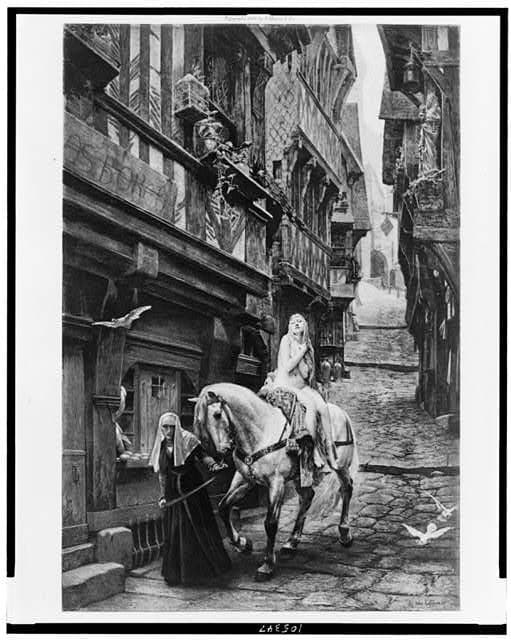
English · Politics · Activism
Lady Godiva
1000 – 1067
Introduction
Lady Godiva, known in contemporary sources as Godgifu or Godgyfu (Old English for “God’s gift”), was an 11th‑century Anglo‑Saxon noblewoman best documented as the wife of Leofric, Earl of Mercia and a major patron of religious houses in the English Midlands.[1][5][8][12] She is one of the most famous women of pre‑Conquest England, yet the historical record about her life is sparse. Her enduring fame rests on a later medieval legend in which she rides naked through the streets of Coventry to persuade her husband to remit oppressive taxes, a story now considered almost certainly fictitious by most historians.[1][5][8][11][12][14] Despite this, Lady Godiva’s documented role as a landowner and benefactor, and her vast afterlife in art and popular culture, have made her a central figure in discussions of women’s agency, civic protest, and myth‑making.
Early Life and Background
No contemporary source records Lady Godiva’s birth date, place, or parentage, and modern scholarship treats these details as unknown.[1][3][5] Her Old English name Godgifu/Godgyfu (“God’s gift”) was common among elite Anglo‑Saxon women and appears in multiple charters and legal documents; historians must therefore distinguish her from other bearers of the same name.[1][8][12][17] Based on the dates of her documented activities and her marriage, many writers infer that she was probably born in the late 10th century, around the 980s or 990s, somewhere in the Anglo‑Saxon territories that later formed Mercia and the Midlands.[3][6][11] This estimate, however, remains a scholarly reconstruction rather than a verifiable fact.
The wider context of Godiva’s early life can be reconstructed from the political landscape of late Anglo‑Saxon England. By the turn of the 11th century, Mercia was one of the major earldoms under the English crown, its leading families deeply enmeshed in royal politics, Viking conflicts, and ecclesiastical patronage.[5][8][11] If Godiva was born into a noble family, as her later marriage and independent landholding strongly suggest, she would have been raised within a culture that expected aristocratic women to manage estates, oversee household and religious patronage, and occasionally appear in legal and diplomatic records.[8][12][17] Her later prominence as a landowner and benefactor aligns with these expectations.
Marriage to Leofric and Position in Mercia
Lady Godiva is firmly attested in 11th‑century sources as the wife of Leofric, Earl of Mercia, one of the most powerful men in England under King Cnut and his successors.[1][4][5][8][11][12] Leofric’s rule over Mercia extended across much of central England, and together the couple appear in several royal charters and monastic endowment records as donors and patrons.[1][4][8][11][12] Their marriage likely occurred by the 1020s or 1030s, though no specific date is recorded; historians infer this from the timing of their joint religious foundations and the probable adulthood of their son by mid‑century.[11][12]
Godiva’s position as countess or lady of Mercia placed her near the center of royal politics. She appears in narrative sources as mother of Ælfgar, Earl of East Anglia, and grandmother of Edwin and Morcar, influential earls during the Norman Conquest, and of Ealdgyth/Aldgyth, who married Gruffydd ap Llywelyn, king of Wales, and later Harold II, last Anglo‑Saxon king of England.[8][11][12] These kinship ties situate Godiva within a network of alliances that shaped the politics of England and Wales in the mid‑11th century.
Contemporary sources suggest that Godiva and Leofric acted in partnership, especially in religious patronage.[11][12] In several accounts, both are credited with founding or endowing churches and monasteries, indicating that Godiva’s role was neither incidental nor purely symbolic. Her wealth and status allowed her to exercise real influence over the disposition of land and the support of religious institutions.
Landholding and Religious Patronage
Beyond her legendary ride, Lady Godiva is historically notable as a substantial landowner and patron of the church. Medieval chroniclers and later historians describe her as holding extensive estates, some apparently in her own right, and as a benefactor of several abbeys and churches across Mercia and the wider Midlands.[4][7][8][11][12]
According to local and national histories, Godiva and Leofric supported religious houses at Leominster, Worcester, Evesham, Burton‑on‑Trent, Hereford, Stowe, and Chester, among others.[7][11][12] These foundations and endowments were part of a broader 11th‑century movement in which aristocratic families sponsored monasteries as centers of spiritual life, political influence, and economic development. Godiva’s gifts often took the form of land grants, jewelry, and other valuables converted into religious images and crosses, reflecting both her piety and her resources.[7][11][12]
Most prominently, Godiva and Leofric are associated with the establishment or refounding of a Benedictine monastery at Coventry, on or near the site of an earlier church destroyed by Danish raids in 1016.[4][5][7][8][11][12] The historian John of Worcester later reported that the abbey’s endowment was made from lands held by each of them, highlighting their joint participation and Godiva’s independent authority as a landholder.[11][12] Coventry’s monastery, dedicated to St Mary, would later evolve into St Mary’s Priory and Coventry Cathedral, giving her patronage a long‑lasting institutional legacy.[12]
Some modern writers, drawing on Domesday Book records and later interpretations, note that Godiva may have been the only female Anglo‑Saxon landowner recorded as a tenant‑in‑chief in Domesday, underscoring her exceptional status in a male‑dominated system of royal tenure.[6][8][17] While scholarly debate continues over the precise identification of Domesday entries with Godiva of Coventry, the tradition reflects a broad consensus that she occupied a distinctive place among elite women of her era.
The Legendary Ride: Origins and Development
Lady Godiva is best known not for these documented acts but for a dramatic legend: that she rode naked through the streets of Coventry to persuade her husband to remit heavy taxes imposed on the town’s inhabitants.[1][4][5][7][8][11][12][13][14] In the story’s standard form, Godiva repeatedly begs Leofric to relieve the townspeople; he finally declares that he will do so only if she rides unclothed through the marketplace. Godiva accepts, covered only by her long hair, and issues a proclamation that everyone must stay indoors with shutters closed. She completes the ride, and Leofric, moved by her sacrifice, abolishes the oppressive taxes.[1][5][7][11][12][13]
This narrative, widely depicted in art and literature from the Middle Ages onward, does not appear in contemporary 11th‑century sources. The earliest surviving version dates from the 13th century, about two hundred years after Godiva’s lifetime, and is found in the Flores Historiarum of Roger of Wendover.[1][5][8][11][12][14] Later chronicles and local traditions elaborated the tale, introducing elements such as the voyeur “Peeping Tom”, who disobeys Godiva’s order to stay indoors and is struck blind for watching her ride.[1][5][7][12][13]
Modern historians largely agree that the ride is a legend rather than a literal event.[1][5][8][11][12][14] They note that no 11th‑century chronicler mentions such a spectacular act, despite Godiva and Leofric’s prominence; that the story appears centuries later in moralizing contexts; and that its details align more with didactic and folkloric motifs than with verifiable political practice.[8][11][12][14] Additionally, Leofric’s reputation in contemporary sources does not match the tyrannical figure of later retellings, making the legend’s depiction of marital conflict historically suspect.[11][12][14]
Nevertheless, historians also recognize that the story may preserve dim echoes of genuine disputes over taxation, civic privileges, or market rights in Coventry and other towns.[8][9][16] Recent scholarship interprets the legend as a symbolic negotiation of civic authority, placing a noblewoman at the intersection of public and private spheres, obedience and resistance.[9] In this reading, Godiva’s nakedness represents vulnerability and moral purity, while her ride through a silent town dramatizes tensions between urban communities and aristocratic landlords.
Myth, Morality, and Cultural Reinterpretations
From the Middle Ages onward, the Godiva legend has been repeatedly adapted to convey different moral, political, and aesthetic messages. In medieval and early modern retellings, the story often functions as a moral exemplum of female modesty, sacrificial charity, and obedience tempered by righteous protest.[8][9] Godiva’s willingness to endure humiliation for the sake of the poor becomes a model of Christian virtue and noble responsibility.
By the 18th and 19th centuries, the legend had entered the wider European imagination, inspiring numerous works of art, poetry, and popular spectacle. Painters such as John Collier and others depicted the ride with romantic eroticism, emphasizing Godiva’s beauty and vulnerability while also casting her as a symbol of civic freedom and resistance to tyranny.[16] Poets, playwrights, and composers turned the tale into dramas and ballads; Tennyson’s poem “Godiva,” for example, presents her as embodying pure self‑sacrifice.[8][9]
In Coventry itself, the legend became central to civic identity. From at least the early modern period, the city staged Godiva processions, festivals, and pageants featuring a costumed “Lady Godiva” riding through the streets, a tradition that persisted into the 19th and 20th centuries.[8][16] These events reinforced Godiva’s status as a symbol of local pride, communal memory, and resistance to unjust power.
Modern cultural studies highlight how the Godiva story has been appropriated in advertising, film, music, and tourism, often emphasizing sensuality and spectacle.[16][17] At the same time, contemporary feminist and historical interpretations reframe her as an icon of female agency and protest, even if the literal ride never occurred.[3][6][9][16] In these readings, Godiva becomes a lens for exploring how medieval women are remembered and reshaped in modern narratives.
Personal Piety and Character
Although the surviving sources give only brief glimpses of Lady Godiva’s personal life, several accounts emphasize her religious devotion. Local histories from Coventry report that she had her jewelry transformed into religious images and crosses, suggesting a desire to convert worldly wealth into spiritual capital.[7] Her reputation as a generous donor to abbeys and churches aligns with this portrayal of piety.[4][7][11][12]
On her deathbed, according to Coventry tradition, Godiva is said to have left her personal rosary to the church at Coventry, which subsequently became a notable center of pilgrimage in the early Middle Ages.[7] While the historicity of these specific details can be difficult to verify, they echo broader patterns in which noblewomen endowed churches with relics, liturgical objects, and personal devotional items, thereby linking their memory to local cults and religious practices.
The combination of documented generosity and legendary self‑sacrifice has made Godiva a recurring figure in debates about the character of Anglo‑Saxon noblewomen. Some modern commentators portray her as compassionate and philanthropic, emphasizing how later generations remembered her as an advocate for the oppressed.[11][12][13] Others caution that these depictions, shaped by centuries of moral storytelling, may reveal more about subsequent cultural ideals than about the historical woman herself.[3][9][17]
Later Life and Death
Precise information about Lady Godiva’s later years and death is limited. Encyclopedic sources generally state that she died sometime between 1066 and 1086, after the Norman Conquest but before the completion of Domesday Book.[1][5][8] This range is derived from the dating of her last known appearances in records and the shifting patterns of landholding documented under the new Norman regime.
Some modern writers place her death shortly after 1066, noting that her grandchildren Edwin and Morcar played prominent roles in the resistance to William the Conqueror in the early 1070s, by which time she was likely deceased.[6][11] No contemporary chronicler records the circumstances of her death, her burial place, or funerary rites. However, given her association with Coventry’s monastery and other religious houses, it is plausible—though not provable—that she was interred in or near one of these institutions.
After her death, Godiva’s memory persisted in monastic and civic traditions tied to the Abbey at Coventry and other establishments she had endowed.[7][8][11][12] Over the following centuries, these institutional memories merged with the developing legend of her ride, gradually transforming a historical patron into an emblematic heroine.
Legacy and Historical Impact
Lady Godiva’s legacy operates on two levels: the historical figure and the cultural symbol. As a historical person, Godiva is significant primarily as a high‑status Anglo‑Saxon noblewoman who exercised independent control over land and directed substantial resources toward religious foundations.[1][4][5][7][8][11][12] Her documented partnership with Leofric in establishing Coventry’s Benedictine monastery and supporting multiple churches reflects the important, often underappreciated role of aristocratic women in shaping the religious and economic landscape of pre‑Conquest England.[7][8][11][12][17]
The possible recognition of Godiva as a female tenant‑in‑chief in Domesday—if accepted—would further underscore her exceptional status within the royal landholding system.[6][8] Even without this, historians regard her as one of the best‑attested noblewomen of her era, providing a valuable case study of gender, power, and patronage in the 11th century.[1][3][8][17]
As a cultural symbol, however, Lady Godiva’s impact has been far greater. The legend of her naked ride has made her, in one historian’s words, “perhaps the most famous Anglo‑Saxon woman in history.”[11] Over the centuries, she has been used to personify civic liberty in Coventry, moral courage in Victorian literature, erotic spectacle in modern art and advertising, and feminist protest in contemporary reinterpretations.[8][9][16][17] The story’s adaptability—its capacity to support readings focused on charity, resistance, sexuality, or urban politics—has ensured its survival and continual reinvention.
Recent scholarship explores how the Godiva legend shapes discussions of protest and public space. Her ride is interpreted as dramatizing the negotiation between private bodies and public authority, between noble privilege and communal rights.[6][9][16] In this sense, Lady Godiva’s enduring image contributes to broader conversations about how myths of female sacrifice are mobilized to represent social change.
Lady Godiva’s name and likeness remain embedded in contemporary culture: in Coventry’s public art and museum displays, in the branding of commercial products, and in ongoing debates about the representation of women in historical memory.[16][17] Museums and local heritage organizations in Coventry continue to present her as a symbol of the city and as an entry point for exploring the Anglo‑Saxon past.[7][16] Whether approached as a real woman, a legendary heroine, or both, Lady Godiva occupies a distinctive place in the international imagination of the Middle Ages and in the history of how women’s stories are told.
Dated achievements
2 indexed.
- Jan011000Politics
Birth of Lady Godiva
Lady Godiva was born around the year 1000 in the Kingdom of England.
View details Encyclopedia Britannica - Lady Godiva's Biography - Jan011067Politics
Death of Lady Godiva
Lady Godiva is believed to have died around 1067, shortly after the Norman Conquest.
View details