← All women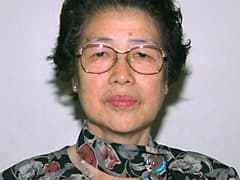
Japanese · Science
Katsuko Saruhashi
March 22, 1920 – September 29, 2007
Early life and education
Katsuko Saruhashi was born on 22 March 1920 in Tokyo, Japan. Sources consistently identify her as the daughter of an electrical engineer and describe a family environment that supported education, although higher education for women was still far from normal in Japan during her youth. She grew up in a period marked by rapid modernization, the militarization of society, and deep gender inequality, all of which shaped the obstacles she would later overcome as a scientist.
As a young woman, Saruhashi initially worked in an insurance company before deciding to pursue higher education. She entered the Imperial Women’s College of Science, later Toho University, and graduated in 1943. Her decision to leave secure employment for science was significant in itself: women in Japan had few pathways into advanced research, and technical fields were overwhelmingly male-dominated. She chose a route that required persistence and unusual ambition at a time when women were typically expected to prioritize domestic roles over professional careers.
After graduation, Saruhashi began work at the Geochemical Laboratory of the Meteorological Research Institute. There she started the research program that would define her early career: the measurement of carbon dioxide in seawater. That choice of subject placed her at the intersection of chemistry, oceanography, and emerging environmental science. It also gave her the technical grounding she would later use to study the movement of radioactive fallout through the Pacific.
Early scientific career and seawater chemistry
At the Meteorological Research Institute, Saruhashi developed a method for estimating dissolved carbonic acid species in natural water from observable variables such as temperature, pH, and chlorinity. Her work culminated in the 1955 publication of On the Equilibrium Concentration Ratio of Carbonic Acid Substances Dissolved in Natural Water, which introduced what became known as Saruhashi’s Table. This reference system became an important tool for scientists studying seawater chemistry and the oceanic carbon cycle.
The significance of this work was both scientific and practical. Reliable measurements of dissolved carbon dioxide in seawater were difficult to obtain, yet they were necessary for understanding how the ocean stores and exchanges carbon with the atmosphere. Saruhashi’s method simplified and standardized a complicated problem, making the chemistry of natural water more accessible to researchers. In that sense, her table helped lay groundwork for later studies of ocean acidification and global carbon dynamics, even though those terms were not yet in common use.
Her early scientific contributions established her reputation as a capable and original geochemist. They also revealed a central pattern in her career: she worked on problems of great practical relevance, not abstract theory alone. That focus would prove decisive when nuclear testing created a new environmental challenge that demanded exactly the kind of quantitative, field-based science Saruhashi had been developing.
Doctorate and barrier-breaking achievements
On 25 March 1957, Saruhashi received her Doctor of Science degree from the University of Tokyo for her dissertation The Behavior of Carbonic Matter in Natural Water. She became the first woman to receive a doctorate in science from the University of Tokyo, and also the first woman in Japan to earn a PhD in chemistry from that institution. The doctorate validated her work at the highest level and marked a historic breach in the country’s most prestigious scientific academy.
This was a defining milestone in postwar Japanese higher education. Women had long been excluded from elite scientific pathways, and even talented female researchers often found their careers constrained by assumptions that they were unsuited to advanced technical work. Saruhashi’s success challenged those assumptions directly. Her doctorate signaled that a woman could produce work of such quality that Japan’s leading university would grant her one of its highest scientific degrees.
The doctorate also strengthened her position in the scientific community at large. By formalizing her expertise, it enabled her later work to carry greater authority in debates over marine chemistry and environmental contamination. Her academic breakthrough thus functioned both as personal recognition and as a broader institutional opening for women in Japanese science.
Radioactive fallout and nuclear research
In the 1950s, Saruhashi’s research took on urgent global importance when the United States conducted a series of nuclear tests in the Marshall Islands, including the Castle Bravo test at Bikini Atoll in 1954. She was later asked to investigate how radioactive isotopes from these tests spread through the Pacific Ocean. Drawing on her expertise in ocean chemistry, she helped quantify the movement of fallout in seawater.
Her studies had major implications. In 1958, Saruhashi published work showing that radioactive contamination from Bikini Atoll had reached Japan in less than two years via ocean currents. That finding challenged the comforting belief that nuclear fallout would remain localized near test sites. Instead, it showed that atmospheric and oceanic systems could spread contamination widely, making nuclear testing an international environmental issue rather than a purely military one.
This research contributed to broader public and political concern about atmospheric nuclear tests. It also connected Saruhashi to anti-nuclear activism, because her findings provided scientific evidence used in arguments for restraint and disarmament. She became known not simply as a geochemist, but as a scientist whose work had real consequences for peace and environmental policy. In the era of the Cold War, when scientific data could intersect directly with geopolitics, her work carried unusual moral and political weight.
During the 1960s and 1970s, Saruhashi and her colleagues continued studying the environmental effects of nuclear weapons testing, including atmospheric impacts and acid rain. These investigations extended her influence beyond the specific question of radioactive fallout and into the wider study of human alteration of the planet. Her scientific career thus bridged marine chemistry, environmental monitoring, and nuclear-era public health concerns.
Leadership in science and women’s advocacy
Saruhashi’s career was equally significant for what she did outside the laboratory. In 1958, she founded the Society of Japanese Women Scientists, an organization intended to support women pursuing scientific careers in Japan. At a time when women researchers often lacked mentoring networks and visibility, the society created a community of professional solidarity and a platform for advancement.
Her commitment to women’s scientific participation deepened in later decades. In 1980, she became the first woman elected to the Science Council of Japan, the national scientific advisory body. That same period saw her help found the Association for the Bright Future of Women Scientists, further institutionalizing support for women in science. These efforts were not secondary to her research; they were part of a coherent vision of science as a field that should be open to talent regardless of gender.
In 1985, Saruhashi became the first woman to win the Miyake Prize for geochemistry, an award named after her mentor Yasuo Miyake. The honor recognized both her technical accomplishments and her stature within Japanese geochemistry. It also underscored the irony that a prize named after a male mentor would eventually honor the woman who had expanded the discipline’s horizons and helped redefine who could lead within it.
After retiring, Saruhashi created the Saruhashi Prize to recognize Japanese women scientists in the natural sciences. The award was designed to honor not only research excellence, but also the mentoring and role-modeling that help younger women persist in scientific careers. This prize remains one of the clearest expressions of her long-term legacy: she built structures that could outlast her own career and continue to elevate women in science.
Personal life and character
Public sources on Saruhashi focus primarily on her scientific work and advocacy, and relatively little is documented about marriage or children. What is clear is that she devoted most of her public life to research, scientific leadership, and the advancement of women in science. Her decision to leave early employment for university study, and later to use her own standing to create institutions for other women, suggests a deliberate commitment to professional life at a time when such a path was unusual for Japanese women.
Contemporary accounts often emphasized her determination, professionalism, and refusal to accept exclusion as normal. She has been described as a pioneering geochemist and an outspoken advocate of nuclear restraint. Those descriptions reflect not only her published research but also the way she carried scientific authority into public life. She was, in effect, both a laboratory scientist and a civic actor.
Later life, death, and legacy
Katsuko Saruhashi died in Tokyo on 29 September 2007. By then she had become one of the most important figures in the history of Japanese science and a model for women entering technical fields. Her influence rested on several interconnected achievements: she advanced the measurement of carbon dioxide in seawater, demonstrated the long-range spread of radioactive fallout, contributed to anti-nuclear evidence, and created institutions that continue to support women scientists.
Her legacy has only grown more visible over time. In 2018, Google marked what would have been her 98th birthday with a Doodle honoring her work. Modern profiles continue to describe her as a foundational geochemist and a pioneering figure in women’s scientific advancement. The Saruhashi Prize remains a living institution associated with her name, linking her own career to the careers of later generations of Japanese women scientists.
Historically, Saruhashi occupies a rare position: she was both a technical innovator and a builder of opportunity. Her scientific contributions helped establish methods used in environmental chemistry, while her advocacy helped challenge the exclusion of women from high-status scientific work. For women’s history, that combination makes her one of the most consequential Japanese scientists of the twentieth century.
Dated achievements
11 indexed.
- Mar221920Science
Birth of Katsuko Saruhashi
Katsuko Saruhashi was born in Tokyo, Japan, later becoming a pioneering geochemist known for her work on CO2 in seawater and radioactive fallout.
View details Katsuko Saruhashi - Wikipedia - Dec011955Science
Publication of paper introducing 'Saruhashi's Table'
Saruhashi published her landmark paper on carbonic acid equilibrium in natural water, introducing the reference system known as Saruhashi's Table.