← All women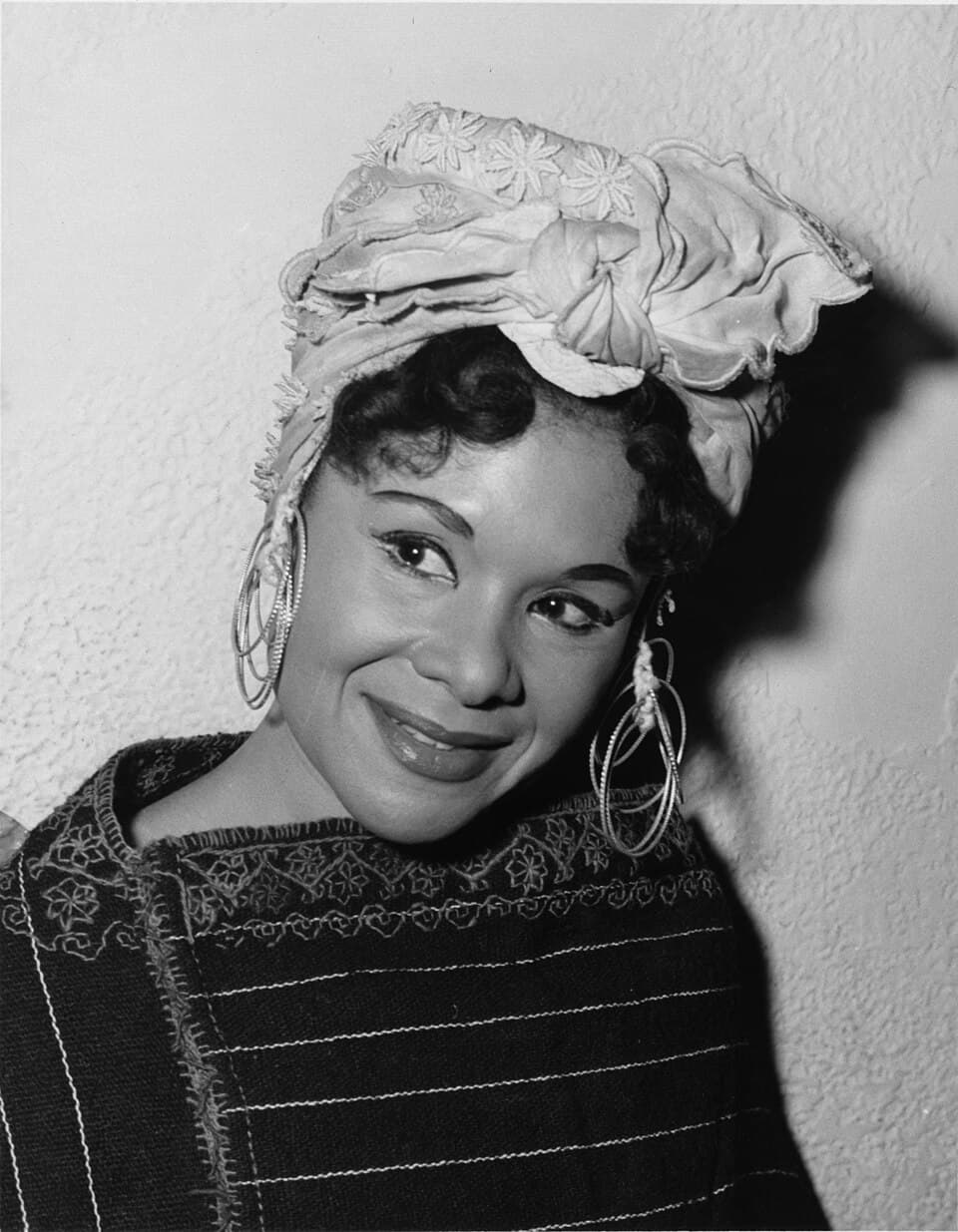
American · Arts · Activism
Katherine Dunham
June 22, 1909 – May 21, 2006
Early Life and Background
Katherine Mary Dunham was born on June 22, 1909, in the Chicago area of Illinois, to Albert Millard Dunham, an African American businessman, and Fanny June Taylor Dunham, of French Canadian and Native American descent. Different sources list her birthplace as Chicago or the nearby suburb of Glen Ellyn, reflecting some archival inconsistency, but all agree on her birth date and Illinois origins.[2][5][8][16]
Dunham spent much of her childhood in Joliet, Illinois. Her mother died when Katherine was young, and she was subsequently raised by her father and stepmother.[1][13][14] Growing up in a racially segregated Midwestern environment, she experienced both the constraints of Jim Crow–era prejudice and the support of Black community institutions. These early experiences shaped her later commitment to racial justice and community-based arts education.
As a child, Dunham showed an interest in literature and performance, participating in school plays and church activities.[18] She did not begin formal dance training until her late teens, when she studied with Russian émigré ballet teacher Madame Ludmila Speranzeva in Chicago.[13][18] This training introduced her to classical ballet technique, but Dunham was equally drawn to African American social dances and music. The tension and interplay between European and African-derived forms would become central to her mature work.
Dunham enrolled at the University of Chicago, where she studied anthropology and social science. In 1936 she completed a bachelor’s degree in social anthropology, and she later pursued graduate work at the same institution.[13][16][18] She studied under leading anthropologists, including Melville J. Herskovits and Robert Redfield, who supported her field research in the Caribbean.[6][18] Dunham’s dual path as dancer and anthropologist was highly unusual for a Black woman at the time and laid the foundation for her pioneering approach to "dance anthropology."
Career Beginnings and Development
Dunham’s entry into professional dance followed quickly upon her university studies. In 1929, she co-founded Ballet Nègre in Chicago, often described as one of the first Negro ballet companies in the United States.[13][16][18] The ensemble performed works that blended ballet and modern dance techniques with Black musical idioms. Though short-lived, Ballet Nègre demonstrated Dunham’s early commitment to building Black-led concert dance institutions.
In 1931, Dunham established a dance school in Chicago with the assistance of Madame Speranzeva, and she continued to choreograph for local theaters.[13] Around the same period, she organized what later sources identify as Ballet Nègre or the Negro Dance Group, consolidating her role as a choreographer-director. Her early ballet "Negro Rhapsody" attracted attention for its integration of Black musical forms into a ballet framework.[13]
A decisive turn in Dunham’s career came with her anthropological fieldwork of 1935–1936. Supported by the University of Chicago and the Julius Rosenwald Fund, she traveled to Jamaica, Trinidad, and Haiti to study dance, ritual, and social life among African-descended communities.[6][16][18] In Haiti, she observed and eventually participated in Vodou ceremonies; in Jamaica and Trinidad, she documented social and ceremonial dances. Her research sought to understand how movement encoded cultural values, religious beliefs, and historical memory. Dunham is often cited as one of the first African Americans to earn an anthropology degree and to apply anthropological methods to the study of Caribbean dance.[6][11][16]
Drawing on this research, Dunham began to create works that translated ethnographic materials into theatrical choreography. On January 29, 1937, she premiered "L’Ag’Ya" at the Federal Theatre Project’s Chicago Civic Opera House, a ballet based on a combat dance from Martinique and incorporating Caribbean legends and music.[8] She later presented "L’Ag’Ya" at the Hollywood Playhouse in Los Angeles on April 7, 1937, expanding her reach to West Coast audiences and the film community.[8] These works showcased her emerging ability to fuse anthropological insight, narrative structure, and modern dance technique.
In 1938, Dunham formed what became the Katherine Dunham Dance Company, regarded as the first self-supported Black modern dance company in the United States and the first Black modern dance company led by an African American woman.[13][16][18] The troupe toured extensively, performing in the United States, Latin America, and Europe. By bringing Black dancers to concert stages previously dominated by white performers, Dunham challenged entrenched racial hierarchies in the dance world.
Broadway, Film, and Major Choreographic Works
Dunham’s breakthrough in New York came on January 9, 1940, when her company opened in the Broadway musical "Cabin in the Sky". Produced by George Balanchine with music by Vernon Duke, the show featured a predominantly Black cast and was unusual for its era.[8] Dunham’s choreography incorporated African American social dance, jazz movement, and stylized theatrical gesture, adding new dimensions to the Broadway idiom. The success of "Cabin in the Sky" established her as a prominent choreographer in New York.
Soon afterward, Dunham launched her own dance-centered revues. On March 30, 1940, the Dunham company opened "Tropical Review" at the Martin Beck Theatre on Broadway.[8] Later that year, on December 27, 1940, they premiered "Carib Song", another revue drawing extensively on Caribbean themes and music.[8] Through these productions, Dunham presented an integrated vision of Black diasporic culture, combining dance, live music, and scenic design. Her revues helped normalize Afro-Caribbean movement vocabularies on the Broadway stage and gave her company sustained visibility.
During the 1940s, Dunham and her troupe also appeared in Hollywood films, bringing her choreography to mass audiences. In 1942, they performed in the wartime musical "Star Spangled Rhythm", and in 1943 they were featured in the film "Stormy Weather", which included standout Dunham numbers such as "Cakewalk" and other ensemble dances.[16][18] These appearances introduced millions of viewers to Dunham Technique and to Black concert dancers, countering both the invisibility and stereotyping of Black performers in mainstream cinema.
Dunham’s choreographic repertory encompassed works based on Afro-Caribbean ritual, African American history, and contemporary social themes. Pieces such as "Shango," "Rites de Passage," "Southland," and "Barrelhouse Blues" combined ethnographic detail with theatrical innovation.[5][18] The controversial work "Southland", created in the 1950s, dramatized the lynching of a Black man in the American South and encountered censorship and opposition, especially in the United States.[5][18] This demonstrated Dunham’s willingness to address racial violence directly through dance.
The Dunham Technique and Educational Work
One of Dunham’s most enduring contributions is the Dunham Technique, a codified system of movement that blends ballet, modern dance, and dances of the African diaspora.[7][10][11] The technique emphasizes articulated torso, polycentric movement, weight shifts grounded in African-derived rhythms, and a holistic integration of mind and body. It requires students to understand the cultural and historical contexts of movement, not merely its physical execution.
To disseminate this technique, Dunham established influential educational institutions. On June 18, 1945, she opened the Katherine Dunham School of Dance and Theatre in New York City.[8][18] The school offered a comprehensive curriculum including dance, theater, music, cultural anthropology, languages, and philosophy. Students encountered not only technical training but also lectures on Caribbean religions, African history, and social issues. The school attracted both aspiring professionals and established artists, some of whom went on to become major figures in modern and jazz dance.
Beyond New York, Dunham developed workshops and training programs across the United States and abroad. Her pedagogical approach insisted on respect for the cultures from which movement vocabularies were drawn; she sought to counter exoticism by foregrounding historical and spiritual dimensions of dance.[6][7] Over time, Dunham Technique became foundational for many dancers working in jazz, musical theater, and contemporary forms, and it is still taught internationally.
Scholarship, Writing, and Anthropological Contributions
Parallel to her artistic work, Dunham produced scholarly and literary writings grounded in her field research. In 1946, she published "Journey to Accompong", an ethnographic account of a Maroon community in Jamaica, detailing rituals, community structures, and festivals.[16][18] In 1947, she published "Las Danzas de Haiti", a Spanish-language study of Haitian dance and Vodou ritual that documented the complex relationships between religion, politics, and movement.[16][18]
These writings contributed to the anthropological understanding of Caribbean societies and offered rare perspectives from a Black woman scholar-practitioner. Dunham combined careful description with interpretive analysis, explaining how dance functioned as historical record, spiritual practice, and social critique. Her work prefigured later interdisciplinary fields such as performance studies and the anthropology of dance.
Dunham also wrote essays, autobiographical reflections, and fiction, including the memoiristic work "Island Possessed", which recounts her experiences in Haiti and her relationship to Vodou.[6][18] Although not all of her writings were widely distributed at the time, they have become important sources for scholars examining intersections of race, gender, embodiment, and colonialism in the Americas.
Major Honors and Institutional Recognition
Over the course of her career, Dunham received numerous awards and honors recognizing her contributions to dance, scholarship, and activism. She was granted multiple honorary doctorates from universities in the United States and abroad, acknowledging her status as a public intellectual as well as an artist.[11][16]
In 1983, Dunham received a prestigious Kennedy Center Honor for lifetime achievement in the arts; the ceremony took place on May 23, 1983, and celebrated her influence on American culture through dance and choreography.[8][11] She was also awarded the Presidential Medal of the Arts, the NAACP Lifetime Achievement Award, the Albert Schweitzer Prize, and membership in the French Legion of Honor, though precise dates for many of these honors are not consistently documented.[11][15][18]
By the late 20th century, Dunham was widely acknowledged as a central figure in modern dance. Institutions such as the Alvin Ailey American Dance Theater embraced her legacy, teaching Dunham Technique and programming her works.[3] The Library of Congress created the Katherine Dunham Collection, and in December 2004 it highlighted her achievements in an article titled "The Life and Work of Katherine Dunham," drawing attention to the scope of her archival footprint.[6]
Personal Life
Dunham’s personal relationships were intertwined with her artistic and scholarly pursuits. She married Jordis (Jordan) McCoo in 1931, but the marriage ended in divorce in 1939.[16] That same year, she married John Thomas Pratt, a theatrical designer and artist who became a long-time collaborator on her productions.[16][18] Pratt worked on sets and costumes for many Dunham pieces, contributing to their visual impact. The couple remained together until his death in 1986.[16]
Dunham and Pratt adopted a daughter, Marie-Christine, who grew up within the milieu of the dance company and its touring life.[16] Dunham’s domestic life was often nomadic due to travel and performance schedules, but she maintained strong ties to Haiti and later to East St. Louis. In Haiti, she developed enduring friendships and ritual affiliations; she was initiated into Vodou and maintained a deep respect for the religion, which informed both her spiritual outlook and her artistic work.[6][18]
Friends and colleagues frequently described Dunham as disciplined, intellectually curious, and demanding, both of herself and of her dancers. She insisted on high standards of technique and cultural literacy and was known for fostering a sense of family within her company, even as she pushed dancers to achieve challenging choreographic goals.[7][18]
Activism and Social Engagement
From early in her career, Dunham used dance as a platform for social commentary. Her works addressed colonialism, racial oppression, and the dignity of Black cultures. She participated in the civil rights movement, aligning herself with campaigns against segregation and discrimination in the United States.[11][16]
Her activism took a dramatic turn in the early 1990s. Deeply concerned about U.S. policy toward Haitian refugees, Dunham began a 47-day hunger strike around March 1, 1992 in East St. Louis.[8][16] She refused solid food to protest the treatment of Haitians detained by U.S. authorities, drawing international attention to the issue. On April 16, 1992, she ended the strike after officials promised to review conditions and policies.[8] This act of personal sacrifice highlighted her profound commitment to Haiti and to human rights.
Dunham also helped organize the First World Festival of Negro Arts in Dakar, Senegal, in 1965, an international gathering that showcased African and diasporic artists and intellectuals.[16][18] Her participation affirmed her belief in transnational Black solidarity and cultural exchange.
In 1967, she extended her activism to urban youth by creating the Katherine Dunham Performing Arts Training Center in East St. Louis, Illinois, formally opened on September 29, 1967.[8][16] The center offered dance, theater, music, and cultural education to a community facing economic hardship and systemic racism. Dunham’s work there exemplified her conviction that the arts could function as tools for social transformation and personal empowerment.
Later Career: Metropolitan Opera and International Work
Dunham’s artistic career continued into her sixties and seventies. On November 12, 1963, her choreography for Giuseppe Verdi’s "Aida" premiered at the Metropolitan Opera in New York.[16][18] This appointment made her the first Black choreographer to work at the Met, a major milestone in the diversification of American high culture. She staged processional and dance sequences for the production, adapting her choreographic language to the scale and conventions of grand opera.
Beyond the Met, Dunham continued to choreograph, teach, and lecture internationally. She maintained residences in Haiti and East St. Louis, traveling between them to oversee projects and participate in cultural activities.[13] Her company’s tours introduced audiences around the world to her synthesis of ballet, modern dance, and African diasporic movement.
In 1974, Dunham formally retired from teaching at certain institutions but intensified her work in East St. Louis, where she opened what became known as the Katherine Dunham Center.[13] There she remained a mentor and community leader, integrating arts, social services, and political engagement.
Legacy and Historical Impact
Katherine Dunham’s legacy is multifaceted, spanning dance, anthropology, education, and activism. As a choreographer, she is credited with bringing African and Caribbean dance aesthetics into the mainstream of American concert dance, influencing the development of modern and jazz dance.[2][7][11] Her work demonstrated that Black movement vocabularies could serve as sources of sophisticated theatrical art rather than mere entertainment or exotic display.
The Dunham Technique remains a cornerstone of many training programs worldwide and continues to be taught at institutions such as the Alvin Ailey American Dance Theater.[3][7] Its emphasis on cultural context and holistic embodiment has shaped generations of dancers and choreographers. In women’s history, Dunham stands out as a Black woman who built and sustained her own company, schools, and international career in a field dominated by white men.
As an anthropologist and writer, Dunham contributed significantly to the documentation and interpretation of Caribbean cultures. Her books and essays are important resources in anthropology, performance studies, and Black diaspora studies.[6][16][18] She helped legitimize dance as an object of serious scholarly inquiry and modeled an approach that combined participant observation, artistic practice, and critical analysis.
In the realm of activism, Dunham exemplified the use of artistic authority to contest racism, colonialism, and unjust policies. Her 1992 hunger strike and her work with Haitian and African American communities illustrate how artists can intervene in public life beyond symbolic representation.[8][16]
Institutional recognition of her impact has grown over time. Dunham has been called the "Matriarch of Black Dance" and the "Queen Mother of Black Dance", titles that acknowledge her role as mentor and progenitor of entire lineages of dancers.[5][14][19] The Library of Congress’s dedicated collection, numerous scholarly studies, and continued performance of her works all testify to her enduring significance.
Later Life and Death
In her later years, Dunham continued to divide her time between East St. Louis and Haiti, maintaining involvement in educational programs and cultural activities despite declining health.[13] She remained a revered figure in dance circles and in communities where she had worked.
On May 21, 2006, Dunham died in her sleep of natural causes in New York City at the age of ninety-six.[1][2][9][18] Her passing prompted tributes from artists, scholars, and activists worldwide, who emphasized both her artistic innovations and her unwavering commitment to social justice.
Shortly after her death, on June 14, 2006, the U.S. House of Representatives approved H. Con. Res. 451, a concurrent resolution honoring her achievements and describing her as a pioneering choreographer and activist.[16] This formal recognition by Congress underscored the national significance of her life’s work.
Today, Katherine Dunham’s influence can be seen in the widespread teaching of Dunham Technique, the presence of Afro-Caribbean and African American idioms in concert dance and popular performance, and the growing scholarly literature on dance, race, and the African diaspora. Her life story continues to serve as a powerful example of how a Black woman artist-intellectual can transform both artistic practice and social realities.
Dated achievements
16 indexed.
- Jun221909Arts
Birth of Katherine Dunham
Katherine Mary Dunham was born in Chicago, Illinois, on June 22, 1909.
View details Katherine Dunham Timeline - Library of Congress - Jan011931Arts
Founding of Ballet Nègre, first Black ballet company in the U.S.
Katherine Dunham founded Ballet Nègre, described by Congress as the first Black ballet company in the United States.