← All women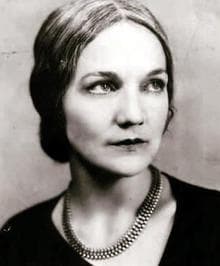
American · Literature
Katherine Anne Porter
May 15, 1890 – September 18, 1980
Early life and family background
Katherine Anne Porter was born Callie Russell Porter on 15 May 1890 in Indian Creek, Texas, in Brown County. She was the fourth of five children of Harrison Boone Porter and Mary Alice Jones Porter. Her mother died when Porter was still young, and she was subsequently raised largely by her paternal grandmother, Catherine Anne Porter Skaggs, a family figure from whom she later drew the name Katherine Anne. The loss of her mother, the instability of her early home life, and the rural poverty of turn-of-the-century Texas remained central emotional realities in her later writing.[2][4][6]
Porter’s formal education was limited and intermittent, but she read widely from childhood and developed an early sense of literary ambition. Biographical accounts describe a young woman who was determined to move beyond the constraints of her surroundings. She began using the name Katherine Porter informally while still young and later adopted the fuller name Katherine Anne Porter as her public identity. The act of renaming herself was more than a cosmetic choice: it signaled self-invention, independence, and a refusal to remain bounded by the life prescribed for a poor girl in rural Texas.[7][15]
Early adulthood, work, and first marriages
Porter’s early adult life was marked by instability, travel, and work in a range of occupations. In 1906 she married John Henry Koontz, a union that was unhappy and later ended in divorce. In 1912 she was hospitalized with tuberculosis in San Antonio, an illness so serious that it nearly killed her. The experience left a lasting imprint on her imagination and would later be transformed into the story Pale Horse, Pale Rider, one of her most celebrated works.[6]
During the 1910s Porter moved toward journalism and criticism. By 1915 she was working for Texas and Colorado newspapers, including the Fort Worth Critic and the Rocky Mountain News. This period marked the beginning of her professional writing life. In 1919 she moved to New York City to pursue writing full time and began publishing freelance journalism and reviews. The move placed her in the center of a wider literary culture and opened the way to the fiction career that would define her reputation.[10][2][12]
Porter traveled to Mexico in 1920 as a correspondent to cover political and cultural developments after the Mexican Revolution. That experience provided material for several early stories and deepened her interest in the complex social and political worlds of the Americas. She also married Ernest Stock in 1920; the marriage was annulled within a year. These early experiences combined professional mobility with personal turbulence, reinforcing themes of alienation, survival, and self-fashioning that recur throughout her fiction.
Emergence as a fiction writer
Porter became visible as a fiction writer in 1922 with the publication of “Maria Concepcion” in The Century Magazine. The story established her emerging reputation and signaled the arrival of a distinctive literary voice. Porter’s prose was immediately recognizable for its compressed intensity, precise observation, and moral seriousness. Rather than writing sentimental domestic fiction, she explored conflict, betrayal, race, class, and the hidden violence of ordinary life.[11][1][20]
In 1925 she married Eugene Pressly, a young United States diplomat, in New York. The couple lived abroad in France and Switzerland before divorcing. The marriage widened Porter’s geographic range and connected her to expatriate life, but it did not provide lasting domestic stability. Like her earlier marriages, it ended without permanent settlement, and Porter increasingly defined herself through work rather than family life.[6][15]
Her first book, Flowering Judas and Other Stories, appeared in 1930 and brought her significant critical attention. The collection was an important statement of artistic identity: its stories were spare, unsettling, and highly crafted, revealing Porter as a major new voice in American fiction. In the following decade her reputation continued to grow as she published work shaped by her experiences in Europe and by her longstanding interest in the political and psychological costs of modern life.[2][1]
Mature career and major works
Porter’s literary stature deepened with the publication of Pale Horse, Pale Rider in 1939, a volume that drew together some of her most admired work. The title story, based on her near-fatal encounter with influenza, became one of her signature pieces. Her collection The Leaning Tower and Other Stories followed in 1944, expanding the range of her short fiction and confirming her reputation as one of the finest practitioners of the form in twentieth-century America.[2][1]
Porter was known for producing relatively little fiction, but what she published was often the product of long gestation and extreme revision. Her work is notable for exact prose, symbolic density, and a capacity to render complex moral and emotional situations with apparent ease. Critics have often observed that her stories possess the richness and breadth of novels while maintaining the intensity of short fiction. That mastery made her a distinctive figure in American literature and helped define the modern prestige of the short story.[2][18]
Her only full-length novel, Ship of Fools, was published in 1962 and became a bestseller. The novel broadened her audience dramatically and confirmed that she could achieve commercial as well as critical success. Drawing on an ocean voyage from Mexico to Germany that she undertook in 1931, the novel used the shipboard journey as a setting for a wide-ranging exploration of human folly, class, nationalism, and moral drift. Despite the novel’s popularity, Porter’s short fiction remained the core of her critical reputation.[5][11]
In 1965 The Collected Stories of Katherine Anne Porter appeared, gathering the major work on which her reputation rested. The volume won both the National Book Award for Fiction and the Pulitzer Prize for Fiction in 1966, placing her among the most honored American writers of the century. These awards recognized not only a single book but a lifetime of achievement in a form that had often been undervalued in mainstream publishing and criticism.[5][3][2]
Recognition, teaching, and later years
Porter received the American Academy of Arts and Letters Gold Medal for Fiction in 1963, a major honor acknowledging sustained excellence. She also spent time in the academic world as a writer-in-residence and visiting lecturer at several universities during the 1950s and 1960s, where her stature as an elder stateswoman of American letters was widely recognized. Her late career brought institutional honors that confirmed what critics had long argued: that she was one of the finest stylists in American prose.[18][5]
Porter’s personal papers and manuscripts were later donated to the University of Maryland, helping establish the archival base for future scholarship on her life and work. This donation reflected the seriousness with which institutions began to treat women writers’ archives and literary legacies. By preserving her correspondence, drafts, and papers, the collection made it possible for scholars to trace the evolution of her stories and to understand the painstaking labor behind her reputation for elegance and precision.
Personal life
Porter’s personal life was complicated and often unsettled. She married three times: John Henry Koontz in 1906, Ernest Stock in 1920, and Albert Erskine in 1937. None of the marriages lasted, and the instability of her private life contrasts sharply with the measured control of her prose. The gap between her turbulent experiences and the formal order of her fiction is one reason her work has continued to attract scholarly attention.[6]
Although she did not have a conventional family life as an adult, Porter cultivated intense friendships and professional relationships in literary circles. She was also politically engaged at various moments of her life, and biographical references describe her as an activist as well as a writer. Her life demonstrates how a woman of her generation could move through the worlds of journalism, international travel, and literary production while resisting the expectations attached to marriage and domesticity.
Legacy and historical impact
Katherine Anne Porter is remembered as one of the major American short-story writers of the twentieth century. Her fiction is admired for its exactness, emotional intelligence, and ability to unite private suffering with historical depth. Stories such as “Flowering Judas,” “Pale Horse, Pale Rider,” and “The Jilting of Granny Weatherall” helped shape the modern American short story and continue to be read for their technical mastery and psychological insight.[2][3]
Porter’s career is also important in women’s literary history. She achieved national recognition in a field that often privileged male novelists and did so through a form, the short story, that was frequently treated as secondary. Her late but sweeping recognition with the National Book Award and Pulitzer Prize demonstrated that a woman writer could command the highest literary honors without conforming to conventional expectations of productivity, genre, or domestic identity. Her work opened a path for later writers who sought artistic authority on their own terms.
Porter died on 18 September 1980 in Silver Spring, Maryland, and was buried near her Texas birthplace. Her legacy endures through her collected fiction, her influence on later American prose stylists, and the archival preservation of her papers. In American literature, she remains a writer of uncommon severity, elegance, and power whose work transformed personal history into enduring art.[2][6][3]
Dated achievements
16 indexed.
- May151890Literature
Birth of Katherine Anne Porter
Callie Russell Porter was born on a farm near Indian Creek, Texas, the fourth of five children of Harrison Boone Porter and Mary Alice Jones Porter.
View details Katherine Anne Porter - Britannica - Nov011906Literature
Marriage to John Henry Koontz
Porter married John Henry Koontz, a salesman, in Lufkin, Texas; the unhappy marriage ended in divorce years later.