← All women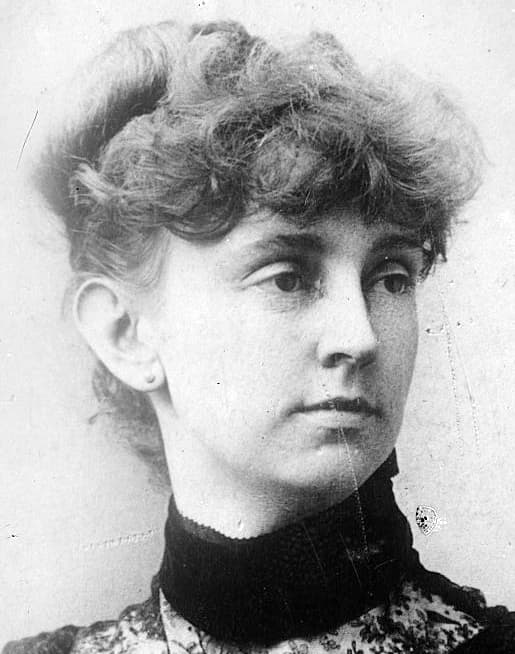
American · Literature · Activism
Kate Douglass Wiggin
September 28, 1856 – August 24, 1923
Early Life and Background
Kate Douglas Wiggin (née Kate Douglas Smith) was born on 28 September 1856 in Philadelphia, Pennsylvania.[1][2][6] Her father, Robert Noah Smith, was a lawyer of Welsh descent, and her mother was Helen Elizabeth (Dyer) Smith.[6][8] Wiggin was of New England Puritan ancestry through her mother’s line, a heritage she later celebrated in her writing about rural Maine communities.[5][7]
When Wiggin was still a child, her father died, and her widowed mother eventually remarried Albion Bradbury and moved the family to Maine.[4][6][7] The family lived in several communities, including Hollis and Buxton, whose people and landscapes would later be thinly disguised in her fiction, notably in Rebecca of Sunnybrook Farm and related New England stories.[1][4][7] Though her early formal schooling was irregular, she received substantial instruction at home from her stepfather and attended local district schools when available.[4][6]
As a teenager, Wiggin was sent to a series of academies, including Gorham Female Seminary in Maine, Morison Academy in Baltimore, and ultimately Abbot Academy in Andover, Massachusetts, one of the first secondary schools for girls in New England.[4][6] She graduated from Abbot Academy in the early 1870s, an educational experience that broadened her literary horizons and exposed her to the New England intellectual traditions that informed her later work as an author.
Training and Early Career in Kindergarten Education
After her schooling in New England, Wiggin moved to California for health and family reasons, joining the westward migration that was reshaping American society in the post–Civil War period.[1][5][6] In California she encountered the ideas of German educator Friedrich Froebel, whose concept of the kindergarten as a "children’s garden" of play-based learning was being adapted by American reformers.[3][5][8]
Wiggin enrolled in Emma J. C. Marwedel’s Kindergarten Training School in Los Angeles and graduated in 1878, receiving formal training in Froebelian methods.[6] She then taught in a kindergarten in Santa Barbara for a period before moving to San Francisco, where she became deeply involved in work among poor children.[4][5][6]
In 1878 she organized the Silver Street Free Kindergarten in a working-class district of San Francisco, widely recognized as the first free kindergarten in the city and on the U.S. West Coast.[1][5][7][11] The school served children of impoverished families, many of whom would otherwise have been in the streets or at work. Wiggin’s classroom combined songs, games, storytelling, and manual activities with a strong emphasis on affection and moral development, reflecting her conviction that education should nurture the whole child.[1][5][6]
Working largely without public funding, Wiggin became a tireless fundraiser and advocate. She canvassed middle-class supporters, organized charity events, and later used the proceeds of her stories to support the kindergarten. Her work caught the attention of San Francisco reformer Sarah B. Cooper, and the two women, joined by Wiggin’s sister Nora Archibald Smith, helped build a network of free kindergartens in San Francisco and Oakland.[5][6]
Expansion of the Kindergarten Movement
From the modest beginnings of the Silver Street Free Kindergarten, Wiggin’s work expanded into a broader movement for early childhood education. In 1879 she formally organized the Silver Street Kindergarten, and by 1880 she and her sister Nora helped found the California Kindergarten Training School (also known as the California Kindergarten Training School for Teachers), which prepared young women to become kindergarten teachers.[5][6]
The training school offered both theoretical instruction in Froebelian philosophy and practical experience in model kindergartens serving poor neighborhoods.[5][6] Wiggin and Smith’s partnership produced not only trained teachers but also manuals and textbooks that adapted Froebel’s ideas to American conditions. Their work contributed to the gradual acceptance of the kindergarten as a standard component of elementary education in the United States, moving it from a philanthropic experiment to a professionalized field.
Wiggin’s pedagogical philosophy emphasized the dignity and potential of every child, particularly those from disadvantaged backgrounds. According to later accounts, she helped to establish or inspire more than sixty kindergartens in low-income areas, working to ensure that young children were not treated merely as cheap labor but as individuals deserving of play, learning, and care.[1][8][9] Her work placed her among a wider network of women reformers, including Elizabeth Harrison and Caroline Severance, who modernized kindergarten teacher training and helped integrate early childhood education into reform-era social work.[3][8]
Transition to Literary Career
Although Wiggin always regarded herself as an educator, financial pressures and the demands of fundraising led her toward writing. In the early 1880s she began composing stories about the children she taught and the communities she knew. Her first notable success came with The Story of Patsy (1883), a tale about a disabled child in a San Francisco tenement, which was initially sold to benefit the kindergarten work.[5][6][9]
The book’s success demonstrated that there was a sympathetic audience for realistic, emotionally resonant stories about children. Wiggin continued to write while conducting her educational work, gradually establishing herself as a professional author. In 1887 she published The Birds’ Christmas Carol, a sentimental holiday story about a generous but terminally ill child whose family befriends a poor neighboring family.[1][5][6] The book became a perennial favorite and was widely reprinted, adding to Wiggin’s reputation and providing additional funds for her philanthropic projects.
In these early works, Wiggin combined keen observation of children’s behavior with moral themes of charity, resilience, and community. Her stories often centered on girls and boys whose liveliness and imagination challenged rigid adult expectations. This focus was consistent with her kindergarten ideals, which viewed playfulness and spontaneity as essential to healthy development.
Major Works and Literary Accomplishments
Throughout the 1890s and early 1900s, Wiggin produced a steady stream of novels, stories, and travel sketches. Among her important early works was Timothy’s Quest (1890), which follows an orphaned boy and his little companion as they flee urban poverty and find refuge in rural Maine.[1][6] The book’s affectionate portraits of New England villagers and its blend of humor and pathos anticipated themes she would develop more fully in her most famous novel.
Wiggin also wrote light romantic fiction and travel narratives, including A Cathedral Courtship (1893) and Penelope’s English Experiences (1900), which drew on her frequent trips to Britain and her fascination with Anglo-American cultural encounters.[6] These works showcased her gift for dialogue and her playful treatment of national character and social manners.
Her best-known work, Rebecca of Sunnybrook Farm, was published in 1903.[1][2][6] The novel tells the story of Rebecca Rowena Randall, a spirited, imaginative girl from a poor rural family in Maine who is sent to live with two strict aunts in the village of Riverboro. Rebecca’s resilience, creativity, and moral growth are portrayed with humor and emotional nuance, and the book offers a loving but gently ironic view of small-town New England life.
Rebecca of Sunnybrook Farm achieved instant and lasting popularity. It was widely read by children and adults, adapted for the stage, and later became the basis for several film versions, including a 1917 silent film and the better-known 1932 and 1938 sound films.[1][9][10] The character of Rebecca entered the pantheon of American girlhood alongside figures such as Louisa May Alcott’s Jo March, influencing subsequent depictions of independent, high-spirited heroines in children’s literature.
Wiggin’s later works included Mother Carey’s Chickens (1911), another family-centered novel, as well as essays, memoirs, and collections of stories.[1][6] She often collaborated with her sister Nora Archibald Smith on educational texts such as Kindergarten Principles and Practice (1896), which articulated their understanding of Froebel’s ideas and their application in American schools.[6]
Awards, Honors, and Professional Recognition
Wiggin’s dual career as educator and author brought her significant recognition in both fields. In 1904, Bowdoin College in Brunswick, Maine, awarded her an honorary Doctor of Literature degree, one of the first such honors the college conferred on a woman.[2][7][11] College president William DeWitt Hyde described Wiggin and fellow honoree Sarah Orne Jewett as "the only daughters of Bowdoin," underscoring the rarity of women’s formal inclusion in the institution’s academic honors at that time.[11]
This honorary degree recognized not only the popularity of Rebecca of Sunnybrook Farm and other works but also Wiggin’s leadership in the kindergarten movement.[1][2][6] The award signaled a growing respect for children’s literature as a field worthy of serious consideration and for women writers as contributors to national culture.
Beyond formal degrees, Wiggin’s work was acknowledged in other ways. She became a sought-after lecturer and public reader of her own works, performing dramatic readings to raise funds for charitable causes and to promote literacy.[7][9] Her stories were widely anthologized, and she gained an international readership, particularly in Britain, where her depictions of New England and her travel writings found appreciative audiences.
Later in the 20th century, her legacy was further recognized through institutional commemorations. The United States Postal Service included her in a "Women on Stamps" series highlighting children’s book authors, emphasizing both her literary achievements and her role in the kindergarten movement.[9] Archival collections of her manuscripts, correspondence, and related materials have been preserved at institutions such as the University of New England’s Maine Women Writers Collection and the University of Wisconsin, reflecting continued scholarly interest in her work.[3][7]
Personal Life
Wiggin’s personal life intersected closely with her professional commitments. On 28 December 1881, she married Samuel Bradley Wiggin, a San Francisco lawyer who supported her kindergarten work.[6] Under contemporary California law, married women could not hold certain public positions or exercise full control over their earnings. To continue heading the Silver Street Free Kindergarten, Kate was required to resign her official position when she married, though she remained actively involved in the school and its fundraising.[1][6] This experience sharpened her awareness of the legal constraints facing married women.
Samuel Wiggin died in 1889, leaving Kate a widow in her early thirties.[6] She increasingly turned to writing as a means of financial support and as an outlet for her experiences with children and communities. On 30 March 1895, she married George Christopher Riggs, a New York businessman, and thereafter sometimes published under the name "Kate Douglas Riggs" while continuing to be known publicly as Kate Douglas Wiggin.[2][6]
Wiggin had no children of her own, but she maintained close relationships with her sister Nora, nieces and nephews, and the many children she taught and wrote about. Her homes in Maine and New York became hubs for literary and artistic visitors, and she continued to travel frequently to Britain and Europe, journeys that provided material for her travel sketches and deepened her transatlantic connections.
Later Life and Continued Work
In the late 19th and early 20th centuries, Wiggin divided her time between Maine, New York, and extensive travels. In Maine, she maintained strong ties to the communities of Hollis and Buxton. In 1897 she helped found the Dorcas Society of Hollis and Buxton, a charitable organization that provided clothing and other assistance to the poor, and which she later memorialized in her book The Old Peabody Pew (1907).[4][7]
As her literary income grew, Wiggin gradually stepped back from direct administration of kindergartens, though she remained an advocate for early childhood education and continued to write about children and pedagogy. She and Nora Archibald Smith produced several joint works on kindergarten theory and practice, and Wiggin’s public readings often raised funds for educational and charitable institutions.[3][5][7]
In her later years, Wiggin wrote autobiographical works that reflected on her life in Maine, California, and abroad. Her memoir My Garden of Memory, published posthumously, offers insight into her formative experiences, friendships, and philosophy of education and writing.[4][7] Even as newer literary fashions emerged in the early 20th century, her earlier books remained widely read, especially among girls and families drawn to their blend of humor, sentiment, and moral seriousness.
Death
In 1923, while traveling in Britain, Wiggin fell ill with bronchial pneumonia.[4][6] She died on 24 August 1923 at a nursing home in Harrow, Middlesex, in the London metropolitan area.[1][2][6] She was 66 years old. Her death was noted both in the United States and Britain, where readers and educators recognized her contributions to children’s literature and to educational reform.
After her death, her ashes were returned to Maine and, according to local accounts, scattered on the Saco River, near the landscapes that had inspired so much of her fiction and where she had long been involved in community activities.[4][11] This final resting place symbolically united her life’s work in education and literature with the New England environment that shaped her imagination.
Legacy and Historical Impact
Kate Douglas Wiggin’s legacy is twofold: she is remembered both as a pioneer of the American kindergarten movement and as a major figure in children’s literature at the turn of the 20th century.
In education, her early leadership in organizing the Silver Street Free Kindergarten and the California Kindergarten Training School helped demonstrate that kindergartens could serve poor urban children as well as the middle class.[1][5][6] Her efforts to professionalize kindergarten teaching and to integrate Froebelian principles into American schooling placed her among the key architects of early childhood education in the United States. Historians of education and women’s history continue to cite her work as an example of how women educators used voluntary institutions to expand social services and to carve out professional identities in a male-dominated society.[3][8]
In literature, Wiggin’s enduring contribution lies above all in Rebecca of Sunnybrook Farm, which has remained in print for more than a century and has been repeatedly adapted for stage, film, and other media.[1][9][10] The novel’s portrayal of a lively, imaginative girl navigating poverty, family duty, and aspiration influenced the development of the "girls’ book" and inspired later authors who created similarly independent heroines. Rebecca’s blend of mischief, intelligence, and moral growth anticipated modern understandings of children as complex individuals rather than merely miniature adults or moral symbols.
Wiggin’s other works, including The Story of Patsy, The Birds’ Christmas Carol, Timothy’s Quest, and Mother Carey’s Chickens, contributed to a body of fiction that treated children’s inner lives seriously while still appealing to family audiences.[1][6][7] Her writing style—warm, humorous, and gently didactic—helped shape the tone of American children’s literature in the late 19th and early 20th centuries.
Her example also expanded the possibilities for women as public intellectuals. As a teacher, organizer, author, and lecturer, Wiggin embodied a model of professional womanhood that combined social reform with creative expression. The honorary degree from Bowdoin College and her presidency of the Bowdoin Society of Women symbolized the gradual incorporation of women into institutions of higher learning and literary prestige.[2][7][11]
Today, Wiggin’s papers and related materials are housed in archives such as the Maine Women Writers Collection at the University of New England and collections at the University of Wisconsin, making her an important subject for scholars of gender, education, regionalism, and children’s culture.[3][7] She is frequently included in reference works on women’s history and children’s literature, and commemorative essays continue to appear in popular and scholarly venues, especially in connection with Women’s History Month and regional celebrations in Maine and California.[4][6][7][9]
Although some of her work reflects the sentimental conventions and social assumptions of her era, Kate Douglas Wiggin’s central achievements—advancing early childhood education for the poor and giving literary voice to spirited, complex children—remain historically significant. Her life illustrates how a 19th-century woman could leverage education, philanthropy, and art to change the conditions of childhood and to secure a lasting place in American cultural history.
Dated achievements
5 indexed.
- Sep281856Literature
Birth of Kate Douglas Wiggin
Kate Douglas Smith (later Wiggin) was born in Philadelphia, Pennsylvania, on September 28, 1856.
View details Kate Douglas Wiggin - Wikipedia - Jan011878Activism
Founded the Silver Street Free Kindergarten in San Francisco
Wiggin established the Silver Street Free Kindergarten, the first free kindergarten in San Francisco and a landmark in West Coast early childhood education.