← All women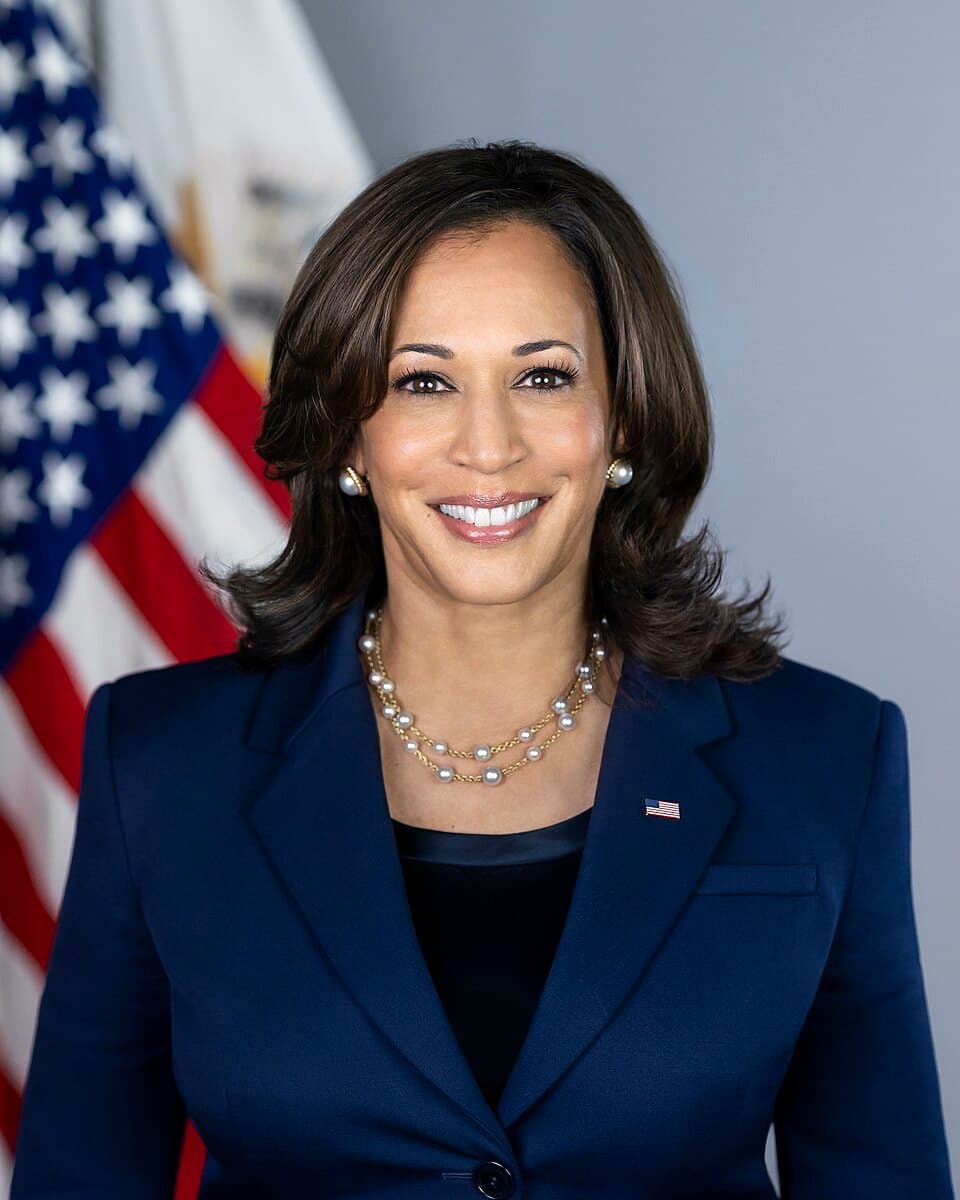
American · Politics · Law
Kamala Harris
October 20, 1964 – present
Early Life and Background
Kamala Devi Harris was born on October 20, 1964, at Kaiser Permanente's Oakland Medical Center in Oakland, California, United States.[1][15] She is the daughter of immigrants: her mother, Shyamala Gopalan Harris, was a biologist and cancer researcher from Chennai, India, and her father, Donald J. Harris, is an economist from Jamaica.[1][4][8][9] Both parents pursued academic careers, and their transnational backgrounds exposed Harris from an early age to global perspectives on race, colonialism, and social justice.
Harris has described her upbringing as deeply shaped by her mother, who raised Kamala and her younger sister, Maya, in Berkeley and later in Montreal after the parents separated.[1][2] The household emphasized education, public service, and pride in their Black and South Asian heritage. Harris attended both a Black Baptist church and a Hindu temple, reflecting a blended religious and cultural upbringing that later informed her emphasis on inclusion.[1][12] Her maternal grandparents in India were engaged in public service and community activism, reinforcing a sense of responsibility toward social change.[10]
As a child, Harris participated in civil rights–era protest culture; she has recalled being taken to marches and community meetings, experiences that would later shape her interest in law as a tool for justice.[1][15] She attended public schools in the Berkeley area, including through a period of school busing aimed at desegregation, and later completed high school in Montreal after her mother accepted a research position in Canada.[1]
Education
After high school, Harris enrolled at Howard University in Washington, D.C., a historically Black university (HBCU) that she has often referred to as her “formative years.”[1][7] She graduated in 1986 with a Bachelor of Arts in political science and economics.[1][3][4] At Howard, Harris joined the debate team, became active in campus politics, and joined the Alpha Chapter of Alpha Kappa Alpha Sorority, Incorporated, experiences that helped her build political networks and leadership skills.
Following her undergraduate studies, Harris returned to California to attend the University of California, Hastings College of the Law in San Francisco. She earned her Juris Doctor (J.D.) degree in 1989.[1][3][4] During law school, she interned and worked in legal settings that reinforced her interest in prosecution and victims’ advocacy, positioning her for a career in public service.
Early Legal Career
In 1990, Harris joined the Alameda County District Attorney’s Office as a deputy district attorney, beginning her professional career in criminal prosecution.[1][7][10] In this role, she focused on cases involving sex crimes and child abuse, gaining experience in addressing sensitive offenses and working closely with victims. Her work in Alameda County allowed her to develop the reputation of a tough but pragmatic prosecutor.
During the mid-1990s, Harris moved to the San Francisco City Attorney’s Office, and she later joined the California Justice Department’s Division on Children and Families, where she handled issues relating to child welfare and family law.[1][15] In the late 1990s and early 2000s, she served as managing attorney in the San Francisco District Attorney’s Office, supervising trial attorneys and helping to shape office policy.[1][15] These roles further developed her expertise in criminal law and her understanding of how prosecutorial discretion affects communities.
San Francisco District Attorney
Harris ran for San Francisco district attorney in 2003, challenging incumbent Terence Hallinan on a platform that combined reforms with a commitment to public safety.[1][15] On December 9, 2003, she won a runoff election to become district attorney, making history as the first woman and first Black person to hold the office in San Francisco.[1][10] She took office in 2004 and served two terms until 2011.[1][15]
As district attorney, Harris introduced initiatives aimed at reducing recidivism and providing alternatives to incarceration for first-time, nonviolent offenders. One notable program, "Back on Track," offered education and job training to first-time drug offenders, in exchange for dismissal of charges upon successful completion.[1][15] She prioritized prosecuting serious offenses, including violent crimes, while also emphasizing community-based approaches to justice.
Her tenure was not without controversy. Harris faced criticism for decisions such as declining to seek the death penalty in the case of a murdered police officer, a stance that drew opposition from some law-enforcement groups but highlighted her long-standing reservations about capital punishment.[1][4] Harris was re-elected as district attorney in 2007, consolidating her position as a leading figure in California law enforcement.[1]
Attorney General of California
In 2010, Harris ran for Attorney General of California and won a narrow statewide race. On January 3, 2011, she was sworn in as attorney general, becoming the first woman, first African American, and first South Asian American to hold the office.[1][2][6] She led the California Department of Justice from 2011 to 2017.[1][4]
As attorney general, Harris oversaw a broad portfolio of criminal and civil matters. She played a prominent role in the national response to the foreclosure crisis, negotiating a major settlement with banks accused of mortgage fraud that provided billions of dollars in relief to California homeowners.[1][4] She worked on consumer protection cases, environmental regulation enforcement, and efforts to combat transnational crime.
Harris’s stance on criminal justice issues continued to generate debate. She supported some reforms, such as efforts to reduce truancy and recidivism, but she also defended certain convictions and policies that reform advocates criticized.[1][4] Her office implemented initiatives related to implicit bias training and data collection but was sometimes perceived as cautious in endorsing sweeping changes. Harris was re-elected as attorney general in 2014, affirming her statewide popularity and solidifying her profile as a national Democratic figure.[1][4]
United States Senator from California
In 2015, Harris announced her candidacy for the U.S. Senate seat being vacated by Senator Barbara Boxer. She won the election in 2016 and took office on January 3, 2017.[1][3] Her swearing-in made her the first Black senator from California and the first South Asian American woman to serve in the U.S. Senate.[1][7][12] Nationally, she became only the second Black woman ever elected to the Senate.
In the Senate, Harris served on influential committees, including Judiciary, Intelligence, and Homeland Security.[1] She gained national attention for her pointed questioning in hearings, particularly during the confirmation processes for Supreme Court nominees and in investigations into Russian interference in U.S. elections. Her prosecutorial style—sharp, prepared, and direct—made her a prominent figure in televised oversight proceedings.
Harris’s legislative priorities included criminal justice reform, immigration policy, health care access, and protections for Dreamers under the Deferred Action for Childhood Arrivals (DACA) program.[1] She co-sponsored bills to reform cash bail, address racial disparities in policing, and expand economic support to working families. Her Senate record positioned her as a progressive but pragmatic lawmaker, balancing civil rights advocacy with attention to institutional constraints.
2020 Presidential Campaign
Harris entered the national presidential arena when she announced her candidacy for the 2020 Democratic presidential nomination in January 2019.[1][4] Her campaign launch highlighted her background as a prosecutor and her identity as a Black and South Asian woman, drawing substantial early media attention. She staged a large rally in Oakland, underscoring her hometown roots.
Throughout 2019, Harris participated in primary debates and promoted policy proposals on health care, criminal justice, and economic equity. She faced complex scrutiny over her prosecutorial record, with some progressives criticizing her past positions while others praised her experience. As the primary season progressed, Harris struggled to maintain momentum, facing challenges in fundraising and consistent polling support.[1][4]
In December 2019, Harris suspended her presidential campaign.[1][4] Despite not securing the nomination, her candidacy marked a significant moment in U.S. political history, demonstrating that a multiracial woman with a prosecutorial background could compete seriously for the presidency within a major party.
Vice-Presidential Nomination and Election
On August 11, 2020, Democratic nominee Joe Biden selected Harris as his vice-presidential running mate.[1][5] With this choice, Harris became the first Black woman and the first South Asian American woman on a major-party U.S. presidential ticket, and the first person of Indian descent nominated for national office by a major party.[1][5] Her selection was widely interpreted as recognition of the importance of Black women voters and the growing political influence of Asian American communities.
The 2020 campaign unfolded amid the COVID-19 pandemic, economic disruption, and nationwide protests following the murder of George Floyd. Harris’s background in law and her multiracial identity positioned her at the intersection of debates about policing, racial justice, and representation.[5] She campaigned virtually and in person, emphasizing themes of accountability, empathy, and coalition-building.
On November 7, 2020, major news outlets projected that the Biden–Harris ticket had won the election, making Harris the vice president–elect of the United States.[5] This projection signaled that she would become the first woman, the first Black person, and the first person of South Asian and Asian-American descent to hold the vice presidency.[2][13] Celebrations worldwide highlighted the symbolic significance of this breakthrough for women and communities of color.
Vice Presidency (2021–2025)
On January 20, 2021, Kamala Harris was sworn in as the 49th vice president of the United States, alongside President Joe Biden.[2][4][6] She took the oath of office from Supreme Court Justice Sonia Sotomayor, becoming the first woman, the first Black American, the first South Asian/Asian-American, and the first graduate of an HBCU to serve as vice president.[2][6][7] That same day, Guinness World Records formally recognized her as the first female, first Black, and first South Asian American U.S. vice president.[6]
As vice president, Harris served as president of the Senate, casting tie-breaking votes on key legislation during a period of closely divided party control.[1] She played visible roles in the administration’s COVID-19 response, economic recovery measures, and advocacy for voting rights and infrastructure investment. Harris traveled domestically and internationally, representing the United States in diplomatic engagements and emphasizing alliances, democratic norms, and shared security concerns.[4]
Her vice presidency continued to generate debates about representation, expectations on women and people of color in executive roles, and the balance between ceremonial and substantive influence in the office. Harris’s presence in the White House normalized the image of a woman of Black and South Asian heritage in the heart of American executive power, influencing perceptions among younger generations about what leadership can look like.[2][7]
2024 Presidential Campaign
According to reference sources, President Joe Biden withdrew from the 2024 presidential race, and Harris became the Democratic Party’s nominee for the 2024 election.[4] Her campaign built on her vice-presidential experience and sought to address issues such as economic inequality, reproductive rights, climate change, and democratic resilience.
Harris’s nomination marked another historic moment in U.S. politics, as she became one of the few women—and the first Black and South Asian woman—to lead a major party’s ticket for president after having served as vice president. In the general election, she faced former President Donald Trump and, as Britannica notes, was defeated.[4] The campaign nonetheless contributed to ongoing debates about gender, race, and electability in American presidential politics.
Awards, Honors, and Recognition
Beyond elected office, Harris has been recognized in numerous ways for her barrier-breaking achievements. She has been featured in international media profiles emphasizing her status as the first woman and first person of multiple racial and ethnic backgrounds to serve as U.S. vice president.[2][13] On January 20, 2021, Guinness World Records formally recorded her vice-presidential firsts, making her achievements part of a widely consulted global archive of records.[6]
Her alma mater, Howard University, has highlighted her as one of its most prominent graduates, celebrating her as the first Howard alum to serve as U.S. vice president.[7] The National Women’s History Museum and other institutions have produced biographies and educational materials that position Harris as a key figure in the history of women’s political leadership.[2] She has also appeared on lists of influential people and has been the subject of documentaries and news features that explore her impact on law, politics, and representation.
Personal Life
Harris married attorney Douglas Emhoff in 2014 after the two met on a blind date in 2013.[1][11] Emhoff, a corporate lawyer, later became the first "Second Gentleman" of the United States during Harris’s vice presidency, and the first spouse of a U.S. vice president to identify as male.[1] Through the marriage, Harris became stepmother to Emhoff’s two children, Cole and Ella, whom she has described as a central part of her family life.[11]
Harris’s sister, Maya Harris, is a lawyer and policy expert who has worked in civil rights advocacy and political consulting. Their close relationship has been frequently noted in profiles of Harris’s career. The Harris family’s experiences as immigrants and multiracial Americans have informed Kamala Harris’s public narratives about identity, opportunity, and solidarity among marginalized communities.[1][9]
Legacy and Historical Impact
Kamala Harris’s career has had a profound impact on the history of women and racial minorities in U.S. law and politics. As the first woman and the first Black and South Asian American vice president, she occupies a singular place in the evolution of representation at the highest level of American government.[1][2][4] Her earlier roles as the first woman and first Black person to serve as San Francisco district attorney, and the first woman, Black, and South Asian person to serve as California attorney general, extended this pattern of barrier-breaking across multiple levels of government.[1][2]
Harris’s trajectory illustrates the complex relationship between criminal justice reform and representation. As a prosecutor and attorney general, she faced criticism from some reform advocates even as she pushed certain initiatives aimed at improving fairness in the system. Her later embrace of more progressive criminal justice policies reflects the evolving expectations placed on elected officials, particularly those from communities most affected by policing and incarceration.
In the broader narrative of women’s political history, Harris stands as a symbol of intersectional progress: she is not only a woman, but a woman who is Black and South Asian, a daughter of immigrants, and a graduate of an HBCU who rose to national office. Her visibility challenges previous limits on who can be seen as a credible candidate for executive leadership, influencing political recruitment, voter imagination, and the aspirations of young people across diverse backgrounds.
Later Life and Continuing Influence
Following her term as vice president during the Biden administration (2021–2025), Harris has remained a central figure in American politics.[1][4] Her 2024 presidential campaign, though unsuccessful, reinforced her position as a leading voice in debates about democracy, rights, and representation. She continues to be the subject of scholarship, media coverage, and public discussion regarding the future of multiracial, gender-inclusive leadership.
Harris’s ongoing work is coordinated in part through her official office, which maintains public communication and highlights her initiatives and priorities.[17] As of the mid-2020s, she remains alive and active, with her legacy still unfolding. Nonetheless, the milestones already recorded—particularly her vice presidency—have secured her place in national and global histories of women in power.
Dated achievements
8 indexed.
- Oct201964Politics
Birth of Kamala Harris
Kamala Devi Harris was born in Oakland, California, United States.
View details Kamala Harris Biography - Britannica - Dec092003Law
Elected San Francisco District Attorney, Breaking Race and Gender Barriers
Harris was elected San Francisco district attorney, becoming the first woman and first Black person in the role.