← All women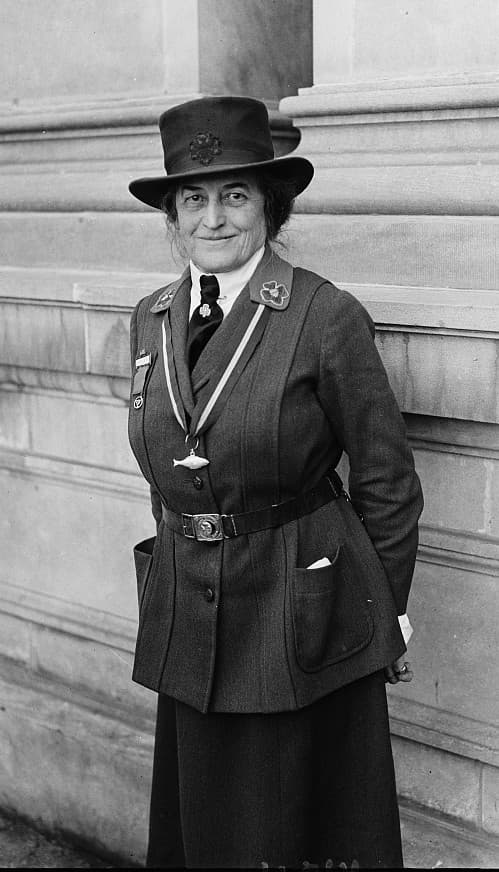
American · Activism
Juliette Gordon Low
October 31, 1860 – January 17, 1927
Early Life and Family Background
Juliette Magill Kinzie Gordon Low was born on October 31, 1860, at 10 East Oglethorpe Avenue in Savannah, Georgia, the second of six children of William Washington Gordon II and Eleanor "Nellie" Kinzie Gordon. Her father was a cotton broker and Confederate officer, while her mother came from the prominent Kinzie family of Chicago, descendants of Midwest pioneers. This dual heritage exposed Juliette to contrasting regional identities and to the upheavals surrounding the American Civil War and Reconstruction.
Known to family and friends by the nickname "Daisy", Juliette grew up in an affluent, influential Southern household. The Gordons moved periodically between Savannah and northern locales, especially during the war years, giving her experience of both Southern and Northern cultures. Her upbringing as a member of the Southern elite emphasized manners, hospitality, and domestic accomplishments, but she also displayed an independent spirit and strong curiosity, often preferring outdoor play to more restrained activities expected of young women of her class.
Juliette received extensive formal education, unusual in breadth for a girl of her era. She attended several boarding schools: the Virginia Female Institute in Staunton (now Stuart Hall), Edge Hill School near Charlottesville, Miss Emmett’s School in Morristown, New Jersey, and eventually Mesdemoiselles Charbonniers, a French finishing school in New York City. These institutions combined traditional "accomplishments" such as languages, music, and art with exposure to wider intellectual currents, travel, and social networks. By 1880 she had earned a diploma from Charbonniers.
Her education cultivated artistic talents in painting and sculpture, a cosmopolitan outlook, and proficiency in several languages. At the same time, she was increasingly expected to conform to the role of a debutante and future wife within upper-class society. This tension between conventional expectations and a desire for more purposeful work would later inform her commitment to creating new opportunities for girls.
Health Challenges and Formative Experiences
A major formative factor in Juliette’s life was the gradual loss of her hearing. She began to experience ear problems in her teens and, following a series of illnesses and accidents—including damage from medical treatments and a grain of rice thrown in jest at her wedding that lodged in her ear—she became almost completely deaf by adulthood. Deafness could have isolated her socially, but Juliette adapted with determination, learning to lip-read and continuing to socialize, travel, and organize.
Despite health setbacks, she developed a reputation for energy, humor, and athleticism. She enjoyed horseback riding, walking, and outdoor activities, foreshadowing the physical emphasis she would later bring to Girl Scouting. Her early exposure to both Northern and Southern worlds and to postwar social change helped her understand the importance of civic responsibility and education.
Marriage and Life in British Society
On December 21, 1886, Juliette married William Mackay Low, a wealthy Anglo-American man from a prominent family connected with British aristocracy, in Savannah. Shortly after the wedding, the couple settled primarily in England, where Juliette moved into the social world of country houses, London society events, and seasonal travel typical of upper-class Britons.
In this environment, she cultivated artistic pursuits and became widely traveled, visiting continental Europe and developing friendships across social circles. However, the marriage proved deeply unhappy. William Low was frequently absent and maintained relationships outside the marriage, leaving Juliette emotionally isolated. She suffered further hearing damage from the rice-throwing incident at the wedding and subsequent medical procedures, compounding her frustration.
The couple had no children. Over time, Juliette sought ways to channel her energy into philanthropic and artistic work rather than solely social engagements. The marriage deteriorated, and the two lived largely separate lives. William Low died in 1905, leaving a contested estate. Juliette ultimately gained sufficient financial independence to support charitable initiatives and personal projects, an outcome that would become critical when she later devoted substantial funds to Girl Scouting.
Discovery of Scouting and Early Girl Guide Work
Juliette’s turning point came in the early 1910s through her encounter with General Sir Robert Baden-Powell, founder of the Boy Scouts and co-creator of the Girl Guides with his sister Agnes Baden-Powell. She met him at a London luncheon and was captivated by his ideas about youth training, outdoor skills, and character development. Baden-Powell encouraged her to take up work with girls, believing her energy and organizing ability would be invaluable.
Inspired, Juliette began helping to establish Girl Guide companies in Scotland and London around 1910 and 1911. She formed her own group of Girl Guides in England, learning the structure of patrols, badges, and training schemes. This experience provided practical knowledge of how to run youth organizations and introduced her to a global vision of Scouting as a peace-building movement that transcended national boundaries.
Her work with British Girl Guides put her in contact with reform-minded educators and social workers who saw Scouting as a way to reach girls of diverse backgrounds, including working-class youth. Juliette was particularly impressed by the way the program combined discipline with fun, and moral education with practical skills such as first aid, signaling, and camping.
Bringing Girl Guides to the United States
In 1912, Juliette returned to her hometown of Savannah, Georgia with the intention of introducing the Girl Guide concept to American girls. She famously telephoned her friend Louise Gordon (or a similar confidante, as accounts vary) and announced, "I’ve got something for the girls of Savannah, and all America, and all the world, and we’re going to start it tonight." This determination marked a clear shift from socialite to activist organizer.
On March 12, 1912, she convened a gathering of girls from her cousin Nina Pape’s progressive school at her home to present the idea of a new club focusing on outdoor activity, skill-building, and service. That same day, eighteen girls officially registered as the first troop of American Girl Guides in Savannah. Shortly thereafter, the troop held its first formal meeting at the Louisa Porter Home, where the girls recited the Girl Guide Promise and Law and began program activities.
These events constituted the first Girl Guides/Girl Scouts troop and first official meeting in the United States. At a time when girls’ organizations often emphasized domestic skills and genteel charity, Juliette’s club promoted camping, physical fitness, leadership, and direct community service. Her program encouraged girls to explore, solve problems, and take initiative—qualities that society more commonly fostered in boys.
From Girl Guides to Girl Scouts
The movement grew rapidly. By 1913, the American organization changed its name from Girl Guides to Girl Scouts, aligning more closely with the well-known Boy Scouts yet maintaining its focus on girls. Juliette’s early troops spread beyond Savannah to other cities, supported by her personal travel and her use of social connections to form new councils.
She devoted her own funds to printing handbooks, uniforms, and badges, often personally underwriting expenses when local groups lacked resources. Her philosophy emphasized inclusivity: she wanted Girl Scouting accessible to girls of different class backgrounds and, in some communities, worked with leaders to include girls of color, though the extent of such inclusion varied and was constrained by prevailing segregation laws.
Juliette insisted that Girl Scouts learn practical skills such as first aid, cooking, map reading, and knot-tying, while also engaging in artistic, cultural, and civic activities. She saw the program as a way to prepare girls for a changing world in which they might pursue work, education, or public leadership, not only marriage and domesticity.
Incorporation and National Leadership
By the mid-1910s, the movement required more formal organization. In 1915, Juliette obtained a charter for The Girl Scouts, Incorporated in Washington, D.C. On March 16, 1915, Girl Scouts, Inc. was officially incorporated in New York, and Juliette became its first national president. She also oversaw the patenting of the trefoil and tenderfoot badge, protecting the organization’s symbols.
As president, she focused on creating a standardized structure that could support rapid expansion. She helped establish a national headquarters, codified badge requirements, and encouraged the formation of local councils to oversee troops. She traveled extensively across the United States, speaking to community leaders, educators, and parents about the benefits of Girl Scouting and recruiting volunteers.
Her leadership style combined charisma with hands-on involvement. She did not hesitate to sell her own jewelry or solicit donations directly to keep the organization solvent in its early years. Juliette was known for her ability to inspire girls, often joining them in hikes and camp activities despite her hearing loss and increasing age.
World War I and International Vision
World War I provided both challenges and opportunities for the young organization. Girl Scouts took on war-related service roles: rolling bandages, knitting garments for soldiers, supporting Liberty Loan drives, and assisting in food conservation campaigns. These activities underscored the group’s emphasis on citizenship and practical service.
Juliette also nurtured an international vision for Girl Scouting. Drawing on her transatlantic experience, she supported efforts to build connections between American Girl Scouts and Girl Guides in other countries. Her belief in the movement as a peace-building force aligned with Baden-Powell’s view that Scouting could foster mutual understanding across national lines.
Throughout the 1910s, she promoted the idea that girls trained in leadership and service could contribute significantly to postwar reconstruction and civic life. This global perspective later informed the development of the World Association of Girl Guides and Girl Scouts, though the formalization of that body would occur after her lifetime.
Resignation as President and Continued Work
In 1920, Juliette resigned as president of the Girl Scouts. The organization had grown complex, and new leaders emerged to manage the expanding structure. Yet her resignation did not mark a withdrawal. She continued to serve on boards, advise local councils, and travel in support of Girl Scouting.
Even out of the presidency, she remained deeply involved in recruitment, fundraising, and public relations. She worked to strengthen training for troop leaders and encouraged the development of programs for older girls, anticipating that teenage girls would need even more robust support to navigate work, education, and public life.
By the mid-1920s, she had helped guide the Girl Scouts from a handful of troops to a large national organization, laying foundations for future growth and diversification of programming.
Awards, Honors, and Recognition
During her lifetime, Juliette Gordon Low was widely recognized within the Girl Scout movement for her leadership and generosity, though formal national honors were limited by the era’s gender norms. Posthumously, she has received extensive recognition:
- She was inducted into the National Women’s Hall of Fame for her role in founding the largest girls’ organization in the world.
- Biographical works, including Juliette Gordon Low: The Remarkable Founder of the Girl Scouts, have documented her life in detail, highlighting her resilience and innovation.
- The U.S. Mint honored her on a commemorative quarter in the American Women Quarters Program, recognizing her national impact.
- Her birthplace in Savannah is preserved as the Juliette Gordon Low Birthplace, a museum and program center for Girl Scouts and the public.
- She is frequently celebrated by the Girl Scouts of the USA in organizational history materials and educational programs.
These honors reflect a broad consensus that her work fundamentally altered the landscape of girls’ education and youth leadership in the United States.
Personal Life, Character, and Relationships
Juliette’s personal life was marked by both privilege and adversity. Her deafness, difficult marriage, and childlessness could have confined her to marginal roles within her social milieu. Instead, she reframed these circumstances as catalysts for service. Friends and acquaintances described her as humorous, spontaneous, and adventurous—traits that resonated strongly with young people.
She cultivated warm relationships with nieces and younger relatives, including Daisy Gordon Lawrence, who was involved in early Girl Scouting. Her friendships with educators such as Nina Pape helped her recruit girls and shape progressive program content. A devout yet practical Christian, she integrated moral values into the Girl Scout Promise and Law without making the organization sectarian.
Juliette’s choice to devote her wealth and time to girl-focused work, rather than to conventional charity or leisure, reflected a strong sense of purpose. Her deafness, in particular, seems to have strengthened her capacity for intense visual engagement and observational insight, which she used to read rooms, gauge girls’ reactions, and adapt activities.
Later Life and Illness
In her later years, Juliette continued to live primarily in Savannah while traveling frequently for Girl Scout business. She was diagnosed with breast cancer, a disease that at the time carried significant stigma and limited treatment options. She chose to keep the severity of her illness largely private, focusing public attention on the Girl Scouts rather than on her own health.
Despite pain and fatigue, she persisted in attending meetings, visiting troops, and advising leaders. Colleagues noted her refusal to let illness curtail her work, a determination that contributed to the organization’s stability during a period of expansion. Her last years coincided with major social changes, including the ratification of the Nineteenth Amendment, granting women the right to vote. Juliette saw Girl Scouting as one avenue through which newly enfranchised women and their daughters could exercise civic responsibility.
On January 17, 1927, Juliette Gordon Low died at her home on Lafayette Square in Savannah. She was 66 years old. At the time of her death, membership in the Girl Scouts had grown from the original eighteen girls to approximately 168,000 members nationwide. She was buried in her Girl Scout uniform, underscoring her lifelong identification with the movement she founded.
Legacy and Historical Impact
Juliette Gordon Low’s legacy centers on her role as founder of Girl Scouts of the USA, one of the largest and most enduring youth organizations for girls in the world. Her decision in 1912 to introduce Girl Guides to American girls, and her subsequent work to build and incorporate the Girl Scouts, fundamentally expanded the social and educational possibilities available to girls.
Historically, her achievements are notable on several fronts:
- Gender roles: She challenged prevailing expectations by promoting physical activity, outdoor adventure, and leadership for girls at a time when many believed such pursuits were unfeminine.
- Civic education: Girl Scouts emphasized citizenship, community service, and democratic participation well before these concepts were widely integrated into girls’ schooling.
- Organizational innovation: She demonstrated that women could design, lead, and sustain a large national organization, prefiguring later women’s leadership in nonprofit and civic sectors.
- Internationalism: Her transatlantic experiences and collaboration with British Girl Guides helped shape an international girl-focused movement that continues today.
Over the decades, the Girl Scouts have adapted to changing social contexts—introducing STEM badges, environmental stewardship projects, and entrepreneurship programs—while retaining core elements of Juliette’s original vision: self-reliance, service, and ethical leadership. Millions of alumnae, including prominent figures in politics, science, and the arts, trace formative experiences to troop activities that echo the curriculum Juliette helped design.
In the broader narrative of women’s history, Juliette Gordon Low occupies a significant place as a social reformer and educator who used voluntary association to alter cultural expectations about girls’ capabilities. Her life illustrates how an individual, even while facing disability and personal disappointment, can leverage privilege, imagination, and perseverance to create an institution that empowers others for generations.
Historical Debates on Dates
Most authoritative sources agree that Juliette was born on October 31, 1860, though a minority source once gave 1861, now regarded as erroneous. There is also minor discrepancy in published accounts about her death date: while some references list January 18, 1927, institutional sources such as the Juliette Gordon Low Birthplace and Girl Scouts of the USA affirm January 17, 1927 as the correct date. Contemporary scholarship and organizational histories typically follow the latter.
These clarifications highlight the importance of careful archival and institutional research in women’s history, ensuring that foundational figures like Juliette Gordon Low are documented with precision. Her life story, firmly anchored in verified dates and events, continues to serve as a touchstone for understanding the evolution of girls’ organizations, youth citizenship, and women’s leadership in the United States.
Dated achievements
7 indexed.
- Oct311860Science
Birth of Juliette Gordon Low
Juliette Magill Gordon was born in Savannah, Georgia, to William Washington Gordon II and Eleanor 'Nellie' Kinzie Gordon.
View details Juliette Gordon Low Biography - National Women's History Museum - Dec211886Science
Marriage to William Mackay Low
Juliette Gordon married wealthy Englishman William Mackay Low in Savannah, beginning ties to British society that led her to scouting.