← All women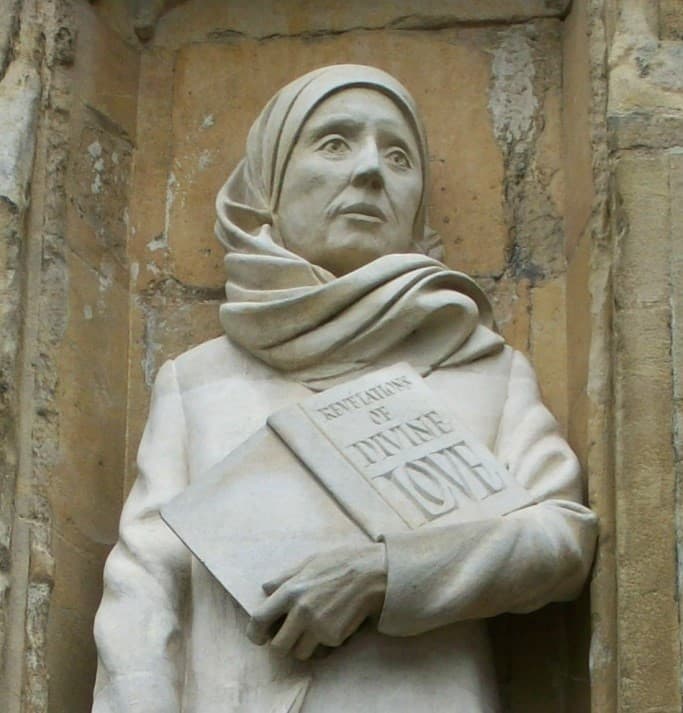
English · Literature
Julian of Norwich
1342 – 1416
Early Life and Background
Julian of Norwich (also known as Juliana, Dame Julian, the Lady Julian, or Mother Julian) was a medieval English Christian mystic and anchoress whose life is dated approximately from c.1342 to after 1416.[1][6][7] Her exact birth date, family name, and social background are unknown; almost everything that can be said about her life is inferred from her own book Revelations of Divine Love and from sparse documentary references. Encyclopedic and theological sources commonly give her birth year as 1342 or c.1342, probably in or near Norwich, in Norfolk, England.[1][6][7]
Norwich in the mid‑fourteenth century was one of England’s largest and most prosperous cities, a major center of the wool and cloth trade, with a dense network of parish churches, religious houses, and lay devotional life.[1][7] At the same time, Julian’s childhood and youth would have been overshadowed by repeated outbreaks of the Black Death, economic dislocation, and political tensions that culminated later in the Peasants’ Revolt of 1381.[7][12] Scholars note that her compassionate, hope‑centered theology cannot be understood apart from this context of pervasive suffering: she lived among war, plague, and social unrest, yet came to articulate a radical trust in God’s goodness.[7][11][13]
Nothing definite is known of Julian’s education, but the Revelations demonstrate that she was highly literate in Middle English prose and possessed an unusual familiarity with the Latin Vulgate Bible for a layperson of her era.[1][7] As Encyclopedia.com observes, she was "highly literate" and shows knowledge of Scripture beyond what would be expected of an uneducated woman, despite her conventional humility in disclaiming learning.[7] This implies that she may have had some formal instruction or access to clerical teaching, perhaps through local religious communities or a devout household.
Visions of 1373 and the Short Text
The central turning point of Julian’s life occurred in May 1373, when she was "thirty years old and a half" and fell gravely ill in Norwich.[1][12][18] On 13 May 1373, as she lay seemingly at the point of death, she experienced a series of sixteen "shewings" or revelations focused on Christ’s suffering on the cross, the Trinity, the Blessed Virgin Mary, and profound insights into divine love and providence.[1][12][18] She had previously prayed for three gifts: a bodily sight of Christ’s passion, a spiritual understanding of that passion, and a deeper love of God; the visions appear as the answer to this prayer.[1][12] These showings were accompanied by physical sensations and intense emotional states, yet Julian later emphasized their theological and contemplative meaning rather than their extraordinary character.
Shortly after her recovery from the illness, Julian wrote an initial account of these experiences, the so‑called Short Text of Revelations of Divine Love (often dated c.1373).[1][3][18] This earliest version, composed relatively soon after the visions, presents a concise narrative and reflection on the sixteen showings. Scholars note that the Short Text may preserve Julian’s earliest interpretive framework before two decades of further meditation; it is more straightforwardly visionary and devotional in tone, but already contains key themes, such as God’s unconditional love and the famous assurance that "All shall be well."[1][3][9]
Through these visions and their first written form, Julian entered the stream of late medieval English mysticism. She was roughly contemporary with figures such as Walter Hilton, Richard Rolle, the anonymous author of The Cloud of Unknowing, and, somewhat later, Margery Kempe, all of whom contributed to a rich tradition of affective, contemplative spirituality in vernacular English.[7] Yet Julian’s voice is distinctive for its striking optimism about the final reconciliation of all things in divine love, her nuanced treatment of sin, and her repeated insistence on the primacy of joy and trust over fear.
Anchoress Calling and Enclosure at St Julian’s
Sometime after her illness and the initial writing of the Short Text, Julian embraced the vocation of an anchoress, a religious recluse attached to a church.[1][5][10] She appears to have taken up residence in a cell built onto the wall of St Julian’s Church, a small parish church off King Street in Norwich.[1][5][18] As an anchoress, she would have undergone a formal liturgical rite of enclosure, symbolically akin to burial to the world, and then lived permanently within the confines of her cell, dedicated to prayer, contemplation, and spiritual counsel.
The anchoritic life in medieval England was a recognized form of religious vocation, governed by texts such as the Ancrene Wisse and supported by local communities.[1][7] An anchoress’s cell typically had three windows: one into the church to see the altar and receive the sacraments, one to the outside world for communication with visitors seeking guidance, and one to a small service area for practical needs. Within this small space, Julian spent decades in solitude and reflection, yet she became, by all accounts, widely respected as a spiritual advisor. Later writers, including Margery Kempe, testify to visiting a "holy woman" recluse in Norwich, widely identified with Julian.[1][7][16]
Although the exact date of Julian’s enclosure is unknown, it likely occurred after 1373 and before the completion of the Long Text, sometime in the later fourteenth century.[1][7] The cell at St Julian’s thus became both the physical and spiritual locus of her mature work. From there she pondered her earlier visions for many years, revising and deepening her theological understanding.
The Long Text and Major Work: Revelations of Divine Love
Julian’s sole known work, Revelations of Divine Love (also called Showings), survives in two main authorial versions: the Short Text and the Long Text. After around twenty years of reflection on the 1373 visions, Julian produced the expanded Long Text, generally dated to c.1393.[1][3][18] This version is roughly six times the length of the Short Text and incorporates extensive theological commentary, contemplative insights, and elaboration of her key themes.[3][18]
In the Long Text, Julian moves beyond simple description to sustained theological interpretation. She wrestles with questions of evil, sin, suffering, and salvation, exploring how an all‑loving God can coexist with the evident brokenness of the world.[1][6] Rejecting the notion of divine wrath, she insists that "I saw no wrath in God" and proposes that sin is "behovely"—necessary or fitting in some mysterious way within God’s plan, because it occasions greater knowledge of God’s love and mercy.[1][6] Her refrain that "All shall be well, and all shall be well, and all manner of thing shall be well" encapsulates her conviction that God’s love will ultimately reconcile all things.[1][6][11]
Julian’s work is also notable for its maternal imagery for God. She frequently describes Jesus as our Mother, emphasizing nurturing, compassion, and intimate care.[1][6][13] This metaphor does not displace traditional Trinitarian doctrine but enriches it, offering a powerful image of divine tenderness that has resonated strongly in later feminist and pastoral theology.[3][13][15] Her prose style, meanwhile, has been praised for its clarity, poetic rhythm, and skillful use of Middle English, placing her alongside Geoffrey Chaucer as a pioneering genius of English devotional prose.[9][13]
Because Revelations of Divine Love is the earliest surviving English‑language work attributed to a woman, Julian is widely regarded as the first recognized female author in the English language whose work survives.[1][3][4][5][7][18] Encyclopedia.com notes that she was "the first woman to compose a literary work in English," while other reference works emphasize that she was the first woman known to have written a book in English that has come down to us.[4][5][7][8][15] Her status depends on survival and attribution: there may have been earlier women writing in English whose texts are lost, but Julian’s book is the earliest extant, identifiable example.
Transmission, Manuscripts, and Later Recognition
Julian’s work did not immediately circulate widely. The Short and Long Texts survive in a small number of manuscripts and later copies, indicating a modest but persistent readership.[1][9] For centuries after her death, she was known primarily within certain devotional circles and remained relatively obscure compared to other medieval writers. Manuscript evidence suggests that her book was read and valued in some English religious communities, but it did not achieve broad fame until much later.[9]
In the twentieth century, renewed interest in medieval mysticism and women’s spirituality led to a major rediscovery of Julian. Scholarly editions and translations made her work more accessible, and theologians and literary critics began to appreciate her originality. The Molloy College guide notes that she had "little influence on literature until the twentieth century," but that her writings then attracted admiration from figures such as T. S. Eliot, who alludes to her famous "All shall be well" in Four Quartets.[9][13] Thomas Merton praised her as "without doubt one of the most wonderful of all Christian voices" and ranked her among the greatest English theologians.[12][13]
Modern scholarship has explored Julian’s gendered perspective, her possible interactions with contemporary religious movements, and her place in late medieval theology. Some studies highlight her as a proto‑feminist voice, given her emphasis on God’s maternal aspects and her assurance of women’s equal access to divine love.[3][13][15] Others situate her within broader currents of affective piety, emphasizing her focus on Christ’s humanity and suffering and her vivid, sensory descriptions of the crucifixion.[1][7]
Personal Life and Relationships
Julian’s personal life beyond her anchoritic vocation remains largely hidden. Her own text mentions very few biographical details, in keeping with medieval spiritual writing conventions that prioritized theological content over personal narrative. There is no firm evidence regarding whether she was ever married or had children before becoming an anchoress. Some scholars have speculated, on the basis of empathetic passages about motherhood and domestic suffering, that she may have experienced family life or bereavement, especially during the plague years, but such claims remain conjectural rather than documented fact.[1][7][15]
Julian’s most clearly attested relationships are spiritual. As an anchoress at St Julian’s, she served as a spiritual counselor to visitors who came to her window seeking advice, consolation, or prayer.[1][5][18] The most famous of these was Margery Kempe, a laywoman mystic whose Book records a visit to "a holy woman" recluse in Norwich around 1413, widely identified by scholars as Julian.[1][7][16] Margery describes receiving encouragement and discernment from this anchoress, who affirmed that Margery’s visions were from God so long as they led her to greater charity. This encounter provides rare external testimony to Julian’s reputation for sanctity and wisdom during her lifetime.[16]
Theological Themes and Historical Significance
Julian’s historical significance lies above all in her distinctive theology of divine love and her status as a pioneering woman writer in English. Central themes of her thought include:
- Divine Love and Optimism: Julian presents God as pure love, refusing to attribute wrath or vengeance to the divine nature. Her confident refrain "All shall be well" expresses a radical trust that, despite sin and suffering, God’s purposes will end in universal well‑being.[1][6][11]
- Sin and "Behovely" Suffering: She grapples with the paradox of sin’s existence within an ultimately good creation, describing sin as "behovely"—in some way necessary or fitting—because it leads to self‑knowledge, humility, and deeper reception of God’s mercy.[1][6]
- Maternal Imagery: Julian’s portrayal of Christ as our Mother, who labors in love to give us new birth and nurture, offers a striking integration of gendered metaphors into orthodox Trinitarian theology, expanding traditional views of God’s care.[1][6][13]
- Prayer, Contemplation, and Trust: Her book models an interior, contemplative practice of continually turning to God with confidence rather than fear, inviting readers into a relationship marked by intimacy and honesty about suffering and doubt.[1][11][19]
These themes have made Julian a key figure in modern discussions of Christian spirituality, feminist theology, and pastoral care.[3][11][13][15] Her ability to articulate profound hope amid catastrophe has been particularly compelling in times of war and pandemic. Contemporary writers have noted that she herself lived through and survived a plague‑torn society, making her reflections on divine love and trust acutely relevant to later generations facing crisis.[11][15]
Later Life and Death
Evidence for Julian’s later life comes chiefly from a few records associated with St Julian’s Church. A document from 1416 mentions an "Julian, anchoress at St Julian’s" in Norwich, confirming that she was still alive at that time.[1][6][7] For this reason, many scholarly sources give her life dates as "c.1342–after 1416" or "1342–1416?".[1][6][7] Some reference works note that her actual death likely occurred between 1416 and about 1423, but no precise date or circumstances have survived, and statements assigning a specific day or month are considered unreliable.[1][6][7]
Julian appears to have remained in her cell at St Julian’s until her death, continuing her contemplative life and ministry of counsel. Over these years she probably continued revising or reciting her book, though we cannot know the exact stages of composition beyond the approximate dating of Short and Long Texts. After her death, her cell and church eventually suffered damage and destruction through later historical events, including the Reformation and, in the twentieth century, wartime bombing; St Julian’s Church has since been rebuilt, and the site of her cell is honored as a place of pilgrimage.[1][5]
Legacy, Feast Days, and Modern Commemoration
Julian of Norwich’s legacy has grown immensely in recent centuries. She is widely revered as one of England’s greatest mystics and theologians; historian Henrietta Leyser, for example, calls her "the greatest English anchoress."[1] Her book Revelations of Divine Love is recognized as "one of the great classics of the spiritual life," and as a foundational text for understanding medieval religious experience.[5][6]
Though never formally canonized, Julian is commemorated in various Christian traditions. The Episcopal Church in the United States includes her in its calendar of saints, and churches and organizations devoted to spirituality often celebrate her feast day on May 8 or May 13, dates associated with her visions.[6][11][14] Modern devotional and scholarly websites, such as the Friends of Julian of Norwich, promote study of her writings and support the preservation of St Julian’s Church and its anchorite heritage.[5][12]
In contemporary culture, Julian’s phrase "All shall be well" has entered common usage as a succinct expression of hope, quoted in sermons, literature, and popular discourse.[1][6][9] Her work has influenced poets like T. S. Eliot, contemplative theologians such as Thomas Merton, and numerous writers engaged in spiritual direction, trauma theology, and feminist thought.[9][12][13][16] Academic research continues to explore her language, manuscript tradition, and theological originality, with studies emphasizing her place as the first recognized female author in English and a major voice in the history of Christian thought.[3][7][15]
Today, Julian of Norwich stands as a symbol of resilient faith and imaginative theological courage. From the confines of a small cell in plague‑stricken Norwich, she produced a work whose calm, luminous confidence in divine love has offered consolation and challenge to readers across six centuries. Her life and writings remain central to women’s religious history, English literary history, and the broader story of how marginalized voices have shaped theological understanding.
Dated achievements
1 indexed.
- May131373Literature
Julian of Norwich receives her sixteen "shewings" during near-fatal illness
At age 30, gravely ill, Julian experienced sixteen visions of Christ's Passion that became the foundation of her later book, the earliest surviving English-language work by a woman.
View details Julian of Norwich - Wikipedia