← All women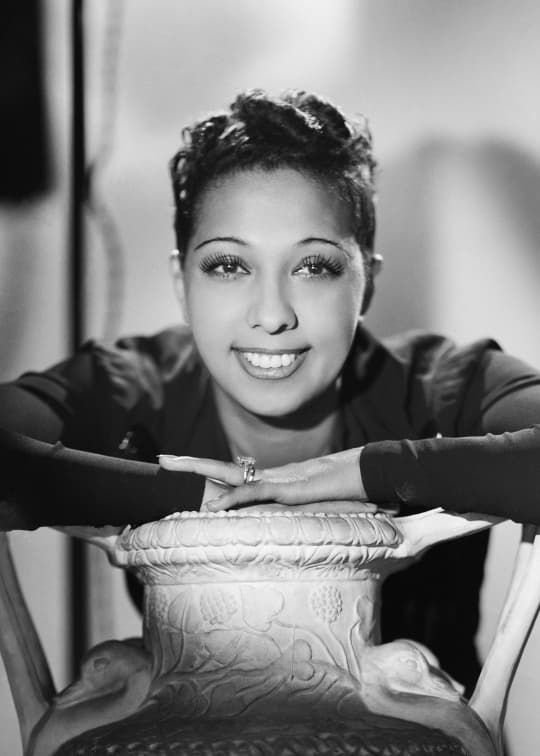
American, French · Arts · Activism
Josephine Baker
June 3, 1906 – April 12, 1975
Early Life and Background
Josephine Baker was born Freda Josephine McDonald on June 3, 1906, in St. Louis, Missouri, then a rigidly segregated American city governed by Jim Crow laws.[3][2][7] Her mother, Carrie McDonald, worked as a washerwoman; her probable father, Eddie Carson, was a vaudeville drummer who soon disappeared from her life.[3][14][15] Baker grew up in deep poverty, often helping her mother by taking in laundry and doing domestic work from a very young age.[1][15]
As a child, Baker experienced both the vibrancy of African American performance culture and the brutality of racism. Sources describe her witnessing racial violence in St. Louis, including the aftermath of the East St. Louis race riots of 1917, an event that left a lasting impression on her understanding of racial injustice.[1][19][15] She attended school irregularly and left formal education early, spending most of her adolescence working to survive.
By age 12, Baker was working as a live-in domestic servant for white families, where she endured harsh treatment and racial humiliation.[7][1] She ran away from one employer after being abused, returning to her mother and seeking work in the city’s streets and theaters.[1][19] Her early encounters with vaudeville troupes and street performers introduced her to dance and comedy as possible paths out of poverty.
Baker married young; she entered into her first marriage in her teens and took the surname "Baker" from her second husband, William Howard Baker, in the early 1920s.[7][3] Although both marriages ended quickly, she kept the name "Josephine Baker" as her stage identity, a symbolic break from her difficult childhood.
Career Beginnings and Development
Baker’s performance career began in local vaudeville shows in St. Louis and other Midwestern cities.[1][15] She quickly developed a comedic persona built around exaggerated facial expressions and elastic, improvisational dance steps. Her talent led her to touring troupes, and eventually to New York City just as African American musical theatre was gaining new prominence.
In 1921, Baker joined the cast of the all-Black musical "Shuffle Along", which opened on December 20, 1921, at Daly’s 63rd Street Theatre on Broadway.[3][1] Initially placed in the chorus line, she gained attention for her comic mugging—pretending to be clumsy and out of sync before suddenly joining the choreography with extraordinary precision.[1][19] "Shuffle Along" became one of the first commercially successful Black-led Broadway shows and offered her crucial exposure to mainstream audiences.
After working in another Black musical, The Chocolate Dandies, Baker was invited to perform in Europe.[3][2] In 1925, she moved to Paris, joining the revue "La Revue nègre" at the prestigious Théâtre des Champs-Élysées. The production premiered on October 2, 1925, and Baker’s performance—including her bold, jazz-inflected Danse Sauvage—caused a sensation.[3][10] She appeared onstage in a minimal costume and later became famous for a banana skirt worn in a Folies Bergère production, embodying the era’s fascination with African American jazz while also subverting colonial stereotypes.[4][15][1]
In Paris, Baker rapidly rose from chorus girl to star. She headlined revues at venues such as the Folies Bergère and the Casino de Paris, becoming one of the highest-paid performers in Europe by the late 1920s and early 1930s.[2][3][15] Her shows mixed jazz, modern dance, comedy, and elaborate staging, and she was widely promoted as an emblem of the Années folles, or "crazy years," of postwar Paris.
Major Works, Film Roles, and Accomplishments
Beyond the music hall stage, Baker made significant inroads into cinema and recorded music. On March 4, 1927, the silent film "La Sirène des Tropiques" premiered in Paris, starring Baker as Papitou and giving her top billing.[3][5] Historians regard this as the first major motion picture to star a Black woman, a milestone in the history of film and representation.[7][4] The film, while framed in colonial imagery, demonstrated that a Black woman could carry a commercial feature in the European market.
Baker continued to work in French cinema throughout the 1930s. On December 7, 1934, the film "Zouzou" was released, featuring her in the title role as a laundress who becomes a music-hall sensation.[3][8] The film showcased her singing and dancing talent and paired her with prominent actor Jean Gabin, further cementing her status as a leading film entertainer.[8][17] She later starred in Princesse Tam-Tam (1935) and appeared in other European productions, though Hollywood remained largely closed to her because of entrenched racism.
On the stage, Baker’s performances in revues like "Un Vent de Folie" and her famous banana-skirt dance at the Folies Bergère turned her into a symbol of modernity and the Jazz Age.[4][15] She recorded songs such as "J’ai deux amours" ("I Have Two Loves"), which celebrated her dual attachment to Paris and her homeland, and became closely associated with French chanson.[3][2]
In 1936, Baker attempted a major return to the United States in the Ziegfeld Follies. The engagement, however, was marred by racism in the press and among audiences, and the production closed early.[3][2][1] Disappointed, she returned to France, where she had already acquired considerable fame and respectful treatment, and where she would later naturalize as a French citizen in 1937.[3][6]
World War II: Resistance and Espionage
During World War II, Baker’s career took a dramatic and political turn. After the German occupation of Paris in June 1940, she left the city; her departure on June 14, 1940 marks the beginning of her active involvement with the French Resistance and Free French forces.[3][5] She relocated to her estate in the Dordogne and used her entertainment tours as cover for intelligence work.
Baker’s celebrity gave her access to embassies, diplomatic receptions, and military gatherings, where she listened for information that could aid the Allies.[5][1] She reportedly smuggled messages written in invisible ink on her music scores and carried sensitive documents pinned inside her costumes or concealed in her luggage.[5][7] She also performed for Allied troops in North Africa and elsewhere, boosting morale while facilitating contacts between resistance networks and soldiers.
For her wartime service, Baker was later awarded the Croix de Guerre and the Resistance Medal, and she was promoted to the rank associated with the Femmes de l’Air in the Free French Air Force.[5][7][4] Her work demonstrated the strategic potential of women—and particularly women of color—in clandestine operations, challenging traditional gender roles in military history.
Postwar Civil Rights Activism and "Rainbow Tribe"
After the war, Baker continued to perform but also deepened her engagement with civil-rights activism, particularly in the United States. She refused to appear before segregated audiences, insisting that venues integrate their seating or risk losing her performances.[1][4][9] In several cases, clubs and concert halls desegregated specifically to host her, making her artistic engagements pressure points in local civil-rights struggles.
During the 1950s and 1960s, Baker became a vocal critic of American racism in interviews and speeches. She joined efforts led by U.S. activists and clergy, and her stature as a glamorous entertainer lent international attention to domestic civil-rights campaigns.[4][12] Despite this activism, she maintained her main residence in France, where she felt less constrained by racial prejudice.
A central component of her postwar life was the creation of her famous "Rainbow Tribe". Beginning in the mid-1950s, Baker and her husband Jo Bouillon, a French orchestra leader whom she married in 1947, adopted 12 children from various countries and ethnic backgrounds.[3][1][9] She raised them at her estate, the Château des Milandes in the Dordogne, as a living experiment in interracial and international harmony. The children included boys and girls from France, Algeria, Japan, Venezuela, Finland, and elsewhere, and Baker invited tourists to visit the estate to witness this model of global brotherhood.[3][17]
While some critics questioned the commercial aspect of turning the family into a tourist attraction, Baker viewed the Rainbow Tribe as a direct challenge to racist and nationalist ideologies. She hoped that seeing children of different races happily living together would weaken stereotypes and inspire others to embrace diversity.[1][4]
March on Washington and Later Activism
On August 28, 1963, Baker traveled to Washington, D.C., to participate in the March on Washington for Jobs and Freedom.[4][10][12] Wearing her Free French uniform bedecked with wartime medals, she took the stage before Martin Luther King Jr.’s "I Have a Dream" speech and addressed the crowd as the only woman to deliver a formal speech from the main podium that day.[4][10]
In her remarks, Baker spoke about the racism she had experienced in the United States and contrasted it with the relative equality she found in France, where she had become a national star and decorated war hero.[4][1] She praised younger activists for their courage and expressed her hope that her children—the Rainbow Tribe—would grow up in a world free of racial hatred.
Baker remained active in civil-rights causes thereafter, lending her presence to demonstrations and fundraisers and continuing to use her fame to bring global attention to racial injustice.[4][1][9] She was occasionally misreported as speaking at a separate "March on Washington" in 1968, but her major documented speech from the main stage occurred in 1963.[1][10]
Awards, Honors, and Recognition
For her wartime service, Baker received multiple French military decorations, including the Croix de Guerre and the Resistance Medal, signifying her contributions to the fight against Nazi occupation.[5][7][4] On May 18, 1961, she was formally awarded the Légion d’honneur, France’s highest order of merit, in recognition of both her resistance activities and her broader civic contributions.[6][10] These honors established her not only as a cultural icon but also as a recognized national heroine.
Baker also received numerous civilian awards from organizations around the world for her humanitarian and civil-rights work, though many of these were conferred without widely documented exact dates.[1][17] She was celebrated by anti-racist groups, LGBTQ+ organizations, and Black cultural institutions, which have emphasized her importance as a trailblazing Black female entertainer and activist.
Decades after her death, France staged one of its highest possible recognitions. On November 30, 2021, Baker was inducted into the Panthéon in Paris, becoming the first Black woman, the first entertainer, and the first American-born person to receive this honor, and only the sixth woman in the mausoleum’s history.[3][10][8] The ceremony, attended by French President Emmanuel Macron, highlighted her roles as resistance fighter, civil-rights advocate, and pioneering artist.
Personal Life and Relationships
Baker’s personal life was complex and often intertwined with her public image. She had several marriages—early unions in the United States, followed by marriages to Jean Lion, a French industrialist, and later to Jo Bouillon, the orchestra leader.[3][2][17] Her marriage to Lion in 1937 coincided with her acquisition of French citizenship.[3][6]
Sources suggest that Baker had relationships with both men and women, and modern commentators often describe her as bisexual, though documentation is fragmentary and shaped by the norms of her era.[16][20] She maintained close friendships and collaborative relationships with artists, intellectuals, and political figures across Europe and the United States, including members of the Parisian avant-garde and civil-rights leaders such as Martin Luther King Jr.[4][12]
Her relationship with her Rainbow Tribe children was central to her later life, though not without strain. Financial difficulties in the 1960s and 1970s threatened the viability of the Château des Milandes, and she at times relied on supporters—most notably Princess Grace of Monaco—to help her secure housing and sustain her family.[3][9] Despite these challenges, Baker remained publicly committed to the ideal of a multiracial, multinational family as a model for peace.
Later Career and Final Years
By the late 1960s and early 1970s, Baker’s finances were precarious, and she faced health problems and the threat of losing her estate.[3][9] Nevertheless, she pursued a comeback on international stages. In 1973, she performed at Carnegie Hall in New York, symbolizing a renewed recognition of her artistry in the United States.[17][9]
Her most ambitious late project was a grand retrospective show staged in Paris in 1975. On April 8, 1975, she opened a new production celebrating 50 years on stage, featuring restaged highlights from her long career and new numbers reflecting her enduring energy.[3][8] The gala attracted high-profile spectators, including music and film stars such as Mick Jagger and Sophia Loren, and reviews were overwhelmingly enthusiastic.[8]
Only days later, tragedy struck. On April 12, 1975, Baker suffered a brain hemorrhage in Paris and died at the age of 68.[3][2][7] Some accounts note that she collapsed after reading the positive reviews of her show at her hotel; she was taken to the hospital but could not be saved.[9][14] France honored her with a funeral that included military elements, reflecting her status as a decorated member of the resistance and an adopted French national icon.
Legacy and Historical Impact
Josephine Baker’s legacy spans multiple domains: arts, activism, gender and sexuality, and transatlantic politics. As a performer, she pioneered new forms of jazz dance and music hall spectacle, using humor, sensuality, and modernism to challenge racial and gender norms. Her banana-skirt performances and leading film roles made her one of the first globally recognized Black female superstars.[2][4][15]
In film history, her starring role in "La Sirène des Tropiques" in 1927 stands as the earliest widely acknowledged instance of a Black woman headlining a major motion picture, setting a precedent for later generations of Black actresses.[3][5][7] Her success in French cinema and theatre broadened the possibilities for Black performers outside the United States, even as Hollywood remained resistant.
Politically, Baker’s wartime work for the French Resistance and her postwar civil-rights activism demonstrate how celebrities could leverage fame for clandestine and public struggles against oppression. Her insistence on performing only for integrated audiences, her symbolic Rainbow Tribe, and her speech at the 1963 March on Washington all made her a prominent figure in campaigns for racial equality.[1][4][12]
Her recognition in the Panthéon in 2021 underscores the enduring significance of her life. By becoming the first Black woman, first entertainer, and first American-born person honored in France’s national mausoleum, Baker’s story has been fully integrated into the country’s narrative of resistance and republican values.[3][10][8] The ceremony also highlighted the intersectional nature of her legacy, emphasizing her contributions as a woman, as a person of African descent, and as an artist.
In contemporary scholarship and cultural memory, Baker is frequently discussed in relation to race, gender, colonialism, and sexuality. Critics examine how she navigated and at times exploited exoticist imagery while simultaneously subverting it and claiming agency. LGBTQ+ historians have emphasized her bisexual relationships and her complex attitudes toward gay communities, situating her within queer history as well as Black and women’s history.[16][20]
Institutions such as the National Museum of African American History and Culture, the National Women’s History Museum, and archives in France and the United States maintain online exhibits and educational resources on Baker, highlighting her as an exemplar of Black female resilience and creativity.[1][4][12] Her image continues to inspire artists, activists, and scholars who see in her life an example of how performance can function as both art and political action.
Overall, Josephine Baker emerges as a multifaceted historical figure: a pioneering Black entertainer whose artistry transformed European popular culture; a decorated resistance agent who risked her life against fascism; a civil-rights activist who confronted American racism from an international platform; and a woman who attempted to model interracial harmony through her Rainbow Tribe. Her story connects the struggles for racial justice, gender equality, and sexual freedom across the 20th century and remains central to any comprehensive account of women’s history.
Dated achievements
12 indexed.
- Jun031906Arts
Birth of Josephine Baker
Freda Josephine McDonald was born in St. Louis, Missouri, later becoming international star Josephine Baker.
View details Wikipedia - Josephine Baker - Dec201921Arts
Broadway debut in 'Shuffle Along'
Josephine Baker appeared on Broadway in 'Shuffle Along,' a pioneering all-Black musical.