← All women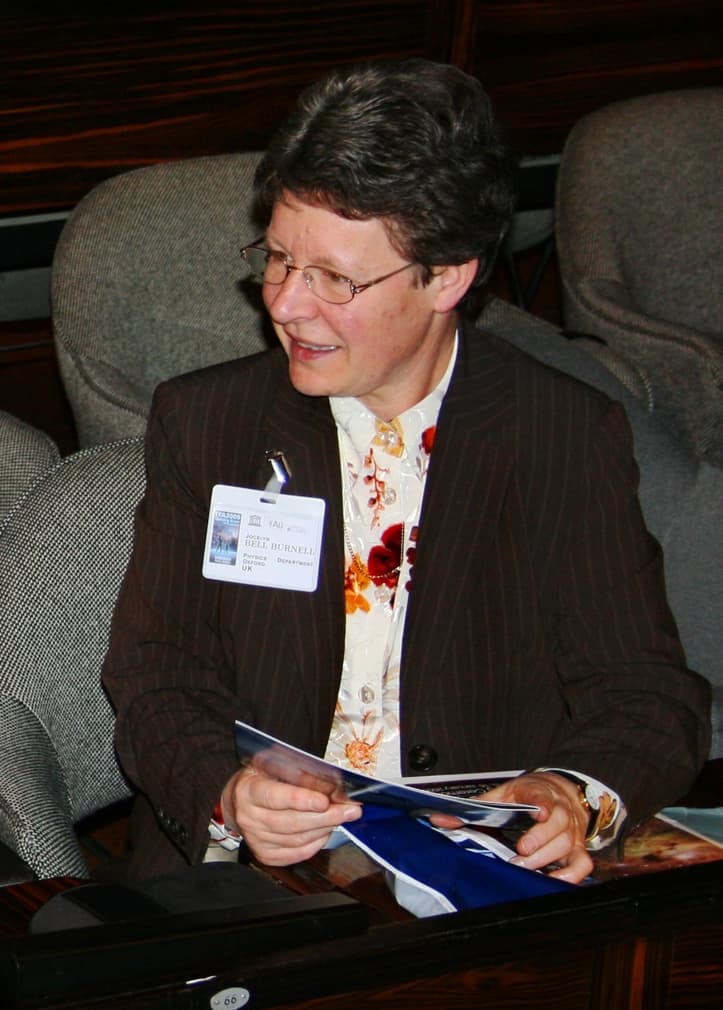
British · Science
Jocelyn Bell Burnell
July 15, 1943 – present
Early life and education
Dame Susan Jocelyn Bell Burnell (born 15 July 1943) is a Northern Irish physicist and astronomer whose work transformed radio astronomy and the study of compact stellar remnants. She was born in Belfast, Northern Ireland, and grew up in a family that valued education and books. As a child, she developed an early interest in astronomy, helped by visits to the Armagh Observatory and by the encouragement of teachers and family members who supported her scientific curiosity. The environment in which she was raised was not one in which women were commonly expected to become professional physicists, but she pursued science with determination.
Bell attended school in Northern Ireland and later studied physics at the University of Glasgow, where she earned her degree. She then went on to the University of Cambridge for postgraduate research, entering a scientific culture in which women were still underrepresented, especially in advanced experimental work. At Cambridge she worked at the Mullard Radio Astronomy Observatory and joined the team building the Interplanetary Scintillation Array, a large radio telescope designed to study rapid variations in radio sources. The technical work was demanding and often routine, but it placed her in exactly the right position to notice a pattern that others might have dismissed.
The discovery of pulsars
Bell Burnell’s reputation rests above all on the discovery of the first radio pulsars in 1967. While examining chart-recorder outputs from the Interplanetary Scintillation Array, she noticed an unusual series of signals from a source later designated CP 1919. On 6 August 1967, she recorded the first radio signals from that source, and on 28 November 1967, she recognized the source’s highly regular pulsing nature. That object later became known as PSR B1919+21, the first identified radio pulsar.
The discovery changed astronomy. Pulsars quickly became understood as rapidly rotating neutron stars emitting beams of radiation, a concept that had far-reaching implications for stellar evolution, high-energy astrophysics, and the physics of dense matter. The observation also demonstrated the power of radio astronomy in an era before automated sky surveys and digital signal processing. Bell Burnell’s role was especially important because she had spent months checking data by hand, following faint anomalies through a dense paper record until a pattern emerged. Her diligence revealed a new class of celestial object and helped open an entirely new branch of astrophysics.
The discovery was formalized in a Nature paper published on 9 February 1968. The paper listed Antony Hewish as first author and Jocelyn Bell as second author, a citation pattern typical of the era’s hierarchical research culture. The announcement quickly drew global attention, and the strange objects were soon called “pulsars,” a term that entered standard scientific language. The discovery is now widely regarded as one of the most significant scientific achievements of the twentieth century.
Nobel Prize controversy and professional career
In 1974, the Nobel Prize in Physics was awarded to Antony Hewish and Martin Ryle for work that included the discovery of pulsars, but Bell Burnell was not included among the laureates. The omission became one of the most discussed episodes in the history of modern science and has often been cited in debates about credit, hierarchy, and gender bias in research. Bell Burnell has generally handled the subject with grace and perspective, emphasizing that Nobel rules limit the number of recipients and that scientific discovery is often collaborative, while also acknowledging the need to recognize the people who do the crucial observational work.
After Cambridge, Bell Burnell built a long career in astronomy and physics, working in several areas beyond pulsars, including gamma-ray, X-ray, infrared, and millimetre-wave astronomy. She held academic and leadership posts at a number of institutions and became a respected figure in British and international science. Her later work and appointments reflected a broad scientific range, not only a single famous discovery. She also became known as an advocate for diversity in physics and for the importance of supporting early-career researchers.
Honors and recognition
Although denied the Nobel Prize recognition many felt she deserved, Bell Burnell received a wide array of honors later in life. She was elected to major scientific societies and served in leadership roles in professional organizations. She became the first female president of the Royal Astronomical Society and the first female president of the Institute of Physics, helping to expand the public visibility of women in British science. She also held senior academic roles, including positions associated with the University of Oxford and the University of Dundee.
Her later honors included the Royal Society’s Michael Faraday Prize in 2010 and its Royal Medal in 2015. In 2018, the Breakthrough Prize awarded her the Special Breakthrough Prize in Fundamental Physics, a highly visible recognition of her discovery and her contributions to the scientific community. The award drew renewed attention to her story and to the longstanding underrecognition of women researchers in major scientific breakthroughs. She used the prize to further her own longstanding commitment to broadening access to physics.
Scholarship fund and advocacy
Bell Burnell’s decision to donate the full Breakthrough Prize award money became an achievement in its own right. On 21 October 2018, she announced that the money would fund PhD scholarships for students from underrepresented groups in physics. This became the Bell Burnell Graduate Scholarship Fund, administered by the Institute of Physics. The fund was later used to support students whose access to advanced study might otherwise have been limited by gender, race, disability, or financial background.
This action reflected a major theme in her later life: using scientific prestige to widen opportunity. Rather than centering herself, she converted an award associated with personal redress into a practical structure for future inclusion. That choice has made her a model for scientists interested in equity and mentorship, and it has linked her name not only to pulsars but also to efforts to make physics more representative of society.
Personal life
Bell married, became known as Jocelyn Bell Burnell, and raised a family while continuing her scientific career. Her personal life has often been discussed only briefly in public biographies, partly because she has generally preferred to focus attention on science rather than on private matters. What is clear is that she balanced research, teaching, leadership, and family responsibilities in a profession that remained difficult for women to enter and to advance within during much of the twentieth century.
Her experiences also helped shape her commitment to supporting younger scientists. Having seen how recognition can be unevenly distributed, she has repeatedly emphasized the importance of environments in which students can flourish and receive credit for their work. That perspective has made her an important voice not only in astronomy but also in the culture of science more broadly.
Legacy
Bell Burnell’s legacy rests on more than the discovery of pulsars. She helped reveal a new class of cosmic objects, influenced the development of modern astrophysics, and became a public symbol of both scientific excellence and structural inequity. Her name is now associated with one of the most famous discoveries in astronomy and with one of the clearest examples of a woman whose contribution was essential but historically under-credited.
At the same time, her later career demonstrated a broader kind of leadership. Through service in scientific societies, teaching, and philanthropy, she helped shape the institutions that define physics today. Her decision to invest prize money in scholarships turned recognition into opportunity for others, making her legacy unusually expansive: she is remembered not only for finding pulsars, but also for helping build a more inclusive scientific future.
By the early twenty-first century, Bell Burnell had come to be celebrated as one of the outstanding figures in modern astronomy, and her story is now often used to illustrate both the brilliance of scientific discovery and the importance of fair recognition. Her work remains a touchstone in the history of women in science.
Dated achievements
6 indexed.
- Jul151943Science
Birth in Belfast, Northern Ireland
Susan Jocelyn Bell (later Dame Jocelyn Bell Burnell) was born in Belfast, Northern Ireland.
View details Britannica Biography of Jocelyn Bell Burnell - Aug061967Science
First detection of radio signals from CP 1919
Jocelyn Bell Burnell recorded the first radio signals from source CP 1919, which later became known as PSR B1919+21.