← All women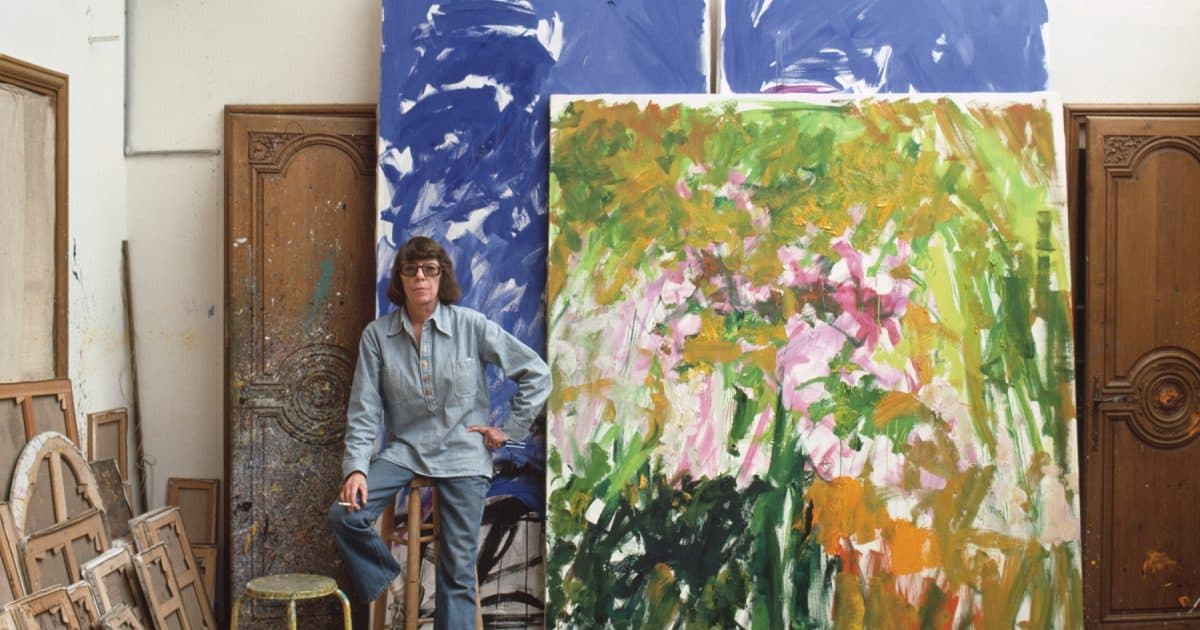
American · Arts
Joan Mitchell
February 12, 1925 – October 30, 1992
Early life and education
Joan Mitchell was born in Chicago, Illinois, on February 12, 1925. She was raised in a cultured household that encouraged music, reading, and museum-going, an environment that helped shape her later sensitivity to rhythm, color, and expressive form. Biographical sources identify her father, James Herbert Mitchell, as a physician and amateur artist, and her mother, Marion Strobel Mitchell, as a poet and coeditor connected with the literary magazine Poetry. This combination of medicine, literature, and art placed Mitchell in an intellectually rich setting from the beginning of her life.
Mitchell attended Smith College before shifting her focus more fully toward visual art. She later studied at the School of the Art Institute of Chicago, where she completed both undergraduate and graduate study, earning a BFA and later an MFA. Her education gave her formal training while also exposing her to a broad range of artistic traditions. The sources note that she first considered writing, reflecting the literary atmosphere of her family home, before committing herself to painting. That turn from literature to art became one of the defining decisions of her life.
As a young artist, Mitchell came of age during the Great Depression and the Second World War, periods that reshaped American cultural life. Women entering the arts in this era faced significant barriers, including limited access to institutional recognition and a critical climate that tended to center men. Mitchell’s early development therefore unfolded in a world where ambition alone was not enough; she had to establish a voice strong enough to command attention in a competitive and male-dominated art scene.
Early career in Chicago and New York
After completing her studies, Mitchell moved toward the New York art world, where the postwar avant-garde was taking shape. By the early 1950s she was part of the circle associated with the New York School and Abstract Expressionism. Her work appeared in the landmark Ninth Street Show in 1951, an important group exhibition that helped define the new postwar painting scene. Although the exact day is not documented in the provided sources, the show marked an important public emergence for Mitchell among artists who were challenging older conventions of representation.
In 1952, Mitchell had her first professional solo exhibition in New York at the New Gallery. This was a major step in any artist’s career, but it carried particular weight for a young woman seeking recognition in a movement that often mythologized male artistic authority. Her early New York years also brought her into contact with leading artists of the day, including Philip Guston, Franz Kline, Willem de Kooning, and Jackson Pollock. These associations situated her at the center of one of the most important turning points in twentieth-century American art.
Mitchell’s paintings from this period were already distinguished by energetic brushwork, a strong sense of surface, and an interest in translating feeling into abstraction. Rather than depicting literal scenes, she sought to convey remembered landscapes and emotional impressions. That approach aligned her with Abstract Expressionism while also giving her work a distinctively lyrical quality. Even in these early years, she was establishing the fusion of memory, nature, and gesture that would become central to her mature style.
Style, influences, and artistic maturity
Mitchell is generally identified with the second generation of Abstract Expressionists, but her work cannot be reduced to a single label. She created large paintings, pastel works on paper, drawings, and prints. Her art is widely recognized for its vigorous brushstrokes, layered color, and tension between abstraction and lived experience. She often spoke of painting from remembered landscapes, and her canvases frequently suggest the sensations of fields, trees, water, wind, or weather without depicting them directly.
Her influences were both American and European. The Fondation Vincent Van Gogh Arles notes that she admired Van Gogh, Cézanne, Matisse, Kandinsky, and Monet, especially the late Water Lilies. This admiration helps explain the emotional resonance and painterly richness of her work. Mitchell did not simply imitate these predecessors; she transformed their lessons into a highly individual language of gesture and color. Her paintings often balance force and delicacy, creating compositions that feel both immediate and deeply considered.
In 1959, Mitchell moved to Paris, a change that would profoundly shape the rest of her career. France offered her distance from the New York scene and a setting in which she could work with greater independence. She later settled in Vétheuil in 1968, living in a house overlooking the landscape associated with Monet. The move reinforced the importance of place in her art, although her paintings were never straightforward landscape views. Instead, they conveyed emotional memory and perceptual experience, often on large, multipart canvases.
During these decades, Mitchell continued to develop a body of work that combined personal intensity with formal invention. She became known for paintings that could be forceful and intimate at the same time, sometimes described as “violent and angry” in relation to the emotional charge she brought to the canvas. That intensity was not simply stylistic; it represented a sustained effort to claim space within a modernist tradition that had not been built with women artists in mind.
Recognition and honors
Mitchell’s reputation grew steadily in the 1970s and 1980s, as museums, critics, and collectors increasingly recognized her importance. A major turning point came in 1982, when she became the first American woman to have a solo exhibition at the Musée d’Art Moderne de la Ville de Paris. That milestone signaled her standing within international modern art and made clear that her reputation extended well beyond a single national scene.
Also in 1982, Mitchell received the Distinguished Artist Award for Lifetime Achievement from the College Art Association of America, becoming the first artist to receive the newly established award. In the same year, she received an honorary doctorate from the School of the Art Institute of Chicago and was appointed Commandeur des Arts et des Lettres by the French Ministry of Culture. These honors recognized not only the excellence of her painting but also the historical importance of her career. They showed that institutions once slow to acknowledge women artists were now responding to the scale of her achievement.
Later recognition continued to accumulate. In 1989, Mitchell received the Grand Prix National de Peinture in France and had her first solo exhibition at the Robert Miller Gallery in New York. In 1991, she received the Grand Prix des Arts de la Ville de Paris in painting. These awards confirmed the broad transatlantic respect she had earned by the end of her life.
Personal life
Mitchell’s personal life was closely intertwined with her artistic world. She lived for long periods in France and spent much of her career between the United States and Europe. Her biography is often discussed through the lens of her professional independence rather than conventional domestic milestones, and reliable institutional sources place the strongest emphasis on her artistic development. The sources provided here do not establish a marriage or children, and no such details are included beyond what can be verified.
What is historically clear is that Mitchell cultivated a life organized around painting. Her move to France, her later residence in Vétheuil, and her relationships within the international art community all supported a career that depended on sustained concentration and a strong sense of personal purpose. For a woman artist working in the twentieth century, that level of autonomy was itself significant.
Death and legacy
Joan Mitchell died on October 30, 1992, in a Paris hospital of lung cancer. Her death ended a career that had lasted more than four decades and left behind an influential body of work in painting, pastel, drawing, and printmaking. She remained a significant figure in the history of Abstract Expressionism, especially because she helped widen the movement’s story beyond the most celebrated male names.
Mitchell’s legacy rests on several intertwined achievements. She forged a powerful abstract style that was at once muscular and lyrical. She created work that linked memory and landscape in a way that remained open, nonliteral, and emotionally resonant. She achieved recognition in major institutions in both the United States and France, breaking barriers for women artists in a field that had historically marginalized them. And she helped define a broader understanding of postwar abstraction as an international and not solely male achievement.
Her influence continues through museum collections, scholarship, retrospectives, and the Joan Mitchell Foundation, which was created to support working artists and preserve her archives. In that sense, Mitchell’s historical importance extends beyond her canvases. She left behind a model of artistic seriousness, independence, and perseverance that continues to matter in the history of women’s art.
Dated achievements
3 indexed.
- Feb121925Science
Birth of Joan Mitchell in Chicago
Joan Mitchell was born in Chicago, Illinois, on February 12, 1925, into an affluent, culturally engaged family.
View details Joan Mitchell Foundation Timeline - Jan011982Science
First American Woman to Have a Solo Exhibition at Musée d'Art Moderne de la Ville de Paris
Mitchell became the first American woman to have a solo exhibition at the Musée d'Art Moderne de la Ville de Paris, a major institutional milestone.