← All women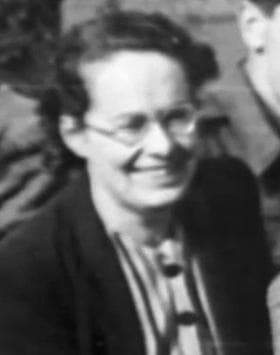
British · Science · Activism
Joan Clarke
June 24, 1917 – September 4, 1996
Early Life and Background
Joan Elisabeth Lowther Clarke was born on 24 June 1917 in West Norwood, London, England.[1][2][13] She was the youngest child of William Kemp Lowther Clarke, an Anglican clergyman and scholar, and Dorothy Elisabeth Clarke
Clarke was educated at Dulwich High School for Girls, where her mathematical talent quickly became apparent.[2] Her abilities were strong enough that one of her teachers, recognising a rare gift in a female student of the period, supported her in applying to the University of Cambridge. In 1936, she won a scholarship to study mathematics at Newnham College, Cambridge, one of the women’s colleges that provided a route into the university for women before they could be admitted to full degrees.[5][2] At Cambridge, Clarke entered the demanding Mathematical Tripos, the university’s rigorous examination system in mathematics. Women could sit the Tripos exams but, until 1948, could not be formally granted degrees; instead, their performance was informally ranked alongside male candidates.[2] Clarke’s decision to pursue this path placed her in the small minority of women attempting the highest-level mathematical training in Britain. During her years at Newnham College, Clarke studied under leading mathematicians, including Gordon Welchman, who was then a fellow of King's College and a key figure in applied mathematics and cryptanalysis.[3][2] She excelled in the Tripos examinations: in 1937 she achieved a First Class in Part I of the Mathematical Tripos, and in 1939 she attained a First Class in Part II, becoming a Wrangler, the term traditionally reserved for top-ranking mathematics graduates.[2][12] These results placed her among the strongest mathematicians of her year. Her academic distinction was further recognized when she was awarded the Philippa Fawcett Prize in 1939, a prize named after the pioneering woman mathematician who had famously outperformed all the men in the Tripos in 1890.[2][12] Clarke also held the Helen Gladstone Scholarship for the academic year 1939–1940, which enabled her to continue her studies.[2] In 1940, Cambridge informally recognized her achievements by classifying her as having earned a double first in Mathematics.[3] Despite this academic success, institutional barriers persisted. Cambridge did not yet award full degrees to women; their achievements were recorded but not formally recognized with the same status as male graduates.[2] Clarke therefore entered professional life with credentials that were, in practice, equivalent to those of male mathematicians, but without the official degree parchment. This disparity illustrates the gendered constraints she would continue to face in her career. Clarke’s path from Cambridge to wartime cryptography was shaped by her connection with Gordon Welchman, who became one of the leading organizers of the Government Code and Cypher School (GC&CS) work at Bletchley Park.[3][2] Recognizing her exceptional analytical skills, Welchman recommended her for a post at Bletchley at the outbreak of the Second World War. In 1940, Clarke was recruited to GC&CS and joined Bletchley Park, the central site of British codebreaking.[2][12] Initially, she worked in the Hut 8 section, which was responsible for deciphering the German naval Enigma cipher. Hut 8 was led by Alan Turing, with whom Clarke had already formed a professional friendship at Cambridge.[1][7] At first, Clarke’s official employment status reflected contemporary gender norms: she was hired under the civil service grade of "linguist," despite not using languages in her work, because that was the category available for women with her qualifications.[15][7] Her salary was lower than that of male colleagues performing equivalent analytical tasks.[7] This mismatch between job title and actual work underscores the institutional sexism of the era and the barriers she had to navigate. Clarke’s most significant contributions at Bletchley Park were in the breaking of the German naval Enigma cipher, used by the Kriegsmarine for U-boat and surface fleet communications.[2][7] Naval Enigma was more complex and secure than the Army and Air Force versions, employing additional rotors and more elaborate keying procedures. Success against naval Enigma was crucial to the Battle of the Atlantic, where Allied shipping was threatened by German submarines. Within Hut 8, Clarke became an expert in a technique known as Banburismus, a probabilistic method developed by Alan Turing to reduce the number of possible Enigma settings that the electromechanical "bombes" had to test.[3][2] Banburismus used statistical analysis and likelihood calculations over long stretches of intercepted messages, exploiting patterns to narrow down the search space. Clarke’s facility with probability and painstaking manual computation made her one of the leading practitioners of this method. According to institutional accounts, she was "adept at Banburismus" and her work resulted in significant savings in bombe processing time, allowing more messages to be read more quickly.[3] These breakthroughs improved the Allies’ intelligence picture of U-boat deployments and convoy routes, contributing directly to reduced sinkings and greater security for Atlantic shipping. Clarke’s role thus linked abstract mathematical reasoning to concrete outcomes in wartime survival. Over time, Clarke rose to become deputy head of Hut 8 and was its longest-serving member.[7][5] She supervised other analysts and was one of the very few women at Bletchley Park entrusted with high-responsibility cryptanalytic leadership, rather than clerical or routine work. Her presence in such a position was itself a barrier-breaking development in the British wartime intelligence establishment. Despite her central importance to Hut 8’s work, Clarke encountered persistent gender-based inequalities. Contemporary recollections and later reporting emphasize that she was paid at a lower rate than male colleagues with similar responsibilities and that her official grading did not reflect her analytical role.[7][15] Her appointment under a "linguist" grade reflected civil service policies that offered limited professional classifications for women. Nonetheless, her achievements did not go entirely unrecognized. In 1946, following the war, Clarke was appointed a Member of the Order of the British Empire (MBE) for her wartime service at Bletchley Park.[1][8][12] This honour acknowledged the contribution of her codebreaking work to the Allied victory, even though the specific nature of that work remained classified for many decades. The secrecy surrounding Bletchley Park meant that Clarke could not publicly discuss her role and often appeared, to outsiders, as a civil servant with an unremarkable career. The lack of public recognition during her lifetime, contrasted with her posthumous acclaim, illustrates how official secrecy intersected with gender to obscure women’s contributions to technical and military history. After the war ended, Clarke continued her work in British signals intelligence. She served at the Government Code and Cypher School and, as the organization evolved, at the Government Communications Headquarters (GCHQ).[12][3] Sources indicate that she worked in cryptanalysis from 1945 to 1952 and then, after a period away, rejoined GCHQ in 1962, remaining there until her retirement in 1977.[12][3] Her postwar work drew on the expertise developed during the Enigma campaign and was applied to new cryptographic and intelligence challenges, including those of the emerging Cold War. Biographical accounts note that she was involved in the analysis of intercepted Soviet communications and in investigations related to espionage activities of figures such as Philby, Burgess, and Maclean, although details remain classified or sparsely documented.[6] At GCHQ, Clarke worked amid rapidly changing technology, from wartime electromechanical devices to early computers and more sophisticated cryptographic systems.[6] Her ability to adapt mathematical insight to evolving operational contexts exemplified the continuity between wartime codebreaking and modern signals intelligence. Alongside her cryptanalytic career, Clarke developed a significant secondary specialization in numismatics, the study of coins and currency.[1][2] She became particularly interested in Scottish coinage and medieval issues, contributing research to the field. Numismatics offered an outlet for her analytical skills in a different historical and scholarly domain. Her work as a numismatist exemplifies the breadth of her intellectual interests and shows her engagement with both contemporary and historical problems. The exact chronology of her numismatic publications is less documented in accessible sources, but accounts consistently describe her as a respected figure in this niche, technical field.[2] While at Bletchley Park, Clarke formed a close friendship with Alan Turing, based on shared mathematical interests and professional collaboration.[1] In the early 1940s, they briefly became engaged to be married. Turing disclosed his homosexuality to her during this period, and the engagement ended amicably, with the two remaining friends.[1] Their relationship has attracted interest from historians and the public as a rare documented instance of a woman’s perspective on Turing’s private life. Clarke later became engaged to Lieutenant Colonel John Kenneth Ronald ("Jock") Murray, an Army officer who had worked with intelligence services.[3][6] They married in 1952Joan Elisabeth Lowther Murray. The couple did not have children, according to biographical accounts, and Clarke maintained her professional career while living a relatively private personal life.[2][6] Descriptions of Clarke’s character emphasize her modesty and preference for a quiet life, consistent with the confidentiality required by her work. Even after the declassification of some Bletchley Park material, she did not seek public prominence. Clarke retired from GCHQ in 1977, concluding a cryptanalytic career that had spanned from early wartime service through three decades of Cold War intelligence work.[12][3] She spent her later years largely out of the public eye, continuing private scholarly interests such as numismatics. On 4 September 1996, she died in Headington, Oxfordshire, England, at the age of 79.[1][2][12][13] Her death was noted in specialized circles, but the wider significance of her work was still only partially appreciated; many of the popular accounts of Bletchley Park that would bring her name to broader attention had yet to be written. In the decades since her death, Joan Clarke has come to be recognized as one of the most important women in the history of cryptanalysis and wartime intelligence. Historians now credit her with a central role in the breaking of German naval Enigma and emphasize that her work, alongside that of colleagues such as Alan Turing and Gordon Welchman, materially contributed to shortening the Second World War and saving lives.[1][2][7] Her legacy has several dimensions: In 2024, English Heritage unveiled a blue plaque on her former home at 193 Rosendale Road in West Dulwich, London, explicitly honouring her as a "code-breaking prodigy" and highlighting her role as the longest-serving member and deputy head of Hut 8.[5] This memorial reflects a broader institutional effort to ensure that women’s contributions to wartime science and intelligence receive public recognition. Clarke’s inclusion in international reference works—including entries in English, Spanish, French, German, Indonesian, and Arabic-language encyclopedias—attests to the global resonance of her story.[1][8][9][10][11][4] She is now routinely cited in discussions of women in STEM, the history of computing and cryptology, and the social history of the Second World War. Although much of her work remains technically complex and, in some areas, still classified, the broad outlines are clear: Joan Clarke brought extraordinary mathematical insight to bear on some of the most consequential problems of her time and did so in the face of structural obstacles related to both secrecy and gender. Her life exemplifies the hidden yet decisive contributions of women to modern science, intelligence, and global history.University Education and Mathematical Distinction
Recruitment to Bletchley Park and Early Wartime Work
Major Work: Naval Enigma and Banburismus
Recognition, Rank, and Gender Barriers
Postwar Career: GC&CS and GCHQ
Numismatics and Scholarly Interests
Personal Life and Relationship with Alan Turing
Later Life and Retirement
Legacy and Historical Impact
Dated achievements
2 indexed.
- Jun241917Science
Birth of Joan Elisabeth Lowther Clarke
Joan Clarke was born in London, England, on 24 June 1917, later to become one of Britain's foremost wartime codebreakers and cryptanalysts.
View details Joan Clarke - MacTutor Biography - Sep041996Science
Death of Joan Clarke in Headington, Oxford
Joan Clarke died on 4 September 1996 in Headington, Oxford, England, at the age of 79, after a lifetime of pioneering cryptanalytic and numismatic work.