← All women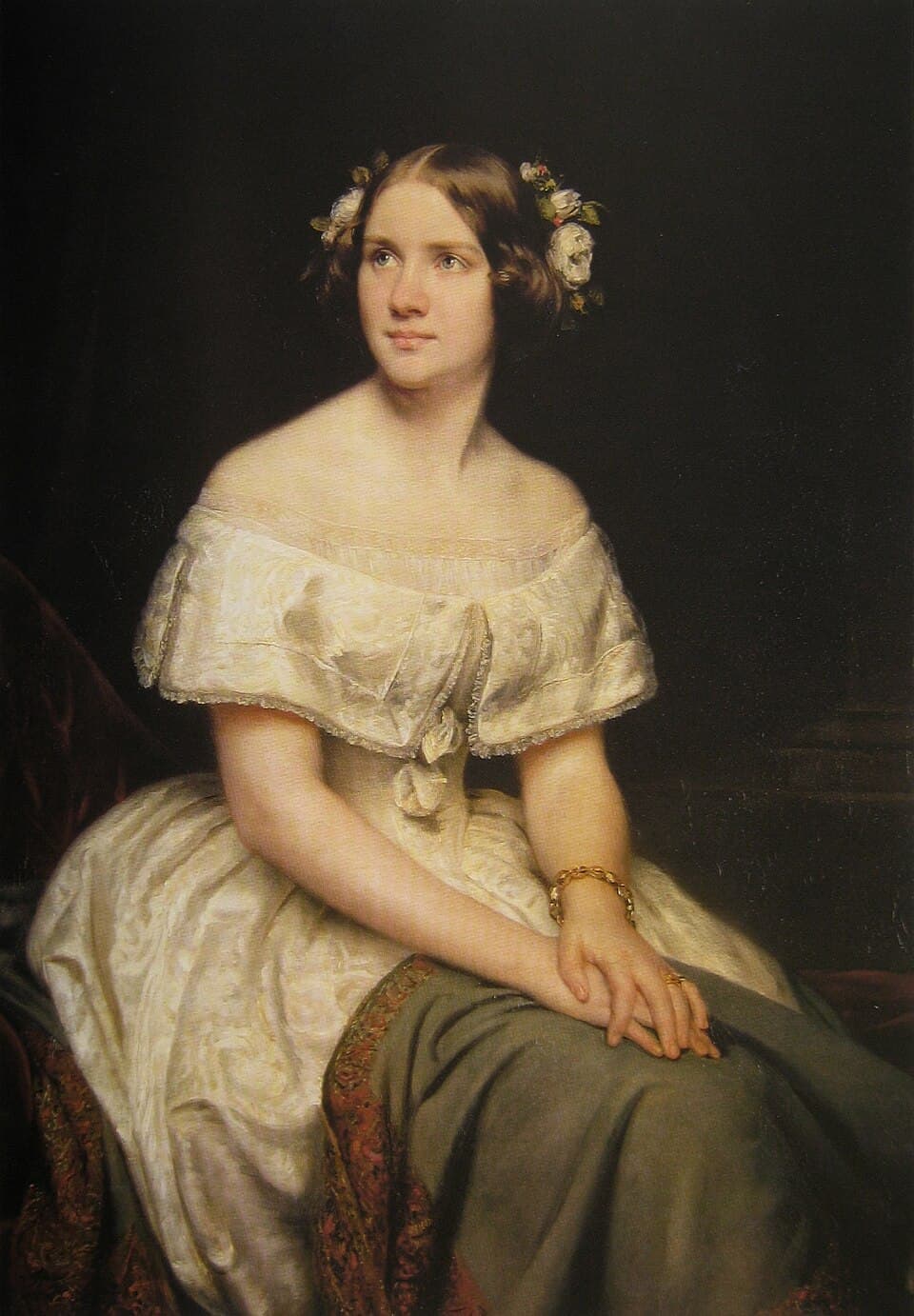
Swedish · Arts
Jenny Lind
October 6, 1820 – November 2, 1887
Early Life and Background
Johanna Maria "Jenny" Lind was born on 6 October 1820 in Stockholm, Sweden, to schoolteacher Anne-Marie Fellborg and lawyer Niclas Jonas Lind.[1][11][6] Her parents were not married at the time of her birth, and she spent much of her childhood in precarious circumstances, moving between households and, for a period, living with a church organist.[11][4] This modest and unstable upbringing profoundly shaped her character, instilling both resilience and a deep sense of social responsibility that later expressed itself in extensive charitable giving.
Lind’s musical talent was discovered early. According to widely cited accounts, a maid overheard her singing and alerted professionals connected with the Royal Swedish Opera, who recognized her unusual gift.[6][16] At the age of nine she was accepted as a voice student at the Royal Theatre school in Stockholm, the training institution attached to the Royal Opera.[16][17] There she studied singing, stagecraft, and languages, and began appearing in small parts in spoken theatre. By age ten she had played dozens of roles, building stage experience long before her official operatic debut.[6]
Her early years were marked by vocal overuse and strain, and some teachers doubted that her fragile voice could withstand the demands of opera.[11] Yet Lind’s determination, combined with careful retraining later in her youth, enabled her to develop a distinctive soprano of remarkable clarity and agility. The contrast between her humble origins and her privileges as a student at a royal institution foreshadowed the social and cultural boundaries she would cross throughout her career.
Career Beginnings and Development
Lind’s first significant professional opportunity came in 1836, when she received an operatic role as Georgette in Adolf Fredrik Lindblad’s opera "Frondörerna" at the Royal Opera in Stockholm.[8][13] Although the exact date is not clearly documented in major sources, this engagement marked her initial steps into professional opera, moving beyond spoken theatre into serious musical repertoire.
Her true breakthrough occurred with her operatic debut on 7 March 1838, when she sang Agathe in Carl Maria von Weber’s "Der Freischütz" at the Royal Opera in Stockholm.[12][1] The performance revealed her refined bel canto technique, expressive phrasing, and ability to project emotional sincerity, and it quickly established her as one of Sweden’s leading young singers. Despite earlier concerns about her voice, Lind’s debut was widely praised, and she soon took on more leading roles, including parts in works by Bellini and Donizetti.
By the early 1840s, Lind’s reputation extended beyond Sweden. In 1840 she was elected a member of the Royal Swedish Academy of Music, a notable honour for a young woman singer.[4][6] In 1841 she appeared at the Royal Theatre in Copenhagen, where her performances won wide acclaim and established her as a major Nordic soprano.[8][2] However, overuse and insufficient technique led to new vocal difficulties, and she withdrew for a period of retraining under the guidance of Manuel García and others.[11][8]
After this retraining, Lind returned to the Stockholm Opera around 1843, singing with renewed assurance and vocal health.[8][11] Her improved technique and artistic maturity quickly attracted attention from abroad. In 1844, she began performing in German cities, including Berlin, where critics and audiences were captivated by what one biographer called her "radiant" soprano and her "wholesome" public image.[11][6] During these years she gained the nickname "the Swedish Nightingale", reflecting both the purity and lyrical quality of her voice and the romantic fascination with Scandinavian artists in European culture.[6][15]
International Fame: German and British Seasons
Through the mid‑1840s, Lind toured extensively across Europe, appearing in Denmark, Germany, Austria, and other locations.[6][11] Her roles in Berlin and Vienna furthered her reputation as an interpreter of Italian and German Romantic opera. She sang parts such as Amina in Bellini’s "La sonnambula" and Norma in "Norma", showcasing her ability to combine technical precision with emotionally intense characterization.[11]
Lind’s London debut on 4 May 1847 at Her Majesty’s Theatre marked an important turning point.[11][1] She appeared in Meyerbeer’s "Les Huguenots", and her presence had been eagerly anticipated by the British public and press. Reports describe sold‑out performances and intense public curiosity about the Swedish singer whose fame already preceded her.[11] Her London season that year included major roles in "La sonnambula" and "Norma", and she quickly became one of the most celebrated figures on the English operatic scene.[11][2]
In an era when Italian sopranos dominated the London stage, Lind’s success as a Swedish singer broadened notions of international operatic stardom. Her style, emphasizing purity of tone and musical sincerity rather than mere vocal display, resonated with Victorian ideals of modesty and moral virtue. She cultivated an image of personal reserve and piety, avoiding the flamboyant social behaviour associated with some other stars. This combination of artistry and perceived virtue made her particularly appealing to middle‑class audiences and to commentators anxious about the moral status of the theatre.[11][6]
The American Tour and Emergence of Mass Celebrity
Lind’s most famous venture came with her American concert tour of 1850–1852, organized initially by the showman P. T. Barnum.[2][1][18] Barnum, seeking a respectable star to broaden his enterprises beyond sideshows, negotiated a contract with Lind while she was still in Europe. He had never heard her sing but relied on reports of her reputation and moral character.[2] The arrangement guaranteed Lind a fixed fee per concert, while Barnum assumed the financial risks and profits from publicity and ticket sales.
Lind arrived in New York on 1 September 1850, aboard the steamship Atlantic, where she was greeted by enormous crowds at the docks.[1][3] Barnum had orchestrated extensive advertising, including newspaper articles, pamphlets, and a highly publicized auction of tickets for the first concert. The American public, largely unfamiliar with her actual voice, became fascinated by the idea of the "Swedish Nightingale" as a paragon of culture and virtue.[3][2]
Her first American concert took place on 11 September 1850 at Castle Garden in New York City.[1][3] Tickets for this event had been auctioned to the highest bidders, producing extraordinary prices and publicity. The concert itself, featuring a mix of operatic arias and lighter pieces, was a triumph; audiences and critics praised both her singing and her modest demeanour. Historians and museum curators have described Lind as one of America’s earliest mass‑market female celebrities, and this debut is often treated as a landmark in the emergence of modern celebrity culture in the United States.[1][3]
Lind’s tour continued to other cities, including Boston, Philadelphia, Baltimore, and beyond. On 6 October 1850, her thirtieth birthday, she performed in Boston, an occasion noted in press accounts and fan literature.[1] She sang in Philadelphia on 6 December 1850, helping to popularize European concert music among American audiences beyond the East Coast’s largest city.[15][2] Throughout the tour, she donated substantial portions of her earnings to charities such as schools, churches, and hospitals, reinforcing her image as a benevolent celebrity.[2][18]
Relations with Barnum, however, changed over time. On 8 January 1851, in Boston, Lind terminated her formal contract with Barnum and assumed direct management of her remaining U.S. concerts.[15][3] This decision gave her control over programming, pricing, and philanthropy, and it is often cited as an early example of a woman performer asserting business autonomy in the entertainment industry. She continued to tour in the United States but with reduced publicity and more emphasis on her own values.
During the American period she also pursued personal happiness. On 29 March 1851, Lind married German pianist and conductor Otto Goldschmidt in a private ceremony in Boston.[13][16] Goldschmidt had joined her tour as accompanist and collaborator, and their partnership would shape the rest of her life. Lind’s final American concert in New York occurred on 9 May 1851, effectively ending the Barnum‑initiated phase of the tour.[15] She gave additional concerts and traveled to sights such as Niagara Falls and Mammoth Cave, but by 20 August 1852 she had returned to Europe, arriving in Liverpool and proceeding to London.[11][1]
The American tour had profound cultural consequences. It demonstrated the potential of publicity, ticketed events, and moralized celebrity images to create mass followings around a woman artist.[3][18] Lind became a symbol of respectable culture, and her concerts helped raise the stature of concert music in the United States. Scholars have compared her impact to that of later figures such as Enrico Caruso and Marian Anderson in shaping American musical tastes and celebrity practices.[19][3]
Later Career: Concerts, Oratorio, and Teaching
Following her return to Europe, Lind gradually withdrew from opera. By around 1855, she had largely retired from staged operatic roles, citing both vocal strain and personal preference for concert and sacred repertoire.[13][16] She and Goldschmidt settled for periods in Germany and later England, raising three children while maintaining a busy schedule of concert performances and occasional tours.
Lind’s post‑opera career emphasized oratorio and religious works, particularly those of composers she admired, such as Felix Mendelssohn. On 19 April 1857, she sang Mendelssohn’s "Elijah" at the Philharmonic Hall in Liverpool, one of several notable performances that solidified her standing as an interpreter of large choral‑orchestral works.[11][16] Her friendship with Mendelssohn, who dedicated music to her and praised her artistry, was a central component of her mid‑career life.
In addition to performing, Lind devoted increasing attention to music education and institutions. She took part in benefit concerts and charitable events across Britain and Europe, continuing the philanthropic pattern established during her American tour. Over time, she became less visible as a touring star and more as a respected elder figure in musical circles.
In 1882, Lind was among the founding figures associated with the establishment of the Royal College of Music in London, an institution created to provide high‑level musical training and to standardize British music education.[16][13] Although the exact dates of her foundational involvement are not clearly documented, sources agree that she played a consultative and supportive role as the college took shape.
On 10 May 1883, Lind was appointed professor of singing at the Royal College of Music.[13][2] This formal position recognized her authority in vocal pedagogy and placed a woman in a key instructional role at one of Britain’s principal conservatories. She worked there with students, imparting lessons drawn from decades of performance and emphasizing sincerity over mere technical display.[16]
Awards, Honours, and Recognition
Throughout her career, Lind received numerous honours, though not always in the form of modern awards. Her election to the Royal Swedish Academy of Music in 1840 was a significant distinction, particularly for a young woman of modest social background.[4][6] She was appointed court singer to the King of Sweden and Norway by the age of twenty, further affirming her national importance.[6]
Lind’s international reputation was reflected in the way cities and institutions commemorated her. Various theatres and concert halls celebrated her visits, and later generations named ships, dolls, household objects, and even communities after her.[6][18] In the United States, for instance, places and products carrying her name attest to the depth of her impact on popular culture.
Her appointment as professor of singing at the Royal College of Music in 1883 was effectively an institutional honour, signalling both trust in her expertise and public recognition of her contribution to British musical life.[13][2] Retrospectively, music historians and institutions such as Classic FM and the American Swedish Historical Museum have highlighted her as one of the most important sopranos of the 19th century.[16][18]
Personal Life
Lind’s personal life was shaped by her marriage to Otto Goldschmidt and their family. The couple, married in Boston in 1851, eventually had three children and resided for much of their later life in England, including London and the Malvern area.[13][16] Goldschmidt, a pianist and conductor trained in Germany, worked closely with Lind in musical projects and shared her interest in religious and charitable activities.
Accounts of Lind emphasize her devout Lutheran faith, which influenced both her choice of repertoire and her philanthropic actions.[11][18] She avoided the more flamboyant social scene of the operatic world, preferring a relatively private domestic life when not performing. Biographers consistently describe her as modest, reserved, and deeply committed to causes such as education and health.
While her public image stressed virtue and domesticity, Lind was also a determined professional, capable of negotiating contracts, controlling tour arrangements, and making strategic decisions about her career, such as ending the Barnum contract. Her life thus combined Victorian ideals of womanly respectability with assertive engagement in the business and institutional aspects of music.
Legacy and Historical Impact
Jenny Lind’s legacy rests on several intertwined contributions: her vocal artistry, her role in the development of musical culture in Europe and America, her philanthropic work, and her pioneering status as a woman in public celebrity and music education.
As a soprano, Lind was celebrated for the range, control, and purity of her voice. Britannica notes that her range extended from the B below middle C to a high G, and that she was admired for her bel canto skill and naturalness of expression.[2] Her interpretations of roles such as Amina, Norma, and characters in Meyerbeer’s operas influenced performance traditions and set benchmarks for later singers.
In the United States, Lind’s 1850–1852 tour is widely regarded as a formative moment in the history of entertainment and celebrity. The Smithsonian and other historians describe her as one of America’s first female mass celebrities, whose tour demonstrated how publicity, moral narratives, and ticketed events could create nationwide popularity.[3][18] Her success helped normalize the idea of women as central figures in high-profile cultural events and showed that a female artist could be admired not only for beauty but for moral character and artistic integrity.
Lind’s extensive charitable donations also left a mark. She gave large sums from her American earnings to schools, churches, and hospitals; while exact dates of individual donations are not always recorded, the pattern is clear in both American and European sources.[2][18] This philanthropy reinforced connections between high culture and social improvement, and it made her a model for later artists who used their fame for humanitarian causes.
In Britain and Sweden, Lind’s contributions to music education and institutions were equally important. Her involvement in founding the Royal College of Music and her professorship there helped establish professional standards for vocal training.[16][13] As one of the few women holding such a position in her time, she broadened expectations about women’s roles as authoritative teachers and shapers of national culture.
Culturally, Lind’s image continued to resonate long after her death. She appears in biographies, museum exhibitions, and cultural memory projects such as Europeana’s story on the "Swedish Nightingale".[6] Her life has been reimagined in popular media, most notably in the 2017 film "The Greatest Showman", where she is portrayed—loosely based on history—as an opera star associated with Barnum.[6][18] While such depictions often take dramatic liberties, they testify to her enduring presence in popular imagination.
Later Life and Death
In her later years, Lind lived a relatively quiet life, focusing on teaching, religious devotion, and family. She continued to make occasional concert appearances but was no longer the constant touring star of her earlier career.[13] Her work at the Royal College of Music brought her into contact with younger generations of singers, many of whom regarded her as a moral and artistic exemplar.
Lind spent much of this period at Wynd’s Point, a house on the slopes of the Malvern Hills in Worcestershire, England.[8][15] The location’s fresh air and scenic landscape were thought beneficial for health and reflection, aligning with Victorian ideas about the restorative qualities of the countryside.
On 2 November 1887, Jenny Lind died at Wynd’s Point near Malvern, aged 67.[1][2][16] Her death was widely reported, and obituaries across Europe and in the United States commemorated her achievements as a singer, philanthropist, and moral figure. She was buried nearby, and Malvern remains associated with her memory.[12][15]
In the decades after her death, Lind’s reputation remained high among musicians and historians, even as changing styles of singing and opera altered audiences’ tastes. She continued to be cited as an example of bel canto artistry and as a symbol of the potential for women from modest backgrounds to attain international influence through talent and integrity. Monographs, encyclopedias, and museum exhibits regularly highlight her story as part of the broader history of women in music and of the evolution of celebrity culture.[11][3][18]
Today, Jenny Lind is remembered not only as the "Swedish Nightingale", but as a pioneering woman whose life intersected with major developments in opera, concert touring, philanthropy, and education. Her trajectory—from an illegitimate child in Stockholm to one of the most celebrated sopranos of the 19th century and a respected professor of singing—continues to provide insight into the possibilities and constraints faced by women artists in the modern era.
Dated achievements
14 indexed.
- Oct061820Arts
Birth of Jenny Lind in Stockholm
Jenny Lind (Johanna Maria Lind) was born in Stockholm, Sweden, later becoming one of the most celebrated sopranos of the 19th century.
View details Jenny Lind - Wikipedia - Mar071838Arts
Operatic debut in Der Freischütz in Stockholm
Jenny Lind made her operatic debut in Stockholm as Agathe in Weber's Der Freischütz, launching her professional opera career.