← All women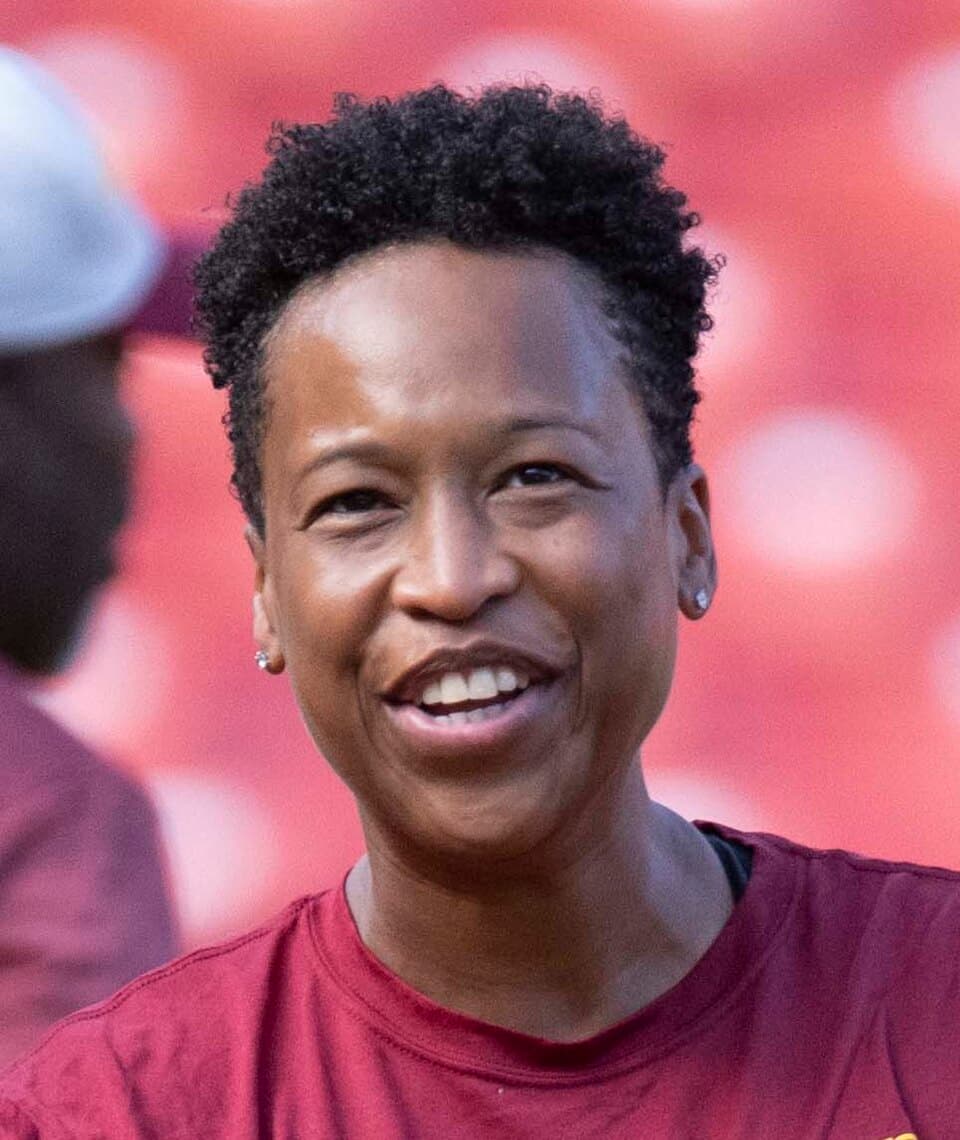
American · Sports
Jennifer King
August 6, 1984 – present
Early life and background
Jennifer King was born on August 6, 1984, and is identified in biographical sources as a native of Eden, North Carolina. She grew up in a state with a deep football culture, but her path to the NFL was neither direct nor conventional. Before entering coaching, King established herself as a multi-sport athlete and then as a coach in both basketball and football, developing a résumé that combined playing experience, teaching, and leadership across several levels of competition.
King attended Guilford College, where she was a two-sport athlete. Sources describe her as a standout in both basketball and softball, and that broad athletic background later informed her coaching style. Rather than specializing early in football, she built her career through a wider set of sports experiences, a pattern that is common among women who break into male-dominated coaching spaces. Her route to football leadership therefore reflects both athletic versatility and the practical realities of professional opportunity.
After college, King moved into coaching. She worked in women’s college basketball before shifting toward football, and that transition became one of the defining features of her career. Before she became nationally known for NFL firsts, she had already spent years learning how to teach, manage, and motivate athletes. Those early experiences mattered because they gave her the credibility needed to enter football coaching, where formal pathways for women were still limited.
Publicly available sources do not provide a detailed, high-confidence account of her private family life, and no reliable source in the provided set documents a spouse or children. For that reason, only verified facts are included here.
Playing career
Before coaching became her primary identity, King played football for more than a decade in the women’s game. She was associated with the Carolina Phoenix, New York Sharks, and D.C. Divas in the Women’s Football Alliance and related women’s football circles. Coverage of her career notes that she played quarterback, receiver, and safety, underscoring her versatility and her deep understanding of the game from multiple positions.
Her experience as a player was more than a prelude to coaching; it was a foundational education in football culture. Women’s football offered fewer resources, less media attention, and fewer institutional supports than the NFL, which meant that players often had to develop technical mastery and resilience in a less protected environment. King’s long playing career helped prepare her for the demands of coaching in a sport where women were still rarely welcomed in formal staff roles.
That background also made her later NFL rise especially meaningful. She did not arrive in coaching from a celebrity platform or an unrelated field. She came from the game itself, having spent years learning football at a level that gave her credibility with players and staff alike.
Basketball coaching and the move toward football
King’s professional coaching background first became established in basketball. She coached women’s basketball at the collegiate level, including at Johnson & Wales University and Greensboro College. Reports also connect her with a successful run at Johnson & Wales, including a Division II championship in 2018. This period matters because it shows that King was already a proven coach before she entered the NFL coaching pipeline.
Her movement from basketball into football was not unusual in the broader history of women’s coaching, but it is unusual at the NFL level. Women often build coaching résumés in one sport before crossing into another, especially when opportunities in football are scarce. King’s ability to translate teaching skills, tactical thinking, and athlete management from basketball into football helped open the door to the next stage of her career.
Early football coaching roles
King’s football coaching career began in earnest in 2018, when she worked as an intern with the Carolina Panthers under head coach Ron Rivera. That role was one of the first steps in a sequence that would eventually make her one of the most visible women in NFL coaching history. Sources also place her in the Alliance of American Football with the Arizona Hotshots, where she worked in an offensive role and gained professional football coaching experience outside the NFL.
In 2019, King also worked with Dartmouth College as an offensive assistant, extending her résumé into the college ranks. That same year, Rivera returned to Carolina and later brought King back into his orbit, reflecting the importance of trust and continuity in coaching careers. By the time Rivera became Washington’s head coach in 2020, King was already part of his professional network and had proven herself in several contexts.
In 2020, she joined Washington as a coaching intern, primarily working with the running backs. The position gave her day-to-day exposure to NFL practice structure, game planning, and in-game adjustments. It also placed her in an environment where her work could be closely observed by the staff, setting the stage for her eventual promotion.
Historic rise in the NFL
King’s breakthrough came on January 26, 2021, when Washington promoted her to assistant running backs coach. Multiple reliable sources identify this as the moment she became the first Black woman to hold a full-time assistant coaching position in the NFL. The distinction is important: while women had worked in various NFL support and internship roles before, King’s appointment gave her a full-time assistant title with direct positional responsibility.
This achievement was historically significant because it challenged one of the NFL’s most persistent barriers: the absence of Black women in formal coaching leadership. Representation in coaching affects hiring networks, player development, and the visible possibilities imagined by future candidates. King’s promotion therefore mattered not only because it was a first, but because it expanded the definition of who could lead on an NFL sideline.
Her role drew additional attention during the 2020 and 2021 seasons. On December 27, 2020, she took on lead responsibilities for the running backs during a game against Carolina when staff absences forced Washington to rely on her more directly. On January 9, 2021, she coached in the NFC wild-card game against Tampa Bay, a postseason contest later recognized as the first in NFL history in which both teams had women on their coaching staffs. On September 13, 2020, she was also part of a regular-season game that became the first NFL matchup with a woman official and a woman assistant coach on each sideline.
King’s rise also made her part of a broader, though still limited, expansion of women’s roles in professional football. Her appointment was widely reported by major media and frequently highlighted during Black History Month and Women’s History Month coverage. Those recognitions framed her not as a novelty, but as a professional whose work had forced the league to confront its own hiring history.
East–West Shrine Bowl and college football visibility
King’s influence widened further on February 3, 2022, when she coached at the East–West Shrine Bowl. That appearance made her the first woman to coach in the event, a notable milestone in one of college football’s long-running all-star showcases. The Shrine Bowl is a scouting and evaluation event, so participation signals acceptance into an important professional football setting where coaching visibility can shape careers.
This milestone mattered because it showed that her barrier-breaking role extended beyond the NFL regular season. All-star games are part of the ecosystem through which future professionals are evaluated, and women’s absence from those spaces has long reinforced the idea that football leadership is male by default. King’s presence challenged that assumption and further normalized women’s participation in top-level football staff work.
North Carolina Central University
In 2023, King moved into the college game again when she joined North Carolina Central University as an offensive analyst. The university’s announcement described her as the program’s first female football coach and, at the time, the only Black female analyst at a Division I HBCU. That role connected her NFL experience to the HBCU coaching environment, a setting with special significance in Black educational and athletic history.
Her appointment at NCCU demonstrated that her career was not simply about breaking one barrier in the NFL and then stopping. Instead, she continued moving into roles where her presence changed the composition of coaching staffs and expanded the visibility of Black women in football leadership. The transition also underscored the portability of her expertise: she had become valuable not only as a trailblazer, but as a football mind whose skills were recognized across levels of the sport.
Recognition and legacy
King has been widely recognized in sports media, educational programs, and institutional profiles as a trailblazer. Coverage has consistently described her as the first Black woman to hold a full-time coaching position in the NFL, and many profiles have emphasized the broader cultural significance of that distinction. Her career has been used in discussions of representation, workplace access, and the slow transformation of football’s leadership pipeline.
Her legacy rests on more than a single title. She built a career through women’s football, college basketball coaching, NFL internships, an assistant role, postseason visibility, and later college staff work. That cumulative record matters because institutional change rarely occurs through one event alone. King’s career shows how persistence, coaching competence, and visibility can combine to create a lasting precedent.
At the same time, her experience reveals the barriers that remain in football. The need to label her as a “first” in so many contexts demonstrates how late the sport has been to include Black women in formal coaching roles. Her story is therefore both inspirational and diagnostic: it celebrates one individual’s success while exposing the structural exclusions that made the success remarkable in the first place.
Personal life
Reliable sources in the provided material focus overwhelmingly on King’s professional career. They do not consistently document a spouse, children, or other intimate family details, and this biography therefore avoids speculation. What is clear is that King has built a public identity rooted in athletics, coaching, and speaking about representation in sports.
Historical importance
Jennifer King’s importance in women’s history lies in the combination of firsts she achieved across the football landscape. She was not just a symbolic hire; she became a sustained professional presence in spaces where Black women had been nearly absent. Her career illustrates how representation advances one appointment, one game, and one role at a time.
In the history of women in sports, King belongs to the generation that helped move women from the margins of football toward its operational center. Her work has made it easier to imagine women as position coaches, analysts, and leaders in football organizations, and that legacy is likely to endure well beyond the specific milestones recorded here.
Dated achievements
7 indexed.
- Aug061984Sports
Born in Eden, North Carolina
Birth of Jennifer King, the North Carolina native who later became the first Black woman appointed to a full-time assistant coaching role in the NFL.
View details Jennifer King (American football) - Wikipedia - Dec272020Sports
First Black woman to act as lead position coach in an NFL game
King acted as lead running backs coach in an NFL game, later recognized as a first for a Black woman in that role.