← All women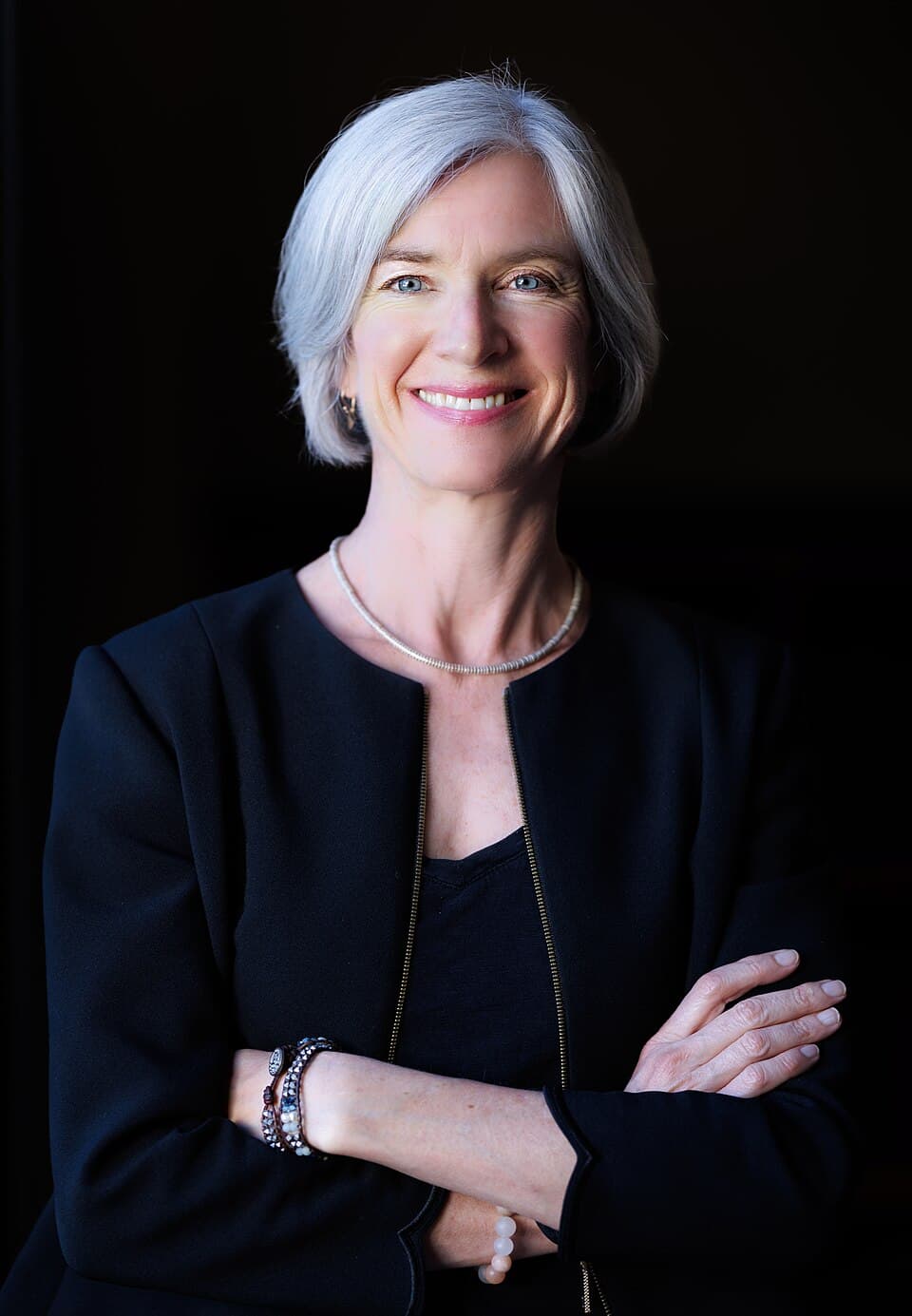
American · Science · Medicine
Jennifer Doudna
February 19, 1964 – present
Early Life and Background
Jennifer Anne Doudna was born on 19 February 1964 in Washington, D.C., United States, the eldest of three sisters.[1][14] Her father, Martin Doudna, was a professor of American literature, and her mother, Dorothy Janell Doudna, taught history at a community college.[5][15] When Jennifer was about seven years old, the family moved to Hilo, Hawaii, where her father took a position at the University of Hawaii at Hilo.[5][15] Growing up in Hawaii, Doudna was surrounded by lush tropical landscapes and a relatively isolated island environment, experiences that shaped her curiosity about the natural world.[1][5]
Doudna has described how her father’s love of books and ideas and her mother’s historical perspective created a home environment that valued learning and inquiry.[1][15] A pivotal moment in her early intellectual development occurred when her father brought home a copy of James Watson’s book The Double Helix and left it on her bed.[11][15] Reading about the discovery of DNA’s structure captivated her and revealed that fundamental biological questions could be addressed through chemistry and structural analysis. This realization helped orient her toward molecular biology and biochemistry.
At public schools in Hilo, Doudna excelled in science and mathematics, though she has noted that she did not initially see many women scientists as role models.[11][15] Her teachers encouraged her interests, and she spent time exploring the island’s flora, fauna, and geology, experiences that nurtured a sense of wonder about how living systems work at the molecular level.[5][12] The combination of intellectual encouragement at home and the rich natural environment of Hawaii laid the foundation for her later career in structural biology and RNA research.
Education and Early Scientific Training
After graduating from high school in Hawaii, Doudna enrolled at Pomona College in Claremont, California, a liberal arts institution known for strong science programs.[7][12] She majored in biochemistry and conducted undergraduate research, gaining hands‑on experience with experimental design and molecular techniques. In 1985 she received her bachelor’s degree in biochemistry from Pomona.[7]
Doudna then pursued graduate study at Harvard Medical School, working in the laboratory of renowned RNA biologist Jack Szostak.[6][12] There she investigated the structure and function of ribozyme RNA molecules—catalytic RNAs capable of accelerating biochemical reactions. Her doctoral research focused on understanding how RNA can fold into complex three‑dimensional structures that confer enzymatic activity.[6][12] She earned her Ph.D. in biological chemistry and molecular pharmacology in 1989.[7][12]
Following her doctorate, Doudna undertook postdoctoral training at the University of Colorado Boulder with Thomas Cech, a Nobel laureate recognized for discovering catalytic RNA.[6][12] There she deepened her expertise in RNA structural biology, learning advanced crystallographic methods to determine RNA three‑dimensional structures. This period was crucial in shaping her career‑long focus on the "secret life of RNA"—its diverse roles in gene expression, catalysis, and molecular recognition.[6]
After her postdoctoral work, Doudna joined the faculty at Yale University, where she rose to the rank of professor and established an independent research program on RNA structure and function.[6][12] At Yale, she and her colleagues determined high‑resolution structures of important RNA molecules and RNA–protein complexes, providing insights into how RNA folding and interactions underpin biological processes. Her growing reputation as a leading structural biologist led to recruitment by the University of California, Berkeley.
Career Development at UC Berkeley and Related Institutions
In 2002, Doudna moved to the University of California, Berkeley, where she became a professor in the Departments of Chemistry and Molecular and Cell Biology.[3][6] She is also a faculty member in the Biochemistry, Biophysics and Structural Biology division and later became the Li Ka Shing Chancellor’s Chair in Biomedical and Health Sciences
Beyond Berkeley, Doudna serves as a senior investigator at the Gladstone Institutes in San Francisco and as an investigator of the Howard Hughes Medical Institute (HHMI).[10][13] These roles reflect her standing as a scientist whose work spans basic research, translational applications, and institutional leadership. At Berkeley, Doudna’s lab explored many facets of RNA biology, including ribozymes, ribonucleoprotein complexes, and mechanisms of RNA‑mediated regulation.[6][12] Her expertise in structural biology positioned her to investigate complex RNA–protein systems such as CRISPR, which would later become central to her career. Colleagues and biographical accounts emphasize that her longstanding focus on RNA’s structural and functional diversity laid the groundwork for her contributions to genome editing.[6][12][15] Doudna is best known for her pioneering work on CRISPR‑Cas9 genome editing. CRISPR (clustered regularly interspaced short palindromic repeats) refers to segments of bacterial DNA that store fragments of viral genomes, while Cas proteins are enzymes that use CRISPR‑derived RNA guides to recognize and cut foreign DNA.[14] By the early 2010s, microbiologists had begun to elucidate CRISPR systems as adaptive immune mechanisms in bacteria, but their potential as programmable genome‑editing tools was not yet realized. Through collaborations, most notably with French microbiologist Emmanuelle Charpentier, Doudna’s group investigated how CRISPR‑associated RNAs and the Cas9 protein function at the molecular level.[4][10][14] In a seminal 2012 paper, they showed that a simplified, dual‑RNA guided Cas9 system could be reprogrammed to cut DNA at chosen sequences in vitro, effectively turning bacterial defense machinery into a versatile "genetic scissors" technology.[14] This work demonstrated that CRISPR‑Cas9 could be engineered for high‑precision genome editing. Building on this conceptual breakthrough, Doudna and co‑inventors at UC Berkeley and the University of Vienna filed a broad patent application covering CRISPR‑Cas9 gene editing in all environments—bacteria, plants, animals, and human cells—on 25 May 2012, as documented in UC Berkeley’s CRISPR timeline.[0] This first‑to‑file event marked the start of a complex patent landscape involving multiple institutions and companies. In subsequent years, laboratories around the world rapidly adopted CRISPR‑Cas9 as a standard tool for editing genomes, studying gene function, creating disease models, and exploring new therapeutic approaches.[10][14] Doudna’s research continued to refine CRISPR systems, improve specificity, and explore variants such as base editors and prime editors, although many of these innovations also involved other scientists. Her role remained central in establishing CRISPR‑Cas platforms as robust, programmable technologies. The emergence of CRISPR‑Cas9 led to an intense competition over intellectual property. While Doudna’s consortium filed early, the Broad Institute pursued expedited examination and on 15 April 2014 received the first U.S. CRISPR‑Cas9 patent, primarily covering applications in eukaryotic cells.[1][2] Analyses in Nature Biotechnology and other venues discuss how this grant sparked patent interference proceedings between the Broad and the University of California over priority and scope.[1][2] In Europe, the European Patent Office granted the UC Berkeley–University of Vienna team the first CRISPR‑Cas9 patent in the European Union on 10 May 2017, covering uses in plants, animals, and human cells.[0] This milestone secured key intellectual property for Doudna’s inventions across the EU. In the United States, the U.S. Patent and Trademark Office (USPTO) granted U.S. Patent No. 10,000,772 to the UC team on 19 June 2018, recognized by UC Berkeley as their first U.S. CRISPR‑Cas9 patent grant.[0] A joint press release from CRISPR Therapeutics, Intellia Therapeutics, and Caribou Biosciences highlighted the patent’s importance for genome‑editing applications.[3] Subsequent grants on 28 May 2019 (U.S. Patent 10,301,651, covering CRISPR methods for sequence‑specific gene repression and activation) and 2 July 2019 (U.S. Patent 10,337,029, covering methods of cleaving and modifying DNA using CRISPR complexes) expanded the UC portfolio.[0] On 1 October 2019, the USPTO granted U.S. Patent No. 10,428,352 to the UC team, prompting Berkeley News to report that the university then held the largest CRISPR‑Cas9 patent portfolio in the United States.[0] These milestones underscored Doudna’s dual role as scientific innovator and central figure in the legal and commercial frameworks surrounding genome editing. Doudna has been instrumental in building institutional and commercial infrastructures for CRISPR research. She co‑founded the Innovative Genomics Institute (IGI), a partnership between UC Berkeley and UC San Francisco dedicated to using genome‑editing technologies to address global challenges in human health and agriculture.[3] As scientific director, she has helped shape IGI’s mission around both scientific innovation and ethical responsibility, emphasizing equitable access to CRISPR‑based solutions.[3][12] She has also been associated with several biotechnology companies that develop CRISPR‑based products and therapies, including Caribou Biosciences and Intellia Therapeutics, among others, though specific corporate roles are detailed in institutional and entrepreneurial profiles rather than the core biographical sources.[3][7][12] These entities aim to translate CRISPR discoveries into clinical treatments and agricultural improvements. Jennifer Doudna’s scientific contributions have been recognized with numerous prestigious awards. Early honors included election to major academies and prizes for her RNA structural work, though many sources emphasize later accolades tied to CRISPR. On 16 October 2018, Doudna and Emmanuelle Charpentier received the Lasker~Koshland Special Achievement Award in Medical Science, which honors exceptional leadership and achievements in biomedical science.[4] The Lasker Foundation credited them with pioneering CRISPR‑Cas9 as a transformative gene‑editing platform. On 7 October 2020, the Nobel Prize in Chemistry was announced for Doudna and Charpentier "for the development of a method for genome editing".[7][14] The Nobel Committee described their work as transforming a bacterial immune system into a globally applicable tool for precise DNA modification.[7][14] This prize positioned CRISPR‑Cas9 among the most impactful technologies in modern chemistry and biology. Due to pandemic‑related adjustments, the formal award ceremony for the 2020 Nobel Prizes took place in 2021, and on 10 December 2021 Doudna received her Nobel medal and diploma.[8] The ceremony speech reiterated the far‑reaching implications of CRISPR for science and medicine. In 2023, the Lasker Foundation again recognized work central to CRISPR’s clinical impact. On 29 March 2023, it announced that Doudna, along with colleagues, would receive the Lasker~DeBakey Clinical Medical Research Award for discoveries that enabled CRISPR‑based therapies.[9] The award was formally presented on 28 September 2023, highlighting the connection between fundamental CRISPR mechanisms and emerging clinical treatments.[9] Doudna has also been honored by the Gruber Genetics Prize, induction into the National Inventors Hall of Fame, and recognition from the Kavli Prize community, among others.[5][7][15][17] She holds memberships and fellowships in leading scientific academies, and is a Foreign Member of the Royal Society (ForMemRS), reflecting international esteem.[4][9] Beyond laboratory achievements, Doudna has been a prominent voice in public discussions about the ethical implications of genome editing. Biographical profiles note that she has spearheaded debates on whether and how CRISPR‑Cas9 should be used to alter human embryos and germline DNA.[12][15] She has advocated for international frameworks to regulate such applications, emphasizing both potential benefits and risks. Her role in organizing meetings and participating in commissions on human genome editing has contributed to global efforts to set norms and guidelines, including work with bodies such as the U.S. National Academies and international panels, though detailed accounts of these activities appear in policy reports and secondary narratives rather than the core sources here.[12][15] Doudna’s visibility increased further with the publication of Walter Isaacson’s biography The Code Breaker: Jennifer Doudna, Gene Editing, and the Future of the Human Race, which portrays her scientific career and ethical engagement and helped introduce broader audiences to the stakes of CRISPR technology.[11][16] Sources describe Doudna as balancing a demanding scientific career with family life. She is married to Jamie Cate, a structural biologist and fellow professor at UC Berkeley, and they have one son.[4][11] Her partnership with Cate reflects a shared commitment to structural and molecular biology, and biographical accounts note the supportive environment that enabled her sustained research productivity.[11][15] Growing up without many visible women role models in science, Doudna has expressed a desire to encourage young women to pursue scientific careers.[11][12][15] She mentors students and postdoctoral researchers and participates in public outreach, using her platform to highlight both the excitement of discovery and the importance of responsible innovation. Jennifer Doudna’s legacy is closely tied to the emergence of CRISPR‑Cas9 as a foundational technology in modern biology. By elucidating the molecular mechanisms of CRISPR systems and helping to reengineer them as programmable "genetic scissors," she enabled researchers to edit genomes with a speed, precision, and accessibility that were previously unattainable.[10][14] This has transformed basic research, allowing rapid creation of gene knockouts, disease models, and functional genomics screens. In agriculture, CRISPR tools derived from Doudna’s work are being used to develop crops with improved resilience, nutritional content, and environmental sustainability.[3][10][14] In medicine, her contributions laid the groundwork for gene‑editing therapies targeting inherited blood disorders, certain forms of blindness, and other conditions, some of which have already reached clinical trials.[9][14] Historically, Doudna’s impact extends beyond technical advances. She is one of the very few women to receive the Nobel Prize in Chemistry and was part of the first all‑female team to share a science Nobel without a male co‑laureate.[9][11][14] This milestone has symbolic importance in women’s history, demonstrating that women can lead conceptual breakthroughs and be fully recognized for their contributions. Her role in shaping ethical debates about genome editing also contributes to her legacy. By calling attention to the moral and societal dimensions of CRISPR, she has helped ensure that discussions about its use consider equity, consent, and long‑term consequences.[12][15] As genome editing becomes more widespread, these frameworks will continue to influence policy and practice. As of the mid‑2020s, Jennifer Doudna remains actively engaged in research, institutional leadership, and public discourse. At UC Berkeley, she continues to direct a laboratory focused on RNA biology and genome‑editing technologies and to serve as Li Ka Shing Chancellor’s Chair and a leading figure in the Innovative Genomics Institute.[3][13] At Gladstone Institutes and HHMI, she contributes to interdisciplinary efforts to understand and treat human disease using molecular tools.[10][13] Her ongoing work includes improving CRISPR precision, exploring new Cas variants, and integrating genome editing with other modalities such as RNA‑based therapeutics, though specific projects evolve over time and are documented in scientific publications rather than biographical summaries. She continues to participate in ethical and policy discussions about genome editing on national and international stages.[12][15] Jennifer Doudna is alive, and her career remains dynamic. Her contributions have already secured her place in the history of science and medicine, and her continued activities are likely to further shape the trajectory of genome engineering and its societal implications.Co‑Discovery and Development of CRISPR-Cas9 Genome Editing
Patent Landscape and Intellectual Property Milestones
Formation of Institutes and Companies
Awards, Honors, and Recognition
Public Engagement and Ethical Leadership
Personal Life
Legacy and Historical Impact
Later Life and Ongoing Work
Dated achievements
13 indexed.
- Feb191964Science
Birth of Jennifer Doudna
Jennifer Anne Doudna was born in Washington, D.C., on February 19, 1964.
View details Jennifer Doudna - Biographical - May252012Science
First UC CRISPR-Cas9 Patent Filing
Doudna and co-inventors at UC Berkeley and the University of Vienna filed the first patent application for CRISPR-Cas9 gene editing across all environments.