← All women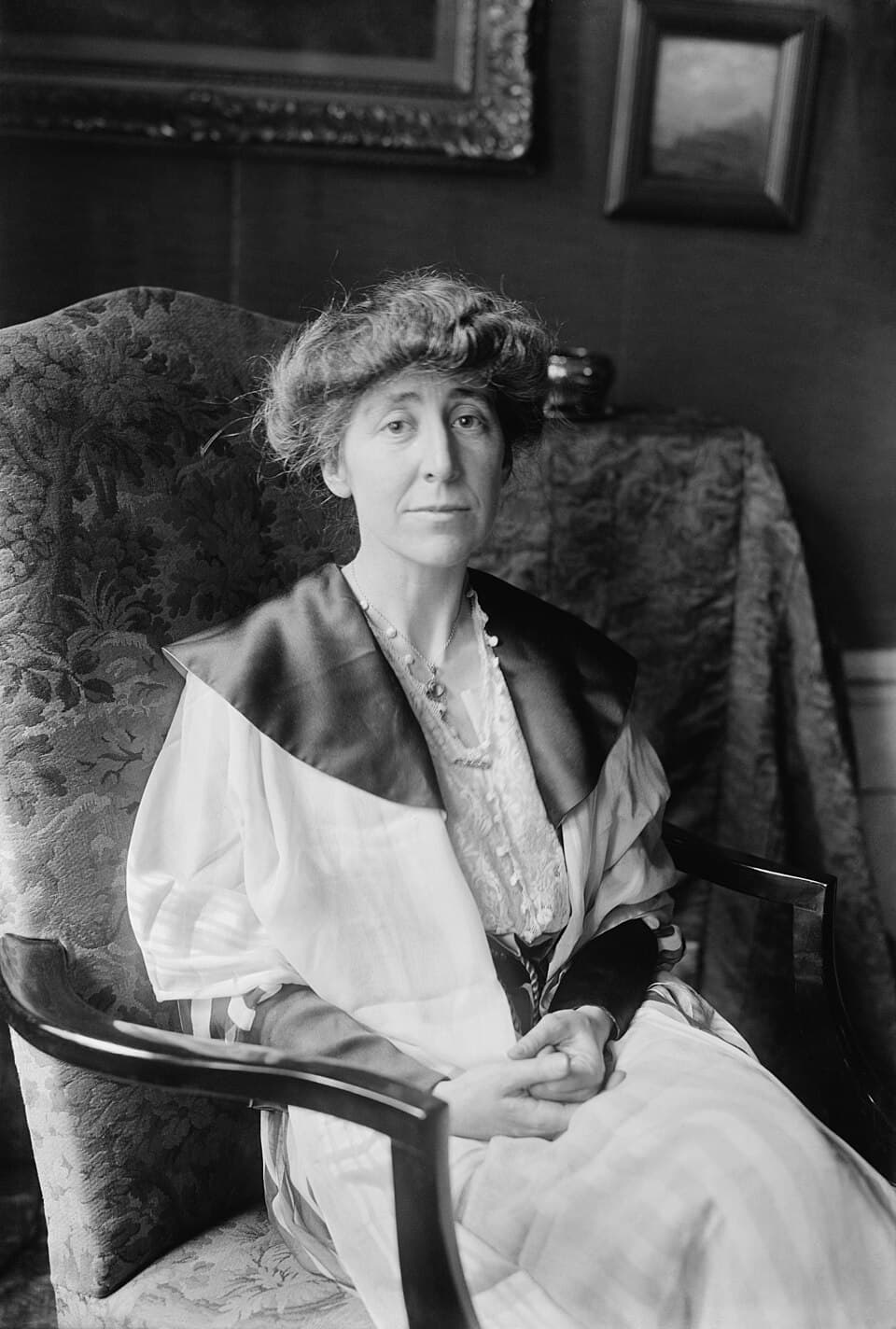
American · Politics · Activism
Jeannette Rankin
June 11, 1880 – May 18, 1973
Early life and education
Jeannette Pickering Rankin was born on June 11, 1880, near Missoula in Montana Territory, to a ranching family. She was the eldest of six children, raised in an environment that fostered practical independence, physical courage, and a habit of self-reliance. Biographical sources consistently describe her childhood on the Montana frontier as formative, because it shaped the confidence and unconventional outlook that later made her an effective reformer and politician. Her father was a rancher and businessman, and her mother was a schoolteacher; the family background combined frontier labor with an appreciation for education and public-mindedness.
Rankin attended the University of Montana, graduating in 1902. After college she explored several directions before settling into reform work. She also studied at the University of Washington and later at the New York School of Philanthropy, an experience that exposed her to professional social welfare work and to the broader urban reform currents of the Progressive Era. Her education and travels connected her frontier upbringing to the national suffrage and reform movements then gaining strength across the United States.
Early activism and woman suffrage leadership
Rankin’s public career began in the woman suffrage movement in the West. She worked in Montana and elsewhere for women’s voting rights and eventually became a leader in the Montana suffrage movement, including service as president of the Montana Women’s Suffrage Association and as a field secretary for the National American Woman Suffrage Association. In the context of early twentieth-century America, this was demanding and often frustrating work. Women activists were expected to persuade legislatures, organize communities, and overcome deeply entrenched cultural assumptions that politics was a male domain.
In 1911, Rankin became the first woman to address the Montana legislature in support of woman suffrage. The exact day of that appearance is not uniformly documented in the sources provided, but the event remains important because it illustrates how she used public speech to move women’s rights from private advocacy into formal political debate. Her efforts helped secure Montana’s woman suffrage legislation in 1914, a major step toward giving women political power in the state.
Rankin’s suffrage work was part of a broader western pattern in which women’s enfranchisement advanced state by state before the Nineteenth Amendment. She understood that political equality depended on both changing law and changing public expectations. Her early activism established the combination of principle, organization, and persistence that later defined her national career.
Historic election to Congress
In 1916, Rankin ran for the U.S. House of Representatives as a Republican from Montana on a platform that emphasized peace, social welfare, and reform. Her victory made her the first woman elected to the U.S. Congress, an achievement that preceded nationwide woman suffrage and broke a barrier no woman had crossed before in federal electoral politics. Montana’s political climate and its recent adoption of woman suffrage helped make the victory possible, but the result still represented a national first.
Rankin’s congressional service began in 1917, when she took her seat in the House and became the first woman to serve in Congress. She entered office at a tense moment, with the United States on the verge of entering World War I. Her first vote, on April 6, 1917, was against declaring war on Germany. She was among the small minority who opposed the measure, and the vote immediately established her as a fearless dissenter. For Rankin, pacifism was not a tactical pose but a core principle that shaped her politics for the rest of her life.
During her first term, Rankin also became a key advocate for woman suffrage at the federal level. She pushed for congressional action on a national suffrage amendment and voted in favor of the proposal that ultimately became the Nineteenth Amendment. Although the exact moment of that vote is not included in the verified dated events here, the broader significance is clear: Rankin used her place in Congress to advance the cause that had helped make her own career possible.
Her first term was brief but transformative. She showed that a woman could hold federal office, participate in floor debate, and vote according to conscience even in wartime. The office she occupied had never before been filled by a woman, and the example she set became part of the foundation for future female political representation in the United States.
Political return, antiwar conviction, and public dissent
After leaving Congress, Rankin remained active in reform and peace work. She continued to support women’s rights, labor concerns, and antiwar activism, and she associated with a broad array of progressive causes. In 1918, she ran for the U.S. Senate in Montana, a candidacy that underscored her ambition and her willingness to challenge political convention. Although she did not win, the campaign demonstrated that women could seek not only the House but the Senate, expanding the range of federal office that women could plausibly contest.
In 1940, Rankin returned to the House by winning election again, becoming once more the only woman in Congress. Her second term began in 1941, placing her in office as the United States moved toward entry into World War II. On December 8, 1941, after Pearl Harbor, she cast the only vote against declaring war on Japan. The vote was one of the most famous dissenting acts in congressional history and effectively ended her congressional service. Rankin’s stand was rooted in the same lifelong pacifism that had shaped her earlier opposition to World War I. It also illustrated the loneliness and moral pressure that came with opposing war in a moment of national emergency.
Rankin’s antiwar positions made her controversial, but they also ensured that she would be remembered as one of the most steadfast pacifists in American political life. Her career linked suffrage, democratic representation, and antiwar conviction in a way few public figures have matched.
Later activism, personal life, and Vietnam-era protest
Rankin never married, and she had no children. Her life was instead organized around public service, reform, and activism. She devoted her later years to peace work and to causes aligned with women’s rights and social justice. She also traveled widely and remained connected to international pacifist networks. Historians note that she studied with and admired figures such as Mahatma Gandhi, reflecting her interest in nonviolent political change.
In 1968, Rankin returned to national visibility when she led a women’s antiwar march in Washington, D.C., often associated with the Jeannette Rankin Brigade. By then she was an elder stateswoman of American dissent, and the march linked the suffrage generation to the Vietnam-era protest movement. The event showed the durability of her reputation and her ability to inspire new generations of women activists. It also underscored a remarkable continuity in her life: from the antiwar vote of 1917 and 1941 to a public march against Vietnam more than half a century later.
Legacy and historical significance
Rankin’s legacy rests on two intertwined achievements: she broke the federal political barrier for women and she did so as an uncompromising pacifist. She was the first woman elected to Congress and the first woman to serve there, and she remains one of the most important pioneers in the history of women’s political representation. Her life demonstrated that a woman from a frontier background could shape national politics, influence suffrage reform, and stand publicly against war even when nearly alone.
Her importance also lies in the way she expanded the meaning of political courage. Rankin did not simply occupy office; she used it to insist that women belonged in the legislative branch and that conviction should not be sacrificed to expedience. For later generations of women candidates, legislators, and activists, she became proof that barrier-breaking could be paired with principle. Her name continues to appear in histories of women’s rights, peace activism, and American democracy because she changed the expectations of what a woman in public life could be.
Rankin died on May 18, 1973, in Carmel, California. By that time her place in history was secure. She had lived through the conquest of woman suffrage, two world wars, and the rise of modern women’s political activism, leaving behind a legacy that still defines the possibilities of women’s participation in American government.
Dated achievements
10 indexed.
- Jun111880Politics
Birth of Jeannette Rankin
Jeannette Rankin was born near Missoula, Montana Territory.
View details Jeannette Rankin Biography - Britannica - Nov071916Politics
Elected to U.S. House of Representatives
First woman elected to the U.S. House of Representatives.
View details