← All women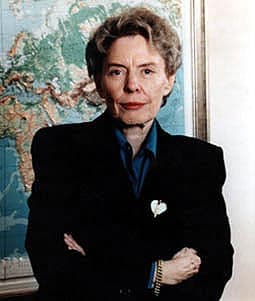
American · Politics · Law
Jeane Kirkpatrick
November 19, 1926 – December 7, 2006
Early Life and Background
Jeane Duane Jordan (later Jeane J. Kirkpatrick) was born on November 19, 1926, in Duncan, Stephens County, Oklahoma.[1][6][7] She was the eldest of two children and the only daughter of Welcher F. Jordan, an oil contractor and drilling specialist, and Leona (Kile) Jordan.[6][7] Growing up in an oil town during the Great Depression and World War II, she experienced first‑hand the economic volatility and social conservatism of mid‑century America, conditions that shaped her understanding of power, class, and political order.[6]
Kirkpatrick’s family relocated during her youth, and she attended Mount Vernon Township High School in Mount Vernon, Illinois, graduating in 1944.[15] As a student she showed strong academic ability and an early interest in politics and government, gravitating toward history and civics. These interests were encouraged by teachers who recognized her intellectual promise, an important factor in her later decision to pursue political science as a profession.[4][7]
After high school, she enrolled at Stephens College, a women’s college in Columbia, Missouri, where she earned an associate’s degree (A.A.) in 1946.[7] Stephens exposed her to a community of ambitious women students and faculty at a time when women’s higher education was still relatively rare, reinforcing her belief that women could and should participate fully in public life.[7] The combination of a small‑town upbringing and a rigorous women’s college education laid the groundwork for her later embrace of both feminist rhetoric and conservative politics.
Education and Intellectual Formation
Following Stephens College, Kirkpatrick transferred to Barnard College, the women’s college affiliated with Columbia University in New York City, where she completed a B.A. in political science in 1948.[2][6][7] At Barnard she was exposed to leading scholars in political science and international relations, and to the cosmopolitan intellectual climate of postwar New York. This environment deepened her interest in political theory, comparative government, and the study of democracy and authoritarianism.[4][6]
She continued her studies at Columbia University, earning an M.A. in political science in 1950.[2][6][7] Her graduate work focused on political parties and democratic institutions, themes that would recur throughout her scholarly and policy career.[4] In 1952–1953 she pursued additional postgraduate studies at the Institut de Science Politique
Kirkpatrick completed her doctoral studies later, receiving a Ph.D. in political science from Columbia University in 1967–1969, with sources differing slightly on the exact year.[2][7] Her dissertation examined the dynamics of democratic processes and party competition, reflecting her long‑standing interest in how institutions mediate social conflict. The Ph.D. marked her transition from student to professional political scientist, positioning her for a career in academia and, ultimately, public service.[4][8]
Career Beginnings and Academic Work
Before fully entering academia, Kirkpatrick held various positions related to research and teaching. She worked for the American Political Science Association and was involved in studies of political organizations and voter behavior.[7] In the early 1960s she joined the faculty of Trinity College in Washington, D.C., as an assistant professor of political science, teaching courses on government and international relations.[15] This period allowed her to refine her teaching skills and begin building a publication record.
In 1967 she moved to Georgetown University, where she served as an associate professor of political science and subsequently as a full professor.[8][15] Georgetown, located in the heart of Washington, D.C., provided a crucial bridge between academia and the world of policy. Kirkpatrick’s research focused on political parties, democratic transitions, and comparative government, and she published scholarly articles and essays in leading journals and edited volumes.[4][8]
By the late 1970s she had become a prominent figure in American political science. She was appointed the Thomas and Dorothy Leavey Professor of Government at Georgetown, a position she would hold intermittently between 1978 and 2002.[8][15] She also became a senior fellow at the American Enterprise Institute (AEI), a conservative think tank, in 1978.[8][15] AEI gave her a platform to engage directly with public policy, contributing to debates about U.S. foreign policy, democracy promotion, and the role of the United States in the world.[8][14]
“Dictatorships and Double Standards” and the Path to Power
Kirkpatrick’s rise to national prominence came with the publication of her 1979 essay “Dictatorships and Double Standards” in Commentary, though the article itself is typically dated only by year.[1][4][6] In this widely discussed piece, she criticized the Carter administration’s emphasis on human rights and argued that the United States should distinguish between "authoritarian" and "totalitarian" regimes. Authoritarian governments, she contended, might be reformed or democratized over time, whereas revolutionary totalitarian regimes posed a more fundamental and irreversible threat to freedom and U.S. interests.[1][4]
The essay attracted the attention of Ronald Reagan and his advisers, who were looking for intellectual frameworks to justify a more assertive anti‑Communist foreign policy. Kirkpatrick’s arguments aligned closely with emerging neoconservative thought, which combined skepticism about radical social change with a belief in the strategic necessity of confronting the Soviet Union and its allies.[1][4][14] Her work helped legitimize the idea that supporting certain non‑democratic but anti‑Communist regimes could be morally and strategically defensible, a position that would later be associated with the "Kirkpatrick Doctrine."[1][4]
In 1980, Kirkpatrick served as a foreign policy adviser to Reagan’s presidential campaign, formally bringing her into Republican politics despite her long identification as a Democrat.[1][2][6] Her role in the campaign raised her national profile and demonstrated the growing influence of academic intellectuals—particularly neoconservatives—on conservative political strategy.[4][8]
First Woman U.S. Ambassador to the United Nations
On February 4, 1981, shortly after Reagan’s inauguration, he appointed Jeane J. Kirkpatrick as United States Permanent Representative to the United Nations, with cabinet rank.[1][2][12] This appointment made her the first woman to serve as chief U.S. representative at the UN, a landmark in both diplomatic and women’s history.[1][2][6]
As ambassador, Kirkpatrick served from 1981 to 1985, a period marked by heightened Cold War tensions, controversies over human rights, and intense debates over U.S. interventions in Central America and elsewhere.[1][2][5][6] She became known for forceful speeches defending U.S. positions and strongly criticizing Soviet and Cuban actions, as well as for opposing UN resolutions she viewed as biased against Israel or the United States.[1][2]
Kirkpatrick was not only the U.S. voice at the UN but also a central figure in the Reagan administration’s internal foreign policy debates. As a cabinet member, she participated in meetings of the National Security Council and served on the President’s Foreign Intelligence Advisory Board and the Defense Policy Review Board.[8][12] Her views sometimes clashed with those of Secretary of State Alexander Haig and other officials, especially over strategies in Central America, but her intellectual influence remained substantial.[1][4]
Major Ideas and Policy Influence
Kirkpatrick’s foreign policy philosophy has often been summarized as the “Kirkpatrick Doctrine.”[1][4] She argued that the United States should differentiate between friendly authoritarian regimes and hostile totalitarian regimes, supporting the former when they aligned with U.S. interests while working gradually to encourage liberalization. She opposed policies that, in her view, destabilized pro‑American governments and facilitated the rise of Marxist or revolutionary movements.[1][4]
In practice, this often meant backing governments in Latin America and elsewhere that were criticized for human rights abuses but were seen as bulwarks against Soviet influence. Kirkpatrick defended U.S. support for such regimes on the grounds that the alternative—revolutionary governments aligned with Moscow or Havana—would be worse for both U.S. interests and local populations.[1][4][11] Her stance provoked intense debate among human rights advocates and liberal critics, who argued that it sacrificed moral consistency for strategic expediency.
Within the Reagan administration, Kirkpatrick’s ideas helped shape the broader Reagan Doctrine, which called for supporting anti‑Communist movements and governments worldwide.[1][9] She worked closely with other conservative intellectuals and policymakers to articulate a vision of U.S. leadership that emphasized military strength, ideological clarity, and a willingness to confront the Soviet Union rhetorically and materially. Her influence extended beyond formal policy documents into speeches, op‑eds, and academic work, contributing to the intellectual climate of the 1980s.[4][8]
Awards, Honors, and Later Government Service
Kirkpatrick’s government service brought significant recognition. In 1985, while she was still serving as UN ambassador, she received the Presidential Medal of Freedom, the highest civilian honor in the United States.[1][6][11] President Reagan presented the medal on May 9, 1985, citing her "clarity and courage" in defending American interests and her contributions to the struggle against Communism.[6][11]
After leaving the UN in 1985, Kirkpatrick remained active in national security discussions. She continued to serve as a member of the President’s Foreign Intelligence Advisory Board until about 1990 and on the Defense Policy Review Board until the early 1990s.[4][8][12] In 1992, she received the Department of Defense Distinguished Public Service Medal for her contributions to defense and national security policy, though sources typically list this honor by year only.[11]
Outside of formal government roles, she served on the Board of Directors of the Council on Foreign Relations from 1985 to 1994 and became its vice chair, reflecting the esteem in which she was held in foreign policy circles.[8] She also authored several books and numerous articles, including Good Intentions: Lost on the Road to the New World Order, which critiqued post–Cold War multilateralism and warned against overreliance on international institutions.[8][9]
Return to Academia and Public Commentary
After her UN tenure, Kirkpatrick returned to Georgetown University in 1986, resuming her position as the Leavey Professor of Government.[8] She taught there until 2002, influencing generations of students in courses on international relations, comparative politics, and U.S. foreign policy. Her teaching combined rigorous theoretical analysis with insights from her practical experience in diplomacy, making her classes highly sought after.[8][15]
Throughout this period, she remained a senior fellow at the American Enterprise Institute, contributing to research projects, conferences, and public debates on foreign and domestic policy.[8][15] She also wrote a syndicated column for the Los Angeles Times for about eleven years, providing commentary on international events and American politics to a broad readership.[8]
Kirkpatrick continued to describe herself as a lifelong feminist, even as her conservative positions and support for Reagan alienated many activists within the organized women’s movement.[3][14] She argued that feminism should focus on expanding women’s access to positions of power, and she encouraged women to pursue high political office. Nonetheless, she declined opportunities to be considered for the Republican vice presidential nomination in the 1980s, preferring to remain in roles more closely tied to foreign policy and analysis.[3]
Personal Life
On February 20, 1955, Jeane Jordan married Evron M. Kirkpatrick, a political science professor and later executive director of the American Political Science Association.[7] The marriage was a partnership of two political scientists, and Evron’s own work in party politics complemented Jeane’s scholarly and policy interests. They remained married until his death in 1995.[3][7]
The couple had three sons: Douglas Jordan, John Evron, and Stuart Alan
Kirkpatrick’s religious and cultural background was rooted in Protestant Christianity and Midwestern values, and she often expressed concern about moral decline and cultural relativism in public life. These views informed her skepticism about certain strands of liberalism and her support for policies that she believed would strengthen Western democratic civilization.[4][11] For much of her early adult life, Kirkpatrick identified as a Democrat, influenced by New Deal liberalism and mid‑century Democratic commitments to social welfare and civil rights.[1][4][7] Over time, however, she became disillusioned with what she saw as the party’s drift toward dovish foreign policy and radical social movements. Her critique of the Carter administration’s human rights approach and her embrace of a hardline anti‑Communist stance placed her increasingly at odds with mainstream Democratic positions.[1][4] By 1985, she formally switched to the Republican Party, cementing her place within the emerging neoconservative wing of the GOP.[1] She supported Reagan’s military buildup, skepticism toward arms control agreements she considered overly accommodating, and assertive promotion of U.S. interests abroad. Her ideological evolution from liberal Democrat to conservative Republican exemplified broader shifts among intellectuals in the late 20th century, many of whom moved rightward in response to the New Left and perceived weaknesses in liberal foreign policy.[1][4][14] Kirkpatrick’s legacy is multifaceted. She is widely remembered as the first woman to serve as U.S. ambassador to the United Nations, a milestone in women’s political and diplomatic history.[1][2][6] Her success in a role traditionally dominated by men helped demonstrate that women could occupy—and thrive in—top national security positions, influencing subsequent generations of female diplomats and policymakers.[2][11][14] As a political theorist and strategist, she helped articulate a vision of U.S. foreign policy that prioritized anti‑Communism and strategic alliances over a universal, immediate application of human rights standards. Her distinction between "authoritarian" and "totalitarian" regimes and her advocacy for supporting friendly authoritarians left a lasting imprint on debates about democracy promotion and U.S. relations with non‑democratic states.[1][4] Critics have argued that this approach contributed to U.S. support for regimes implicated in serious human rights abuses, while supporters contend that it helped contain Soviet influence and paved the way for eventual democratic transitions in some countries.[1][4][11] Within the broader history of feminism and women’s political engagement, Kirkpatrick occupies a complex place. She used the language of feminism to encourage women to seek power but often opposed positions favored by mainstream feminist organizations, particularly on issues of social policy and nuclear disarmament.[3][14] Her career illustrates that women’s political identities are diverse and that female leadership in foreign policy has emerged across the ideological spectrum. Kirkpatrick also had a lasting impact on institutions. The Jeane J. Kirkpatrick Chair in National Security Studies at the Council on Foreign Relations commemorates her contributions and supports ongoing work on defense and security issues.[8] Her books, essays, and public speeches continue to be studied by scholars of international relations, political theory, and U.S. foreign policy, and biographies such as Political Woman: The Big Little Life of Jeane Kirkpatrick explore her influence and contradictions.[9][14] In her later years, Kirkpatrick remained active as a scholar and commentator, though she gradually reduced her teaching load. She continued to write and speak on foreign policy, criticizing what she saw as naïve approaches to international institutions and warning against complacency in defending Western democratic values.[8][11] On December 7, 2006, Jeane J. Kirkpatrick died in Bethesda, Maryland, from congestive heart failure related to heart disease, at the age of 80.[1][2][10][15] Obituaries in major newspapers and tributes from academic and policy institutions highlighted her role as a pioneering female diplomat, influential neoconservative thinker, and central figure in the foreign policy of the Reagan era.[1][3][13] Her death closed a chapter in the history of Cold War policymaking but left behind unresolved debates about the ethics and effectiveness of the strategies she advocated. In the years since her death, Kirkpatrick’s life and work have continued to be reassessed. Scholars examine her as a case study in the intersection of gender, ideology, and power; policy analysts consider the long‑term consequences of her approach to authoritarian regimes; and women’s history researchers note her significance as one of the few women to hold a cabinet‑level foreign policy post in the early 1980s.[2][7][11][14] Through these ongoing discussions, Jeane J. Kirkpatrick remains an important figure in understanding both the evolution of U.S. foreign policy and the expanding, contested role of women within it.Political Realignment and Ideological Stance
Legacy and Historical Impact
Later Life and Death
Dated achievements
4 indexed.
- Nov191926Politics
Birth in Duncan, Oklahoma
Jeane Duane Jordan (later Kirkpatrick) was born in Duncan, Oklahoma, to an oil-drilling family on the American frontier.
View details Jeane Kirkpatrick - Wikipedia - Feb041981Politics
Appointed first female U.S. Permanent Representative to the United Nations
President Reagan appointed Jeane Kirkpatrick as U.S. Ambassador to the UN, making her the first woman to hold this position and a cabinet-level post.