← All women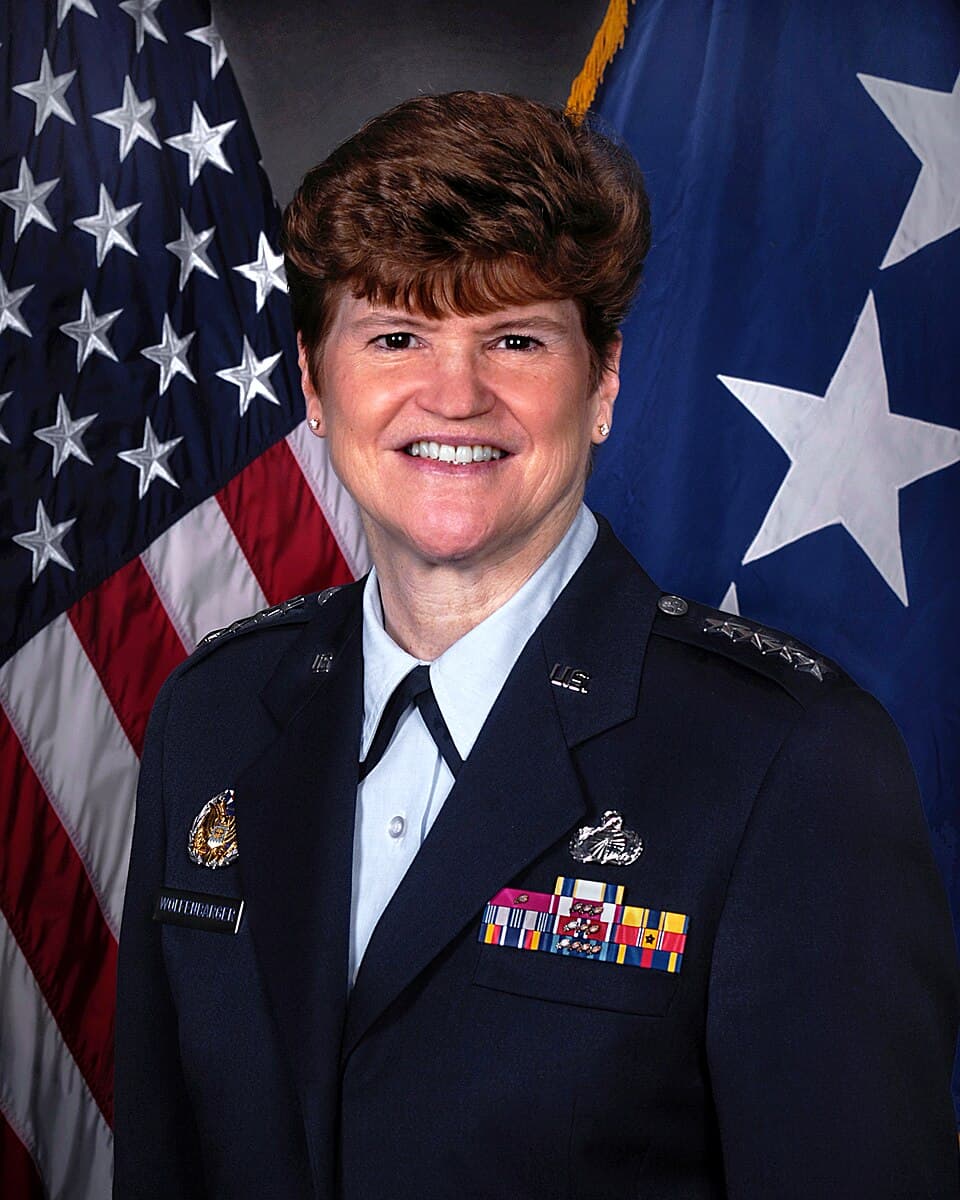
American · Aviation · Science
Janet Wolfenbarger
January 1, 1958 – present
Early Life and Background
Janet Carol Wolfenbarger (née Libby) was born in 1958 in Tampa, Florida, in a period when women were largely excluded from the highest levels of the U.S. military and from its service academies.[1][4] Although specific details of her family background are not widely documented in public sources, she spent most of her youth in Ohio, graduating from Beavercreek High School in 1976.[8] Growing up near Dayton, a city strongly associated with aviation through the legacy of the Wright brothers and the presence of Wright‑Patterson Air Force Base, she was immersed in a regional culture that valued aerospace innovation and military service.
By the mid‑1970s, national debates over gender equality and the role of women in the armed forces were reshaping opportunities for young women. In 1976, the United States service academies opened their doors to female cadets for the first time. Wolfenbarger was among the first cohort of 157 women admitted to the U.S. Air Force Academy (USAFA) in Colorado Springs that year.[3][9] Entering an institution that had previously been male‑only, she faced the dual challenge of meeting demanding academic and physical standards while navigating an environment adjusting to rapid cultural change.
Education and Formative Influences
At the Air Force Academy, Wolfenbarger studied engineering sciences, a discipline that provided a strong foundation in mathematics, physics, and applied engineering. She graduated in 1980 with a Bachelor of Science degree, as part of the Academy’s first graduating class to include women.[1][4][8] Only 97 women were among nearly 900 graduates, underscoring how small the pioneering group remained within the broader officer corps.[8] Upon graduation she was commissioned as a second lieutenant in the United States Air Force.[2][8]
Her academic trajectory demonstrated a sustained commitment to technical expertise. In the mid‑1980s she attended the Massachusetts Institute of Technology (MIT), earning a Master of Science degree in aeronautics and astronautics, reported in official biographies as completed in 1985.[2][6] This program strengthened her knowledge of aircraft design, propulsion, and systems engineering, positioning her for roles in the Air Force’s acquisition and development organizations. Later, in 1994, she completed a Master of Science in national resource strategy at the Industrial College of the Armed Forces (now part of the National Defense University), adding training in strategic planning, budgeting, and defense industrial policy.[2][7]
These educational experiences, coupled with professional military education such as Squadron Officer School and Air Command and Staff College, equipped Wolfenbarger with an unusually strong blend of technical and strategic skills. This combination would become central to her authority as she moved into senior roles overseeing complex weapons programs and, eventually, a major command.
Career Beginnings in Acquisition and Engineering
Commissioned in 1980, Wolfenbarger began her Air Force career in acquisition as an engineer at Eglin Air Force Base, Florida.[1][2][7] Working in the acquisition field meant she was responsible for planning, developing, and procuring systems that would be used across the service. Early assignments accustomed her to the intricate collaboration between engineers, operators, and industry that underpins modern airpower.
She later held a variety of assignments at headquarters Electronic Security Command and Air Force Systems Command, organizations responsible for electronic warfare, surveillance, and systems development.[2] These roles exposed her to emerging technologies and complex program management challenges. As she progressed through the ranks—reaching major roughly a decade out of the Academy and lieutenant colonel three years later—Wolfenbarger increasingly took on leadership responsibilities for teams managing sophisticated aircraft and systems.[8]
Her career path diverged from the more common route to senior Air Force leadership, which traditionally ran through fighter or bomber operational commands. Instead, she built a reputation in the technical and acquisition communities, a path that would later prove crucial as the Air Force confronted major modernization and sustainment issues.
Development of Major Program and Command Roles
By the late 1990s and early 2000s, Wolfenbarger’s assignments placed her at the center of some of the Air Force’s most important weapons programs. She served as chief of an F‑22 subsystems team, chief of a B‑2 air vehicle team, and later as commander of the C‑17 Systems Group at Wright‑Patterson Air Force Base.[2][8] These positions involved oversight of advanced fighter, bomber, and cargo aircraft—systems critical to air superiority, strategic deterrence, and global mobility.
Her work on the F‑22 Raptor program, in particular, demonstrated her ability to manage high‑technology projects under intense scrutiny. The F‑22 combined stealth, supercruise, and advanced avionics, making it one of the most complex aircraft ever developed. The Smithsonian National Portrait Gallery later highlighted her "deep knowledge of engineering, aeronautics, program management, and logistics" in furthering the development and fielding of the F‑22 weapon system.[4] Her leadership contributed to the aircraft’s eventual operational deployment as a cornerstone of U.S. air superiority.
Wolfenbarger’s command of the C‑17 Systems Group underscored her versatility. The C‑17 Globemaster III is a large transport aircraft vital for rapid strategic airlift and humanitarian operations. Managing its systems required coordinating with operators, maintenance personnel, and contractors to ensure reliability and performance. These roles at Wright‑Patterson, where she worked from June 1997 to July 2005, deepened her ties to the Dayton region and to the broader logistics and sustainment enterprise of the Air Force.[8]
Senior Leadership: Pentagon and AFMC
As she rose to colonel and beyond, Wolfenbarger moved into senior leadership positions. After pinning on colonel, she directed the B‑2 Spirit System Program Office and commanded the C‑17 Systems Group in the Mobility Systems Wing at Wright‑Patterson.[2][9] These commands demonstrated her ability to lead large organizations and manage high‑profile programs.
Her growing expertise in acquisition led to key Pentagon assignments. She served as the Service’s Director of the Acquisition Center of Excellence, and later as the Military Deputy to the Assistant Secretary of the Air Force for Acquisition
In 2009, Wolfenbarger became vice commander of Air Force Materiel Command (AFMC), headquartered at Wright‑Patterson.[9] AFMC manages research laboratories, test centers, logistics complexes, and program offices, employing tens of thousands of personnel. As vice commander, she helped guide the command through organizational changes and ongoing support to global operations. Her progression from vice commander to commander would soon mark a turning point in the history of women’s leadership in the Air Force. On May 30, 2012, President Barack Obama nominated Wolfenbarger for promotion to four‑star general, an event later commemorated by the Air Force Academy as a key milestone.[11] A few days later, on June 5, 2012, she assumed command of Air Force Materiel Command at Wright‑Patterson, becoming the eighth commander of AFMC.[1] With this command, she achieved two historic firsts: she became the first woman to lead an Air Force major command and the first female four‑star general in the United States Air Force
AFMC, one of the Air Force’s largest major commands, oversees research, development, acquisition, and sustainment of weapon systems, employing approximately 80,000 people and managing tens of billions of dollars in annual resources.[12] As its commander, Wolfenbarger held responsibility for ensuring that the Air Force’s technological edge, logistical readiness, and industrial relationships remained strong. Her technical background and prior program leadership made her particularly well suited to the role. Her four‑star promotion also placed her in a unique position within the armed forces: at that time, she was the only active‑duty woman with four‑star rank and only the second woman in any branch of the U.S. military to attain four stars
Wolfenbarger commanded AFMC from June 5, 2012, to June 8, 2015, guiding the organization through ongoing conflicts, budget pressures, and modernization efforts.[1] Her tenure encompassed efforts to sustain aging fleets, field advanced systems, and streamline acquisition processes, and she continued to advocate for rigorous program management and logistics. Throughout her career, Wolfenbarger received numerous military decorations, including the Air Force Distinguished Service Medal and the Legion of Merit with oak leaf cluster
In the civilian sphere, her achievements drew significant recognition. On April 26, 2013, Wright State University awarded her an honorary Doctor of Science degree, describing the honor as another milestone for the Air Force’s first female four‑star general.[7] The degree acknowledged her impact on science, technology, and public service, particularly in the Dayton region where AFMC is headquartered. In March 2016, she was inducted into Women in Aviation International’s Pioneer Hall of Fame during the organization’s 27th Annual International Women in Aviation Conference.[14] The Hall of Fame honors individuals who have helped expand opportunities for women in aviation, and Wolfenbarger’s induction placed her in a select group of pioneers whose careers reshaped the field. The Smithsonian National Portrait Gallery also created a portrait and biographical entry highlighting her role in the first class of women to graduate from the Air Force Academy and her groundbreaking four‑star promotion.[4] General Wolfenbarger retired from the U.S. Air Force on July 1, 2015, after more than 35 years of service.[12][1] Her retirement concluded her tenure as AFMC commander but did not end her involvement in national security and STEM leadership. Immediately afterward, she joined the Board of Directors of AECOM, a global infrastructure and engineering firm, on August 1, 2015.[12] Her experience in large‑scale program management and logistics translated naturally into corporate governance. She later served as an independent director at KPMG LLP from 2018 to 2023 and took on roles with organizations such as the Falcon Foundation, which supports the Air Force Academy, and FIRST (For Inspiration and Recognition of Science and Technology), a nonprofit promoting youth engagement in robotics and STEM fields.[5][10] In 2020 she became a member of the MIT Corporation, the governing body of MIT, reflecting the institution’s recognition of her contributions and connection to its aeronautics program.[5][10] Her corporate and nonprofit roles extended her influence into education, industry, and youth outreach, helping shape environments in which future engineers, scientists, and military officers—both women and men—would train and work. On June 9, 2016, the Department of Defense announced that Wolfenbarger had been appointed as chairperson of the Defense Advisory Committee on Women in the Services (DACOWITS)
Her appointment came during a period of major policy shifts, as the U.S. military was moving toward full integration of women into combat positions and reexamining longstanding gender‑based restrictions. As chair, Wolfenbarger brought both historical perspective—having entered the Academy when women were first admitted—and practical experience from commanding a major Air Force organization. The Smithsonian notes that she began an "unprecedented" five‑year tenure as DACOWITS chair after her retirement, emphasizing the committee’s importance in shaping gender integration policy.[4] In this capacity, Wolfenbarger helped oversee studies and recommendations that influenced how the services addressed issues such as standards, assignments, and support structures for women. Her role at DACOWITS expanded her impact beyond aviation into the broader landscape of women’s military service, making her a key figure in both the operational and policy dimensions of gender integration. Public sources provide limited detail about Wolfenbarger’s private life, reflecting both operational security and personal privacy considerations common among senior military leaders. Biographical entries consistently note her maiden name, Libby, indicating that she married and took the surname Wolfenbarger, but do not extensively document her family arrangements.[1][4] Information about children or spouse’s background is not widely available in major institutional profiles. Her long association with Beavercreek and the Dayton area, however, suggests deep regional roots and relationships. She is frequently featured in local news and institutional materials associated with Wright‑Patterson Air Force Base, Wright State University, and regional aerospace history.[7][8] These ties highlight how her personal and professional lives have been intertwined with communities centered on aviation and the Air Force. Janet C. Wolfenbarger’s legacy in women’s history, military history, and aviation is multifaceted. She was one of the first women admitted to the U.S. Air Force Academy in 1976 and among the first to graduate in 1980, demonstrating that women could succeed in a demanding military and engineering environment during its initial stages of coeducation.[3][4][8] Her subsequent career showed that these early trailblazers were not symbolic additions but could rise to the highest levels of leadership. Her promotion in 2012 made her the first female four‑star general in the Air Force and the first woman to command an Air Force major command
Beyond rank, Wolfenbarger’s work on major programs such as the F‑22, B‑2, and C‑17 contributed to the operational capabilities of the Air Force in the late 20th and early 21st centuries.[2][4][8] Her leadership in AFMC affected research, development, logistics, and sustainment across the service, influencing how the Air Force manages its technological edge and industrial base. Her post‑retirement roles at AECOM, KPMG, FIRST, the Falcon Foundation, and the MIT Corporation extended her impact into corporate governance, STEM education, and institutional leadership.[5][10] As DACOWITS chair, she helped shape policies that continue to affect women’s experiences in all branches of the armed forces.[4][13] In museums, academic institutions, and professional associations, Wolfenbarger is frequently cited as a trailblazer who helped "prove that women can not only survive, but thrive" in the demanding environment of the Air Force Academy and the wider military.[4] Her career is used in leadership training materials and public histories to illustrate the importance of perseverance, technical competence, and inclusive policy in achieving institutional change. As of the mid‑2020s, Wolfenbarger remains active in governance and advisory roles, including her membership on the MIT Corporation and board positions in corporate and nonprofit organizations.[5][10] She continues to be associated with efforts to promote STEM education and leadership development, particularly among youth and within communities connected to the Air Force Academy. Her ongoing public service underscores a common trajectory among barrier‑breaking women: after achieving historic firsts within their original professions, they often move into roles that shape the broader ecosystems of education, industry, and public policy. In Wolfenbarger’s case, her influence now extends across military, corporate, and academic domains, reinforcing her status as a significant figure in the continuing story of women in science, engineering, and military leadership.First Female Four‑Star General and MAJCOM Commander
Awards, Honors, and Recognition
Retirement and Later Civilian Career
Leadership in Gender Integration and Policy: DACOWITS
Personal Life
Legacy and Historical Impact
Later Life and Ongoing Contributions
Dated achievements
9 indexed.
- Jan011958Science
Birth in Tampa, Florida
Janet Carol Libby was born in Tampa, Florida, later becoming the first woman to reach four-star general rank in the U.S. Air Force.
View details Janet C. Wolfenbarger - Wikipedia - May302012Science
Nominated for promotion to four-star general
President Obama nominated Janet C. Wolfenbarger for promotion to four-star general, setting up her historic rise to the Air Force's top rank.