← All women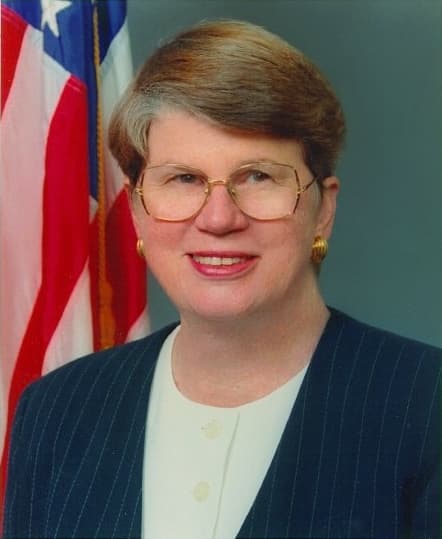
American · Law · Politics
Janet Reno
July 21, 1938 – November 7, 2016
Early Life and Family Background
Janet Wood Reno was born on July 21, 1938, in Miami, Florida, on the edge of the Everglades, to parents whose unconventional careers and values profoundly shaped her outlook on life and law.[1][3][17] Her father, Henry Olaf Reno, was a Danish‑born police reporter for the Miami Herald, known for his coverage of crime and law‑enforcement. Her mother, Jane Wood Reno, was an investigative journalist who later became a nature columnist and homesteader, building their family home herself in the then‑rural Redlands area.[1][8][11]
Reno grew up in a relatively modest household that prized curiosity, independence, and public service. Her mother’s decision to design and construct the family house, while raising four children, gave Reno an early model of a woman defying traditional gender roles. Her father’s work as a crime reporter exposed her to the workings of the justice system and the realities of policing. These experiences instilled in Reno a respect for evidence, fairness, and plain speaking—qualities that would later define her public persona.[1][8]
Raised near the Everglades, Reno developed a deep affection for Florida’s environment and a pragmatic appreciation of rural life. She attended local schools and excelled academically, preparing to enter higher education at a time when relatively few women pursued demanding scientific or legal careers.[1][3]
Education and Formative Influences
In 1956, Reno left Florida to attend Cornell University, where she majored in chemistry.[6][5] She received her A.B. degree in 1960, a scientific training that reinforced her analytical approach and respect for empirical evidence.[5][7] At Cornell she encountered rigorous academic expectations and broadened her understanding of national politics and social change, including early conversations about civil rights that would inform her later work.
Reno then entered Harvard Law School, one of the most prestigious but male‑dominated legal institutions in the United States. She graduated in 1963 with an LL.B., in a class that contained only sixteen women among more than 500 students.[2][5][13] Navigating this environment required resilience in the face of pervasive gender bias and limited support networks for women. Reno later recalled that the experience toughened her and taught her to focus on substance rather than social expectations.
Her legal education coincided with major shifts in American law, including the Warren Court’s expansion of due‑process rights and growing attention to civil rights. Exposure to these developments at Harvard informed Reno’s long‑term commitment to fairness and procedural integrity in criminal justice.[7]
Early Legal Career in Florida
After graduating, Reno returned to Florida and began practicing law in Miami. She first worked in private practice before moving into public service, reflecting her interest in using law to “make things work” for ordinary people rather than simply to litigate disputes.[7][11] In 1971, she was appointed staff director of the Judiciary Committee of the Florida House of Representatives, a key role in which she helped lead a comprehensive revision of the state’s court system.[7][18]
As staff director, Reno focused on improving the efficiency, accessibility, and fairness of Florida’s judiciary. She was heavily involved in reorganizing court structures and updating statutes, particularly around juvenile justice. Her work earned a reputation for diligence and clarity, and it demonstrated her capacity to navigate complex institutional reforms in a male‑dominated legislative environment.[7]
Reno later left the legislative post and returned to the world of prosecution. She joined the Dade County State Attorney’s Office, working under State Attorney Richard Gerstein on felony prosecutions.[7][18] After a period in private practice with Steel, Hector & Davis from 1976 to 1978, she came back to public service—this time poised to lead it.[7]
State Attorney for Dade County: Breaking Barriers
On February 8, 1978, Governor Reubin Askew appointed Janet Reno state attorney for Dade County, encompassing Miami and its surrounding communities.[1][11] Her appointment made her the first woman to head a county prosecutor’s office in Florida, breaking a significant barrier in an era when women rarely led law‑enforcement institutions.[1][2][6]
Later that year, on November 7, 1978, Reno won election to the office in her own right.[1][11] She would go on to be re‑elected four more times through the 1980s and early 1990s, serving as Dade County state attorney until 1993.[5][7] In this role she oversaw thousands of criminal prosecutions, managed a large staff, and became known for a tough yet reform‑minded approach.
Reno earned a reputation for personally visiting crime scenes, talking directly with law‑enforcement officers, and making charging decisions rooted in both legal standards and community impact. She was notably involved in cases dealing with public corruption and violent crime, but she was also deeply concerned with systemic issues affecting children and families.[11][18]
During the late 1980s and early 1990s, Reno helped develop innovative approaches to criminal justice in Miami. She was a key supporter of one of the nation’s pioneering drug courts, designed to address addiction through supervised treatment rather than solely incarceration.[7][2] She also pushed for improvements in juvenile justice and child‑support enforcement, arguing that long‑term public safety required attention to family stability and youth opportunities. These programs reflected her belief that justice should be both firm and humane.
Nomination and Confirmation as U.S. Attorney General
In early 1993, President Bill Clinton sought a new Attorney General of the United States. After earlier nominees encountered confirmation difficulties, Clinton turned to Reno, impressed by her record as a local prosecutor and reformer.[4][7] On February 11, 1993, he formally nominated her to the post, making clear that she would, if confirmed, become the first woman to lead the Department of Justice.[4][1]
Reno’s confirmation hearings showcased her unvarnished style. Senators from both parties noted her direct answers and apparent independence from Washington political culture. On March 11, 1993, the U.S. Senate confirmed her by a unanimous vote of 98–0, a rare show of bipartisan support for a Cabinet‑level appointee.[1][7]
The following day, on March 12, 1993, Reno was sworn in as the 78th Attorney General of the United States, becoming the first woman in American history to hold the office.[5][4][3] The Department of Justice’s official biography later emphasized that she became the longest‑serving U.S. attorney general of the twentieth century, holding the position through the end of the Clinton administration in January 2001.[5][13]
Tenure as Attorney General (1993–2001)
As attorney general, Reno oversaw a broad portfolio that included federal criminal prosecutions, civil rights enforcement, antitrust actions, and the coordination of law‑enforcement agencies such as the FBI and DEA. Her tenure coincided with significant events in domestic terrorism, high‑profile criminal cases, and expanding concerns about cybercrime.
One of the earliest and most controversial episodes of her tenure was the Branch Davidian siege near Waco, Texas. The 51‑day standoff with followers of David Koresh ended on April 19, 1993, when a federal operation authorized by Reno culminated in a fire that killed more than 70 people.[17] She publicly accepted responsibility for the decision to approve the FBI’s plan and testified extensively before Congress. Waco became a defining and contested aspect of her legacy, fuel for critics concerned about federal overreach, but also a case study in the complexities of confronting heavily armed groups.
Reno’s tenure was also marked by the rise of domestic terrorism. On April 19, 1995, the bombing of the Alfred P. Murrah Federal Building in Oklahoma City killed 168 people and injured hundreds more.[11][17] Under Reno’s leadership, the Department of Justice directed the investigation and prosecution of Timothy McVeigh and accomplice Terry Nichols. The successful federal case against McVeigh, leading to his conviction and execution, illustrated the ability of the criminal justice system to respond to large‑scale terrorism, and it influenced subsequent legal frameworks for handling such threats.[11][7]
Reno also oversaw responses to numerous other high‑profile matters, including complex cases involving international crime, public corruption, and civil rights. She supported efforts to modernize the FBI’s approach to technology and cybercrime, recognizing that emerging digital threats required new tools and legal strategies.[7][8]
In the realm of civil rights, Reno’s Justice Department pursued cases involving police misconduct, voting rights, and discrimination in employment and housing. She emphasized that enforcement should be grounded in careful investigation and respect for due process, while firmly upholding federal statutes designed to protect marginalized communities.[7][11]
Juvenile Justice and Systemic Reform
Throughout her career and continuing as attorney general, Reno maintained a strong focus on children and youth. She frequently argued that the justice system needed to do more than punish; it needed to prevent crime by supporting families, education, and mental health services.[2][19] Her earlier work on Florida’s juvenile code and later efforts at the federal level helped spur reforms in juvenile courts and detention practices.
Reno convened and supported task forces on youth violence and juvenile justice, advocating for research‑based strategies and better coordination among federal, state, and local agencies.[19] She highlighted the importance of early intervention in cases of child abuse and neglect, and she worked to improve collaboration between social services and law‑enforcement.
Her emphasis on juvenile justice reflected both personal conviction and broader shifts in thinking about crime and punishment in the late twentieth century. She championed approaches that treated young offenders as capable of rehabilitation, influencing policy debates and contributing to the development of more nuanced youth‑justice frameworks.[2][19]
The Elián González Case and Immigration Controversies
In 2000, Reno’s commitment to legal principle was tested in the highly publicized Elián González case. Elián, a young Cuban boy who survived a dangerous journey by sea in which his mother died, became the subject of a custody dispute between relatives in Miami and his father in Cuba. After immigration and family‑law determinations favored reunification with his father, Reno faced intense political pressure from Cuban‑American groups and some U.S. politicians who opposed returning the child to Cuba.[17]
On April 22, 2000, Reno authorized a federal raid in Miami to seize Elián from his relatives’ home so he could be reunited with his father.[17] The images of armed federal agents entering the house at dawn provoked fury among critics, who accused the Justice Department of excessive force and political insensitivity. Reno defended the operation as necessary to enforce the law and protect the rights of the child’s father, stressing that the case had been adjudicated consistent with U.S. legal standards.
The González affair highlighted the intersection of immigration, foreign policy, and family law, as well as the complexities of serving as attorney general in a politically polarized environment. It remains one of the most debated episodes of Reno’s tenure, illustrating her willingness to make unpopular decisions when she believed legal principles demanded them.[17][14]
Health Challenges and Public Service
In the mid‑1990s, Reno was diagnosed with Parkinson’s disease, a progressive neurological disorder. She chose to remain in office, openly discussing her condition and its symptoms.[14] Her decision to continue serving while managing a serious illness was both controversial and inspiring; it drew attention to issues of disability and leadership, and demonstrated her determination to fulfill her responsibilities despite personal challenges.
Reno’s illness did not diminish her workload as attorney general, though it raised questions about succession planning and the physical demands of high office. She used her experience to advocate for greater understanding of neurological conditions and disability rights, reinforcing her broader commitment to inclusion and fairness.[13][14]
Later Career, Advocacy, and the Innocence Project
Reno stepped down as attorney general at the end of the Clinton administration in January 2001.[5][7] After leaving office, she remained active in public life, focusing on criminal justice reform, youth issues, and wrongful convictions. She served on boards and advisory groups and spoke frequently about the need for evidence‑based policy in law‑enforcement and corrections.
She was involved in the early development of the Innocence Project, working as a founding director and supporter of efforts to use DNA and other scientific evidence to exonerate wrongfully convicted individuals.[8] Her scientific background and prosecutorial experience made her a strong advocate for integrating new technologies into post‑conviction review, not only to free the innocent but also to improve the accuracy of investigations and trials.
Reno also lent her name and expertise to initiatives such as the Janet Reno Endowment at Georgetown University’s Center for Juvenile Justice Reform, which honors her legacy by advancing research and training in youth justice.[2] She continued to speak on topics ranging from juvenile justice to mental health, emphasizing the importance of prevention, community engagement, and compassion within the rule of law.
Personal Life and Character
Reno never married and did not have children, a personal choice that drew occasional public curiosity but that she treated as a private matter.[1][11] She lived simply, often driving herself, cooking her own meals, and eschewing the trappings of Washington social life. Friends and colleagues described her as shy and physically imposing—standing over six feet tall—but also warm, with a dry sense of humor and a deep loyalty to family and close associates.[12][17]
Her mother’s example of independence and her father’s engagement with the realities of crime and policing profoundly shaped Reno’s character. She valued direct communication, often telling reporters, “I don’t do spin,” and she preferred to explain decisions in plain language rather than rely on political messaging.[12][17]
Reno maintained strong ties to Florida throughout her life, frequently returning home and ultimately choosing to live in the Miami area after her time in Washington. Her continued identification with her home state reinforced her image as a grounded public servant rather than a career Washington insider.[6][17]
Awards, Honors, and Recognition
Over the course of her career, Reno received numerous honors for her contributions to law and public service. She was inducted into institutions such as the National Women’s Hall of Fame, recognized for her pioneering role as the first woman U.S. attorney general and her leadership in juvenile justice and criminal justice reform.[2] Universities, legal organizations, and advocacy groups awarded her honorary degrees and distinguished service awards, acknowledging both her trailblazing status and her substantive impact on policy.
The Harvard Law School community honored her as one of its most prominent alumnae, noting that she became the longest‑serving attorney general of the twentieth century and highlighting her dedication to fairness and rule of law.[13] The National Portrait Gallery commissioned and exhibited portraits of Reno, underscoring her significance as a figure in American political history and women’s advancement.[16]
Legal journals, including the NYU Annual Survey of American Law, dedicated issues to her work, reflecting the scholarly interest in her policy choices and leadership style.[4] These recognitions collectively situate Reno as a central figure in late‑twentieth‑century legal history and a symbol of women’s progress in public office.
Legacy and Historical Impact
Janet Reno’s legacy is multifaceted and sometimes contested, but several elements are widely recognized. As the first woman Attorney General of the United States, she broke a major gender barrier and normalized women’s leadership in federal law‑enforcement institutions.[3][5] Her long tenure from 1993 to 2001 made her a central figure in shaping responses to domestic terrorism, high‑profile criminal cases, and emerging threats such as cybercrime.[7]
Reno’s commitment to juvenile justice, youth welfare, and systemic reform influenced policies at both state and federal levels. Her support for problem‑solving courts, early‑intervention strategies, and improved coordination among agencies helped shift criminal justice conversations toward prevention, rehabilitation, and evidence‑based approaches.[2][19]
Her career also illustrates the burdens that accompany barrier‑breaking roles. The controversies surrounding Waco and the Elián González case generated enduring debate, and critics argue that these episodes reflect the dangers of federal overreach. Supporters, by contrast, emphasize her willingness to accept responsibility, her adherence to legal principle, and her refusal to tailor decisions to political convenience.[11][17]
For women’s history, Reno stands as a model of unpretentious, principled leadership. She showed that women could lead major law‑enforcement institutions, manage crises, and navigate national politics while maintaining a commitment to fairness and plain speaking. Her trajectory—from a modest home near the Everglades to the helm of the Department of Justice—continues to inspire women entering the legal profession and public service.[1][3]
Later Life and Death
In her final years, Reno lived in Miami‑Dade County, continuing to speak and write about law, youth, and public policy, despite the progression of Parkinson’s disease.[14][13] She maintained a low‑profile lifestyle, focusing on family, friends, and causes she believed in.
On November 7, 2016, Janet Reno died at her home in Miami‑Dade County at age 78, due to complications from Parkinson’s disease.[14][17] News of her death sparked widespread reflection on her career and character. Obituaries and tributes emphasized her role as a trailblazer for women, her integrity and independence, and the complexity of the decisions she faced as attorney general.[12][13]
Reno’s passing marked the close of a life deeply intertwined with the evolution of American criminal justice and women’s participation in high government office. Her story remains a touchstone in discussions of gender, law, and leadership in the United States, and her influence endures through the institutions, reforms, and individuals she helped shape.
Dated achievements
11 indexed.
- Jul211938Science
Birth of Janet Reno
Janet Wood Reno was born in Miami, Florida, to journalist parents Henry Olaf Reno and Jane Wood Reno.
View details Janet Reno - Wikipedia - Jun121963Science
Graduated from Harvard Law School
Reno earned her LL.B. from Harvard Law School, one of only sixteen women in a class of over 500 students.
View details