← All women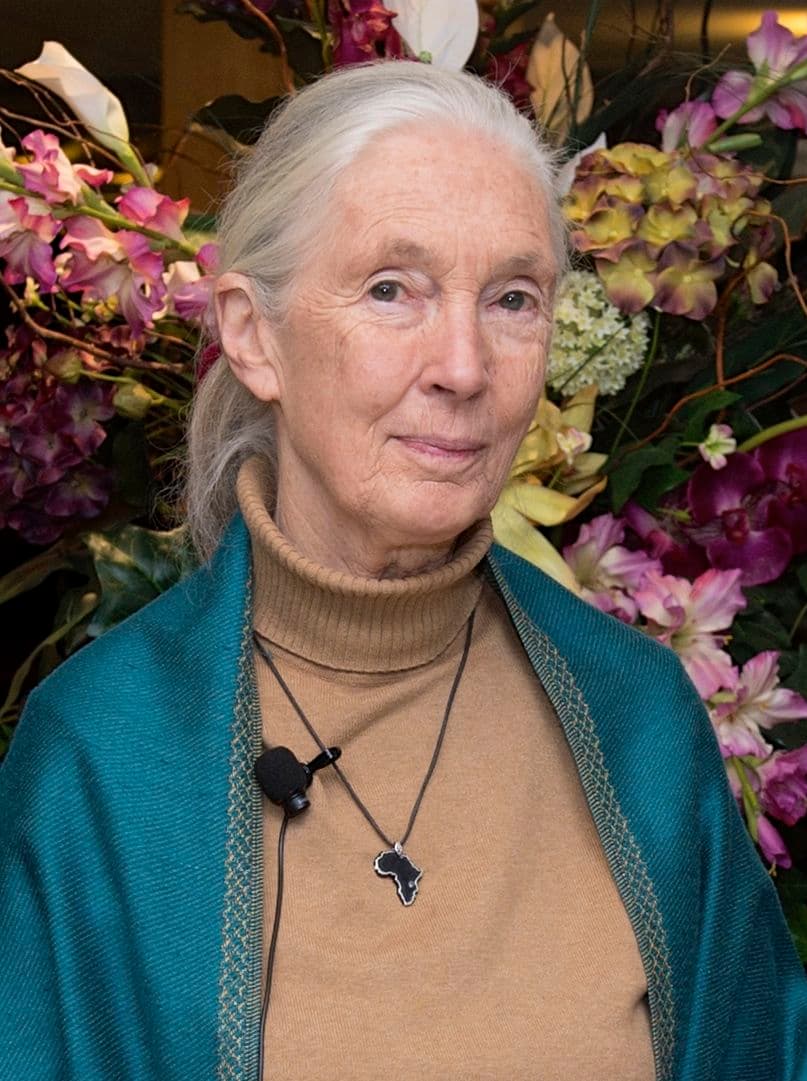
British · Science · Activism
Jane Goodall
April 3, 1934 – April 16, 2025
Early Life and Background
Jane Goodall was born Valerie Jane Morris-Goodall on 3 April 1934 in London, England. Her parents were Mortimer Herbert Morris-Goodall, an engineer and businessman, and Margaret "Vanne" Myfanwe Joseph, a novelist and homemaker. Shortly after her birth, the family moved to Bournemouth on England’s south coast, where Goodall spent much of her childhood.[1][3][5][10]
From an early age, Goodall demonstrated an intense curiosity about animals and nature. She famously spent hours observing hens in her family’s garden, wanting to understand how they laid eggs. Her mother encouraged these interests rather than dismissing them, a support Goodall later credited as crucial to her development as a scientist.[5][8][12] Children’s books such as The Story of Doctor Dolittle and Tarzan of the Apes further fueled her imagination; she later joked that Tarzan married the wrong Jane.[1][11]
World War II disrupted Goodall’s early schooling, but she continued to read widely and develop observational skills. The postwar period offered limited avenues for girls interested in science, and Goodall did not attend university immediately. Instead, she studied secretarial work and held various jobs, including office work and waitressing, while nurturing a dream of going to Africa to live among wild animals.[3][10][12]
Journey to Africa and Career Beginnings
In 1957, Goodall’s long-held ambition to travel to Africa finally materialized. Invited by a school friend, she sailed to Kenya, where she soon met the prominent paleoanthropologist Louis Leakey at the Coryndon Museum in Nairobi. Impressed by her enthusiasm and knowledge of animals despite her lack of formal scientific training, Leakey hired her as his assistant.[1][3][6][8]
Leakey believed that understanding primate behavior would illuminate human evolution, and he was searching for someone to study wild chimpanzees. Goodall’s patience, observational acuity, and passion for animals convinced him she was the right candidate. After some years of preparatory work, he secured funding and permissions for Goodall to begin a field study of chimpanzees in Tanganyika (now Tanzania), at a remote site along Lake Tanganyika known as the Gombe Stream Chimpanzee Reserve.[1][6][14]
Goodall arrived at Gombe on 14 July 1960, accompanied initially by her mother to satisfy colonial regulations that young single women be chaperoned. She had no formal university degree and little traditional research training, but she brought a notebook, binoculars, and a determination to observe chimpanzees as individuals rather than anonymous data points. This immersive, empathetic approach would soon revolutionize primate ethology.[1][6][8]
Pioneering Research at Gombe
At Gombe, Goodall focused on the Kasakela chimpanzee community. She spent long days on the steep forested hillsides, gradually habituating the animals to her presence by providing bananas at a feeding station and patiently watching their behavior. Unlike many scientists of the time, she gave the chimpanzees names—such as David Greybeard, Flo, and Fifi—rather than numerical codes, and recorded their personalities, alliances, and family relationships.[3][6][12]
Within months, she made discoveries that challenged fundamental assumptions in biology and anthropology. In October 1960, she observed chimpanzees hunting and eating meat, showing that they are omnivores rather than strict vegetarians. This finding overturned a widespread belief that chimpanzee diets consisted primarily of fruit and plant matter, and it opened up new lines of inquiry about primate ecology and social cooperation.[2][6][8][14]
Even more transformative was her observation in November 1960 that chimpanzees at Gombe created and used tools. Goodall saw individuals select twigs, strip off leaves, and insert the modified sticks into termite mounds to "fish" for insects. This was the first documented instance of toolmaking and tool use in wild chimpanzees. The discovery directly challenged the prevailing notion that humans alone were "man the toolmaker" and forced scientists to reconsider the supposed uniqueness of human technology.[1][3][6][11]
Goodall’s reports to Louis Leakey and subsequent publications captured these revolutionary findings. Leakey famously remarked that science might need to redefine "tool," redefine "man," or accept chimpanzees as human, underscoring the profound implications of her work. Over the 1960s and 1970s, Goodall continued to document complex social structures, dominance hierarchies, long-term maternal bonds, adoption of orphaned infants, and behaviors such as warfare between chimpanzee groups, infanticide, and coalitionary aggression.[3][6][13]
Her observation of a prolonged violent conflict between the Kasakela and Kahama communities in the 1970s revealed that chimpanzees could organize lethal raids and territorial takeovers, behaviors reminiscent of human warfare. These findings complicated popular images of chimpanzees as purely gentle creatures and highlighted the evolutionary roots of both cooperation and violence.[3][6][13]
Academic Formation and Major Publications
Despite lacking a university degree when she started at Gombe, Goodall’s work quickly attracted attention from the scientific community. On Leakey’s recommendation, she was admitted to the University of Cambridge to pursue a PhD in ethology, an exceptional case given that she did not hold a bachelor’s degree. She studied at Cambridge from 1962 to 1965, dividing her time between academic work and continued field research.[1][3][7][10]
On 30 July 1965, the University of Cambridge awarded Goodall a PhD in ethology for her thesis on chimpanzee behavior. The degree formalized her status as a scientist and helped legitimize her innovative methods, including the naming of individual animals and the emphasis on their personalities and emotional lives. Her doctoral work laid the foundation for a series of influential publications that blended rigorous data with vivid narrative.[1][7][10]
Goodall wrote both scientific papers and popular books that brought her research to wide audiences. Early works such as "My Life Among Wild Chimpanzees" (1963) introduced readers to the daily lives of the Gombe chimpanzees, while later books including "In the Shadow of Man" (1971) and "The Chimpanzees of Gombe" (1986) offered comprehensive accounts of behavior, ecology, and long-term social dynamics.[3][6][12] She also authored memoirs and reflections such as "Reason for Hope" and children’s books that encouraged young people to care about animals and the environment.[3][6]
Her body of work redefined standards for behavioral field studies. Goodall combined detailed longitudinal observation with a narrative style that acknowledged animal emotion and individuality, challenging strict behaviorist approaches that treated animals as abstract units responding to stimuli. Her methods influenced later primatologists and ethologists, who increasingly recognized the importance of long-term, relationship-based study in understanding complex social species.[3][12]
From Scientist to Conservationist and Advocate
Over time, Goodall’s focus expanded from research to conservation and activism. As she observed deforestation, habitat fragmentation, and the impacts of human poverty surrounding Gombe, she became increasingly concerned about the future of chimpanzees and local communities. In response, she sought to integrate scientific knowledge with community-based solutions.[12][14]
In 1977, Goodall founded the Jane Goodall Institute (JGI), formally established on 16 May 1977, to support ongoing research at Gombe and to develop conservation and education programs.[1][5][12][18] JGI promoted long-term studies of wild chimpanzees, funded sanctuaries for orphaned and rescued apes, and launched initiatives such as the Lake Tanganyika Catchment Reforestation and Education (TACARE) program, which worked with local villages to improve agriculture, health, and forest management.[12][14]
Recognizing the importance of youth engagement, Goodall launched Roots & Shoots on 19 September 1991.[2][5][18] The program invited young people to design and carry out projects that benefit people, animals, and the environment. Starting with a small group in Tanzania, Roots & Shoots grew into a global movement involving thousands of groups in more than 100 countries, emphasizing empathy, local action, and cross-cultural collaboration.[12][14][18]
Goodall increasingly spent much of each year traveling, delivering lectures, meeting with students, and advocating for conservation, animal welfare, and sustainable development. She highlighted links between environmental degradation, social injustice, and the climate crisis, urging audiences to see the world as an interconnected system. Her gentle but insistent message of "hope"—grounded in practical examples of change—became a hallmark of her public persona.[14][17]
Awards, Honors, and Recognition
Goodall’s contributions earned her extensive recognition from scientific bodies, governments, and civil society organizations around the world. She received numerous honorary degrees from universities across Europe, North America, and Asia, reflecting the interdisciplinary impact of her work on biology, anthropology, psychology, and environmental studies.[3][7][12]
Among her major honors, Goodall was appointed Dame Commander of the Order of the British Empire (DBE), acknowledging her service to science and conservation.[6][10] She received prestigious awards such as the Kyoto Prize, the Tyler Prize for Environmental Achievement, and the Benjamin Franklin Medal in Life Science, as well as the UNESCO Gold Medal and the French Legion of Honour.[3][6][7] Many of these awards recognized both her scientific discoveries and her leadership in global conservation and education.
On 8 April 2002, United Nations Secretary-General Kofi Annan appointed Goodall as a UN Messenger of Peace, a role reserved for distinguished individuals who help bring attention to UN priorities.[1][5] In this capacity, she advocated for issues such as environmental protection, poverty alleviation, and the humane treatment of animals, addressing international forums, schools, and public events.
Media organizations also honored Goodall’s influence. The BBC included her among its "Icons" of the twentieth century, highlighting her role in revolutionizing the study of wild chimpanzees and demonstrating the evolutionary connections between humans and other primates.[9] She was frequently described as the world’s foremost expert on chimpanzees and one of the most influential environmental advocates of her era.[2][3][6]
Personal Life
While her professional life is widely documented, Goodall’s personal relationships also played a role in her work. In 1964, she married Dutch wildlife photographer Baron Hugo van Lawick, whom she met during her early years at Gombe when he was assigned by National Geographic to film her research. The couple had one son, Hugo Eric Louis, nicknamed "Grub," born in 1967.[3][6][10]
The marriage combined two demanding international careers and eventually came under strain; Goodall and van Lawick divorced in 1974, though they remained connected through their shared work and their son.[3][10] In 1975, she married Derek Bryceson, a Tanzanian politician and director of national parks, who supported her efforts to protect Gombe and expand conservation initiatives. Bryceson died of cancer in 1980, leaving Goodall widowed.[3][10]
Goodall generally kept details of her private life out of the public eye, emphasizing instead her work and the animals she studied. Nonetheless, her family relationships, particularly with her supportive mother and her son, were important sources of stability amid constant travel and the emotional demands of long-term field research. Her experiences of marriage, divorce, and widowhood also informed her empathy for the complex challenges faced by families in communities affected by environmental and economic stress.[3][10]
Legacy and Historical Impact
Jane Goodall’s legacy is multifaceted, spanning scientific discovery, methodological innovation, conservation practice, youth education, and public advocacy. In primatology and ethology, her long-term study of the Gombe chimpanzees set a new standard for behavioral field research. By following individuals and families over decades, she revealed complex social structures, enduring maternal bonds, alliances, and personality differences that could not be captured in short-term or laboratory studies.[3][6][12]
Her documentation of toolmaking and meat-eating in chimpanzees fundamentally altered scientific conceptions of the human–animal boundary. These discoveries contributed to broader recognition of animal cognition, culture, and emotion, influencing disciplines such as comparative psychology, cognitive ethology, and evolutionary anthropology. Philosophers and scientists cited her work in debates over animal rights and the moral consideration owed to nonhuman beings.[3][6][13]
Methodologically, Goodall’s willingness to name animals, acknowledge their emotional lives, and integrate empathy into observation challenged strict behaviorist frameworks. While some scientists initially criticized this approach as anthropomorphic, her meticulous data and long-term consistency demonstrated its value. Many later field researchers adopted similar practices, and her influence can be seen in studies of other primates, elephants, dolphins, and social carnivores.[3][12]
In conservation, Goodall helped transform the field from a primarily species-focused endeavor to a holistic practice that considers human communities, education, and economic development. Through the Jane Goodall Institute, she promoted community-centered conservation, recognizing that protecting forests and wildlife requires addressing poverty, health, and empowerment. Programs like TACARE have been cited as models for participatory conservation in Africa and beyond.[12][14][18]
Her Roots & Shoots program reshaped youth engagement with environmental and social issues. By encouraging young people to identify local problems and design their own projects, Roots & Shoots fostered agency, creativity, and cross-cultural understanding. The movement’s spread to more than 100 countries reflects Goodall’s ability to translate scientific insight into educational practice and social change.[12][14][18]
Goodall also played a crucial symbolic role as a woman in science. Beginning her career without a university degree, she entered a field dominated by male academics and overcame skepticism about both her gender and her nontraditional methods. Her success helped challenge stereotypes about who could conduct rigorous field research and inspired many women to pursue careers in biology, conservation, and environmental activism.[9][11][12]
Later Life and Death
In her later decades, Goodall increasingly devoted herself to global advocacy while remaining engaged with scientific and conservation work at Gombe and other sites. She traveled extensively, often spending more than 300 days a year on the road, giving lectures, meeting with students, and supporting Roots & Shoots groups. She consistently emphasized that despite the severity of environmental crises, there were reasons for "hope" rooted in human ingenuity, the resilience of nature, and the efforts of young people.[14][17]
Even as she aged, Goodall maintained a demanding schedule, appearing at international conferences, participating in documentaries, and collaborating on books and media projects that brought stories of chimpanzees and conservation to wider audiences. Her gentle demeanor, characteristic ponytail, and soft-spoken but urgent message made her one of the most recognizable scientific figures worldwide.[3][6]
On 1 October 2025, Goodall died peacefully in her sleep in Los Angeles, California, while on a speaking tour in the United States.[5][6] She was 91 years old. Obituaries and tributes from media outlets, scientists, environmental organizations, and political leaders highlighted her pioneering research, her tireless activism, and her impact on generations of students and conservationists.[3][4][14][17]
Following her death, the Jane Goodall Institute and Roots & Shoots continued their work, guided by the principles she articulated: respect for all living beings, the interconnectedness of environmental and social systems, and the power of individual action. Her legacy lives on in ongoing research at Gombe, in community conservation projects across Africa, and in the millions of young people who have participated in Roots & Shoots activities worldwide. Jane Goodall remains a central figure in the history of women in science, emblematic of how determination, empathy, and careful observation can transform both knowledge and practice.[3][5][12][14]
Dated achievements
9 indexed.
- Apr031934Science
Birth of Jane Goodall
Jane Goodall was born on April 3, 1934, in London, England.
View details Wikipedia - Jane Goodall - Jul141960Science
Arrival at Gombe to begin chimpanzee research
On July 14, 1960, Jane Goodall began her chimpanzee research at Gombe.
View details