← All women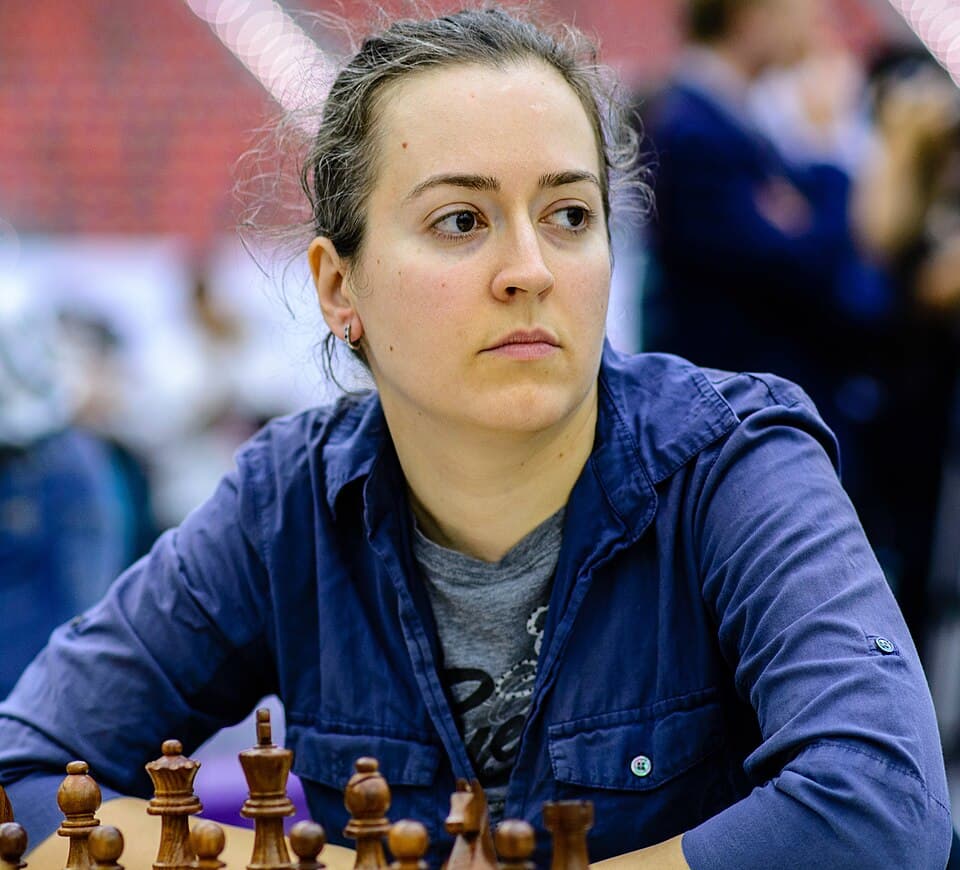
Ukrainian, American · Sports
Irinia Krush
December 24, 1983 – present
Early Life and Background
Irina Borisivna Krush (Ukrainian: Ірина Борисівна Круш) was born on 24 December 1983 in Odessa, then part of the Ukrainian Soviet Socialist Republic in the USSR.[1][3][8][19] She was born into a Jewish family and spent her early childhood in the closing years of the Soviet Union.[1] In 1989, when she was five, her parents emigrated from Odessa to Brooklyn, New York, joining the wave of Soviet Jewish emigration that reshaped many American urban communities.[1][3][11]
Krush learned chess from her father soon after arriving in the United States.[3][7][11] Several biographical sketches note that she "learned to play chess the same year" she immigrated, indicating that the game became an early tool of adaptation and discovery in a new country.[7][9] Growing up in Brooklyn, she entered the vibrant New York scholastic chess scene, which provided tournaments, clubs, and coaches for talented children.
Her family’s immigrant experience and her Jewish heritage form part of the context of her later achievements. As a child from a recently arrived family, Krush navigated cultural and linguistic transitions while developing her chess talent. This background contributes to her historical significance as a figure who emerged from immigrant communities to become a leading American woman in a traditionally male‑dominated sport.
Krush pursued formal education alongside her chess career. She later attended New York University (NYU), graduating in 2006 with a Bachelor of Arts in International Relations, according to her professional biography.[18] Balancing university studies with an active competitive schedule reflected her commitment to academic as well as sporting achievement.
Career Beginnings and Development
Krush’s rise in chess was swift. By the mid‑1990s, she was already competing in top national events. At age 11, she made her debut in the U.S. Women’s Championship, becoming the youngest participant in the event’s history at that time.[5][17] This early appearance announced her as a prodigy on the American chess scene.
Her breakthrough year was 1998. At just 14, Krush won the U.S. Women’s Chess Championship, scoring an extraordinary 8.5/9 and becoming the youngest U.S. Women’s Champion ever.[2][3][6][17] This victory in Madison, Wisconsin set a record that has endured for decades and marked her emergence as the leading woman player in the country.
1998 also brought international success. Krush earned a bronze medal at the World Junior Championship for Girls (U20) in Kozhikode, India, one of her earliest podiums at world level.[11] Later that year she captured gold at the Pan-American Youth Championships in Brazil with a perfect 7–0 score, demonstrating her dominance in continental youth competition.[11] These performances established her reputation as a rising star not only in the United States but internationally.
In 1999, Krush tied for first at the World Junior Championship for Girls, further confirming her strength in the under‑20 category.[11] Throughout these years she gained experience in international round‑robin events, learning to compete against diverse styles from Europe, Asia, and the Americas.
By 2000, Krush’s progress translated into a significant titled milestone: she became the first American woman to earn the FIDE International Master (IM) title, as noted in contemporary profiles.[11] The IM title is a gender‑neutral recognition of high chess strength, and her achievement represented a major step forward for American women’s participation in elite chess.
Advancement to Elite Titles
Krush continued to build on her early successes in the early 2000s. She obtained her first grandmaster norm at the New York City Mayor’s Cup International Chess Tournament, where she tied for first place.[6][17] This result, achieved in a strong open field, showed that she could perform at GM level against male and female opponents alike.
According to title records, Krush received the International Master title formally in 2001 and the Woman Grandmaster (WGM) title in 2002, reflecting her steady advance through the FIDE hierarchy.[10][19] She accumulated norms and rating gains across a variety of events, including Olympiads and international opens.
Within the United States, she added national titles. Krush won the U.S. Women’s Championship again in 2007 and 2010, bringing her total number of championships to three by the end of the decade.[2][17] These victories helped establish her as the dominant American woman player of her generation.
A crucial aspect of her development was regular participation in the Women’s Chess Olympiad. Krush joined the U.S. women’s team from age 14 and played in every Women’s Chess Olympiad since 1998, as noted by US Chess and GMChess Inc.[17][18] This long-term role gave her extensive experience in team competitions and exposure to the strongest women players worldwide.
National Titles and Domestic Dominance
Krush’s impact on American women’s chess is most visible in her record at the U.S. Women’s Championship. She is an eight‑time champion, winning in 1998, 2007, 2010, 2012, 2013, 2014, 2015, and 2020.[1][2][3][5][17] This achievement places her second on the all‑time list of U.S. Women’s titleholders, behind only Gisela Gresser, who has nine.[5]
Her 2012 victory in Saint Louis began a historic streak of four consecutive titles from 2012 through 2015.[6][17] During this period, Krush dominated the national women’s field while simultaneously pursuing and securing the grandmaster title. The championships in 2013, 2014, and 2015 were held in St. Louis, a city increasingly recognized as the hub of American elite chess.[6][17]
By her seventh title in 2015, media outlets described Krush as "the greatest American female chess player in history," highlighting her combination of titles, rating, and international results.[2] The 2020 U.S. Women’s Championship, held online due to the COVID‑19 pandemic, brought her eighth national crown, further solidifying her place on the all‑time list.[1][2][5]
In addition to her national championships, Krush has won other domestic honors. She is noted as a two‑time Women’s American Cup Champion, reflecting success in newer formats designed to showcase women’s chess in the United States.[1][14] She has also been recognized by the U.S. Chess Hall of Fame, with Saint Louis sources referring to her as a U.S. Chess Hall of Famer in their materials.[5]
International Representation and Olympiad Success
Krush’s international career is closely tied to her long-standing service on the U.S. women’s Olympiad team. Since 1998, she has represented the United States at virtually every Women’s Chess Olympiad, becoming one of the team’s most consistent members.[17][18]
Her first major team success came at the 36th Chess Olympiad (Women’s section) in Calvià 2004, where the U.S. women’s team won a historic silver medal.[6][5] Krush, playing on board two, scored 7.5/12 and delivered crucial points against strong opposition. The silver was one of the best results ever achieved by a U.S. women’s team.
At the 38th Women’s Chess Olympiad in Dresden 2008, Krush again contributed to a medal-winning performance, as the U.S. women’s team earned a bronze medal.[5][18] GMChess Inc. notes that she was a member of the teams that earned both historic silver and bronze medals, reinforcing her role as a core team leader.[18]
Her Olympiad contributions extended beyond team successes. At the 43rd Chess Olympiad in Batumi 2018, Krush earned an individual silver medal on her board, signifying one of the best performances among all players at that position.[18] This honor came after two decades of Olympiad participation, illustrating her enduring competitiveness.
Profiles also highlight Krush’s notable individual victories against top-level opponents in Olympiad play. US Chess records that she defeated reigning Women’s World Champion Xu Yuhua in both the 2002 and 2004 Olympiads, underlining her capacity to beat the world’s best in high‑stakes team events.[6]
Grandmaster Title and Barrier-Breaking Achievements
Krush’s most historically significant titled achievement is her attainment of the FIDE Grandmaster (GM) title in 2013. Chess.com, Pantheon, and GMChess Inc. all note that she became the first—and, for a time, only—woman to earn the full GM title while playing for the United States.[1][2][14][18]
US Chess describes the path to her GM title as involving norms at the 2001 New York City Mayor’s Cup, the 2013 Women’s World Team Championship, and the 2013 Baku Open.[17] After achieving the necessary norms and rating, FIDE awarded her the GM title in 2013.[2][19]
This achievement is widely regarded as a barrier‑breaking moment in American women’s chess history. Prior to Krush, no American woman had attained the gender‑neutral GM title, which has historically been held predominantly by men. Her success demonstrated that the highest standard of international chess was attainable for women trained within the U.S. system and helped challenge lingering stereotypes about women’s capabilities in the game.
By the time she became a grandmaster, Krush had already established herself as an eight‑time U.S. Women’s Champion and a regular Olympiad player. The GM title confirmed international recognition of her strength and placed her in a select global group of women grandmasters. Of particular note is that she earned the full GM title, not only the Woman Grandmaster (WGM) title, underscoring the gender‑neutral nature of her achievement.
Playing Style, Teaching, and Media Presence
Krush is known for an attacking and dynamic style of play. She is widely recognized for her instructional video series "Krushing Attacks", produced for chess training audiences.[3][13] These videos focus on tactical themes and aggressive strategies, reflecting her practical approach over the board.
Beyond competition, Krush has developed a substantial teaching career. GMChess Inc. notes that she has "many years of teaching experience" with both private students and larger classes and that she has taught across the United States.[18] Her dual role as elite player and coach has made her a prominent figure in American chess education, especially for girls and young women.
She has been featured in interviews and profiles aimed at broader audiences. Big Think introduced her as a three-time U.S. Women’s Champion at the time of their profile and emphasized her journey from learning chess at age five to becoming the youngest U.S. Women’s Champion.[7] Interviews such as those on The Fearless Nomad and youth publications explore her experiences and perspectives as "America’s only woman chess grandmaster" in the 2010s.[12][15]
Krush has also engaged with online platforms and streaming culture, appearing in video interviews and commentary, including on major chess channels and the Saint Louis Chess Club’s media outlets.[5][16] Her presence in these media helps inspire a new generation of players and broadens public understanding of high-level women’s chess.
Awards, Honors, and Recognition
In addition to her titles and medals, Krush has received institutional recognition within American chess. The Saint Louis Chess Club describes her as a U.S. Chess Hall of Famer, signaling her inclusion among the most honored figures in U.S. chess history.[5] This status reflects her record of eight national women’s championships, her GM title, and her long Olympiad service.
Media coverage has often underscored her pioneering role. After securing her seventh U.S. Women’s Championship in 2015, outlets such as Business Insider characterized her as "the greatest American female chess player in history," citing her record number of titles and her grandmaster status.[2] Chess.com highlights her as "one of the strongest women in U.S. chess history" and notes that, as of October 2020, she was the only American woman to have earned the GM title.[2]
Her achievements also appear in global biographical collections. Pantheon, a project that tracks historical figures’ presence in cultural memory, profiles Krush as an American chess grandmaster and emphasizes her status as the only woman to earn the GM title while representing the United States.[14]
Personal Life
Public sources focus primarily on Krush’s chess career and professional activities, offering limited detail on her private life. It is reported that she grew up and resides in Brooklyn, New York, the city to which her family moved upon emigrating from Odessa.[1][3][17] She completed her degree in International Relations at New York University in 2006, indicating a commitment to academic pursuits alongside chess.[18]
Krush’s biographies frequently emphasize the role of her father in introducing her to chess and supporting her early development in the game.[11] Her Jewish and immigrant background is mentioned in several sources, highlighting cultural and community contexts but without extensive personal detail.[1]
Information about marriage, children, or other family relationships is not broadly documented in major chess or biographical sources, suggesting that Krush keeps such aspects of her life relatively private. Editorial accounts of her significance therefore focus primarily on her public role as a player, coach, and representative of women in chess.
Legacy and Historical Impact
Irina Krush’s legacy lies in her combination of record‑setting national success, barrier‑breaking titles, and long-term international representation. As an eight‑time U.S. Women’s Champion, she has shaped the competitive landscape of American women’s chess for more than two decades.[1][2][5][17] Her titles from 1998 to 2020 illustrate both early precocity and sustained excellence.
Her attainment of the FIDE Grandmaster title in 2013 as the first American woman GM is a cornerstone of her historical significance.[2][14][18] This achievement altered expectations about what women in the U.S. chess system could accomplish and provided a powerful example for younger players. It also contributed to broader conversations about gender equity in chess.
Krush’s long service on the U.S. women’s Olympiad team, including team silver and bronze medals and an individual silver, underscores her importance as a representative of the United States on the world stage.[5][17][18] Her victories over a reigning Women’s World Champion and her strong board results show that she has competed successfully with the global elite.
As a teacher and creator of instructional content such as "Krushing Attacks," Krush has extended her influence beyond her own games. She has helped transmit tactical and strategic knowledge to students across the country, contributing to the development of future generations of players.[3][18]
In the broader narrative of women’s history, Krush exemplifies the impact of immigrant women on American culture and sport. Her journey from Odessa to Brooklyn, from child learner to grandmaster, demonstrates how access to education, federated competition, and supportive communities can enable women to thrive in fields historically dominated by men.
Later Career and Continuing Activity
Krush remains active in elite chess. Liquipedia and other sources note her participation in major women’s events, including the FIDE Women’s World Cup and the Cairns Cup in 2023, confirming her continued presence at the highest competitive levels.[19] She has also taken part in newer tournaments such as the Women’s American Cup, winning it twice.[1][14]
Her rating has remained strong; around 2014 her FIDE rating approached 2491, placing her among the top women players worldwide.[19] Although detailed year‑by‑year rating histories are not central to most biographical accounts, they illustrate her sustained high level of play.
Krush continues to teach and share her expertise through coaching, lectures, and media appearances.[18][5][16] As online chess and streaming platforms have grown, she has adapted by participating in digital content, maintaining relevance in a changing chess culture.
As of the mid‑2020s, there is no recorded death date; she is an active player and public figure. Her story is still unfolding, with new competitions, students, and projects further extending her impact on chess and women’s history.
Dated achievements
15 indexed.
- Dec241983Sports
Birth of Irina Krush
Irina Krush was born in Odessa, later becoming a U.S.-based chess grandmaster.
View details Wikipedia - Sep241998Sports
Youngest-ever U.S. Women’s Chess Champion
Krush became the youngest U.S. Women’s Champion at age 14.
View details