← All women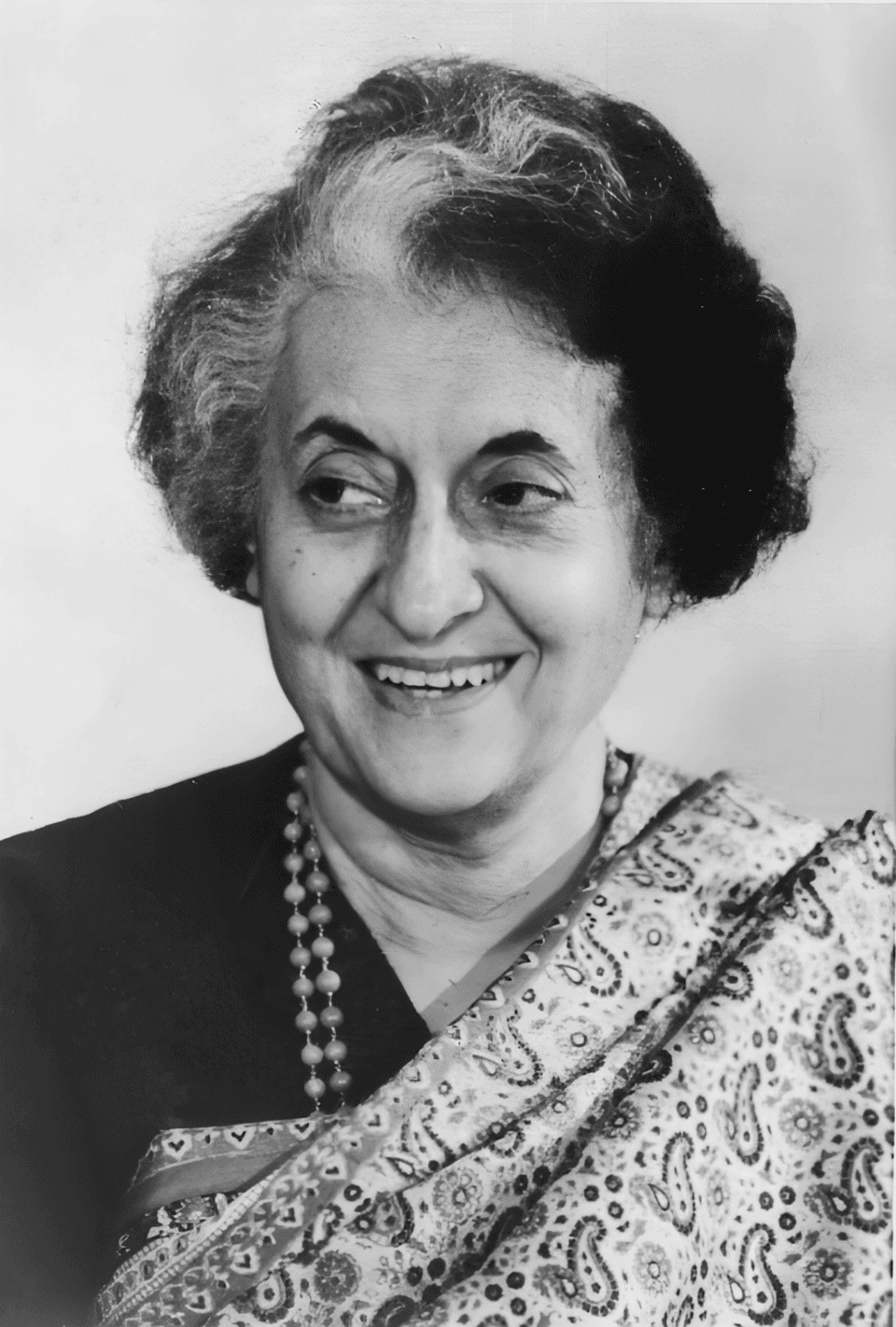
Indian · Politics
Indira Gandhi
November 19, 1917 – October 31, 1984
Early Life and Background
Indira Priyadarshini Nehru (later Indira Gandhi) was born on 19 November 1917 in Allahabad, in the United Provinces of Agra and Oudh in British India (now Prayagraj, Uttar Pradesh).[1][2] She was the only child of Jawaharlal Nehru, a leading figure in the Indian National Congress and the future first prime minister of independent India, and Kamala Kaul Nehru, who was active in the freedom movement and social work.[1][2] Her upbringing unfolded in a household deeply immersed in nationalist politics. The Nehru home, Anand Bhavan, served as a venue for meetings of Congress leaders, including Mahatma Gandhi, exposing Indira from childhood to anti‑colonial strategy and debate.[1]
Indira’s early years were marked by both privilege and disruption. Her father spent long periods in British prisons for his political activities, and her mother’s recurrent illness required treatment abroad. These circumstances contributed to a sense of solitude and responsibility that shaped her personality.[12] She attended several schools, including institutions in Allahabad and Pune, but her education was frequently interrupted by her parents’ political commitments and her own ill health.[1][2]
In the 1930s, Indira studied at Visva‑Bharati University at Santiniketan, founded by Rabindranath Tagore, where she was influenced by Tagore’s humanist and cultural ideals.[1] Later, she went to Europe, continuing her education at schools in Switzerland and England, including Somerville College, University of Oxford
Indira Gandhi’s political engagement began long before she held formal office. In the mid‑1930s, she organised a children’s group known as the Vanar Sena (Monkey Brigade), which participated in the independence movement by distributing leaflets, conveying messages, and taking part in protests.[7][12] Although informal, the group symbolised the diffusion of nationalist activism across age and gender lines and gave Indira early experience in mobilisation and clandestine organisation. She joined the Indian National Congress and became closely associated with its leadership, especially her father and Gandhi.[1][2] During the freedom struggle, she worked in the Congress Party’s organisational activities and campaigns, and in 1942 she married Feroze Gandhi, a fellow Congress activist and journalist.[1][2] The couple later had two sons, Rajiv (born 1944) and Sanjay (born 1946).[1] After independence in 1947, Jawaharlal Nehru became prime minister, and Indira often served as his hostess and confidante, managing the prime ministerial residence and accompanying him on foreign tours.[1][2] This role gave her insight into diplomatic protocol, international issues, and the mechanics of government, even though she did not yet hold high formal office. Her organisational responsibilities within the Congress Party grew over time. In the 1950s she was appointed to the Working Committee and the Central Election Committee of the Congress, deepening her involvement in party decision‑making and candidate selection.[7] These posts required her to navigate factional rivalries and electoral strategy, providing practical political training that would be crucial when she later competed for national leadership. Indira Gandhi’s first major formal breakthrough came when she was elected president of the Indian National Congress in 1959, a largely honorary position but symbolically important for a woman.[5][7] Her selection signaled growing recognition of her role beyond that of her father’s daughter. During this period she also served on various committees and worked to strengthen the party’s mass base. Jawaharlal Nehru died in 1964, a turning point in Indian politics and in Indira’s trajectory.[1][2] She entered the government as Minister of Information and Broadcasting under Prime Minister Lal Bahadur Shastri, where she cultivated an image as a capable administrator, using radio and film to promote developmental and cultural initiatives.[1][2] Shastri’s sudden death in January 1966 triggered a succession crisis within the Congress parliamentary party. On 19 January 1966, after intense internal contestation, Indira Gandhi was chosen as leader of the Congress Party in Parliament, defeating rival Morarji Desai.[12] By convention, this made her Prime Minister of India, and on 24 January 1966 she was formally sworn in as prime minister by President Sarvepalli Radhakrishnan, along with her cabinet.[13][17] Indira Gandhi thus became India’s first woman prime minister and one of the earliest women to lead a major democratic state.[2][8] Initially perceived by some party bosses—the "Syndicate"—as a compromise candidate who could be controlled, she soon demonstrated independence, engaging in policy initiatives and asserting authority over key portfolios. Her early challenges included food shortages, inflation, and foreign‑policy pressures from Cold War rivalries and tensions with Pakistan and China.[1][2] Over the late 1960s and early 1970s, Indira Gandhi moved to consolidate political power and implement a more left‑leaning economic agenda. A key turning point was the nationalisation of 14 major commercial banks, enacted through the Banking Companies (Acquisition and Transfer of Undertakings) Ordinance, 1969, which came into effect from midnight on 19 July 1969.[13] This measure aimed to redirect credit towards agriculture, small industry, and under‑served regions, aligning banking with national development goals and strengthening the state’s role in the economy.[2] Nationalisation was controversial, opposed by conservative business circles and some Congress leaders, but it bolstered Gandhi’s popularity among poorer voters and trade unions. It also signaled a break with the more incremental economic strategies associated with earlier governments and underscored her willingness to override party elders.[1] In 1969, Gandhi clashed with the Syndicate over the presidential election and policy orientation, leading to a split in the Congress and the formation of Congress (R), later Congress (I), under her leadership.[1] In the 1971 general election, she campaigned on the powerful slogan "Garibi Hatao" (Remove Poverty) and won a sweeping victory.[1][2] Her government subsequently introduced various poverty‑relief programmes and rural development schemes. Her domestic agenda also included family‑planning initiatives and attempts to control inflation and food shortages through imports and the promotion of the Green Revolution. While these policies had mixed results and regional variations, they contributed to increasing agricultural productivity in parts of northern India and reinforced the central government’s role in economic management.[1][2] Indira Gandhi’s foreign policy combined non‑alignment with pragmatic alignment, especially closer ties to the Soviet Union. One of the most consequential episodes of her leadership was the 1971 Indo‑Pakistani War, which arose from the crisis in East Pakistan (now Bangladesh) following the repression of Bengali nationalists and a massive refugee influx into India.[1][2] After diplomatic efforts failed, India intervened militarily in December 1971, supporting Mukti Bahini forces and confronting Pakistan. The brief war ended with Pakistan’s defeat, the surrender of its forces in Dhaka, and the creation of the independent state of Bangladesh. This outcome reshaped South Asian geopolitics, significantly weakened Pakistan, and enhanced India’s regional influence, earning Gandhi considerable domestic acclaim.[1][2] Another landmark in her foreign and security policy was India’s first nuclear test. On 18 May 1974, under her leadership, India conducted the "Smiling Buddha" (Pokhran‑I) nuclear test at the Pokhran Test Range in Rajasthan.[1][2] The underground explosion, publicly described as a "peaceful nuclear explosion," effectively demonstrated India’s nuclear capability and made it the first country outside the five permanent members of the UN Security Council to test a nuclear device.[1] The test provoked international concern and led to sanctions and restrictions on nuclear cooperation, particularly from Canada and the United States. It also intensified global non‑proliferation efforts. Domestically, however, it reinforced perceptions of India as a technologically capable and strategically assertive state and strengthened Gandhi’s image as a decisive leader willing to pursue national security objectives despite external pressure.[2] Indira Gandhi’s most controversial period in office was the Emergency from 1975 to 1977. Facing escalating opposition protests, economic difficulties, and a critical court ruling, she moved to centralise power. On 25 June 1975, President Fakhruddin Ali Ahmed, acting on her advice, proclaimed a nationwide Emergency under Article 352 of the Constitution, citing internal disturbances.[2] During the Emergency, civil liberties were curtailed; opposition leaders, activists, and some journalists were detained; and press censorship was imposed.[1] The government argued that these measures were necessary to restore order and implement long‑delayed reforms, but critics saw them as a grave assault on democratic norms. The period also saw controversial programmes, including coercive sterilisation campaigns and slum clearances, which were strongly associated with her son Sanjay Gandhi.[1][2] In an effort to present the Emergency as a vehicle for development, Gandhi’s government launched the Twenty Point Programme on 1 July 1975, outlining measures to reduce poverty, improve housing, enforce land reforms, restrain prices, and enhance the welfare of women and marginalised groups.[13] Some components of the programme influenced later anti‑poverty policies, but implementation was uneven and often overshadowed by the coercive aspects of Emergency rule. In 1977, amid growing discontent and international criticism, Gandhi ended the Emergency and called general elections. Voters delivered a decisive verdict: the Congress Party was defeated, and a coalition of opposition parties formed the Janata Party government, with Morarji Desai as prime minister.[1][2] Gandhi herself lost her parliamentary seat and, for a time, her political standing. The Emergency remains a central reference point in debates about executive power, constitutional safeguards, and the dangers of personality‑centered politics in democratic systems. After the 1977 defeat, Indira Gandhi faced legal challenges and political isolation, but she retained a loyal base within the Congress and among many voters. Internal conflicts and perceived ineffectiveness within the Janata government led to its collapse. In 1980, the reconstituted Congress (I) under her leadership contested the general elections and won a clear majority.[1][4] On 14 January 1980, Indira Gandhi was sworn in again as Prime Minister of India, beginning her second premiership, which lasted until her death in 1984.[4] Her return to power underscored both the resilience of Congress as a political organisation and her enduring appeal to voters who associated her with stability and decisive leadership. During this second term, Gandhi confronted new challenges. Separatist movements and ethnic unrest emerged in several regions, most notably in Punjab and Assam. Economic issues persisted, and India navigated a shifting international environment, including the Soviet invasion of Afghanistan and evolving relations with the United States and neighboring countries.[1][2] She continued to promote developmental programmes and technological initiatives, including work in space and atomic energy, though economic growth remained uneven. The most consequential and controversial decision of Gandhi’s second term was Operation Blue Star. Sikh militancy had intensified in Punjab, with armed groups led by Jarnail Singh Bhindranwale occupying the Golden Temple complex in Amritsar, using it as a base and symbol for demands including greater autonomy and, among some, secession.[1] After efforts at negotiation and police action failed, Gandhi authorised a military operation. On 1 June 1984, she ordered Operation Blue Star, and from 1 to 10 June, the Indian Army entered the Golden Temple to remove the militants.[2] The assault resulted in significant casualties among militants, soldiers, and civilians, and it damaged parts of the complex, including the Akal Takht, deeply shocking many Sikhs in India and abroad.[1][2] The operation intensified alienation among sections of the Sikh community and was widely criticised for its planning and execution. It directly contributed to the atmosphere of hostility and grievance that culminated in her assassination later that year. Blue Star continues to be a focal point in discussions of minority rights, state violence, and the management of religiously sensitive conflicts. Indira’s personal life was closely intertwined with her political journey. Her marriage to Feroze Gandhi in 1942 initially drew criticism from some family members and conservatives but reflected the growing autonomy of women within nationalist circles.[1] While the couple later lived largely separate lives, they remained formally married until Feroze’s death in 1960.[1][2] Her elder son, Rajiv Gandhi, trained as a pilot and initially showed little interest in politics, working for Indian Airlines. Her younger son, Sanjay Gandhi, became a central and controversial figure in the Congress during the 1970s, particularly during the Emergency, when he gained influence over youth organisations and urban development schemes.[1] Sanjay’s death in a plane crash in 1980 was a severe personal blow and a political turning point; Rajiv was then drawn into the Congress Party and later into national leadership.[1][2] Indira’s relationships with family members and political colleagues were complex. She was often described as reserved, disciplined, and intensely committed to her work. Her close association with her father and their extensive correspondence shaped her worldview and sense of responsibility for India’s future.[6] She also maintained relationships with international leaders and intellectuals, from the Non‑Aligned Movement to Western governments, balancing ideological commitments with pragmatic diplomacy. Indira Gandhi received numerous honors and recognitions during her career. Domestically, she held the highest elected office in the country for over fifteen years, making her the second‑longest serving prime minister of India after her father.[14] She was widely acknowledged for her role in the liberation of Bangladesh and the assertion of India’s strategic autonomy. Internationally, she served as a prominent voice in the Non‑Aligned Movement, advocating for peace, disarmament, and development among newly independent states.[1][2] She addressed the United Nations and participated in high‑level summits, where she argued for a more equitable international economic order. Posthumously, Indira Gandhi has been commemorated through institutions, scholarships, and memorials across India. Her birth anniversary is observed in official programmes, and sites such as the Indira Gandhi Memorial Museum at her former residence in New Delhi preserve artifacts and narratives of her life. While the Emergency and other contentious decisions temper uncritical celebration, she remains a central figure in national memory. Indira Gandhi’s legacy is multifaceted and intensely debated. She is remembered as India’s first and, to date, only female prime minister, whose tenure redefined expectations of women’s political leadership in South Asia and beyond.[2][8][11] Her rise demonstrated that a woman could wield executive authority over a large, complex democracy, and her longevity in office showed that such leadership could be sustained across electoral cycles. On the positive side, Gandhi is credited with strengthening the Indian state, steering the country through war and crisis, and advancing development programmes aimed at poverty reduction and rural uplift. The 1971 war and the creation of Bangladesh, bank nationalisation, and the Smiling Buddha nuclear test are often cited as moments when she asserted India’s autonomy and pursued strategic and economic transformation.[1][2] At the same time, her tenure exposed vulnerabilities in Indian democracy. The 1975–1977 Emergency remains a cautionary episode, demonstrating how constitutional provisions can be used to suspend rights and centralise power. Scholars and activists have highlighted the detention of opponents, censorship, and coercive social policies as serious departures from democratic norms.[1][2] Her leadership style—decisive and centralising—contributed to a concentration of authority in the prime minister’s office and fostered a culture of personality politics that influenced subsequent governments. The prominent roles of her sons, especially Sanjay and later Rajiv, reinforced the dynastic character of the Congress Party.[1][2] For women’s history, Indira Gandhi’s life underscores that women leaders can embody both emancipatory and authoritarian possibilities. She broke gender barriers, inspired many women to enter politics, and symbolised female capability in governance. Yet her government’s record on issues such as civil liberties during the Emergency and the handling of Punjab shows that gender alone does not determine a leader’s commitments to democracy or non‑violence. In her final years, Indira Gandhi remained deeply engaged in managing internal conflicts and external relations. The unrest in Punjab, culminating in Operation Blue Star in June 1984, weighed heavily on her government and on her personal security.[1][2] Despite threats, she continued public engagements and travel. On 30 October 1984, she delivered her last public speech at the BBSR parade ground in Bhubaneswar, Orissa, where she remarked, "I am here today, I may not be here tomorrow", a line later seen as reflecting awareness of the dangers she faced.[13] The next morning, 31 October 1984, she was walking through the garden of her residence at 1 Safdarjung Road in New Delhi to an interview when she was shot by two of her Sikh bodyguards, Beant Singh and Satwant Singh.[1][2][3] She was rushed to the All India Institute of Medical Sciences but succumbed to her injuries. Her assassination triggered horrific anti‑Sikh riots in Delhi and other cities, in which thousands of Sikhs were killed and many more displaced.[2] The violence exposed deep fault lines in Indian society and raised enduring questions about state responsibility and accountability. Within hours of her death, her elder son Rajiv Gandhi was sworn in as prime minister, continuing the Nehru‑Gandhi family’s central role in Indian politics.[1][2] Indira Gandhi’s death marked the end of an era in which she had been the dominant figure in Indian public life. Her legacy continues to be contested and reevaluated by historians, political scientists, and citizens, reflecting the complexity of her contributions to India’s democracy, development, and global standing.Early Political Engagement and Career Beginnings
Rise to Party Leadership and First Premiership
Consolidation of Power and Major Domestic Policies
Foreign Policy, the 1971 War, and Nuclear Test
The Emergency (1975–1977)
Return to Power and Second Premiership
Operation Blue Star and Rising Conflict
Personal Life
Awards, Honors, and Recognition
Legacy and Historical Impact
Later Life and Assassination
Dated achievements
12 indexed.
- Nov191917Politics
Birth of Indira Nehru (Indira Gandhi)
Indira Nehru was born in Allahabad, India, to Jawaharlal and Kamala Nehru.
View details Britannica – Indira Gandhi: At a Glance - Feb021959Politics
Elected President of the Indian National Congress
Indira Gandhi was elected President of the Indian National Congress.