← All women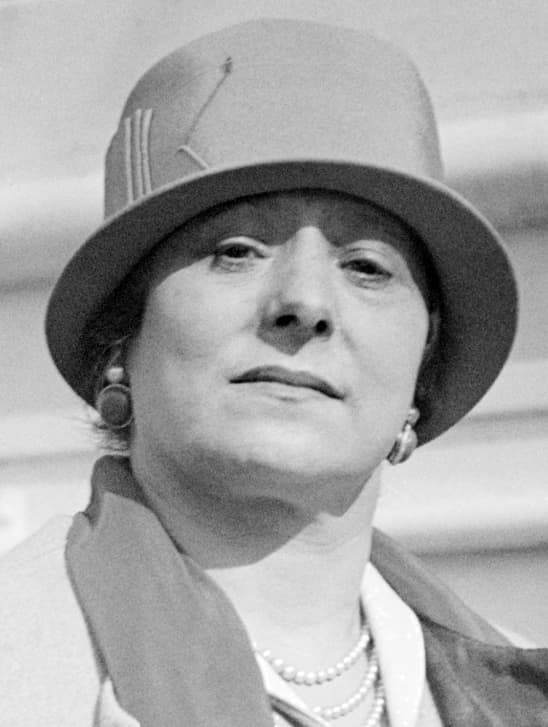
Polish, American · Arts
Helena Rubinstein
December 25, 1872 – April 1, 1965
Early Life and Background
Helena Rubinstein, born Chaja Rubinstein on 25 December 1872 in Podgórze near Kraków, then part of Austria-Hungary (now Poland), emerged from a poor Orthodox Jewish milieu to become one of the most powerful businesswomen of the 20th century.[1][3][16] She was the eldest of eight daughters of Horace (Hersz) Rubinstein, an egg and kerosene merchant, and Augusta (Gitel) Silberfeld Rubinstein, who maintained a strictly observant household and prepared homemade beauty remedies.[1][4][9]
Growing up in the Jewish quarter, Rubinstein experienced both tight-knit community life and the legal and social discrimination faced by Jews in late 19th-century Central Europe.[13][14] As the eldest child, she helped with bookkeeping in her father’s business, gaining early familiarity with accounts and trade.[9][15] Her mother’s creams and lotions, especially a lanolin-based face cream later known as "Crème Valaze," introduced her to the idea that beauty preparations could be both effective and commercially valuable.[1][6]
Sources suggest that Rubinstein briefly attended the University of Kraków and undertook preliminary medical studies in Switzerland before family pressure and financial constraints curtailed her formal education.[9][14][15] She clashed with her parents’ expectations regarding marriage and domesticity, resisting arranged matches and expressing a desire for independence. These tensions, combined with the limited prospects for Jewish women in Poland at the time, set the stage for her decision to emigrate.
Emigration and Career Beginnings in Australia
In 1902, Rubinstein left Kraków for Australia, arriving in Melbourne in mid-July with minimal funds and little English.[6][14] She carried several jars of her mother’s face cream, whose formula had been refined by a local Kraków chemist, and soon noticed that Australian women admired her fair, smooth complexion. When they inquired about her skincare, she began selling small portions of the cream, rebranded as "Crème Valaze" and presented as an exotic European preparation.[6][15]
Rubinstein quickly realized the commercial potential of her product. She arranged for additional supplies from Europe, experimented with ingredients, and cultivated an aura of expertise by advising customers on diet and skincare routines.[6][11] In 1903, she opened her first beauty salon in Melbourne, a refined space offering facial treatments, consultations, and customized regimens.[11][14] There, she interviewed clients, observed their complexions, and kept notes, effectively conducting informal research on skin conditions and responses to treatment.
Operating as a young, unmarried Jewish immigrant woman in a British colony, Rubinstein faced significant barriers, including skepticism toward women entrepreneurs and prejudice against outsiders. She overcame these by emphasizing European sophistication and scientific language. She framed her services as both luxurious and health-related, positioning beauty care as a modern necessity rather than frivolity. Her Melbourne success allowed her to open additional salons in Sydney and other Australian cities, building a profitable network and a strong local reputation.[11][14]
Expansion to Europe: London and Paris
By 1908, Rubinstein had amassed enough capital to expand beyond Australia. She relocated to Europe, establishing a prominent salon in London’s Grafton Street, an upscale area that attracted fashionable clientele.[11][12] In London, she further developed her brand identity: the salons combined clinical consultation rooms with luxurious décor, and staff members wore crisp uniforms to signal professionalism.
Rubinstein reinforced her self-styled authority by attending lectures and consulting physicians, deepening her knowledge of dermatology and nutrition.[15] She incorporated these ideas into her advice to clients, insisting that beauty reflected overall health and lifestyle. Her London operations also allowed her to refine advertising strategies, using print media and testimonials to reach broader audiences.
In 1912, she opened a salon in Paris, then the global capital of fashion and luxury.[11][12] The Paris establishment further elevated her profile, attracting aristocrats, artists, and socialites. Rubinstein immersed herself in the city’s cultural avant-garde, beginning to collect modern art and forming connections with figures who would influence her aesthetic tastes. Paris also offered access to sophisticated laboratories and suppliers, enabling more advanced product formulations.
Entry into the United States and Corporate Development
The outbreak of World War I prompted Rubinstein to seek a more stable base. In 1915, she moved to the United States, opened a salon in New York, and incorporated her business as Helena Rubinstein, Inc.[4][11][12] This marked the beginning of the American phase of her empire. New York salons adopted her established model of personalized care, emphasizing consultations and tailored treatments.
Rubinstein’s U.S. company rapidly expanded, adding salons in major cities and distributing creams, powders, and other cosmetics through department stores.[11] She invested heavily in advertising, using magazine spreads and newspaper campaigns to promote the idea that expert skincare could transform women’s lives. Her brand combined scientific rhetoric, aspirational luxury, and accessible pricing tiers, allowing her to serve both elite and middle-class women.
In 1928, Rubinstein sold her U.S. operations to a consortium led by Lehman Brothers for a substantial sum, reflecting the high valuation of her brand.[11][12] During the Great Depression, the company’s fortunes declined, and in 1931 she recognized an opportunity: she re-acquired the business at a fraction of the sale price, regaining control and demonstrating remarkable business acumen.[11][12] This move allowed her to reshape product lines and marketing strategies in response to changing consumer conditions.
Scientific Innovation and Product Pioneering
Throughout her career, Rubinstein insisted on integrating science into cosmetic practice. Around 1910, she pioneered a systematic classification of skin types—oily, dry, normal, and combination—and organized her products and treatments around these categories.[8][9] This framework, introduced across her salons, required staff to analyze clients’ skin and recommend tailored regimens, prefiguring modern dermatological approaches.
Rubinstein collaborated with chemists and medical professionals to test ingredients and formulations. She promoted ideas about the relationship between diet, sun exposure, and skin health, popularizing preventative care concepts.[8][15] Her product range grew to include anti-wrinkle creams, sun preparations, powders, lipsticks, and perfumes, many marketed with claims of scientific efficacy.
In 1939, she acquired a patent for the first waterproof mascara and introduced it with a striking aquatic ballet demonstration, in which performers emerged from the water with intact eye makeup.[8][9] This innovation answered the needs of increasingly active women who wanted cosmetics that could withstand swimming, sports, and emotional intensity. It also showcased Rubinstein’s talent for combining genuine technological advances with theatrical publicity.
While promotional materials sometimes attribute additional "firsts" to her—such as rigorous product testing and early use of clinical trial methods—reliable sources clearly document her skin-type classification and waterproof mascara as key industry innovations that reshaped both consumer expectations and professional practice.[8][9]
Awards, Honors, and Philanthropy
Rubinstein’s commercial success enabled extensive philanthropy. In 1953, she founded the Helena Rubinstein Foundation, which supported medical research, child health initiatives, educational institutions, and arts organizations.[12][13][15] The foundation made grants to museums, colleges, and social-service agencies, reflecting her belief that beauty was intertwined with cultural and intellectual life.
She became a noted patron of the arts, assembling an extraordinary collection that included modern paintings, African sculpture, and 17th- and 18th-century French furniture.[5] Her New York residence and Paris apartments were showcases for works by artists such as Salvador Dalí and Elie Nadelman, alongside textiles and furnishings from diverse cultures.[5] Museums and critics recognized her collection as one of the earliest encyclopedic assemblages of African art in private hands.
Although she did not seek formal honors to the same extent as some contemporaries, Rubinstein received considerable public recognition. She was profiled in influential magazines, including a LIFE feature in 1941 that highlighted her fortune—estimated at tens of millions of dollars—and her exceptional position as a self-made female tycoon.[11][13] Later biographies and studies have emphasized her role in legitimizing cosmetics as a serious business and in opening professional avenues for women in sales, management, and laboratory work.[1][9]
Personal Life and Relationships
Rubinstein’s personal life intersected closely with her business and cultural activities. In 1908, she married Edward (Edouard) Titus, an American-born journalist and intellectual active in Paris.[9][14][15] Titus moved in literary and artistic circles, and through him Rubinstein deepened her connections with writers, artists, and critics. The couple had two sons, Roy and Horace, and maintained homes in Europe and later the United States.[9]
The marriage was complex; Rubinstein’s intense focus on business and her formidable personality sometimes conflicted with Titus’s own ambitions and lifestyle. They eventually divorced in 1937–1938, though they remained linked through their shared social networks.[9][14]
In 1938, Rubinstein married Prince Artchil Gourielli-Tchkonia, a Georgian émigré who styled himself as a member of a princely house.[9] This second marriage, which lasted until his death in 1956, added a layer of aristocratic glamour to her public image and inspired the brand name "Prince Gourielli" used for some of her products. Rubinstein, however, remained firmly in control of her business and identity, using titles and social status strategically rather than subordinating her commercial persona to them.
Despite her wealth, Rubinstein maintained a rigorous, often frugal personal routine. She was known for working long hours, scrutinizing details of packaging and shop displays, and personally testing products. Accounts describe her as both demanding and charismatic, capable of sharp critiques yet generous in mentoring promising employees.[1][13] Her relationships with other beauty magnates—including Elizabeth Arden—combined rivalry with mutual recognition of their shared path-breaking roles as women in business.
Legacy and Historical Impact
By the time of her death in 1965, Helena Rubinstein had transformed a small immigrant enterprise into one of the first truly international cosmetics corporations, with salons and distribution networks across Europe, the Americas, and beyond.[1][11][16] She demonstrated that a woman could lead a global industrial concern, manage complex finances, and shape consumer culture, challenging prevailing assumptions about gender and economic power.
Her insistence on scientific framing changed how cosmetics were perceived. By promoting skin-type analysis, ingredient research, and consultation-based sales, she helped shift beauty culture from purely decorative practices toward a hybrid of medicine, self-care, and fashion.[8][9] This approach influenced later dermatology and cosmetic chemistry, as well as contemporary marketing strategies that emphasize expertise and personalization.
Rubinstein also left a lasting mark on art and philanthropy. Her collection and support for museums contributed to the recognition of modern and non-Western art, while her foundation fostered health and educational initiatives. Scholars have pointed out that her patronage was particularly important for women’s access to medical care and professional training, aligning her business interests with broader social change.[5][12][15]
In cultural memory, Rubinstein is frequently contrasted with fellow cosmetics entrepreneur Elizabeth Arden; the two women built rival empires that dominated mid-20th-century beauty. Their parallel trajectories underscored the possibility of female leadership in consumer industries and cemented the association between women-led companies and products aimed at women’s everyday lives.[1][13]
Today, the Helena Rubinstein brand, acquired by L’Oréal in 1984, continues to operate in the luxury skincare market, reflecting the enduring resonance of her name and approach.[2][8][19] Academic works, biographies, and museum exhibitions—including projects at the Metropolitan Museum of Art—continue to explore her role as a pioneer of cosmetics, a collector, and a symbol of female entrepreneurial power.[5][20]
Later Life and Death
In her later decades, Rubinstein remained actively involved in product development, salon design, and advertising. She traveled frequently between New York and Paris, oversaw the arrangement of her art collections, and engaged with philanthropic projects funded by her foundation.[12][15] Even into her 80s, she was known to visit laboratories and salons, offering direct feedback and insisting on high standards.
Rubinstein’s second husband, Prince Gourielli-Tchkonia, died in 1956, and she continued to live primarily in New York thereafter.[9] Her residences, including a famed apartment on Park Avenue, were landmarks of avant-garde interior design, blending baroque furniture with modern art. Journalists and photographers documented these spaces, reinforcing her image as a woman who united commerce, taste, and cultural experimentation.[5][11]
Helena Rubinstein died on 1 April 1965 in New York City.[1][4] At the time, reports estimated her fortune at around $100 million, and she was widely described as one of the richest women in the world.[12] Control of her company passed to relatives and executives, and over subsequent decades the brand changed hands, eventually entering the portfolio of L’Oréal.[2][8]
Her death prompted reflections on the trajectory from impoverished Jewish girl in Kraków to global business icon. Commentators emphasized her tenacity, eye for talent, and ability to navigate male-dominated financial and industrial spheres. Subsequent biographies and studies have cemented her status as a central figure in both women’s business history and the evolution of modern beauty culture.[1][9][15]
Rubinstein’s life story continues to inspire discussions about migration, identity, and the intersection of commerce with aesthetics and science. As an immigrant, a Jew, a woman, and a self-made tycoon, she illustrates how multiple forms of marginalization can coexist with extraordinary agency, making her an enduring subject for historians of gender, culture, and capitalism.
Dated achievements
6 indexed.
- Dec251872Science
Birth of Helena Rubinstein in Kraków
Chaja (Helena) Rubinstein was born in Kraków, then part of Austria-Hungary, to a Jewish family, later becoming a pioneering cosmetics entrepreneur.
View details Helena Rubinstein - Wikipedia - Jul151902Science
Emigration to Australia and Start of Cosmetics Sales
Rubinstein emigrated from Kraków to Melbourne, Australia, and soon began selling face creams that would launch her cosmetics career.