← All women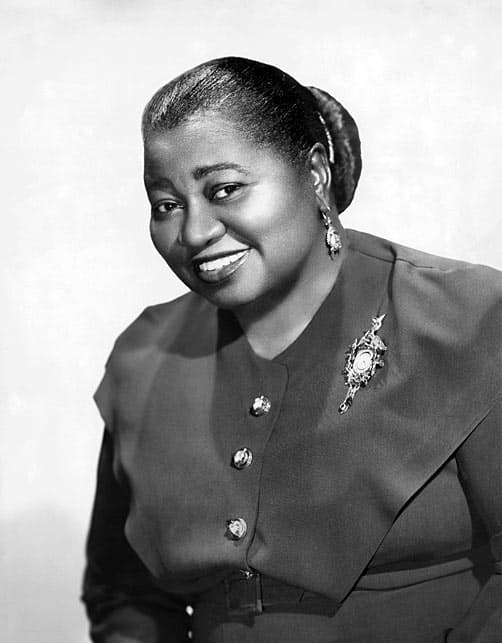
American · Arts
Hattie McDaniel
June 10, 1893 – October 26, 1952
Early life and background
Hattie McDaniel was born in Wichita, Kansas, on June 10, 1893, though some biographical sources give 1895 as her birth year. The uncertainty reflects a broader historical problem: the lives of Black women performers were often documented inconsistently, and recordkeeping for working-class Black families in the late nineteenth century could be incomplete or contradictory. McDaniel was the daughter of former slaves, and several sources identify her parents as Henry and Susan McDaniel. Her father was also a Civil War veteran, and her family background placed her within the generation that lived through the end of slavery, Reconstruction, and the emergence of Jim Crow.
McDaniel grew up in a large family and later lived in Colorado, where her early exposure to music and performance helped shape her path. She attended school in Denver, but like many young women who entered performance work at the time, she moved into entertainment early. Accounts of her youth describe her appearing in minstrel shows and other traveling acts while still young, an experience that introduced her to both the possibilities and the humiliations of Black performance in a racially segregated nation.
The entertainment world that McDaniel entered was highly restrictive. Black women were generally denied access to prestigious stage and screen roles, and when they did appear, they were often confined to stereotypes created for white audiences. McDaniel’s later career must be understood against that backdrop: she was working in an era when the mainstream American entertainment industry offered very few roles for Black women at all, and almost none that allowed them to appear as complex human beings.
Career beginnings in music and live performance
McDaniel began performing professionally in live shows, traveling with minstrel and vaudeville acts before she became widely known in film. Those early years mattered because they gave her the versatility she later used in radio and movies. She was not only an actress but also a singer and comedian, and that range helped her survive in an industry that often attempted to define Black women narrowly.
One of the earliest nationally significant milestones associated with her career was her work in radio. According to contemporary biographies and later institutional summaries, McDaniel became one of the first Black women to sing on radio in the mid-1920s, and TV Guide identifies her as the first African-American woman to sing on U.S. radio when she performed on Denver’s KOA station in 1925. Other sources also describe her as the first Black performer to sing on network radio in 1915, though the exact date is not consistently documented in the available sources. These milestones show how early she was working in broadcast media at a time when Black performers were rarely heard nationally.
Her early recordings also contributed to her reputation. Biographical references note that she recorded blues sides in the late 1920s, adding to a body of work that connected her with the African American musical traditions that influenced popular entertainment across the country. Even where the precise dates are not fully documented, the arc is clear: McDaniel was building a career across multiple media long before Hollywood recognized her name.
Move to Hollywood and film breakthrough
McDaniel moved into film in the early 1930s after relocating to Los Angeles. Her screen debut is generally dated to 1932, when she appeared in The Golden West. Like many Black actors of the period, she entered Hollywood through minor roles and often played maids, cooks, or other domestic workers. These parts were limited and stereotyped, but McDaniel brought wit, timing, and force of personality to them, making even small roles memorable.
Her breakthrough came in 1934 with Judge Priest, where she made a strong impression in a supporting role. Sources describe this film as the point at which she began attracting broader attention. That breakthrough did not eliminate the racial barriers she faced, but it made her one of the most visible Black actresses in Hollywood. The following year, she appeared in The Little Colonel, another significant role that helped cement her profile in the studio era.
McDaniel’s film career unfolded during the peak of the Hollywood studio system, a period of intense control over casting, image, and publicity. For Black performers, opportunities were especially constrained by racist assumptions about audience preference. Within that system, McDaniel developed a screen persona that was at once limited by stereotype and sharpened by craft. She became known for playing strong-willed domestic workers, and although those roles were controversial then and remain so now, her performances helped make her one of the most recognizable Black actresses of the period.
Gone with the Wind and the Oscar breakthrough
McDaniel’s defining role was Mammy in Gone with the Wind (1939). The performance brought her international attention and led to the crowning achievement of her career: on February 29, 1940, at the 12th Academy Awards, she won Best Supporting Actress. In doing so, she became the first African American to win an Academy Award.
The award was historic on several levels. It was an extraordinary personal accomplishment for McDaniel, but it also exposed the contradictions of Hollywood recognition in the segregation era. McDaniel was invited to the ceremony, yet the social conditions surrounding the event reflected the racial barriers of the time. Her win signaled that Black talent could no longer be wholly ignored by the Academy, even if full inclusion remained a distant goal.
The role of Mammy remains debated by historians and critics because it reflects the deeply racist framework of the source material and the era’s film industry. McDaniel was later criticized by some Black contemporaries who believed that playing stereotyped domestic roles reinforced damaging images. At the same time, many historians recognize that she worked within extraordinarily narrow options and used those roles to build a public career, gain visibility, and break a barrier that no Black actor had crossed before. Her Oscar became a landmark in American cultural history and remains one of the most cited firsts in the history of film awards.
Radio, wartime work, and later career
After her film career slowed, McDaniel returned to radio and became the star of The Beulah Show on CBS in the late 1940s. Sources place this work beginning in 1947, and it represented one of the rare sustained starring opportunities for a Black woman on national radio. The program’s premise centered on a Black domestic servant, which again reflected the limited roles available to her, but McDaniel’s presence on the show made her one of the most familiar voices in American broadcasting.
During World War II, McDaniel also entertained American troops and promoted war bond sales. These activities placed her among the many entertainers whose public work supported the war effort, but they also showed how fully her name had entered national life. She was no longer simply a character actress in Hollywood; she was a public figure whose appearances and performances carried symbolic weight.
Her career after the Oscar did not bring the equal opportunities that might be expected today. Like many Black performers of her generation, she continued to work under racial restrictions and typecasting. Yet her persistence through these conditions made her career a case study in the contradictory nature of progress in mid-century America: barrier-breaking victories often coexisted with systemic exclusion.
Personal life
McDaniel married several times. Biographical sources identify husbands including Howard Hickman, George Langford, James Lloyd Crawford, and Larry C. Williams. These marriages were part of a personal life that unfolded alongside a demanding and often unstable career in entertainment. As with many women in Hollywood, the public record on her private life is less complete than the record of her work, but it is clear that she balanced professional ambition with significant personal upheaval.
She had no widely documented children. Her family connections remained important throughout her life, especially her links to Denver and to siblings who helped her move toward acting opportunities in Los Angeles. McDaniel’s broader personal story is inseparable from the history of Black migration and Black labor in the first half of the twentieth century: she lived through the movement from the post-Reconstruction South and Midwest into western urban centers where Black communities built new forms of cultural life.
Awards, honors, and recognition
McDaniel’s Academy Award remains her most famous honor, but it was not her only recognition. Later references identify her as a figure of enduring significance in Black cinema and American performance history. She was eventually inducted into the Black Filmmakers Hall of Fame in 1975, an acknowledgment of her importance to Black screen history even after decades of debate about the roles she played.
She also received lasting posthumous recognition in the form of memorials, historical studies, and institutional tributes. Multiple biographies emphasize that she was the first African American to win an Oscar, and museum and historical organizations in Colorado have highlighted her as a trailblazer from the state’s Black history. Her legacy is also preserved through public memory projects and fan-maintained tribute sites, reflecting the broad and sustained interest in her life.
Legacy and historical impact
Hattie McDaniel’s legacy is complex because it sits at the intersection of breakthrough and constraint. On one hand, she shattered a barrier that had seemed nearly absolute by winning the first Academy Award ever awarded to an African American. On the other hand, the roles available to her were shaped by racist assumptions that limited the kinds of Black women stories Hollywood was willing to tell. Both realities are part of her historical significance.
McDaniel opened a path that later Black actresses and entertainers would walk more fully. Her success on radio, in film, and on the Oscar stage demonstrated that Black women could command national audiences and highest-level recognition despite entrenched discrimination. At the same time, her career exposes the cost of that visibility: she had to navigate a profession that profited from racial stereotypes while withholding equal opportunity.
For women’s history, McDaniel matters because she represents the intersection of race, gender, labor, and representation. She was not only “the first” in a statistical sense; she was a woman whose public achievements forced institutions to acknowledge talent they had long marginalized. Her life remains central to conversations about representation in film, the history of Black broadcasting, and the changing meaning of American celebrity.
Later life and death
In her final years, McDaniel faced serious health problems, including breast cancer. She died on October 26, 1952, in Los Angeles. Her death marked the end of a career that had stretched from the era of live minstrel and vaudeville performance into the age of network radio and Hollywood sound film.
Posthumously, her importance has only expanded. Historians increasingly frame her not simply as a performer who accepted limited roles, but as a woman who worked inside a racist system and still achieved unprecedented visibility and lasting fame. Her life remains a reminder that progress often arrives through imperfect and compromised avenues, especially for Black women in the early twentieth century.
Today, Hattie McDaniel is remembered as a pioneering actress and singer whose achievements in radio and film helped redefine what Black women could accomplish in American popular culture.
Dated achievements
5 indexed.
- Jun101893Science
Birth of Hattie McDaniel
Hattie McDaniel was born in Wichita, Kansas, the youngest of thirteen children born to formerly enslaved parents.
View details Hattie McDaniel - Wikipedia - Jan011915Science
First Black performer to sing on network radio
Hattie McDaniel became the first Black performer to sing on network radio, performing with George Morrison's orchestra.