← All women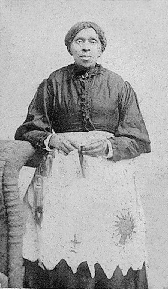
American · Arts
Harriet Powers
October 29, 1837 – January 1, 1910
Early Life and Background
Harriet Powers (October 29, 1837 – January 1, 1910) was an African American folk artist and quiltmaker born into slavery in rural northeast Georgia near Athens.[1][8] She is widely regarded as one of the best-known southern African American quilt makers of the nineteenth century, despite the survival of only two of her quilts.[1][8]
Powers was born enslaved in Clarke County, Georgia, in the outskirts of Athens.[1][8] Several sources agree on the birthdate of October 29, 1837, although a few later references contain typographical errors or report an 1847 birth year.[3][4][14] Georgia-focused biographical entries and multiple art-historical treatments support the 1837 date.[3][4][8] She spent much of her early life on the Madison County plantation of John and Nancy Lester, where young enslaved girls typically learned sewing and textile work either from older enslaved women or from the white mistress of the household.[3][5][8]
Like many enslaved children, Powers would have performed agricultural labor and domestic tasks, including spinning cotton and sewing.[10][13] A video produced for the Museum of Fine Arts, Boston notes that she likely spun cotton for her enslaver as a girl, an experience that acquainted her with fiber, thread, and the material foundations of quiltmaking.[10] Her early introduction to handwork, combined with the oral traditions of Black communities in the region, laid the groundwork for her later narrative quilts, which draw heavily on Biblical stories, folklore, and accounts of natural phenomena.
Powers’s formative years unfolded against the backdrop of the antebellum South, where slavery structured every aspect of Black life. While no direct records of her education exist, it is generally assumed that she, like most enslaved people, had limited or no access to formal schooling. Nevertheless, the complexity of her later iconography suggests that she was deeply familiar with the Bible and local oral traditions, likely through family, church, and community networks.[1][8]
Emancipation, Family, and Early Career
Powers came of age in the decades leading up to and during the American Civil War (1861–1865). She was emancipated at the war’s end, along with millions of other enslaved African Americans.[4][6] Postwar accounts describe her as becoming a landowner and familial matriarch in the Athens area, a notable achievement in a period of intense racial violence and economic instability for Black southerners.[4][6]
Biographical entries indicate that Powers married young. Some sources state that she married around age nineteen, though precise documentation of the marriage date is lacking.[2] Her husband is identified as Armstead Powers, a farmhand who was also enslaved before the war.[11][14] Together they farmed land around Athens after emancipation, combining agricultural labor with Powers’s domestic and artistic work.[14]
Accounts differ on the exact number of children the couple had. One entry suggests that Powers had nine children.[2] Another encyclopedia article lists three named children—Amanda, LeonJoe, and Nancy—born between 1855 and 1866, and notes that historians believe the family had eight children in total.[11][14] While details vary, all sources agree that Powers balanced the demands of motherhood with work in the fields and at home, a context crucial to understanding quiltmaking as part of her daily life rather than a separate professional identity.
In the years following emancipation, Powers and her family lived primarily in Clarke County, especially in communities such as Sandy Creek and Buck Branch near Athens.[8] County records and later scholarship describe her as a landowner, though economic hardship in her later years forced her to sell parcels of land and livestock to meet debts.[14] Within this landscape of Reconstruction and the rise of Jim Crow segregation, Powers began creating the extraordinary narrative quilts that would define her legacy.
Development of a Narrative Quilting Practice
By the 1870s, Powers had begun making the remarkable story quilts for which she would become known.[8][13] She used traditional appliqué techniques—layering cut fabric shapes onto a base cloth and securing them with hand stitching and, at times, machine stitching—to construct complex scenes.[1][2] Her quilts combined Biblical episodes, local legends, and representations of astronomical events such as comets and eclipses.[1][8][13]
Powers’s approach placed her within both African American and Euro-American quilting traditions while simultaneously transcending them. Scholars have noted that her "story quilts" reflect West African aesthetic and narrative practices, in which textiles serve as vehicles for collective memory and spiritual meaning.[3] At the same time, her quilts align with nineteenth-century American patchwork and appliqué forms, suggesting that she blended techniques learned in slavery with innovations of her own.
Only two of Powers’s quilts are known to have survived: the "Bible Quilt" (1886) and the "Pictorial Quilt" (1898).[1][2][8] Both were created after the Civil War and exhibit a sophisticated use of color, imagery, and compositional structure. Each quilt is organized into panels or blocks that function like narrative vignettes, inviting viewers to "read" the stories sewn into the cloth.[1][8]
In the late nineteenth century, Powers gained some regional recognition at fairs and through commissions, although documentation is sparse. An article on her life notes that she received attention at art fairs and was awarded commissions for narrative quilts in her early fifties, indicating that her work circulated within local networks of patrons.[6] Even so, she remained largely unknown to the broader American art world during her lifetime.
The Bible Quilt (1886)
The first of Powers’s surviving masterpieces, commonly identified as the "Bible Quilt", was completed in 1886.[1][8] Constructed using appliqué and embroidery, the quilt consists of eleven panels depicting scenes from the Old and New Testaments as well as astronomical phenomena such as stars and celestial bodies.[1][13] The imagery includes representations of Adam and Eve, Jacob’s ladder, Jonah and the whale, the Last Supper, and other episodes, stitched with stylized human and animal figures.
In October 1886, Powers exhibited the Bible Quilt at the Athens Cotton Fair, a regional event that showcased agricultural products and domestic crafts.[1] On October 5, 1886, art teacher Jennie Smith first saw the quilt at the fair and was deeply impressed by its originality and spiritual power.[1] Smith later recalled that she wished to purchase the quilt but could not immediately do so; her account suggests that the work stood out amidst the fair’s displays of conventional handiwork.
Powers and Smith eventually negotiated the quilt’s sale, though the transaction took place some years later. Smith’s interest proved crucial for the object’s preservation and subsequent visibility. For Powers, the fair exhibition marked the first documented public showing of her work and demonstrated that an African American woman artist could command attention in a predominantly white, rural setting.
The Bible Quilt is now held by the National Museum of American History of the Smithsonian Institution in Washington, D.C.[1][7] It is frequently cited as one of the finest examples of nineteenth-century Southern quiltmaking and a touchstone in the history of American story quilts.[1][7][13]
The Jennie Smith Letter (1890)
On November 24, 1890, Jennie Smith wrote a detailed letter that has become a primary source for understanding Powers and her work.[1] In the letter, Smith described her encounter with Powers at the Athens Cotton Fair, the process of purchasing the Bible Quilt, and Powers’s own explanations of the scenes depicted.
Smith transcribed Powers’s descriptions of each panel, noting how the quilt represented specific Biblical narratives and events. The letter preserves Powers’s interpretive voice, albeit mediated through Smith’s writing, and reveals the artist’s theological and cosmological vision. The document has been crucial for art historians, curators, and contemporary quilters seeking to interpret the quilt’s iconography and understand Powers’s intentions.[1][13]
Because so few written records by or about Powers survive, Smith’s 1890 letter carries outsized importance. It situates Powers’s quilt within religious and artistic frameworks, confirms her authorship, and underscores that Powers conceived the Bible Quilt as a narrative artwork rather than mere household bedding.
Sale of the Bible Quilt (1895)
By the spring of 1895, Powers had sold the Bible Quilt to Jennie Smith for five dollars, a modest sum that belied the quilt’s artistic value.[1] The sale is often dated to around April 1, 1895, based on Smith’s account.[1] Powers reportedly regretted parting with the quilt but accepted the sale, likely out of financial necessity.
For Powers, the transaction reflected the economic constraints faced by African American women in the post-Reconstruction South. Five dollars represented some income but did not correspond to the time, skill, and creative labor invested in the quilt. For Smith, however, the purchase enabled her to preserve a work she admired deeply, eventually facilitating its transfer to a major museum collection.
From an art-historical perspective, the sale of the Bible Quilt is a pivotal moment in the object’s provenance. Without Smith’s acquisition and care, it is unlikely that the quilt would have survived into the twentieth century or entered the Smithsonian. The transaction thus illuminates the complex interplay of race, class, and ownership in American art history, as well as the ways in which Black women’s artworks have often been preserved through the stewardship of others.
The Pictorial Quilt (1898)
Powers’s second surviving major work, the "Pictorial Quilt", was completed in 1898
The Pictorial Quilt is more eclectic than the Bible Quilt, combining Biblical references with representations of local or historical events and possibly astronomical phenomena.[1][8][13] Its panels include images that may refer to natural disasters, everyday life, and spiritual themes, stitched with the same bold figures and vivid compositions characteristic of Powers’s style. Powers sold this quilt in Athens, and it later entered the collection of the Museum of Fine Arts, Boston (MFA).[1][2][8] The MFA describes the piece as a "pictorial quilt" and notes its importance in the museum’s holdings of American textiles.[2][10] Together with the Bible Quilt, it represents a rare corpus of surviving work from a nineteenth-century African American woman artist. The existence of two major quilts allows scholars to observe continuities and developments in Powers’s visual language across more than a decade. The Pictorial Quilt confirms that she continued to produce ambitious narrative textiles after emancipation and that her work extended beyond strictly Biblical subject matter. During the late nineteenth century, Powers received regional recognition through art fairs and commissions, though her fame remained limited.[6][8] She was known in the Athens area as a skilled quilter, and white patrons such as Jennie Smith and others admired her narrative quilts.[1][6] Nonetheless, the broader art establishment paid little attention to African American women’s domestic arts at the time. Powers’s later years were marked by economic hardship. Encyclopedia entries based on county records indicate that she struggled with debt, selling land and animals to meet financial obligations.[14] At the time of her death, she reportedly possessed only a small amount of money, underscoring the precariousness of Black women’s lives in the Jim Crow South, even when they held land and produced valued artistic work. On January 1, 1910, Powers died in Clarke County, Georgia.[1][3][8] Her headstone at Gospel Pilgrim Cemetery, a historic African American burial ground in Athens, records this date and confirms her age as seventy-two.[8][12] She was buried among members of the Black community for whom the cemetery served as a crucial site of memory in an era of segregation. For several decades after her death, Powers remained relatively obscure outside of quilting circles and local memory. Her quilts, however, gradually attracted scholarly attention. By the mid- to late twentieth century, art historians, folklorists, and feminist scholars began to identify the Bible and Pictorial quilts as paradigmatic works of women’s domestic art and African American textile storytelling.[1][13] In the early twenty-first century, exhibitions and publications further elevated Powers’s status. The Museum of Fine Arts, Boston’s exhibition "Fabric of a Nation: American Quilt Stories" presented the Bible Quilt and Pictorial Quilt together, marking the first time the two works were displayed side by side.[10] The exhibition emphasized her role as a "mother of the African American story quilt tradition" and highlighted the quilts as cornerstones of American quilting history.[10][13] Quilter and researcher Kyra E. Hicks, in work published in the early 2000s, played an important role in solidifying Powers’s status as a symbolic foremother of African American women quilters.[13] Hicks’s research and advocacy helped integrate Powers into contemporary quilting discourse and inspired new generations of Black women quilters to see their work as part of a long lineage. On March 12, 2009, Powers was inducted into the Georgia Women of Achievement Hall of Fame.[3][8] The organization’s profile celebrates her as a woman born into slavery who created story quilts reflecting West African traditions and timeless narratives. Her induction placed her alongside other notable Georgia women in fields ranging from activism to the arts, and signaled statewide recognition of her cultural significance. Powers’s surviving quilts share several stylistic characteristics. She used bold, flat figures and stylized animals that stand out against colored grounds, often arranging scenes in block-like panels.[1][2][13] Her appliqué work demonstrates considerable technical skill, with carefully cut shapes and secure stitching that has endured for more than a century. Thematically, her quilts center on faith, folklore, and cosmic events. Biblical narratives form the backbone of the Bible Quilt, while both quilts reference phenomena such as stars and possibly comets or eclipses.[1][13] This blend of spiritual and cosmic imagery suggests a worldview in which sacred history and natural events intertwine. Scholars have also highlighted the quilts’ connections to African diasporic storytelling practices. The arrangement of scenes in panels invites viewers to interpret the stories sequentially or symbolically, much as one might read a series of proverbs or moral tales.[3][13] By embedding these narratives in a domestic textile—a bedcover used in everyday life—Powers fused the sacred and the ordinary, transforming home furnishings into visual sermons and historical records. Today, Harriet Powers is widely regarded as a foundational figure in African American quilting and a key contributor to the tradition of story quilts.[1][10][13] Her Bible and Pictorial quilts have become essential reference points in discussions of women’s art, folk art, and African American cultural history. Her legacy operates on multiple levels. In art history, Powers’s work challenges the distinction between "fine art" and "craft" by demonstrating that a domestic textile can carry complex theological, historical, and cosmological narratives.[1][13] Curators at the Smithsonian and the MFA have used her quilts to broaden understandings of American art, foregrounding Black women’s creative labor. In African American cultural studies, Powers represents a continuity of storytelling from oral tradition to visual form. Her quilts preserve narratives that might otherwise have been lost, embodying memory in fabric and stitch. Contemporary artists and quilters cite her as an inspiration for works that address Black history, spirituality, and resistance. Within women’s history, Powers stands as a powerful example of how an enslaved girl and later a free but marginalized woman transformed the tools of domestic survival into instruments of artistic expression. Her posthumous recognition—including scholarly studies, museum exhibitions, and her Georgia Women of Achievement induction—illustrates the ongoing process of recovering and honoring women’s contributions that were overlooked in their lifetimes. Although only two quilts survive, they carry enormous interpretive weight. They invite viewers to consider the lives, beliefs, and experiences of Black women in the nineteenth-century South, and they continue to stimulate research into the broader, largely undocumented world of African American quiltmaking. Through these works, Harriet Powers’s voice—stitched rather than written—remains audible in the historical record. Harriet Powers’s life spanned from slavery to Jim Crow, from the cotton fields of rural Georgia to the galleries of major museums. Born on October 29, 1837, near Athens, she learned sewing within the confines of enslavement, married and raised children under changing but still oppressive conditions, and developed a unique practice of narrative quiltmaking that expressed faith, folklore, and cosmic wonder.[1][3][8][11] Her Bible Quilt (1886) and Pictorial Quilt (1898) stand today as rare, eloquent witnesses to Black women’s creativity in the nineteenth century. Through the efforts of admirers like Jennie Smith, researchers like Kyra E. Hicks, and institutions such as the Smithsonian, the Museum of Fine Arts, Boston, and Georgia Women of Achievement, Powers has been recognized as a pioneering artist whose work continues to shape understandings of American art and African American cultural history.[1][3][8][10][13] Despite the scarcity of written records, the quilts themselves, along with a handful of documents and later scholarship, allow a vivid portrait of Powers to emerge: a woman of deep faith and formidable skill who transformed fabric into narrative, bearing witness to both sacred stories and the lived realities of her time.Recognition and Later Life
Posthumous Scholarship and Honors
Artistic Style and Themes
Legacy and Historical Impact
Conclusion
Dated achievements
7 indexed.
- Oct291837Arts
Birth of Harriet Powers
Harriet Powers was born near Athens, GA, on October 29, 1837.
View details Harriet Powers - Georgia Women of Achievement - Oct051886Arts
Bible Quilt shown at Athens Cotton Fair
Harriet Powers's famous Bible Quilt was exhibited at the Athens Cotton Fair on October 5, 1886.
View details