← All women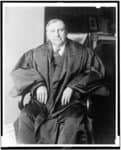
American · Law
Harlan Fiske Stone
October 11, 1872 – April 22, 1946
Early Life and Background
Harlan Fiske Stone was born on October 11, 1872, in Chesterfield, New Hampshire, to Anne Butler and Frederick L. Stone, a farming family in rural New England.[2][18] Shortly after his birth, the family moved to Amherst, Massachusetts, a college town whose intellectual atmosphere would shape his youth and later academic pursuits.[2][3][14] The Stone homestead in Chesterfield and family papers preserved in Amherst provide a record of his modest origins and early environment.[14][18]
Stone’s early education included attendance at local schools in Amherst. As a young man he enrolled at Massachusetts Agricultural College (now the University of Massachusetts Amherst) in 1888, pursuing a premedical program.[18] His time there ended abruptly in 1890 when he was expelled after pushing the college chaplain, Charles Swan Walker, an incident described in later biographical materials.[18] This setback forced Stone to reconsider his path but did not derail his ambition. He transferred to Amherst College, where he embraced the liberal‑arts curriculum that would anchor his intellectual development.[2][3]
Stone graduated from Amherst College in 1894, earning a B.S. degree.[2][3][6] During these years he formed friendships that would later prove important, most notably with fellow student Calvin Coolidge, who would become President of the United States.[3][6] Amherst’s emphasis on philosophy, history, and literature broadened Stone’s outlook beyond technical training, fostering the analytical habits and ethical concerns that would characterize his judicial work.[3][7]
Education and Career Beginnings
After graduating from Amherst, Stone spent a year teaching physics and chemistry at Newburyport High School in Massachusetts, gaining practical teaching experience and deepening his interest in education.[7] He soon turned to law, enrolling at Columbia Law School in New York City. Columbia exposed him to contemporary legal thought and the emerging case‑method style of instruction that emphasized analysis of judicial decisions.[3][6]
Stone received his law degree from Columbia in 1898, beginning a long association with the institution.[3][6][11] The following year, he passed the New York bar and entered private practice with the firm of Wilmer & Canfield, later becoming a partner in its successor, Satterlee, Canfield & Stone.[3][6][14] Practicing law in New York at the turn of the twentieth century immersed him in corporate and commercial matters during a period of rapid industrialization and financial expansion, giving him firsthand experience with the legal frameworks underpinning modern capitalism.[3][14]
At the same time, Stone maintained close ties to Columbia Law School. He began lecturing there in 1899, serving as a lecturer in law until 1902, then as a full professor from 1902 to 1905.[6] Balancing practice and teaching, he brought practical insights from corporate law into the classroom and helped train a generation of lawyers attuned to both doctrinal reasoning and real‑world consequences.[3][6] This blend of academic and professional work became a hallmark of his career.
Dean of Columbia Law School and Academic Leadership
In 1910, Stone was appointed Dean of Columbia Law School, a position he held for thirteen years until 1923.[3][6][11] As dean, he presided over a period of modernization and reform in legal education. He strengthened entrance requirements, expanded the faculty, and promoted rigorous analytical training over rote memorization.[3][11]
Stone insisted that legal education incorporate ethical and public‑interest dimensions, resisting pressures from corporate interests and political factions that sought to influence the law school’s direction.[6][11] His leadership during controversies—such as conflicts arising from faculty members’ outside ties to prominent Wall Street firms, including Sullivan & Cromwell—underscored his commitment to institutional integrity and independence.[6][11] These disputes eventually led him to resign the deanship and join Sullivan & Cromwell briefly, but his stance emphasized the need for clearer lines between academic institutions and private power.
Stone’s tenure as dean helped establish Columbia’s reputation as a leading center of legal scholarship. He supported the development of more scientific and sociological approaches to law, encouraging students and colleagues to consider the social impact of legal rules.[3][11] His experience as an administrator and educator made him known nationally, setting the stage for his later transition into federal public service.
Attorney General of the United States
Stone’s move from academia to national office came when President Calvin Coolidge, his former Amherst classmate, appointed him Attorney General of the United States in 1924.[3][6][10] The Federal Judicial Center notes his appointment in early 1924, and the Department of Justice records that he officially served from April 7, 1924, until March 2, 1925.[6][10] He thus joined the Cabinet during a period when the Department of Justice was under intense scrutiny following the Teapot Dome and related scandals.
As Attorney General, Stone undertook reforms aimed at restoring public confidence in the department. One of his most notable acts was demanding the resignation of FBI Director William J. Burns, who had been implicated in questionable investigative practices.[1][10] Stone appointed J. Edgar Hoover as acting director, emphasizing non‑partisan professionalism and the need to insulate federal law enforcement from political interference.[1][10] This decision proved consequential, as Hoover would go on to shape the FBI for decades.
Stone also pursued more vigorous enforcement of antitrust laws and sought to ensure that prosecutorial decisions were based on legal merit rather than political considerations.[3][6] His brief tenure in the Cabinet highlighted his commitment to ethical government and provided a national platform for his views on the proper role of law in public administration. It also brought him to the attention of the Senate and broader public, preparing the ground for his elevation to the Supreme Court.
Associate Justice of the Supreme Court
On January 5, 1925, President Coolidge nominated Stone to be an Associate Justice of the Supreme Court of the United States, filling the vacancy created by Justice Joseph McKenna’s retirement.[3][10] Following hearings that examined his record as Attorney General and his approach to corporate regulation, the Senate confirmed his appointment on February 5, 1925.[3][10]
Stone took his oath and joined the Court on March 2, 1925, ending his service as Attorney General and beginning what would be a sixteen‑year tenure as Associate Justice.[5][6][17] His appointment brought to the Court a jurist deeply influenced by academic legal thought and committed to judicial restraint, particularly in economic matters. He soon became associated with Justices Louis Brandeis and Benjamin Cardozo as part of a bloc more sympathetic to governmental regulation of the economy than some conservative colleagues.[1]
Stone’s jurisprudence emphasized the idea that courts should generally defer to legislatures on questions of economic and social policy, intervening only when laws violated specific constitutional guarantees.[1][16] At the same time, he showed strong sensitivity to civil liberties and First Amendment values. The First Amendment Encyclopedia notes that he is regarded by experts as one of America’s great jurists in part because of his defense of free expression and religious liberty.[7]
One of Stone’s most famous contributions came in United States v. Carolene Products Co. (1938), where he authored the majority opinion. In a footnote—later known as the "Footnote Four"—Stone suggested that while economic regulation deserved judicial deference, laws restricting political processes or targeting discrete and insular minorities might warrant more searching scrutiny.[1][7] This conceptual distinction laid groundwork for later constitutional doctrine on levels of scrutiny and became highly influential in civil‑rights jurisprudence.
Throughout the 1930s, Stone participated in landmark cases involving the New Deal. He often sided with upholding federal regulatory legislation, reflecting his view that democratic processes, not judges, should determine economic policy except where clear constitutional prohibitions applied.[1][3] His opinions and dissents helped shift constitutional law away from the Lochner‑era skepticism toward economic regulation and toward a more deferential posture.
Chief Justice of the United States
By 1941, Stone had become a central figure on the Court. On June 12, 1941, President Franklin D. Roosevelt nominated him to be the twelfth Chief Justice of the United States, elevating him to the Court’s leadership despite his original appointment by a Republican president.[3][10] The Senate confirmed the nomination on June 27, 1941, recognizing his experience and temperament.[3][10]
Stone took his oaths of office as Chief Justice on July 3, 1941.[5][17] The Supreme Court’s own exhibition notes that with this elevation Stone became the first—and to date only—justice to have sat in every seat on the Supreme Court bench, a distinction that earned him the description "a man for all seats."[17] Over his sixteen years as Associate Justice, changes in the Court’s composition and seating had placed him in each associate position; assuming the center chair completed that experience.
As Chief Justice, Stone also served as Chairman of the Judicial Conference of the United States from 1941 until his death in 1946.[3] In that role he helped oversee the administration of the federal courts during World War II, addressing caseload pressures and coordinating judicial responses to wartime legislation and executive actions.
Stone’s tenure as Chief Justice coincided with the United States’ entry into World War II and the complex legal questions that accompanied it. The Court under his leadership heard cases involving military tribunals, wartime economic controls, and civil liberties. While the Court sometimes upheld controversial measures, Stone’s broader judicial philosophy continued to stress the importance of protecting fundamental rights even in wartime and of maintaining the judiciary’s limited role in reviewing democratic decisions.[1][7]
Major Works, Opinions, and Jurisprudential Contributions
Stone did not publish major treatises but exerted his influence primarily through judicial opinions, academic lectures, and administrative reforms. His most widely cited work is the Carolene Products Footnote Four, which has been described in scholarship as a foundational text for modern equal protection and substantive due process analysis.[1][7] By distinguishing between economic regulation and laws affecting political processes or minorities, Stone offered a framework that later courts would develop into tiers of scrutiny.
His jurisprudence in First Amendment cases reflected a strong commitment to free speech and press. The First Amendment Encyclopedia highlights his sensitivity to civil‑liberties claims and his role in establishing stronger protections for dissenting and minority voices.[7] Stone authored and joined opinions that expanded constitutional safeguards for expression and religious liberty, even as he supported broad regulatory powers in economic domains.
Beyond the Supreme Court, Stone’s academic and administrative work shaped legal education and institutional practice. As dean of Columbia Law School, he helped institutionalize case‑method teaching and emphasized the social responsibilities of lawyers.[3][11] His reforms as Attorney General, including the reorganization of federal investigative leadership and his insistence on non‑partisan professionalism, influenced the development of the Department of Justice and the FBI.[1][6][10]
Awards, Honors, and Recognition
Stone’s career brought him numerous forms of recognition. While specific awards are less prominently documented than his offices, his appointment as Attorney General, Associate Justice, and ultimately Chief Justice itself attests to the high esteem in which he was held by presidents of both major political parties.[3][6][10]
In 1948, two years after his death, the U.S. Post Office Department issued a commemorative postage stamp bearing his image, known as the Harlan F. Stone Issue.[19] The Smithsonian National Postal Museum notes that this stamp formed part of a series honoring notable figures in American history and reflects official recognition of Stone’s national significance.[19] Such commemorations were reserved for individuals considered to have made lasting contributions to the nation’s institutions and civic life.
Within the legal academy, Columbia Law School honors Stone through the Harlan Fiske Stone Moot Court Competition, a prestigious advocacy contest bearing his name and held annually.[11] The competition commemorates his commitment to rigorous argumentation and legal education, and serves as a continuing testament to his influence on generations of lawyers.
Personal Life
Biographical sources emphasize Stone’s professional achievements more than his private life, but available records note that he married and had children, including a son, Harlan Fiske Stone Jr., and other family members whose papers are preserved in the Jones Library archives.[18] His family connections to Amherst and Chesterfield remain part of local historical memory, with the Stone homestead and personal papers documenting his familial relationships and everyday life.[14][18]
Contemporaries described Stone as plain‑spoken, independent, and somewhat austere, qualities consistent with his New England upbringing.[3][8] He enjoyed intellectual conversation and maintained friendships across political lines, including with Calvin Coolidge, despite their differing partisan affiliations.[3][6] His personal habits reflected his belief in hard work and modest living, and he was known for his integrity and reluctance to engage in overt political maneuvering.
Later Life and Death
In his later years on the Court, Stone continued to participate actively in major decisions and to articulate his philosophy of judicial restraint and protection for civil liberties. He served as Chief Justice through the end of World War II and into the early postwar period, presiding over a Court that confronted the implications of wartime policies and the emerging contours of the modern administrative state.[1][3]
On April 22, 1946, Stone suffered a cerebral hemorrhage while presiding over a Supreme Court session in Washington, D.C., and died later that day at age seventy‑three.[3][4][11][18] He thus died in active service, having spent twenty‑one years on the Court, including five as Chief Justice.[3][10] His death led President Harry S. Truman to appoint Fred M. Vinson as his successor, marking a new chapter in the Court’s history.[1]
Legacy and Historical Impact
Harlan Fiske Stone is widely regarded as one of the significant American jurists of the twentieth century. Britannica and other reference works emphasize his role as Associate Justice (1925–41) and twelfth Chief Justice (1941–46), highlighting his influence on constitutional law during a transformative era.[4][8] The First Amendment Encyclopedia notes that he is considered one of America’s great jurists, especially for his contributions to civil‑liberties jurisprudence.[7]
Stone’s legacy rests on several pillars. First, he helped move the Supreme Court away from the Lochner‑era skepticism toward economic regulation and toward greater deference to legislative judgment in economic policy. His opinions supported the constitutionality of many New Deal measures, reinforcing the idea that democratic institutions, not courts, should manage economic experimentation unless clear constitutional prohibitions were violated.[1][3]
Second, through his Carolene Products Footnote Four and related writings, Stone provided an enduring framework for distinguishing between types of legislation in constitutional review. By suggesting that laws affecting political processes or discrete and insular minorities warrant closer scrutiny, he laid an intellectual foundation for later developments in civil‑rights law and equal protection doctrine.[1][7]
Third, Stone’s emphasis on integrity and professionalism in law enforcement and legal education influenced institutional practices. His reforms as Attorney General helped reorient the Department of Justice toward non‑partisan standards and professionalized investigative work.[1][6][10] As dean of Columbia Law School, he strengthened academic rigor and fostered an ethos that linked legal analysis with social responsibility.[3][11]
Finally, his unique experience of having sat in every seat on the Supreme Court bench, culminating in his service as Chief Justice, symbolizes his deep engagement with the institution.[17] The Supreme Court’s own exhibition, "Harlan Fiske Stone: A Man for All Seats," highlights this distinction and underscores his longstanding presence at the heart of American judicial life.[2][17]
Stone’s ideas continue to resonate in discussions of judicial restraint, civil liberties, and the role of courts in a democracy. His life and work offer a model of the scholar‑jurist: a figure who bridged academia, practice, and public service, and whose influence on constitutional thought endures long after his death.
Dated achievements
13 indexed.
- Oct111872Law
Birth in Chesterfield, New Hampshire
Harlan Fiske Stone is born in Chesterfield, New Hampshire.
View details U.S. Supreme Court Biography: Harlan F. Stone - Jun271894