← All women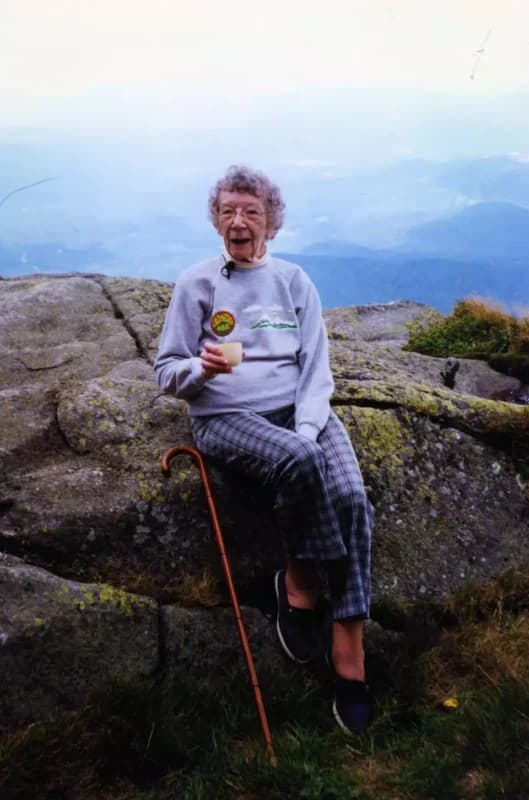
American · Exploration · Activism
Grace Hudowalski
February 25, 1906 – March 13, 2004
Early Life and Background
Grace Dolbeck Leach Hudowalski was born on February 25, 1906, in Ticonderoga, New York, a small industrial town situated in the foothills of the Adirondack Mountains.[1][2][8] She was the youngest of six children of James Casper Leach and Alice Luella Dolbeck Leach, growing up in a family of modest means surrounded by the forests, lakes, and ridges that would later define her life.[2] The proximity of Ticonderoga to the Adirondack High Peaks gave her an early visual and emotional connection to mountainous landscapes.
Grace’s childhood unfolded in an era when outdoor recreation was not yet widely accessible and was often regarded as a masculine domain. Nonetheless, she developed a deep appreciation for the outdoors and for the region’s folklore and history. Adirondack Hub and Forty‑Sixers accounts note that she spent her youth exploring the local countryside and listening to stories that linked human communities with the surrounding wilderness.[2][8] These formative experiences fostered both her love of mountains and her interest in narrative—two strands that would intertwine throughout her career.
Her early education took place in local schools in and around Ticonderoga, where she proved to be an able student and an avid reader.[2] Although detailed records of her schooling are limited, later biographical sketches emphasize her talent for writing and her curiosity about geography and history, suggesting that she gravitated toward subjects that helped her interpret both landscapes and human experience.[6][11]
First Encounters with the High Peaks
Grace’s life changed decisively in her teenage years. On August 2, 1922, when she was sixteen, she undertook her first ascent of Mount Marcy, New York’s highest peak.[2] She later recalled setting out wearing everyday oxfords and balloon bloomers rather than specialized hiking gear, a detail that highlights both the informality of early 20th‑century mountaineering and the additional practical barriers women faced.[5] As she departed, her father offered the advice that would become her guiding ethic: “It doesn’t matter whether you reach the top, what matters is how you make the climb.”[11]
Reaching Marcy’s summit proved to be a life‑changing experience. According to the Adirondack Forty‑Sixers’ official biography, this climb started her "climbing and talking about mountains," turning a single teenage outing into the foundation of a lifelong vocation as a hiker, writer, and mentor.[2] In the early 1920s, very few women were visible in demanding backcountry pursuits, and almost none were systematically recording their ascents. Grace’s 1922 climb thus stands as an early breach of gender expectations in American mountaineering.[2][6]
After Marcy, Grace continued exploring the Adirondack High Peaks, gradually increasing the difficulty and ambition of her trips. She learned navigation, route‑finding, and backcountry camping skills in an era before lightweight gear and modern trail networks, developing competencies that were essential for safe travel in the High Peaks wilderness.[2][8] These formative climbs laid the groundwork for her later achievement as the first recorded woman to complete all 46 Adirondack High Peaks.
Marriage and Life in Troy
In the 1920s, Grace’s personal and professional life widened beyond Ticonderoga. In 1926, she married Edward (Ed) Hudowalski, an electrical engineering student at Rensselaer Polytechnic Institute.[3] The couple settled near Troy, New York, where both maintained office jobs while devoting much of their free time to exploring the Adirondacks.[3][8] Their marriage formed a partnership grounded in shared love of the mountains, with Ed accompanying Grace on many climbs and supporting her growing involvement in Adirondack hiking circles.
The Hudowalskis’ home near Troy provided a convenient base for trips north into the High Peaks region. Over the years, they became central figures in a loose network of climbers who were attempting to visit all 46 summits then known to exceed 4,000 feet in elevation.[11] In the 1950s, they purchased a second home on the eastern side of Schroon Lake, further anchoring their lives in the Adirondack landscape.[8] This pattern of living—maintaining urban or suburban employment while dedicating weekends and vacations to the mountains—was typical of mid‑century outdoor enthusiasts, but Grace’s commitment and leadership would prove exceptional.
Climbing All 46 Adirondack High Peaks
Between 1922 and the late 1930s, Grace methodically worked toward climbing all 46 of the Adirondack High Peaks. The list included rugged and, at the time, often remote summits such as Dix, Seward, and the Great Range. Trails were fewer and less maintained than today, and many approaches required long, multi‑day trips or difficult bushwhacks.[2][8] Grace persisted through these challenges, balancing her climbs with work and family responsibilities.
On August 26, 1937, she completed her round by summiting Esther Mountain.[12] With that ascent she became Adirondack Forty‑Sixer #9 and the first recorded woman to climb all 46 Adirondack High Peaks.[8][12] Sources such as Adirondack Hub, the Adirondack Forty‑Sixers, and later historical markers uniformly cite 1937 as the completion year, and Forty‑Sixers records specify the August 26 date.[8][12][13] At that time, only eight others had documented finishing the list, all of them men.[6]
Her achievement carried multiple layers of significance. In a physical sense, completing the 46 required stamina, navigation skills, and resilience in variable weather and terrain. Culturally, it challenged entrenched assumptions that serious mountaineering belonged to men. Grace climbed at a time when women were often discouraged from strenuous outdoor pursuits and lacked both specialized gear and institutional support.[6][9] By becoming the first woman Forty‑Sixer, she demonstrated that women could not only participate in demanding wilderness travel but also lead and define its traditions.
Grace’s 46er status also established her authority within the emerging peak‑bagging community. She was not simply a participant; she became a central storyteller and record‑keeper, roles that would shape Adirondack hiking culture for decades.
Founding the Adirondack Forty-Sixers
Even before she completed her own round of climbs, Grace was involved in organizing fellow peak‑baggers. In the 1930s, she helped form the "46rs of Troy," an early group of Adirondack High Peaks climbers who shared information, stories, and encouragement as they pursued the list.[11] This group is credited with coining the term "Forty‑Sixer" to describe someone who had climbed all 46 peaks.[11] Through these activities, Grace began to link individual achievement with communal identity.
The informal networks of the 1930s evolved into a formal organization in the post‑war years. On May 30, 1948, Grace organized the first meeting of the Adirondack Forty‑Sixers, transforming what had been a loosely structured group into a recognized club.[13] At this founding meeting, she was elected the first president of the organization, a position she held from 1948 to 1951.[6][8][13]
As president, she helped establish the club’s policies, membership procedures, and record‑keeping practices. The Forty‑Sixers developed an application process whereby aspiring members would submit detailed narratives or "letters" describing their climbs, which the historian would review and file.[6][8] This narrative‑based documentation, strongly influenced by Grace, fostered a culture in which personal reflection and storytelling were as important as the bare fact of reaching summits.
Her leadership as a woman in a mountaineering club was notable in the mid‑20th century. Hiking and climbing organizations of the era typically had male presidents and board members, paralleling broader gender hierarchies in civic life. Grace’s presidency signaled that expertise and commitment in wilderness recreation could justify female leadership even within conservative social norms.[6][13]
Historian and Mentor of the Forty-Sixers
After serving as president, Grace continued to shape the Forty‑Sixers as their historian, a role she held for more than fifty years.[6][8] As historian, she corresponded with thousands of hikers who aspired to become 46ers, reading and responding to letters that recounted their climbs. She offered advice on routes and safety, encouragement in difficult sections of the list, and reflection on the spiritual and emotional meaning of time spent in the "high places."[6][9]
Biographical accounts emphasize that Grace answered "thousands of letters" from club members, often with thoughtful, individualized responses.[6][7][8] Over decades, she built an archival record of personal narratives that documented not only who completed the 46 but how they experienced the mountains. This work made her a central figure in the social and emotional life of the club; many hikers considered her their mentor even if they never met her in person.
Her concept of the mountains as places of healing and growth appears repeatedly in her writings and in recollections by others. The Adirondack Forty‑Sixers note that she often spoke of the "healing woods," invoking the title of Martha Reben’s 1952 memoir and linking wilderness experience with personal recovery and resilience.[12] Through decades of correspondence, she encouraged people to seek not just physical challenge but also reflection and solace in the Adirondacks.
Writing, Tourism, and Conservation
Grace’s influence extended beyond club leadership into writing and public service. She became an accomplished writer, contributing articles to magazines such as High Spot, Cloudsplitter, and Adirondac, the journal of the Adirondack Mountain Club.[5][6] Her articles touched on conservation, outdoor recreation, local folklore, and history, weaving together the human and natural dimensions of the region.
In addition to freelance writing, Grace worked as a tourism writer for New York State, promoting the state’s attractions, natural resources, and historic sites.[6][11] She used her knowledge of the Adirondacks to encourage visitors and residents alike to explore the region responsibly. Her tourism work helped build New York’s outdoor recreation economy while highlighting the cultural significance of wilderness landscapes.
Grace was also an advocate for trail building and backcountry infrastructure. Biographical sources note that she supported constructing trails and shelters to open more wilderness to recreation, while insisting on preserving the "forever wild" character of the High Peaks.[11] This balance—facilitating access while defending ecological integrity—placed her within the broader conservation movement that shaped mid‑century Adirondack policy.
Her writing and advocacy contributed to public understanding of the Adirondacks as a place where recreation, history, and conservation intersect. She helped popularize the idea that mountains could be simultaneously playgrounds, classrooms, and sanctuaries.
Personal Life
Grace’s marriage to Ed Hudowalski was central to her personal and professional life. The couple shared many climbs and co‑founded early groups that prefigured the Adirondack Forty‑Sixers.[3][11] Their second home on Schroon Lake served as a retreat and a base for mountain trips, reinforcing the integration of domestic and wilderness life.[8] Ed’s support made it possible for Grace to devote substantial time to club correspondence and writing while balancing household responsibilities.
Accounts focus primarily on the couple’s partnership and do not emphasize children or broader family details, suggesting that her public identity was defined largely through mountain and community work rather than domestic roles.[2][3][8] Within their social circles, Grace was known for her warmth, humor, and capacity to listen deeply to others’ experiences, traits that made her an effective mentor and correspondent.[6][9]
Awards, Honors, and Recognition
Grace’s contributions received a range of formal recognitions. The most poignant occurred on March 13, 2004, the day of her death, when the Adirondack Mountain Club conferred its highest honor, the Trail Blazer Award, at its annual banquet.[13] The award acknowledged her lifelong work promoting the Adirondacks, mentoring hikers, and advancing conservation ideals.
Her legacy also came to be honored through historic markers and geographic naming. In 2016, a historic marker funded by the William G. Pomeroy Foundation was placed at 10 Montcalm Street in Ticonderoga, noting her birth near the site and her status as the first woman to climb the Adirondack 46 High Peaks.[6] The marker’s text affirms 1937 as her completion year, reinforcing the consensus date in regional memory.
An even more enduring honor arrived on June 12, 2014, when the U.S. Board on Geographic Names approved a petition by the Adirondack Forty‑Sixers to rename East Dix as Grace Peak in her honor.[8][13] By inscribing her name onto an Adirondack High Peak, federal authorities recognized her significance in American mountaineering and regional culture. This kind of toponymic recognition is rare, particularly for women in outdoor history.
Legacy and Historical Impact
Grace Hudowalski’s legacy is multifaceted, encompassing gender, recreation, conservation, and community. She is best known as the first woman and ninth person to climb all 46 Adirondack High Peaks, an achievement that challenged gender norms and expanded possibilities for women in wilderness recreation.[1][6][9] Yet her influence extends far beyond her personal climbs.
As a founder and first president of the Adirondack Forty‑Sixers and as the club’s long‑time historian, she shaped a distinctive culture of mentorship and storytelling around peak‑bagging.[6][8][13] Her insistence that climbers submit narrative accounts of their ascents encouraged reflection on the emotional and ethical dimensions of wilderness travel. Thousands of hikers came to see their 46er journey not merely as a checklist but as a process of personal growth, resilience, and connection with nature.
For women’s history, Grace stands as a pioneering figure who claimed authority in a field dominated by men and then used that authority to support others. She showed that women could be central organizers, historians, and symbolic leaders in mountaineering communities. Later generations of female hikers and conservationists in the Adirondacks have cited her as an inspiration and as evidence that mountain leadership is not gender‑bound.[6][9]
Her work in tourism and conservation helped build broader appreciation for the Adirondacks as a "forever wild" region where recreation and preservation must coexist.[6][11] By blending folklore, history, and natural description in her writing, she contributed to a narrative in which mountains are cultural as well as physical landmarks.
The continued vitality of the Adirondack Forty‑Sixers, the presence of Grace Peak on maps, and the thousands of letters she wrote as historian all testify to a legacy that is institutional, geographic, and personal. She is remembered not only as an accomplished climber but as the "soul of the summits," a woman who made mountains a place of healing, community, and possibility.[5][8]
Later Life and Death
In her later decades, Grace remained deeply involved with the Adirondack Forty‑Sixers and regional conservation efforts. Even as age limited her own climbing, she continued to correspond with hikers, attend meetings when possible, and lend her voice to discussions about trail management and wilderness ethics.[6][8] Her reputation as a wise elder and mentor grew as new generations of hikers discovered the High Peaks.
Grace died on March 13, 2004, at age 98 at Guilderland Centre Nursing Home in New York.[1][13] On the evening of her death, the Adirondack Mountain Club awarded her the Trail Blazer Award at its annual banquet, symbolically closing her life on a note of public recognition for the work she had carried out quietly and persistently over many years.[13]
In the years following her death, efforts to memorialize her legacy intensified. The historic marker in Ticonderoga and the federal renaming of East Dix as Grace Peak ensured that her story would remain part of the physical and cultural landscape of the Adirondacks.[6][8][13] Oral‑history podcasts, documentary clips, and online tributes continue to introduce new audiences to her life, cementing her status as a key figure in both Adirondack and women’s history.[6][9][10]
Grace Hudowalski’s life, spanning nearly a century, traces the evolution of American outdoor recreation from a niche pursuit to a broader cultural phenomenon. Through vision, persistence, and an unwavering commitment to helping others "make the climb," she left a legacy that endures on summits, in archives, and in the lives of those she inspired.
Dated achievements
6 indexed.
- Feb251906Exploration
Birth of Grace Dolbeck Leach Hudowalski
Grace Dolbeck Leach (later Hudowalski) was born in Ticonderoga, New York, in the foothills of the Adirondack Mountains.
View details Wikipedia: Grace Hudowalski - Aug021922Exploration
First Ascent of Mount Marcy
At age 16, Grace made her first ascent of Mount Marcy, beginning her lifelong commitment to the Adirondack High Peaks.