← All women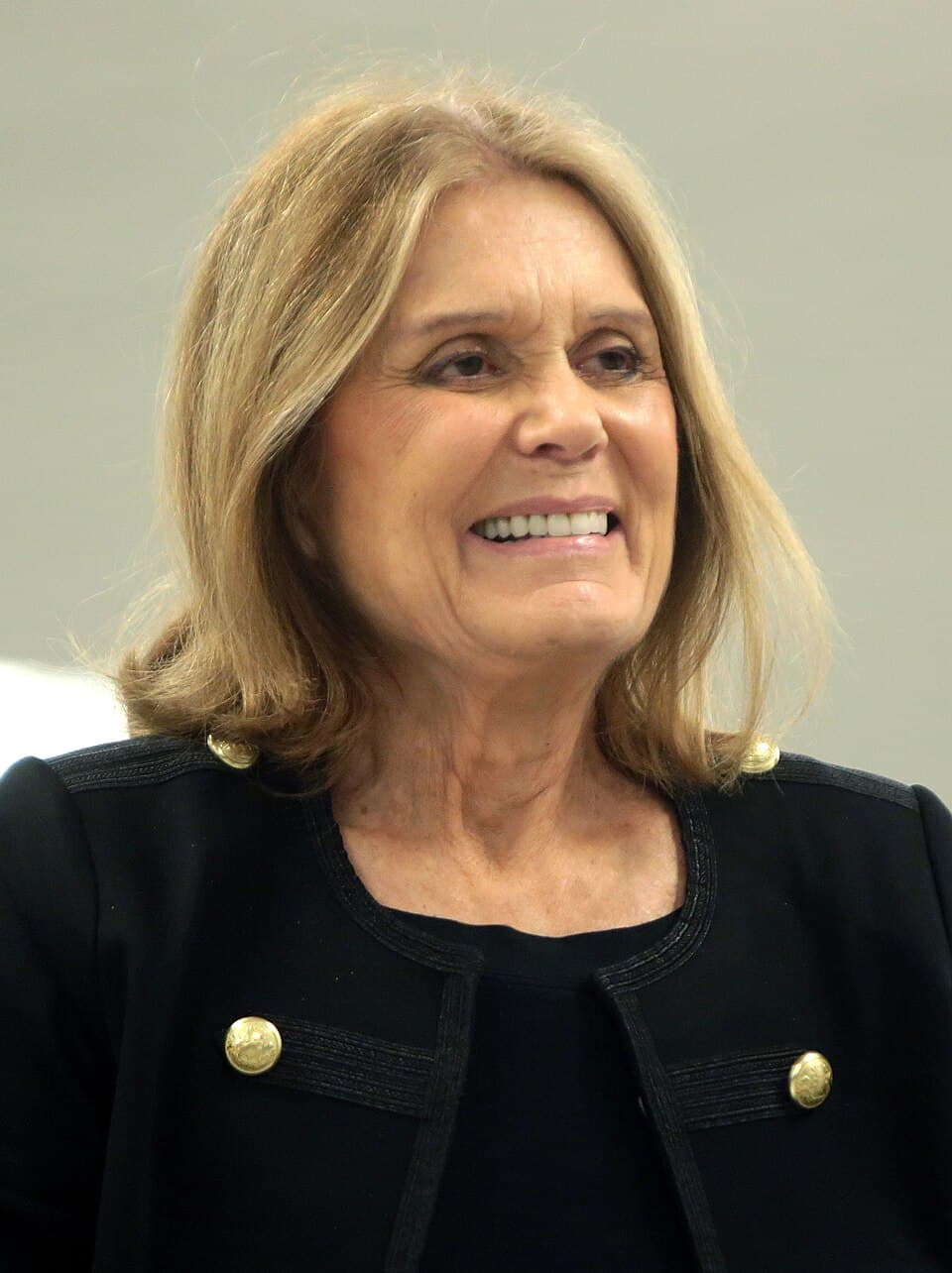
American · Activism · Literature · Politics
Gloria Steinum
March 25, 1934 – present
Early Life and Background
Gloria Marie Steinem was born on 25 March 1934 in Toledo, Ohio, United States, the second daughter of Leo Steinem, an itinerant antiques dealer, and Ruth Nuneviller Steinem, a former teacher.[1][2][3][4][14] Her older sister, Suzanne, was born in 1925.[4] The family spent much of Gloria’s childhood traveling across the Midwest in a house trailer while Leo bought and sold antiques, leading to an unconventional upbringing marked by economic uncertainty and frequent school changes.[2][11][12]
When Steinem was a teenager, her parents divorced, and she returned with her mother to Toledo.[1][11][12] Ruth struggled with severe depression and other mental health challenges, for which she received inadequate treatment in an era when such conditions were poorly understood and heavily stigmatized.[1][2][11][12] Gloria assumed significant caregiving responsibilities, an experience she later described as deeply formative for her understanding of women’s unpaid emotional labor and the social isolation of those who do not conform to gendered expectations of marital and domestic life.[1][2][11]
Steinem’s family background also included a Jewish paternal lineage, and she has spoken about growing up aware of anti-Semitic prejudice alongside sexism, though she was raised in a largely secular environment.[1][8] These early experiences of economic hardship, gendered caregiving, and social marginalization helped shape her sensitivity to intersecting forms of injustice.
Education and Formative Influences
After attending high school in Toledo, Steinem enrolled at Smith College, one of the leading women’s colleges in the United States.[1][2][9][11] She majored in government and became involved in campus publications, developing skills in writing and editing that would define her professional life. She graduated in 1956 with a Bachelor of Arts degree in government, having completed a notable junior year abroad in India.[1][2][9]
Her time in India proved particularly influential. There, Steinem observed grassroots organizing, studied nonviolent resistance, and learned from local activists about the importance of listening to marginalized communities.[10] She later credited this experience with deepening her understanding of political movements and the importance of democratic, participatory methods of social change.[10] It also acquainted her with the global dimensions of inequality, which would inform her later work connecting women’s rights struggles across borders.[1][2][3]
Returning to the United States after her travels, Steinem briefly worked in Washington, D.C., and then moved to New York City in 1960 to pursue a career in journalism.[1][2][4][12] The combination of her political education at Smith, exposure to Indian activism, and lived experience of caregiving in Ohio laid the foundation for her later role as a feminist organizer and writer.
Career Beginnings in Journalism
In New York, Steinem entered a media landscape that largely confined women to roles as researchers, assistants, or writers of fashion and lifestyle features.[2][12] She began working at the satirical magazine Help!, gaining experience in editing and story development.[4][12] She soon transitioned to freelance work, writing for publications including Esquire, New York, and other major magazines.[1][2][3]
Steinem’s first major assignment came with her article “The Moral Disarmament of Betty Coed: The Contraceptive Revolution”, published in Esquire in 1962.[2][10] The piece examined how the birth control pill was transforming sexual and social dynamics on college campuses, framing reproductive technology as a catalyst for women’s autonomy and as a challenge to traditional moral codes.[10][12] This article helped establish Steinem as a serious journalist capable of tackling controversial topics with analytical rigor.
In 1963, Steinem undertook an undercover assignment that would become one of her best-known early works. She spent several weeks working as a Playboy Bunny at the New York Playboy Club, documenting the working conditions, bodily surveillance, and exploitation that the job entailed.[1][6][12] Her two-part exposé, “A Bunny’s Tale,” published in Show magazine, exposed the gap between Playboy’s glamorous image and the reality of low pay, long hours, and routine sexual harassment faced by its female employees.[1][6][12] The article was a landmark in investigative journalism and feminist critique of the sex industry, though Steinem later noted that being labeled an “ex-Bunny” initially hindered her efforts to be taken seriously as a political writer.[1][6][11][12]
By the late 1960s Steinem had become a columnist and co-founding editor at New York magazine, where she wrote on politics, culture, and social issues.[1][6][12][13] The magazine’s coverage increasingly reflected the emerging women’s liberation movement, and Steinem used her platform to highlight sexism in politics and everyday life. In 1969 she published the influential essay “After Black Power, Women’s Liberation”, which appeared in New York and brought her national prominence as a feminist commentator.[1][6][8][12] The piece argued that the logic of liberation articulated in Black Power movements also applied to women’s struggles against patriarchal structures, helping articulate a more intersectional understanding of civil rights.
Emergence as a Feminist Leader
Steinem’s reporting and essays coincided with the rise of second-wave feminism, and she quickly became one of its most visible spokeswomen.[1][2][3] In the late 1960s and early 1970s she spoke frequently at rallies, campuses, and community events, often appearing alongside activists such as Dorothy Pitman Hughes, Florynce Kennedy, and Margaret Sloan.[10] Their interracial speaking tours emphasized coalition-building and highlighted the connections between racism and sexism.
In 1971, Steinem helped create a feminist preview insert in New York magazine that would lay the groundwork for Ms. magazine.[1][6][12] The insert’s success demonstrated a strong readership for feminist journalism. Building on this momentum, Steinem and colleagues including Patricia Carbine, Letty Cottin Pogrebin, and others co-founded Ms. magazine as an independent publication in 1972, with Steinem serving as a founding editor.[1][2][6][12]
Ms. was the first national feminist magazine run entirely by women, and it quickly became a central organ of the women’s liberation movement.[3][6][12] Early issues covered topics such as abortion rights, domestic violence, childcare, employment discrimination, and the Equal Rights Amendment (ERA). The first stand-alone issue in mid-1972 sold out its initial print run of approximately 300,000 copies.[1][6] Steinem remained closely involved with the magazine, serving as an editor through 1988, and using its pages to advocate for feminist perspectives on both domestic and international issues.[12][13]
Beyond media, Steinem was instrumental in founding and sustaining organizations central to second-wave feminism. In the early 1970s she helped establish the National Women’s Political Caucus (NWPC), which worked to increase women’s participation and representation in electoral politics.[1][2][5][6] She also helped form the Ms. Foundation for Women, dedicated to funding grassroots initiatives and promoting economic and social justice for women.[2][5][6]
Major Works, Initiatives, and Campaigns
Across the 1970s and 1980s, Steinem produced a series of books and essays that codified her feminist philosophy. Her collection Outrageous Acts and Everyday Rebellions, first published in 1983, brought together many of her most influential articles, including “If Men Could Menstruate” and “I Was a Playboy Bunny.”[1][5][12] Later works such as Revolution from Within: A Book of Self-Esteem (1992) explored the psychological dimensions of oppression, arguing that structural change must be accompanied by transformations in internalized self-worth.[1][5]
Steinem became a prominent advocate for the Equal Rights Amendment, traveling extensively to speak in support of its ratification during the 1970s and early 1980s.[1][2][6] She also focused on issues such as reproductive freedom, co-founding and supporting organizations committed to abortion rights and comprehensive reproductive health care.[1][3][13] Her speeches and writings consistently linked control over one’s body to broader notions of citizenship and democracy.
In the labor sphere, Steinem supported the formation of the Coalition of Labor Union Women, emphasizing the importance of unionization and workplace rights for women.[17] She argued that feminism must address economic structures as well as cultural narratives, highlighting the intersections between class and gender inequality.
In the media realm, Steinem continued to innovate. In 2005 she co-founded the Women’s Media Center with Jane Fonda and Robin Morgan, an organization dedicated to increasing women’s visibility and leadership in all forms of media.[1][13][17] The Center works to train women experts, challenge bias in news coverage, and promote diverse voices in journalism and entertainment.
One of Steinem’s most widely recognized initiatives is the “Take Our Daughters to Work Day” program, developed through the Ms. Foundation for Women in the early 1990s and nationally launched in 1993.[1][2][6] The program encouraged parents and employers to invite girls into workplaces for a day of observation and mentoring, responding to concerns about declining self-esteem among adolescent girls and limited exposure to professional role models.[2][6][12] It later expanded to include boys while maintaining a focus on gender equity.
Steinem’s activism also extended internationally. She was involved in founding organizations such as Equality Now, which works to end legal discrimination against women globally, and Donor Direct Action, connecting donors with front-line women’s rights groups.[5] She supported campaigns against sex trafficking, female genital mutilation, and other manifestations of gender-based violence worldwide.
Awards, Honors, and Recognition
Steinem’s contributions have been recognized with numerous awards. In 1969, she received the Penney-Missouri Journalism Award for excellence in magazine writing, acknowledging her achievements as a feature writer in a field still heavily dominated by men.[13]
Over subsequent decades, universities, feminist organizations, and civil rights groups honored Steinem with fellowships, honorary degrees, and leadership awards. She became a sought-after lecturer, delivering keynote addresses on campuses and at major conferences worldwide.[1][2][5]
A major milestone came in 2013, when President Barack Obama selected her as a recipient of the Presidential Medal of Freedom, one of the United States’ highest civilian honors.[1][3][9][17] Announced in August and formally presented in November at the White House, the award recognized her “extraordinary work as a journalist and political activist” and her long-term impact on the women’s liberation movement.[3][9] Steinem emphasized that the medal honored the collective efforts of countless women and men who had participated in feminist organizing, not solely her own achievements.
Steinem’s work has also been celebrated in cultural forums. The theatrical production “Gloria: A Life”, which dramatizes her story and the broader history of women’s liberation, has been staged in multiple venues. In 2019, the Library of Congress hosted a screening of the production followed by a conversation with Steinem, highlighting the integration of feminist biography into national cultural institutions.[1][7][15]
Personal Life
Steinem long resisted traditional expectations around marriage, famously quipping that she did not want to be part of an institution that treated women as property. For much of her life she remained single and without children, arguing that marital status should not define a woman’s identity or social value.[1][2][3]
However, in September 2000, at age 66, Steinem married David Bale, a British-born environmental and animal rights activist and father of actor Christian Bale.[9][13][16] The couple’s relationship reflected shared interests in social justice and global activism. Their marriage lasted until Bale’s death from brain lymphoma in 2003.[9][13][16] Steinem has spoken warmly of the partnership while maintaining her critique of the patriarchal assumptions often embedded in marital institutions.
In 1986, Steinem underwent surgery for breast cancer, an experience that reinforced her commitment to health advocacy and made her more vocal about the need for women-centered medical research and support.[13] She recovered and continued her activism, often addressing issues of aging, health, and resilience in later writings and talks.
Steinem has made New York City her primary home, though she has spent substantial time traveling nationally and internationally for lectures, organizing meetings, and solidarity visits with feminist groups.[1][5][15] Her personal life is closely intertwined with her public activism, reflecting a long-standing commitment to “organizing across boundaries for peace and justice.”[5][15]
Later Life, Writings, and Ongoing Activism
After leaving her formal editorial role at Ms. in 1988, Steinem devoted more time to books, freelance writing, and public speaking.[13] She continued to publish essays in major outlets and to appear in documentaries and television programs discussing gender, politics, and media.
In 2015, she released her memoir My Life on the Road, which chronicles her decades of travel for activism, journalism, and personal exploration.[1][6][10][11] The book reflects on her experiences organizing across regions, listening to diverse communities, and building coalitions. It emphasizes the importance of movement-building from the ground up and credits countless local activists for sustaining feminist struggles.
Steinem remains active as a lecturer and organizer well into the 21st century. She has continued to speak out on issues such as reproductive rights, racial justice, LGBTQ+ equality, and the rise of authoritarian political movements.[1][2][5] She often stresses the interconnectedness of different forms of oppression and advocates for intersectional approaches to activism.
Her official website and associated organizations provide resources, links to her writings, and information about current campaigns.[5][15] She has supported newer generations of feminists and writers, mentoring activists and using her platform to draw attention to emerging leaders and marginalized voices.
Legacy and Historical Impact
Gloria Steinem is widely regarded as one of the most influential figures in the history of modern feminism.[1][2][3][17] As a journalist, she helped define the intellectual contours of second-wave feminism by articulating how personal experiences of sexism are rooted in broader political and economic structures. As a media innovator, she co-founded Ms. magazine, proving that a national publication run by women and devoted to feminist issues could thrive in mainstream markets.[3][6][12]
Her role as a public speaker and organizer made her a central bridge between grassroots activists and wider audiences. Steinem’s ability to explain complex feminist ideas in accessible language helped broaden public understanding of issues such as reproductive freedom, domestic violence, workplace discrimination, and sexual harassment.[1][2][3] She consistently emphasized the importance of intersectionality, acknowledging that gender oppression is intertwined with race, class, sexuality, and nationality.
Institutionally, Steinem’s legacy includes organizations that continue to shape policy and public discourse: the National Women’s Political Caucus, the Ms. Foundation for Women, the Women’s Media Center, Equality Now, and others.[1][2][5][17] These groups have supported political candidates, funded grassroots projects, challenged media bias, and campaigned against discriminatory laws worldwide.
Take Our Daughters to Work Day and similar initiatives exemplify her commitment to practical strategies for expanding girls’ horizons, while her writings on self-esteem and internalized oppression underscore the psychological dimensions of social change.[2][6][12] Her memoir and essays serve as vital historical sources for understanding the evolution of U.S. feminism from the 1960s onward.
Recognition such as the Presidential Medal of Freedom and dedicated theatrical works like Gloria: A Life reflect the extent to which her contributions are now embedded in national cultural memory.[1][3][7][15][17] For scholars, archivists, and activists, Steinem’s life illustrates how sustained, multi-decade engagement—combining journalism, organizing, institutional founding, and mentorship—can reshape both public consciousness and policy landscapes.
Although she remains a living figure whose work continues to evolve, Gloria Steinem’s place in women’s history is already secure. She is cited as a defining voice of second-wave feminism and as a key architect of feminist media infrastructure, with an enduring impact on how issues of gender, race, and power are understood in the United States and beyond.[1][2][3][6][12][17]
Dated achievements
10 indexed.
- Mar251934Science
Birth of Gloria Steinem
Gloria Marie Steinem is born in Toledo, Ohio, to Ruth and Leo Steinem.
View details Gloria Steinem - Wikipedia - Sep011962Literature
Publishes "The Moral Disarmament of Betty Coed" in Esquire
Esquire publishes Steinem's early feature on the 'contraceptive revolution' and changing sexual attitudes on college campuses.