← All women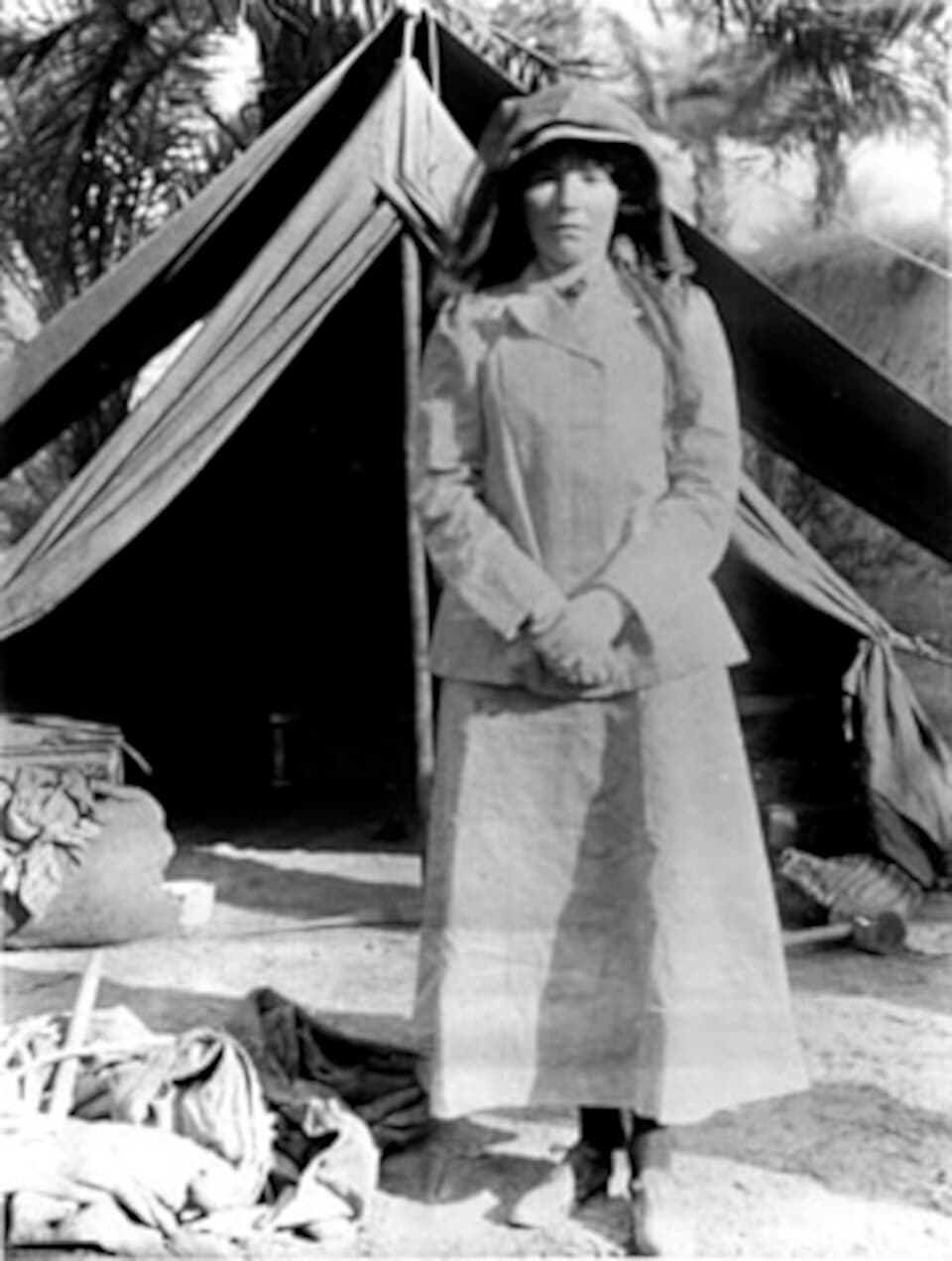
British · Exploration · Politics · Activism · Literature
Gertrude Bell
July 14, 1868 – July 12, 1926
Early Life and Family Background
Gertrude Margaret Lowthian Bell was born on 14 July 1868 at Washington New Hall in Washington, County Durham, in northeast England. She was the eldest child of Sir Hugh Bell, an iron and steel magnate, and Mary Bell, daughter of renowned industrialist and scientist Sir Isaac Lowthian Bell. Her family ranked among the wealthiest in Britain, with deep involvement in heavy industry and Liberal politics, giving her early exposure to national affairs and social reform.
Bell’s mother died when Gertrude was a young child, an event that profoundly affected her and fostered a sense of emotional self-reliance noted by later biographers. In 1872 her father married Florence Olliffe, later Dame Florence Bell, a playwright and social reformer whose progressive views helped shape Gertrude’s intellectual development. Florence encouraged serious reading, writing, and languages, and believed that girls deserved rigorous education, a view still uncommon in Victorian Britain.
Gertrude spent much of her childhood between Washington Hall and Redcar on the North Yorkshire coast, where the Bell family had another residence. She grew up in a household that combined industrial wealth, literary culture, and discussion of public life—conditions that made it plausible, though still unusual, for a daughter to pursue academic distinction and independent travel.
Education and Early Intellectual Formation
Bell was initially educated at home with governesses, learning French and German alongside standard subjects. At age around fifteen she attended Queen’s College, London, one of the first institutions in Britain dedicated to serious education for women. Her performance convinced her family she could attempt university-level study.
In the 1880s Bell entered Lady Margaret Hall, Oxford, which had been founded in 1878 as the university’s first women’s college. She read Modern History, a demanding discipline that included constitutional history, political thought, and European diplomacy. Despite social expectations that women pursued education only as ornament, Bell sought full academic recognition.
In 1888, she became the first woman at Oxford to achieve first-class honours in Modern History, a milestone frequently cited as a breakthrough for women’s higher education. At that time, Oxford did not formally confer degrees on women; Bell received a classification but no official degree scroll, highlighting gender barriers even at elite institutions. Nonetheless, her success demonstrated that women could meet the highest academic standards and gave her intellectual confidence that later underpinned her political and diplomatic work.
Early Travels and Writing Career
After Oxford, Bell entered upper-class society but soon found conventional roles limiting. Her father’s wealth made extended travel possible, and she began spending long periods abroad. In the late 1880s she visited relatives serving in the British diplomatic corps in Tehran, Persia (Iran), which sparked her fascination with the wider Middle East. She quickly began learning Persian and Arabic and collecting observations on culture and landscape.
Bell turned these experiences into travel writing. Her first major book, Persian Pictures, based on journeys in Iran, was published in the 1890s and offered literary sketches of people and places rather than formal scholarship. She followed this with The Desert and the Sown, a widely read account of expeditions through Greater Syria, which demonstrated her talent for combining ethnographic detail, historical commentary, and vivid description. Over time she produced additional travel narratives, letters, and translations, including a notable English rendering of the poems of the Persian writer Ḥāfeẓ.
Her books established Bell as an author in the tradition of nineteenth-century travel literature, but with distinct depth of linguistic and historical knowledge. They also helped shape European perceptions of the Middle East at a time when tourism and archaeological interest were expanding under imperial influence.
Mountaineering and Alpine Achievements
Parallel to her literary activity, Bell pursued serious mountaineering in the European Alps in the late 1890s and early 1900s. Beginning around 1899, she undertook a period of major alpine climbing, training with professional guides and attacking technically demanding routes usually attempted by male climbers.
In 1901, she achieved a widely noted feat by becoming the first person to climb seven peaks in the Engelhörner range in the Swiss Alps, a cluster of rugged limestone summits considered difficult and dangerous. Her climbs also included attempts on La Meije and other challenging mountains; in one case she survived a near-fatal accident on an exposed route, an incident that underscored the risks she was willing to take.
Bell’s mountaineering contributed to changing views of women’s physical abilities in the early twentieth century. In an era when women were generally expected to avoid strenuous sport, she climbed in cold and hazardous conditions, sometimes discarding skirts in favour of more practical clothing. Her exploits were reported in alpine journals and helped normalize female participation in high-level climbing, even as they remained exceptional.
Deep Engagement with the Middle East
By the first decade of the twentieth century, Bell had shifted her main focus from Europe to the Middle East. She travelled extensively through Greater Syria, Mesopotamia, Asia Minor, and Arabia, often journeying by horse or camel and camping in desert environments. Unlike many tourists, she studied tribal structures, Islamic law, and regional histories while forming relationships with local leaders.
Bell’s linguistic skills became central to her work. She learned multiple dialects of Arabic and deepened her Persian, enabling direct communication with Bedouin sheikhs, urban notables, and scholars. She mapped routes and regions that were then poorly documented by European cartographers, contributing to the broader imperial knowledge base on which military and administrative decisions relied.
Her journeys often intersected with the efforts of contemporaries such as T. E. Lawrence ("Lawrence of Arabia"), though she retained a distinct outlook shaped by her long-term engagement and emphasis on understanding local society as more than an arena for British strategy.
World War I and Intelligence Work
With the outbreak of World War I in 1914, Bell’s experience and contacts made her valuable to the British state. In 1915, she was recruited to British intelligence operations in Cairo, joining a small group of Middle East specialists analyzing tribal politics, geography, and potential wartime alliances. Her appointment was unusual: few women held any formal role in military intelligence, and her presence reflected a recognition that cultural and linguistic expertise could outweigh conventional gender barriers.
In 1916, Bell became Liaison Officer and Correspondent to Cairo with British forces, and contemporary accounts note that she was effectively the only woman in that role. She produced memoranda on Arab aspirations and the potential consequences of postwar arrangements, warning against policies that ignored regional identities.
Her wartime work associated her more closely with the British imperial project, but Bell often advocated outcomes she believed would grant greater autonomy to Arab populations under British protection or influence. The complexity of her position—as a woman operating within a male-dominated imperial bureaucracy, advocating both strategic and quasi-nationalist solutions—would later shape assessments of her legacy.
Role in the Formation of Modern Iraq
After the war, Bell moved to Baghdad, where she assumed increasingly important administrative responsibilities under British authority in Mesopotamia. In 1917 she was appointed Commander of the Order of the British Empire (CBE) in recognition of her wartime service and named Oriental Secretary, a senior advisory position attached to the British administration.
Around 1920, Bell played a central role in discussions and planning that led to the creation of the new state of Iraq from former Ottoman provinces. Her detailed knowledge of tribal boundaries, religious communities, and economic conditions shaped British decisions on borders and governance. She argued that Iraq should be a kingdom under a ruler accepted by both British officials and Arab elites, proposing Faisal ibn Hussein, a Hashemite prince with wartime prestige.
In 1921, Bell helped organize the process through which King Faisal I was installed on the throne of Iraq under a British mandate. She participated in drafting political memoranda, advised on the composition of local councils, and encouraged a settlement that, in her view, balanced British strategic needs with Iraqi aspirations. Her influence earned her nicknames such as the "uncrowned queen of Mesopotamia," reflecting perceptions that she acted as a pivotal behind-the-scenes architect of Iraqi monarchy.
Scholars continue to debate the effects of Bell’s decisions. Some credit her with supporting a relatively inclusive monarchy; others argue that the boundaries and system she helped design embedded tensions—particularly between Arab and Kurdish areas and between Sunni and Shiʿa communities—that later contributed to instability.
Archaeology, Museums, and Cultural Policy
Beyond politics, Bell was deeply involved in archaeology and the protection of antiquities. She had long taken part in excavations and surveys across Mesopotamia and Syria, photographing and cataloguing ruins and inscriptions. Her scholarly writings and field notes contributed to Western knowledge of ancient sites, though they also participated in broader patterns of imperial collection.
In 1922, Bell helped establish the Baghdad Archaeological Museum, the institution that later became the National Museum of Iraq. She was appointed Honorary Director of Antiquities, taking responsibility for acquisition policies, display strategies, and liaison with foreign excavation teams. Her aim was to ensure that significant artefacts uncovered in Iraqi territory remained in the country rather than being removed to European museums.
Her efforts culminated in the drafting of antiquities legislation in 1924, which regulated archaeological digs and export of finds. These laws sought to balance scientific exploration with national rights to heritage, a concept that was gaining international attention but had few strong precedents. Bell’s work thus helped lay the legal and institutional foundations for modern heritage protection in Iraq.
Political Views and the Anti-Suffrage Anomaly
Bell’s position in British and Iraqi politics was marked by an apparent paradox: she broke numerous gender barriers yet opposed some key feminist demands. Notably, she was associated with anti-suffrage views in Britain, arguing that women of her class already exercised influence through informal channels and that granting votes might not improve governance. This stance has drawn critique from historians who see it as reflecting privilege and the limitations of her reformism.
Nonetheless, Bell’s everyday practice contradicted prevailing ideas about suitable work for women. She operated in spaces normally reserved for men—tribal camps, military headquarters, and high-level diplomatic meetings—while insisting that her expertise took precedence over gender norms. In this way, her life illuminates the complex ways elite women could both reinforce and subvert existing power structures.
Awards, Honours, and Recognition
Bell’s formal honours included her appointment as Commander of the Order of the British Empire (CBE) in 1917, recognizing her wartime intelligence and advisory work. Informally, British officials and journalists frequently described her as a central figure in the Mesopotamian administration, emphasising her unique combination of cultural knowledge and political skill.
Her name later entered popular culture through biographies, documentaries, and a feature film portraying her as a "Queen of the Desert" and a female counterpart to Lawrence of Arabia. Institutions such as the World History Encyclopedia and museums in Britain and Iraq have presented her as an important, though contested, historical figure.
Personal Life and Relationships
Bell never married and had no children. Biographical accounts note that she experienced a significant emotional attachment to Henry Cadogan, a young diplomat she met in Persia, but their potential engagement foundered on family opposition and Cadogan’s early death. Later, she formed a close bond with Colonel Charles Doughty-Wylie, a married British officer; their relationship remained unformalized and ended with his death at Gallipoli during World War I.
These experiences, together with her demanding travel and political schedules, contributed to a life centred on work rather than domesticity. Bell herself sometimes expressed loneliness in letters, but also a sense of purpose derived from her responsibilities in the Middle East. She maintained strong ties with her family in Britain, regularly sending detailed letters describing political events and archaeological discoveries.
Later Life in Baghdad
In her final years, Bell’s primary base was Baghdad, where she served as Oriental Secretary and directed the emerging museum. She continued to advise British high commissioners and Iraqi ministers, attended royal ceremonies, and helped mediate disputes among tribal leaders. At the same time, she faced growing fatigue and health problems, partially attributed to the climate and the pressures of constant political involvement.
By the mid-1920s, the initial postwar settlement seemed increasingly precarious, and Bell worried about the long-term stability of the monarchy she had helped create. She nonetheless remained committed to Iraq and declined opportunities to withdraw into a quieter life in Britain.
On 12 July 1926, she died in Baghdad after an overdose of sleeping pills. Some accounts suggest possible depression; others view the overdose as accidental. Her funeral was conducted with both British and Iraqi honours, and she was buried in the British cemetery in Baghdad, where her grave has continued to attract historical interest.
Legacy and Historical Impact
Gertrude Bell’s legacy is multifaceted and controversial. She is widely remembered as a key architect of the modern state of Iraq, having helped design borders, promote Faisal I’s kingship, and shape early institutions. Historians and commentators have debated whether the territorial and political arrangements she supported mitigated or exacerbated later conflicts. Many agree that her influence on Britain’s Middle Eastern policy was exceptional for a woman of her time.
In the field of archaeology and heritage, Bell’s contributions are more consistently praised. Her role in founding the Baghdad Archaeological Museum and drafting antiquities laws represented an early assertion of local rights to historical artefacts and inspired subsequent efforts to strengthen national museums across the region.
As a cultural intermediary, Bell helped introduce Middle Eastern literature, architecture, and tribal customs to Western audiences through her writings and photographs. At the same time, her work operated within an imperial framework that often privileged European strategic interests. Contemporary scholars therefore view her both as a pioneering woman and as an agent of empire, whose actions must be assessed in light of colonial power relations.
In women’s history, Bell stands out as a figure who navigated and reshaped male-dominated institutions without aligning fully with mainstream feminist movements. Her life illustrates how individual women could gain influence through exceptional education, wealth, and daring, while broader structural inequalities persisted. She remains a subject of continuing research, exhibitions, and debates about empire, gender, and state formation in the twentieth-century Middle East.
Dated achievements
4 indexed.
- Jul141868Exploration
Birth of Gertrude Bell
Gertrude Margaret Lowthian Bell was born in Washington, County Durham, England.
View details Britannica: Gertrude Bell Biography - Jan011888Exploration
First woman to earn first-class honours in Modern History at Oxford
Gertrude Bell achieved first-class honours in Modern History at Oxford, a first for women.