← All women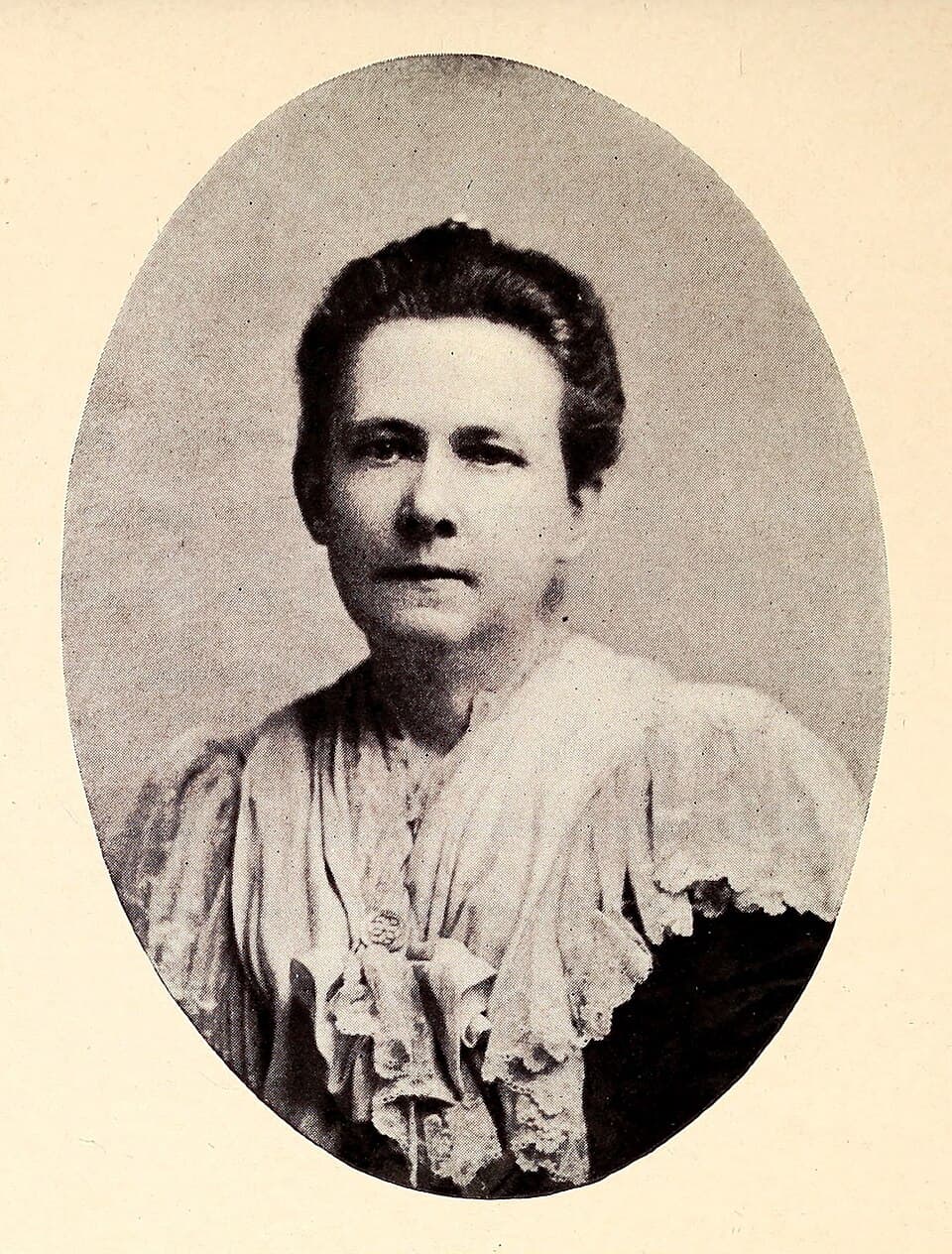
American · Activism · Literature
Florence Howe Hall
August 25, 1845 – April 10, 1922
Early Life and Family Background
Florence Marion Howe Hall (born Florence Marion Howe) entered the world on 25 August 1845 in South Boston, Massachusetts, as the eldest daughter of two nationally prominent reformers, Samuel Gridley Howe and Julia Ward Howe.[1][3] Samuel Gridley Howe, a physician and educator, was celebrated for his pioneering work with blind students at the Perkins Institution and for his deep commitment to abolitionism and other humanitarian causes.[3] Julia Ward Howe, a poet and social reformer, would later gain fame as the author of the Civil War hymn "The Battle Hymn of the Republic" and as an architect of the organized woman suffrage movement.[1][4]
Florence grew up in a household suffused with intellectual energy and reform activism. Contemporary accounts and later biographical sketches emphasize that the Howe home was visited by leading figures of nineteenth‑century American culture and politics, including Ralph Waldo Emerson, Henry Wadsworth Longfellow, Frederick Douglass, Charles Sumner, Henry Ward Beecher, Lucy Stone, Oliver Wendell Holmes, Charles Dickens, and the scientist Louis Agassiz.[4] This environment exposed Florence from childhood to debates over slavery, education, women’s rights, and literary production, and helped to shape her own ambitions as a writer and public speaker.
Florence and her siblings were educated both at home and in a variety of private schools, reflecting her parents’ belief in serious intellectual training for daughters as well as sons.[3] The Jewish Women’s Archive biographical entry on her mother notes that the Howe daughters were encouraged to read widely, and Florence’s later facility as an essayist, biographer, and lecturer shows the depth of that education.[3][7] Alongside her sisters Laura Elizabeth Richards and Maude Howe Elliott, Florence would eventually become part of a literary family network that reached national prominence.[1][2]
Marriage, Children, and Economic Responsibilities
In the later 1860s, Florence married David P. Hall, a lawyer whose practice had uneven financial success.[3] Encyclopedia.com gives the year of marriage as 1871, while other biographical sketches note that she married in the late 1860s, illustrating minor discrepancies in the record.[3][7] After marriage she became known as Florence Howe Hall or, in some sources, Florence Marion Howe Hall.[1][2]
The couple had four children: three sons and one daughter.[3] Because her husband’s legal practice flourished only intermittently, Florence increasingly assumed responsibility for the family’s financial stability. According to Encyclopedia.com, she went to work lecturing and writing for magazines, and her income enabled her three sons to attend college while her daughter undertook advanced artistic training.[3] This pattern — a married woman using professional writing and lecturing to support her family — illustrates both the constraints and possibilities facing middle‑class American women in the late nineteenth century.
Florence’s experience of paid intellectual labor was shaped by gendered expectations. While she could not easily pursue a formal profession as a lawyer or physician, she could engage in writing, public speaking, and club work in ways that were deemed acceptable for women. Nonetheless, her role as primary earner for her children’s education challenges stereotypes of nineteenth‑century wives as economically dependent and underscores the importance of women’s cultural work in sustaining families.
Career Beginnings and Development
Florence Howe Hall’s career unfolded primarily in the last decades of the nineteenth century and the early twentieth century. Encyclopedia.com divides her writing into three main categories: stories for children, memoirs and reminiscences, and etiquette books.[3] Her early publications included children’s literature, such as Little Lads and Lassies: Stories in Prose and Verse about and for Them (1898), which combined narrative and verse in pieces tailored to younger readers.[3]
At the same time she developed as an essayist and memoirist. One important strand of her work involved writing about figures connected to her father’s career in education of the blind. For example, she authored Laura Bridgman; or, Howe’s Famous Pupil and What He Taught Her (1903), a biographical account of Laura Bridgman, a deaf‑blind woman educated at Perkins under Samuel Gridley Howe’s direction.[3][6] By documenting Bridgman’s life and her father’s pedagogical methods, Florence contributed to the historical record of disability education and highlighted the significance of her father’s work.
Another category of her career involved social commentary and etiquette writing. In Social Usages at Washington (1906), Florence provided guidance on behavior and customs in the nation’s capital, reflecting both her familiarity with elite social circles and a broader cultural interest in the codification of manners.[3] Such works positioned her as an interpreter of social norms in a period when the United States was grappling with rapid urbanization, shifting class structures, and the entrance of new groups into public life.
Florence’s skills as a lecturer complemented her writing career. According to biographical sketches, she lectured widely on women’s suffrage, social issues, and literary topics, using public speaking both as a means of income and as a platform for advocacy.[1][3][7] Her reputation as a "club woman" — a leader in women’s clubs and civic organizations — further anchored her in the growing network of female reformers who used voluntary associations as vehicles for social change.[3][4]
Major Works and Literary Contributions
Florence Howe Hall’s best‑known writings center on her mother and family history, knitting personal biography into broader narratives of war, religion, and reform. Among her major works is Memories Grave and Gay, a collection of reminiscences first published in 1901.[6] In this volume she offers portraits of family members, friends, and experiences that illuminate the social world of Boston reformers and intellectuals. The text blends affectionate anecdote with historical reflection, preserving details about the Howe household that might otherwise have been lost.
Another significant work is The Story of the Battle Hymn of the Republic, a book that explores the origins, composition, and cultural impact of Julia Ward Howe’s famous Civil War song.[5] Later descriptions of the work highlight its intertwining of family narrative with national history; Florence traces how her mother came to write the lyrics, the hymn’s wartime and postwar reception, and its evolving symbolic place in American civic religion.[5] Through this text, Florence not only honors her mother’s achievement but also contributes to the understanding of how a single piece of music can shape collective memory.
Florence also co‑authored, with her sisters Laura Elizabeth Richards and Maude Howe Elliott, the multi‑volume biography Julia Ward Howe. This work, published during the 1910s, chronicles their mother’s life as poet, abolitionist, and suffragist.[1][2] The biography became historically notable when, in 1917, it was awarded the first Pulitzer Prize ever given for biography, a distinction shared by the three sisters.[1][2][12] The Pulitzer Prize, established in the mid‑1910s, recognized excellence in journalism and letters; that its inaugural biography award went to three women writing about a woman reformer is an important milestone in women’s literary history.
In addition to these better‑known works, Florence’s bibliography includes a range of children’s stories, essays, and manuals. Encyclopedia.com lists several titles and emphasizes that her writing collectively reflects her interests in family, education, and social conduct.[3] Her oeuvre thus demonstrates how women of her generation used literature to navigate and interpret their changing social world, even as they advocated for greater public roles for women.
Suffrage Activism and Club Leadership
Beyond her literary output, Florence Howe Hall played an important role in the American woman suffrage movement and in organized women’s club work. According to Wikipedia and biographical sketches, she became a well‑known lecturer on women’s suffrage, speaking in various communities about the need for women’s political rights.[1][2][4] Her activism was rooted in the example of her mother, Julia Ward Howe, who had been instrumental in founding some of the era’s most enduring suffrage organizations.[4]
From 1893 to 1900, Florence served as president of the New Jersey State Woman Suffrage Association, helping to lead campaigns for state‑level enfranchisement and to coordinate educational efforts.[1] In that capacity she worked with other reformers to organize meetings, disseminate literature, and lobby legislators. Her leadership role in New Jersey reflects how the suffrage movement relied on networks of local and state organizations staffed largely by volunteer women who devoted substantial time to organizational work.
Florence also held positions in broader women’s organizational structures; sources note that she served as a vice‑president of the General Federation of Women’s Clubs, though exact dates are not consistently reported.[3][7] The General Federation united women’s clubs across the United States and advocated on issues ranging from education to public health. Her vice‑presidency indicates the respect she commanded among clubwomen and underscores her role in shaping national conversations about women’s civic participation.
Biographical narratives describe Florence as a "club woman" whose activism extended beyond suffrage narrowly defined. She participated in civic campaigns and literary societies, leveraging club networks as spaces where women could share knowledge, develop leadership skills, and exert influence on public policy.[3][4][7] Her combination of literary production and organizational work exemplifies the multi‑faceted strategies used by women reformers of her generation.
Awards, Honors, and Distinctions
The most prominent formal recognition associated with Florence Howe Hall is the Pulitzer Prize for Biography awarded in 1917 for Julia Ward Howe, the collaborative biography she co‑authored with her sisters.[1][2][12] This book received the first Pulitzer Prize ever conferred in the biography category, making Florence, Laura, and Maude the inaugural recipients of the award.[1][2] Contemporary and later accounts emphasize that along with her two sisters, Florence "received the first Pulitzer Prize for a biography."[1][2][12]
The significance of this distinction is multifold. First, it honored the sisters’ careful and expansive portrayal of their mother’s life, which combined intimate family knowledge with extensive documentary research. Second, it marked an early moment in which women authors were publicly celebrated for serious historical and biographical work, a field often dominated by male writers. Third, the subject of the biography — a woman abolitionist and suffragist — signaled the increasing visibility of women reformers in mainstream historical narratives.
Beyond the Pulitzer, Florence’s honors were more informal, consisting of reputational esteem within suffrage and club circles. Obituaries and retrospective sketches describe her as "noted as writer and lecturer" and as a respected leader in women’s organizations.[3][4][20] Her ability to help finance her children’s education through her writing and lecturing was itself noted as a mark of her accomplishment. Although she did not accumulate a long list of formal prizes, her career illustrates how recognition could take the form of influence, leadership roles, and the enduring circulation of her works.
Personal Life and Relationships
Florence’s personal life was deeply intertwined with the extended Howe family network, which continued to shape American literary and reform history beyond her own generation. Her sisters, Laura Elizabeth Richards and Maude Howe Elliott, each had distinguished careers: Laura as a children’s author and Maude as a writer and social figure.[1][2] The three sisters’ collaboration on their mother’s biography epitomizes the family’s shared sense of mission in preserving and interpreting Julia Ward Howe’s legacy.
Florence’s four children benefited from her labor as an author and lecturer. Encyclopedia.com emphasizes that her earnings allowed her three sons to attend college and her daughter to pursue advanced artistic training.[3] This investment in education suggests that Florence sought to pass on to her children the intellectual and cultural capital she herself had inherited. Later family accounts, such as an oral history archived by the Perkins School for the Blind, confirm that descendants remembered Florence both as a grandmother and as a writer who had helped secure the Pulitzer Prize for the family biography.[12]
Florence maintained ties to Boston and to High Bridge, New Jersey, where she spent much of her later life. The High Bridge Hound’s local historical essay notes that she developed a strong attachment to High Bridge and participated in community life there, even as she remained connected to broader suffrage and literary networks.[4] These geographical movements — from Boston’s reform circles to small‑town New Jersey — mirror shifts in her life from the intense public activism of middle age to a quieter existence in later years.
Legacy and Historical Impact
Florence Howe Hall’s legacy operates on several levels: as an author, as a biographer of a major woman reformer, and as a suffrage and club leader. Her writings, especially Memories Grave and Gay, The Story of the Battle Hymn of the Republic, and the co‑authored Julia Ward Howe, provide valuable primary and secondary sources for historians studying nineteenth‑century reform movements, the Howe family, and women’s cultural production.[1][3][5][6]
By contributing to the first Pulitzer Prize–winning biography, Florence helped set a precedent for recognizing biographical work that centers women’s lives and activism. The sisters’ portrait of Julia Ward Howe amplifies the visibility of women in historical narratives and demonstrates the possibilities of collaborative female authorship in serious nonfiction genres.[1][2][12]
Her suffrage work in New Jersey and within national club organizations situates her among the many women whose organizational labor underpinned the eventual success of the woman suffrage amendment. While she was not among the most famous national suffrage leaders, her presidency of the New Jersey State Woman Suffrage Association and her vice‑presidency in the General Federation of Women’s Clubs contributed to the dense infrastructure of local and state advocacy that made constitutional change possible.[1][3][7]
Florence’s life also offers a lens on the economic dimensions of women’s intellectual labor. Her use of lecturing and magazine writing to finance her children’s education illustrates how cultural work could function as a serious income source for women long before they had equal access to professional careers.[3] In this sense, she forms part of a broader history of women authors who leveraged their writing to support families and pursue public ideals.
In contemporary women’s‑history scholarship, Florence Howe Hall is sometimes overshadowed by her more famous mother and by the later feminist scholar Florence Rosenfeld Howe (1929–2020), whose similar name has caused occasional confusion.[9][10][15][19] Yet careful attention to Florence Howe Hall’s own career reveals an important transitional figure linking mid‑nineteenth‑century reform traditions with early twentieth‑century women’s literary and civic leadership.
Later Life and Death
In her later years, Florence Howe Hall resided in High Bridge, New Jersey, remaining active as a local figure while continuing her connections to the suffrage and club movement. The High Bridge Hound’s historical account notes that she was remembered in the town as a "noted suffragist, author, public speaker, [and] club woman," and that she maintained a strong attachment to the community.[4]
On 10 April 1922, Florence died in High Bridge after a brief illness, reported in some accounts as pneumonia or pleurisy.[3][4][20] Her death came less than two years after the ratification of the Nineteenth Amendment in 1920, which granted American women the constitutional right to vote — a cause she and her mother had long supported. The proximity of her death to this milestone underscores how her lifetime encompassed the arc from early, often marginalized suffrage advocacy to its eventual national success.
After her death, Florence was buried in Mount Auburn Cemetery in Cambridge, Massachusetts, a resting place for many prominent New England intellectuals and reformers, and the site of her parents’ graves.[1] Obituaries highlighted her status as the "eldest daughter" of Samuel Gridley and Julia Ward Howe and as a "noted writer and lecturer," signaling both the familial and individual dimensions of her legacy.[20]
Today, Florence Howe Hall’s works remain accessible through library collections and digital archives, including the Online Books Page and Project Gutenberg, which host editions of Memories Grave and Gay and her other writings.[2][6] These texts continue to serve scholars and readers interested in women’s history, the Howe family, and the intertwined worlds of nineteenth‑century reform, literature, and civic activism.
Dated achievements
2 indexed.
- Aug251845Activism
Birth of Florence Marion Howe in Boston, Massachusetts
Florence Marion Howe was born in Boston, Massachusetts, to reformers Samuel Gridley Howe and Julia Ward Howe.
View details Encyclopedia.com: Hall, Florence Marion Howe - Apr101922