← All women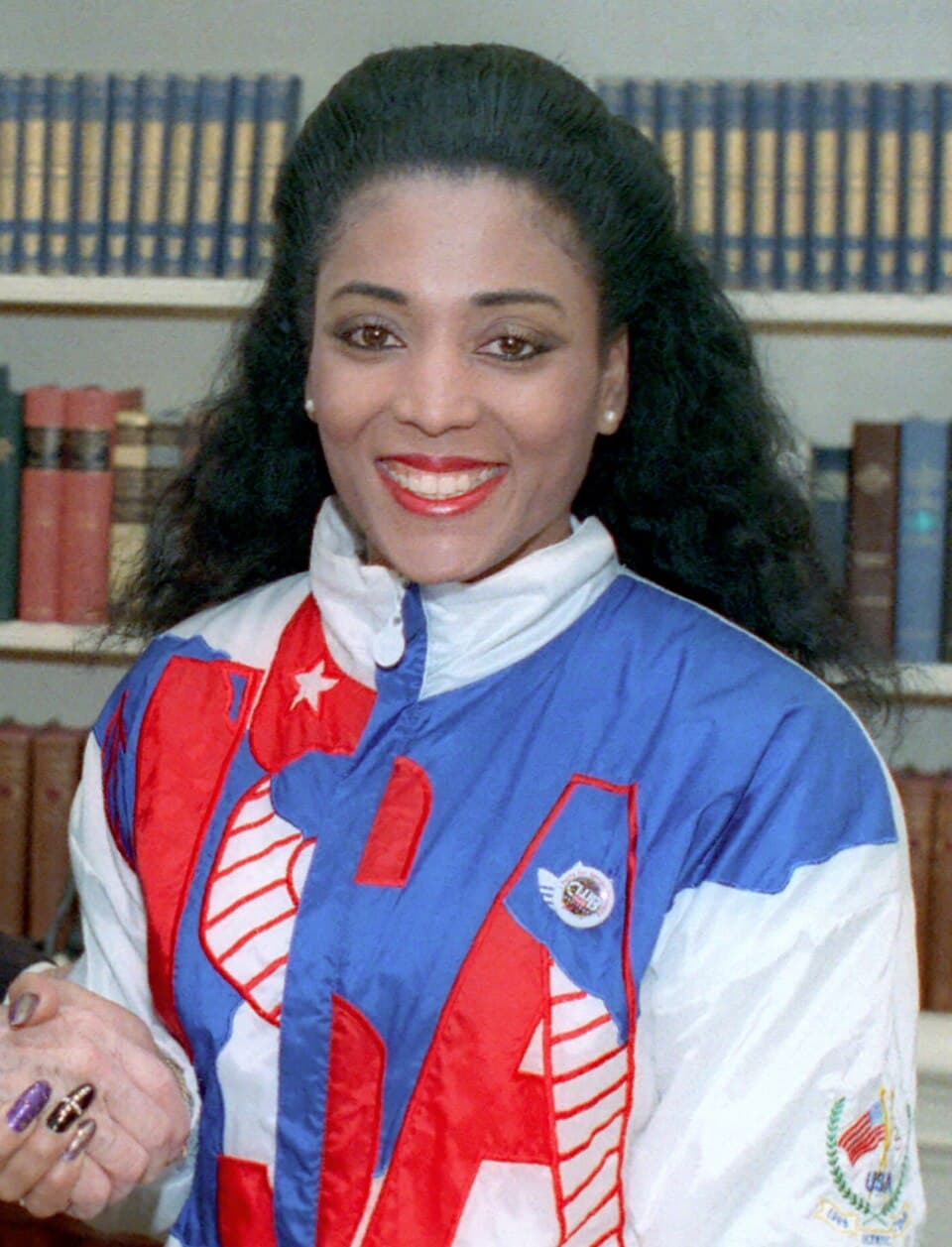
American · Sports
Florence Griffith Joyner
December 21, 1959 – September 21, 1998
Early Life and Background
Florence Delorez Griffith Joyner, widely known as Flo‑Jo, was born on 21 December 1959, in Los Angeles, California.[1][2] She was the daughter of Robert and Florence Griffith and one of five children in a working-class African American family.[7] Much of her childhood unfolded in the Watts and Jordan Downs housing projects of South Central Los Angeles, environments marked by economic hardship but also strong community networks.[1][15] Growing up in this context shaped her resilience, discipline, and determination.
From an early age, Florence showed a natural affinity for running. She reportedly began racing at around seven years old, competing against her siblings and neighborhood children and later joining organized youth track programs.[5][7] As a teenager, she participated in the Jesse Owens National Youth Games, winning the competition at age fourteen, a victory that signaled her potential as an elite sprinter and connected her to the legacy of one of America’s most celebrated track athletes.[7][17]
Griffith Joyner attended local schools in Los Angeles, where she continued to run track. Her abilities attracted the attention of coaches who recognized her speed and competitive spirit. These formative years coincided with the broader expansion of opportunities for girls and women in sports in the United States, influenced by the implementation of Title IX in 1972. Access to school and community athletics programs contributed to her development, offering spaces where she could refine her talent despite persistent gender and racial barriers in elite sports.[15]
Career Beginnings and Collegiate Development
After high school, Florence Griffith continued her athletic career in college. She initially attended California State University, Northridge, where she ran under coach Bob Kersee and participated in NCAA competition.[1] At Northridge she helped her team win multiple titles, and her performances began to draw national attention. Economic pressures, however, forced her to leave school and work to support her family, temporarily stepping away from competitive athletics.[5][7]
Her talent and passion for the sport, coupled with support from coaches and mentors, eventually brought her back. She later enrolled at the University of California, Los Angeles (UCLA), where she again trained under Bob Kersee, a leading sprint and hurdles coach.[1][7] At UCLA she competed in collegiate championships, winning major titles and breaking records. Sources note that she became an NCAA champion in the 200 m, and she was part of relay squads that set or challenged American collegiate marks.[7][17] These achievements, though often recorded year-only, form the foundation of her ascent from promising collegiate runner to international contender.
During this period, Griffith Joyner refined her technique and gained experience in high-level competition, including national meets and early international events. The transition from collegiate to elite athletics required adjustment to more rigorous training regimens, travel demands, and the psychological pressures of competing against established stars. By the early 1980s, she had established herself as a strong sprinter, particularly in the 200 m, though she had yet to reach the extraordinary performance levels that would later define her career.[1][12]
Emergence on the International Stage
Florence Griffith Joyner’s breakthrough on the global stage came with her participation in the 1984 Summer Olympics in Los Angeles. Competing in the 200 m, she won the silver medal, finishing behind fellow American Valerie Brisco-Hooks.[2][12] This achievement introduced her to a worldwide audience, demonstrating that she could contend with the best sprinters in the world and raising expectations for her future.
Following the Los Angeles Games, Griffith Joyner continued to compete internationally. She represented the United States at events such as the World Cup and World Championships. In 1987 she contributed to the U.S. women’s gold medal in the 4×100 m relay at the World Championships in Rome, reinforcing her status as a key member of the national sprinting program.[1][13] Despite these successes, she was still regarded more as a very good sprinter than as a dominant, record-breaking figure.
During these years, she faced the challenge of balancing athletic ambition with financial realities. Track and field offered far fewer lucrative sponsorships for women than for men, and even fewer for women of color. Griffith Joyner temporarily stepped away from the sport at one point to work and help support her family, illustrating the economic constraints within which many female athletes operated.[5][7] Her decision to return and pursue elite competition again testifies to her commitment and to the support she received from coaches and allies.
Transformation and the 1988 Season
The year 1988 marked a dramatic transformation in Florence Griffith Joyner’s career. She adopted a more intense training regimen and debuted a striking new visual style, wearing bold, asymmetrical racing outfits—often one-legged bodysuits—and vividly painted, long fingernails.[1][12] This combination of heightened performance and flamboyant self-presentation quickly made her one of the most recognizable figures in athletics.
The pivotal moment came at the U.S. Olympic Trials in Indianapolis. On 16 July 1988, Griffith Joyner ran the women’s 100 m in 10.49 seconds, shattering Evelyn Ashford’s world record of 10.79.[5][1] The time, recorded in a quarterfinal race, lowered the mark by an unprecedented margin and instantly made her the fastest woman in history. The official wind reading was 0.0 m/s, though the performance sparked ongoing debate and scrutiny about conditions and measurement. Nevertheless, governing bodies ratified the time as the world record, and it continues to stand decades later.[1][2]
This breakthrough reshaped expectations for women’s sprinting. Analysts, fans, and competitors were stunned by the magnitude of the improvement, and media coverage intensified around Griffith Joyner. Her success at the Trials ensured her selection for the U.S. Olympic team and set the stage for one of the most dominant performances in Olympic track-and-field history.
Seoul 1988: Olympic Dominance
At the 1988 Seoul Olympic Games, Florence Griffith Joyner delivered a series of performances that cemented her legend. On 26 September 1988, she won the women’s 100 m final in 10.54 seconds, a wind-aided time that nonetheless set a new Olympic record and gave her her first individual Olympic gold medal.[4][9] The race showcased her explosive start and powerful acceleration, as she pulled away from the field and crossed the line with a visible margin of victory.
Three days later, on 29 September 1988, she turned to the 200 m. In the semifinals, she ran 21.56 seconds, breaking the existing world record and signaling extraordinary form.[9][5] Later the same day, in the final, she improved further, clocking 21.34 seconds to win gold and break her own record.[9][1] This 21.34 remains the ratified women’s 200 m world record and, alongside her 10.49, underpins her status as the fastest woman ever at both distances.[2][15]
Griffith Joyner’s dominance extended to relay events. On 1 October 1988, she helped the U.S. women’s team win gold in the 4×100 m relay, adding a third gold medal to her Seoul tally.[9][5] On 2 October 1988, she and her teammates secured silver in the 4×400 m relay, demonstrating her ability to compete in longer sprint distances as part of a versatile relay squad.[9][5]
By the conclusion of the Games on 2 October, Griffith Joyner had earned four medals—three golds and one silver—making her the first American woman to win four track-and-field medals at a single Olympics.[10] This achievement elevated her into a select group of Olympians whose performances have defined entire Games and set new standards for their sports.
Awards, Honors, and Recognition
Florence Griffith Joyner’s extraordinary 1988 season brought a cascade of awards and honors. She was named Associated Press Female Athlete of the Year and Track & Field News Athlete of the Year, among other distinctions.[7][18] She received the AAU James E. Sullivan Award, recognizing her as the top amateur athlete in the United States, and was honored by the U.S. Olympic Committee and other bodies for her achievements.[18]
Her performance and charisma also led to extensive commercial and media opportunities, from endorsements to appearances in popular culture. Over time, her legacy was further institutionalized. In 1995, she was inducted into the USA Track & Field Hall of Fame, acknowledging her record-breaking career and enduring influence on American athletics.[18][7] On 1 July 2004, she was posthumously inducted into the U.S. Olympic & Paralympic Hall of Fame, placing her among the most celebrated Olympians in U.S. history.[7][4]
These honors reflect not only her competitive achievements but also the symbolic role she played in elevating women’s sports. Her world records, Olympic medals, and iconic style made her a focal point for discussions about gender, race, and the commercialization of athletics, and they continue to feature prominently in narratives of Olympic history.
Personal Life
Beyond the track, Florence Griffith Joyner’s life included significant personal milestones. In 1987, she married Al Joyner, an Olympic triple jump champion and the brother of renowned heptathlete and long jumper Jackie Joyner-Kersee.[1][12] The marriage connected two prominent athletic families and brought together individuals deeply involved in elite sports and training.
Florence and Al Joyner had one daughter, Mary Joyner, who was born during the late 1980s.[7][12] Motherhood coincided with the peak and subsequent conclusion of her competitive career, and Griffith Joyner often emphasized her role as a parent in interviews, highlighting family life alongside athletic identity.
In public life, she cultivated a strong interest in fashion and design. After retiring from competition, she designed sportswear and even created uniforms for the NBA’s Indiana Pacers, merging her sense of style with professional opportunities.[7] She also engaged in writing and motivational speaking, using her platform to encourage young people—especially girls—to pursue education, fitness, and their dreams.
Retirement, Public Service, and Philanthropy
Florence Griffith Joyner retired from elite competition around 1989, though she briefly attempted a comeback in the early 1990s.[1][17] In her post-competitive years, she devoted significant energy to public service and philanthropy. She established the Florence Griffith Joyner Youth Foundation, aimed at supporting underprivileged children through sports and educational programs.[17] The foundation’s mission aligned with her belief that athletics could provide discipline, confidence, and pathways out of poverty, much as it had in her own life.
In 1993, Griffith Joyner was appointed co-chair of the President’s Council on Physical Fitness and Sports, a federal advisory body that promotes physical activity and health across the United States.[7][17] In this role, she worked to encourage Americans—especially children—to adopt active lifestyles, appearing at events and campaigns that emphasized fitness and well-being.
She also remained a visible figure in the media, making guest appearances on television and participating in promotional activities. Her distinctive image—long nails, stylish outfits, and confident presence—continued to attract attention, and she used that visibility to advocate for causes she valued. However, she also faced persistent questions and rumors about her athletic performances, reflecting broader tensions in how extraordinary achievements by women and athletes of color are sometimes received.
Later Life and Death
In the mid-1990s, Florence Griffith Joyner dealt with various health issues, including concerns related to breathing and possible neurological conditions, though details are limited and often summarized in broad terms in public sources.[1] Despite these challenges, she continued her work in fitness advocacy, fashion, and family life.
On 21 September 1998, Griffith Joyner died unexpectedly at her home in Mission Viejo, California, at the age of 38.[1][2] She suffered an epileptic seizure during sleep, which led to suffocation.[5][12] An autopsy reportedly revealed a congenital vascular brain abnormality but found no evidence of illegal performance-enhancing drugs.[1] Her sudden death shocked fans and fellow athletes, triggering tributes from across the sports world.
In the aftermath, discussions about her career and health intensified. While some commentators continued to speculate about the causes behind her exceptional times, many others emphasized her role as a trailblazer and highlighted the absence of formal sanctions or positive drug tests. Her death reinforced the sense that her life and legacy were complex, combining extraordinary athletic success, cultural impact, and unresolved questions that still animate debates about performance, fairness, and gender in sport.
Legacy and Historical Impact
Florence Griffith Joyner’s legacy in women’s and Black sports history is profound. Her 100 m world record of 10.49 seconds and 200 m world record of 21.34 seconds, both set in 1988, remain unbroken decades later.[1][2][15] These marks continue to define the outer edge of recorded female sprint performance, serving as benchmarks for every generation of sprinters who follow.
Beyond statistics, Griffith Joyner transformed the presentation and perception of women athletes. Her flamboyant style—featuring one-legged racing suits, bold colors, and long, decorated nails—challenged traditional norms that expected women in sport to minimize visible femininity. By embracing fashion, spectacle, and self-expression, she demonstrated that women could be simultaneously fast, strong, and unapologetically stylish, thereby expanding the cultural script for female athletic identity.[1][12]
Her achievements also helped elevate media and public attention toward women’s track-and-field events. The spectacle of her performances at Seoul 1988, combined with her world records, proved that women’s races could captivate audiences and generate iconic Olympic moments. This helped pave the way for increased coverage and sponsorship for women sprinters and contributed to broader recognition of women’s sports within the Olympic movement.[4][17]
As a Black woman from a low-income background, Griffith Joyner’s story has particular resonance in discussions of race, class, and opportunity. Her rise from public housing in Los Angeles to global stardom underscores the importance of youth sports programs, collegiate athletics, and community support in creating pathways for talented individuals who might otherwise be overlooked.[1][15] Her success challenged stereotypes about Black women and offered a highly visible example of excellence, resilience, and creativity.
At the same time, her career has remained a focal point in debates about doping and unfair suspicion directed at women whose performances exceed established expectations. The enduring scrutiny she faced—even in the absence of formal sanctions—highlights gendered and racial dynamics in how athletic achievements are interpreted and remembered. Scholars and commentators continue to examine her case when considering how sport institutions and media respond to extraordinary female performance.
Institutionally, her influence is preserved through Hall of Fame inductions and official profiles. The USA Track & Field Hall of Fame and the U.S. Olympic & Paralympic Hall of Fame both enshrine her contributions, ensuring that future generations encounter her name and records within the formal heritage of American sport.[7][4][18] Educational materials and children’s books present her as a role model, emphasizing her determination and creativity.[18]
In sum, Florence Griffith Joyner stands as a seminal figure in women’s athletic history. Her records, medals, and persona reshaped the landscape of sprinting and expanded the possibilities for how women—and particularly Black women—could inhabit the role of sports hero. While her life was cut short, its impact continues to reverberate in stadiums, classrooms, and cultural conversations about speed, style, and equality in sport.
Dated achievements
11 indexed.
- Dec211959Science
Birth of Florence Griffith Joyner
Florence Delorez Griffith was born in Los Angeles, California, the future world-record-holding sprinter known as 'Flo-Jo.'
View details Florence Griffith Joyner - Wikipedia - Jul161988Science
Sets 100m World Record (10.49s) at U.S. Olympic Trials
Griffith Joyner ran a stunning 10.49 seconds in the 100m quarterfinals at the U.S. Olympic Trials in Indianapolis, shattering the world record.