← All women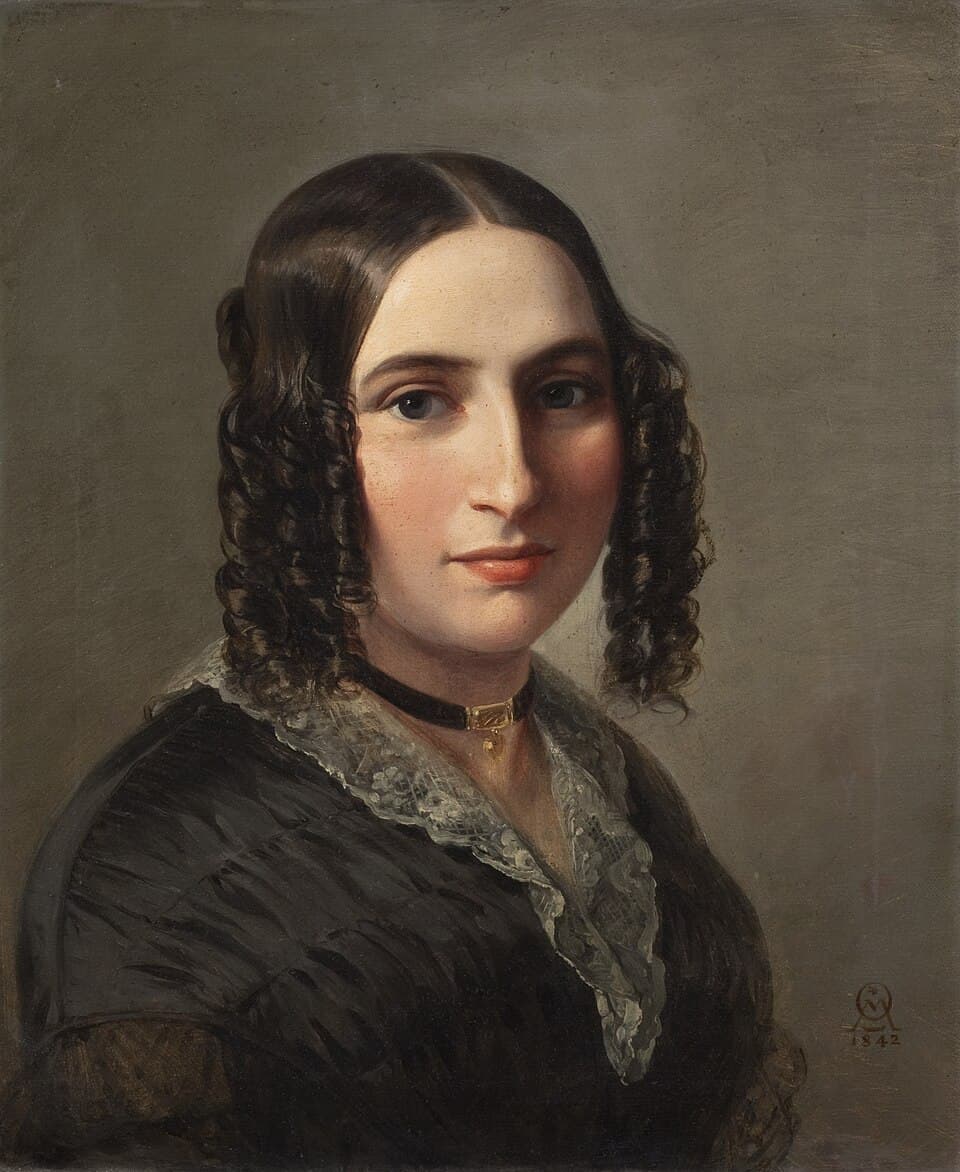
German · Arts · Literature
Fanny Mendelssohn
November 14, 1805 – May 14, 1847
Early Life and Family Background
Fanny Cäcilie Mendelssohn, later known as Fanny Mendelssohn Hensel, was born on 14 November 1805 in Hamburg, into the distinguished Mendelssohn family.[1][2][5][6][9] Her grandfather was the philosopher Moses Mendelssohn, a central figure of the German Enlightenment, and her father Abraham Mendelssohn was a successful banker.[3][5][9] Her mother Lea Salomon Mendelssohn came from an affluent, culturally engaged family, and had herself studied with a student of Johann Sebastian Bach, passing on a deep reverence for Bach’s music to her children.[1][7]
Fanny grew up as the eldest of four siblings: Fanny, Felix (b. 1809), Rebecka, and Paul.[2][11] In 1811 the family moved from Hamburg to Berlin, then part of the Kingdom of Prussia, where Abraham sought better economic and social opportunities and deeper integration into the city’s intellectual life.[2][6][11] The Mendelssohns converted to Protestantism and adopted the surname Mendelssohn Bartholdy, reflecting both their assimilation and a desire to distance themselves from the stigmas attached to their Jewish heritage in that era.[2][3][5]
From an early age Fanny exhibited extraordinary musical talent. Contemporary accounts note that she could play all of Bach’s Das wohltemperierte Klavier (The Well‑Tempered Clavier) from memory as a teenager, an achievement that established her reputation within the family circle as a prodigy on par with, or even exceeding, her brother Felix.[2][7][9] The siblings received rigorous musical instruction: their mother taught them piano initially, and later they studied with Ludwig Berger, a distinguished pianist, and Carl Friedrich Zelter, a prominent composer and conductor deeply involved in the revival of Bach’s works.[1][2][14]
The Mendelssohn household in Berlin became a hub of artistic and intellectual activity. Abraham and Lea cultivated connections with leading thinkers and artists, and music making formed a central part of domestic life. Within this environment, Fanny’s capacities flourished. However, the same bourgeois setting imposed strict gender expectations. While Felix was groomed for a public career, familial correspondence indicates that Abraham regarded Fanny’s musicality as a delightful but essentially private accomplishment, unsuitable as the basis for a professional vocation.[2][11][13]
Musical Education and Early Compositional Activity
Fanny’s formal musical education was unusually advanced for a woman of her time. Under Berger’s tutelage she developed a formidable pianistic technique and refined interpretive skills.[1][2] Zelter provided training in harmony, counterpoint, and composition, giving her access to the same high-level curriculum offered to Felix.[1][2] Zelter recognized her gifts but, like many contemporaries, viewed a public career as inappropriate for a woman, reinforcing domestic boundaries even while nurturing her artistry.
By the 1820s Fanny was composing regularly. She produced lieder (art songs), piano pieces, and short instrumental works that circulated within the family and among close friends.[2][5][9] Many were performed in private concerts at the family home. Her style reflected an early Romantic sensibility: lyrical melodies, expressive harmonies, and an intimate scale well suited to salon performance. She was especially adept at writing for piano, exploiting its coloristic possibilities and dynamic range.
Throughout this period, Fanny collaborated closely with Felix. The siblings exchanged manuscripts, critiqued each other’s works, and shared ideas about form and expression.[1][2][11] Fanny advised Felix on compositional matters, and her insights influenced some of his most notable scores. Several of her songs were later published under Felix’s name in his collections, a practice that underscored both the closeness of their partnership and the structural barriers that led to the effacement of her authorship.[2][13][14]
Despite such obstacles, Fanny continued to compose prolifically. Estimates of her total output vary by catalogue, but authoritative sources cite over 400–450 works, including more than 250 lieder, at least 125 solo piano pieces, a string quartet, a piano trio, a piano quartet, four cantatas, and an orchestral overture.[1][2][9][12] Much of this music remained unpublished during her lifetime and was preserved only in manuscript form.
Marriage, Personal Life, and the Berlin Cultural Scene
In 1829 Fanny married the painter Wilhelm Hensel, a respected artist who had worked at the Prussian court.[2][3][5][14] After marriage she became known as Fanny Hensel, though modern scholarship often uses both Mendelssohn and Hensel to note continuity with her natal family and highlight her role in the Mendelssohn musical circle.[2][3][12]
The marriage was by most accounts supportive of her musical pursuits. Hensel encouraged Fanny’s composing and documented aspects of her life in his drawings and notes. The couple had one son, Sebastian Ludwig Felix Hensel, born in 1830, who would later become a historian of the family and father to the mathematician Kurt Hensel.[3][5] Domestic responsibilities and motherhood nevertheless absorbed much of her time, reflecting the dual burdens women carried when pursuing artistic work alongside family care.
Fanny’s Berlin home became a central venue for artistic exchange. As the Mendelssohn and Hensel families were part of a wider network of intellectuals, their residence attracted writers, scientists, and musicians. This social fabric provided the audience and performers for her most important institutional creation: the Sonntagsmusiken.
Sonntagsmusiken: Private Concerts as Public Influence
Around 1831, Fanny began organizing a series of Sunday concerts at the family’s Berlin residence, known as the Sonntagsmusiken (Sunday musicales).[2][6][11][13] Initially conceived as private gatherings, these events evolved into semi-public performances featuring chamber music, choral works, and solo repertoire. Fanny often served simultaneously as pianist, conductor, programmer, and host.
The Sonntagsmusiken became a major force in Berlin’s musical life. They attracted prominent performers and intellectuals and offered a platform for new works by Felix, Fanny herself, and other composers. Through these concerts, Fanny helped sustain the city’s interest in Bach and other earlier composers, aligning with Zelter’s Bach revival and the broader project of historicizing musical repertoire.[6][13]
Although the series remained formally private, it effectively functioned as an alternative public sphere for women’s musicianship. Fanny directed a high-caliber ensemble, rehearsed complex works, and tested her own compositions before a discerning audience. Her leadership within this context demonstrated that women could conduct, curate, and compose at the highest levels, even while barred from official posts in concert halls, churches, and academies.
The Sonntagsmusiken also underpinned her compositional productivity. Many of her cantatas and larger-scale works were written for performance at these gatherings. The concerts provided both motivation and practical occasion for new compositions, shaping her output and allowing experimentation with form and orchestration.[2][13]
Major Works and Compositional Achievements
Fanny’s oeuvre spans genres, though it is best known for its lieder and piano music. She wrote more than 250 songs, often setting texts by Goethe, Heine, and other leading poets.[1][2][9] Her lieder employ nuanced word painting, subtle harmonic shifts, and idiomatic piano parts that integrate accompaniment and melody into a unified expressive texture. These songs display a sensitivity to text and a mastery of miniature form comparable to that of Schubert and her brother Felix.
In piano music, her most celebrated work is the cycle Das Jahr (The Year), completed in 1841.[2][5][9] This large-scale suite of character pieces is organized around the twelve months, plus an epilogue, and reflects both autobiographical and seasonal associations. It demonstrates her ability to construct an extended formal arc across multiple movements, using motivic connections and tonal planning. Scholars and performers have increasingly recognized Das Jahr as one of the major piano cycles of the early Romantic period.
Her string quartet, composed in 1834, represents another important milestone.[2][5] At a time when chamber music was considered a serious, often male-coded genre, Fanny’s entry into the string quartet medium challenged expectations about women’s compositional domains. The work shows her command of contrapuntal writing and thematic development.
Fanny also wrote an orchestral overture, several chamber works, and at least four cantatas, some of them composed for the Sonntagsmusiken.[2][12][13] These larger forms underscore that her creativity was not confined to the salon scale often associated with women composers of the era.
A key career milestone came with the publication of her song collection Op. 1, Sechs Lieder, in 1846, issued under her own name.[1][2][7] Up to that point most of her music existed only in manuscript or, in a few cases, had been published under Felix’s name. The appearance of Op. 1 signaled her determination to claim authorship and a modest but meaningful entry into the commercial music market. The Library of Congress notes that she was among the first female composers to have their works published, creating a precedent for the acceptance of women in a traditionally male-dominated profession.[13]
Barriers, Gender Norms, and Limited Publication
Despite her talent and output, Fanny’s opportunities for public recognition were sharply limited by 19th‑century gender norms. Her father’s letters clearly articulated a belief that composing and performing in public were inappropriate careers for women, even as he funded her musical education.[2][11][13] Felix, though supportive in many respects, also cautioned her against publishing, fearing the potential social disapproval it might bring.
These attitudes meant that Fanny’s work circulated largely within domestic and private spheres. While she commanded great respect among those who attended the Sonntagsmusiken or participated in the Mendelssohn circle, her name seldom appeared on printed title pages. The division between “serious” public art and “amateur” domestic music was deeply gendered; women were expected to cultivate music as a refinement of character rather than as a profession.
The tendency to publish her songs under Felix’s name reflected this structure. It allowed her music to reach a broader audience but obscured her authorship. Only in the mid-1840s, with Op. 1 and a few other pieces, did she begin to break this pattern.[1][2][7][13] Even then, the number of works published in her own name remained small relative to her overall catalogue.
Her experience has thus become emblematic in scholarship on women composers: she demonstrates how institutional and familial constraints, rather than talent, determined whose works entered the official canon. Modern feminist musicology has used her case to interrogate the historical construction of “greatness” and to argue for re-evaluating repertory through a gender-conscious lens.[6][9][13]
Later Life, Final Years, and Death
In her final decade, Fanny continued to compose and to lead the Sonntagsmusiken, even as health concerns intermittently troubled her.[2][13] She maintained close ties with Felix, and the siblings exchanged visits and letters discussing composition and performance. By the mid‑1840s, she had secured some modest recognition through the publication of Op. 1 and the admiration of Berlin’s artistic community.
On 14 May 1847, during a rehearsal at her Berlin home for her brother’s cantata Die erste Walpurgisnacht, Fanny suffered a stroke and collapsed.[5][13] She died the same day, at age 41.[2][5][6][9][10][13] Contemporary accounts emphasize the shock felt by her family and circle; her passing was sudden and occurred at the very center of her musical activities. Later that year, in November 1847, Felix himself died, leading some commentators to link their deaths in discussions of the emotional and familial toll of her loss.
After her death, Wilhelm Hensel and other family members preserved her manuscripts. Some works appeared in print posthumously, but systematic publication and scholarly study of her oeuvre remained limited for decades.[2][13][14] The dispersal and partial neglect of sources contributed to the long delay in fully integrating her music into standard repertories and histories.
Posthumous Recognition and Legacy
For much of the late 19th and early 20th centuries, Fanny Mendelssohn Hensel’s music remained relatively obscure. She was often mentioned only in passing as Felix Mendelssohn’s talented sister, a pianist and hostess rather than a significant composer in her own right.[2][6][13] A few works were published and performed, but her larger catalogue lay in archives, and the attribution of pieces originally printed under Felix’s name complicated efforts to reconstruct her authorship.
Scholarly interest in Fanny’s life and work grew substantially in the late 20th century, driven by broader movements in women’s history and feminist musicology. Researchers began to catalogue her manuscripts, analyze her compositions, and situate her within Romantic-era aesthetics.[6][9][13] Institutions such as the Library of Congress and the Mendelssohn Society created biographical resources, while academic studies and biographies explored her creative process and personal circumstances.[6][9][13]
Modern performances and recordings have further enhanced her reputation. Pianists and chamber ensembles now routinely include Das Jahr, the string quartet, lieder, and other works in recital programs. Critics emphasize the originality of her harmonic language, her structural control in large forms, and the emotional depth of her smaller pieces.[1][7][11] These reassessments have helped secure her place among the major composers of the early Romantic era.
Fanny’s story also carries broader symbolic weight. She is frequently cited as one of the first women to have compositions published under her own name, a milestone that challenges the historical narrative of composition as an exclusively male profession.[13] Her experience illustrates how familial support, educational access, and social networks could enable women’s artistry, even when public institutions remained closed.
Within women’s and gender history, Fanny serves as a case study in the negotiation of domestic and professional roles. Her ability to transform the private space of her home into an influential concert venue through the Sonntagsmusiken demonstrates how women created cultural institutions outside official structures.[2][6][13] Her leadership in these concerts undermines stereotypes of women as passive consumers rather than active producers and organizers of art.
Today, Fanny Mendelssohn Hensel is recognized as an important figure in 19th‑century music, both for the intrinsic quality of her compositions and for what her career reveals about the gendered dynamics of artistic recognition. Her birth in Hamburg in 1805 and her death in Berlin in 1847 frame a life that, though constrained by its time, left a substantial and now increasingly appreciated musical legacy.
Assessment of Historical Impact
Historians and musicologists now view Fanny Mendelssohn Hensel as central to understanding the cultural history of early Romanticism. Her role in sustaining Berlin’s musical culture through the Sonntagsmusiken, her contributions to the reception of Bach, and her influence on Felix Mendelssohn’s work collectively mark her as a key mediator of musical ideas.[1][2][6][11][13]
Her compositions expand the canon, particularly in the domains of lieder and piano cycles, where her works stand alongside those of better-known male contemporaries. The reassessment of her oeuvre challenges the criteria by which historical significance is measured, suggesting that publication, institutional positions, and gendered reputation cannot be the sole metrics.
Beyond musicology, Fanny’s life has inspired broader discussions about women’s creativity, authorship, and the structures that enable or hinder artistic careers. She exemplifies how high-level training, familial networks, and personal determination can coexist with systemic limitations, resulting in a body of work that is both remarkable and historically marginalized.
As new editions, performances, and studies continue to emerge, Fanny Mendelssohn Hensel’s legacy grows, reshaping our understanding of 19th‑century music and underscoring the necessity of attending to women’s contributions across cultural history.
Dated achievements
3 indexed.
- Nov141805Science
Birth of Fanny Mendelssohn
Fanny Cäcilie Mendelssohn was born in Hamburg, the eldest child of the prominent Mendelssohn banking family, later known as a pioneering composer and pianist.
View details Fanny Mendelssohn - Britannica - Jan011846Science
First publication of her own music under her own name: Op. 1, Sechs Lieder
Fanny Mendelssohn published her song collection Sechs Lieder (Op. 1) under her own name in 1846, a landmark first after decades of composing largely in private.