← All women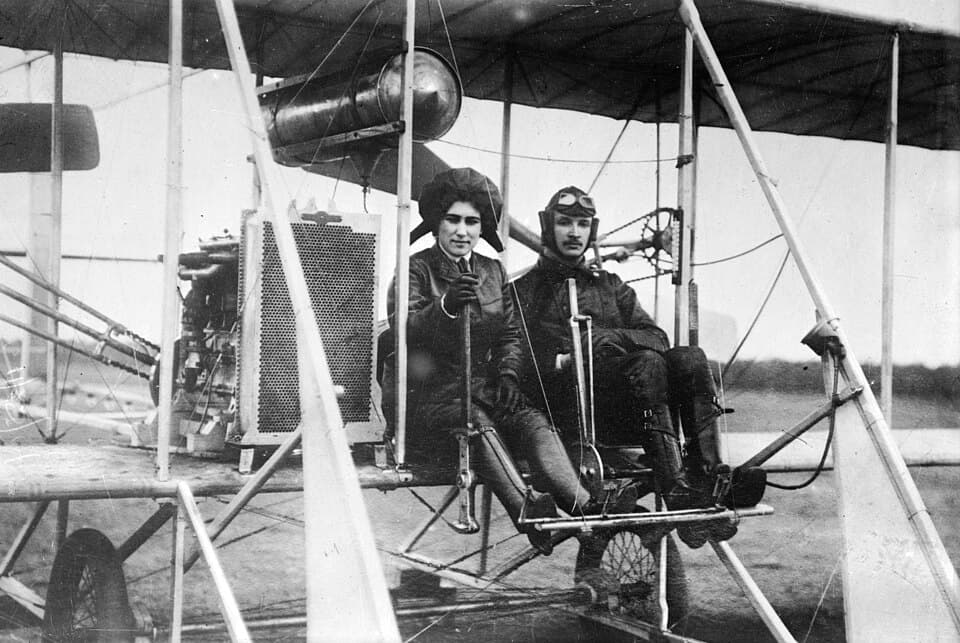
Russian · Aviation · Exploration
Eugenie Mikhailovna Shakhovskaya
September 5, 1889 – 1920
Early life and background
Eugenie (Evgeniya) Mikhailovna Shakhovskaya (Russian: Евгения Михайловна Шаховская) was born in Saint Petersburg, Russian Empire, in 1889.[2][1] German biographical reference gives her birth as 5 September (Julian) / 17 September (Gregorian) 1889.[2] Russian‑language accounts differ on the exact date, some citing 5 December 1889 without calendar clarification, but all agree on the year and the St. Petersburg origin.[2][3][8]
Her exact family background is contested in the sources. The SFO Museum, summarizing aviation archival material, states that she was born into a wealthy Russian merchant family and later married into the princely House of Shakhovskoy, thereby becoming a princess linked to the Romanov circle.[4] A genealogical entry on Geni similarly describes her as born Andreeva in a merchant family and receiving the princely title through marriage to Prince Andrei Shakhovskoy, although other accounts claim she may have been the daughter of a high‑ranking official or prince.[5] The Girl Museum’s profile notes that her father was remembered as a baron who owned textile and fabric mills, again underscoring substantial wealth.[6]
Whatever the precise lineage, most commentators agree that Eugenie grew up in or near elite circles of late imperial Russia.[4][6] She reportedly married into the House of Romanov and thus held the title of princess, which brought expectations of participation in court life. Yet her personal interests diverged sharply from traditional aristocratic roles. Exhibition notes from the SFO Museum emphasize that she was more interested in sports and mechanics than in performing royal duties.[4] This combination of privilege and unconventional inclinations would be crucial in enabling her to pursue aviation at a time when almost no institutional pathways existed for women.
Little is documented about her formal education, but her later achievements suggest a solid technical grasp and the ability to study aircraft construction, weather, and navigation sufficiently to pass rigorous pilot examinations in Germany.[3][4] Contemporary gender norms in Russia generally did not encourage women to pursue technical fields, which makes her later career all the more unusual.
First encounters with aviation
Shakhovskaya’s path to aviation began in the years just after powered flight became a reality. Exhibition materials from the SFO Museum state that she attended an aviation meet in St. Petersburg in 1910, an event that inspired a strong desire to learn to fly.[4] At that time, aviation was still a spectacle: demonstration flights drew crowds, and pilots were public celebrities. For an aristocratic woman to openly express a wish to fly herself was highly unconventional.
Russia’s nascent aviation infrastructure offered her few options. According to multiple summaries, she initially tried to obtain flying instruction within Russia but found that schools either did not admit women or lacked capacity.[3][4][6] The barriers were both institutional and cultural, as the idea of women piloting aircraft clashed with prevailing notions of femininity and physical capability. Unable to pursue training at home, she turned abroad.
Around 1911, Shakhovskaya traveled to Germany, then one of Europe’s leading centers of aviation training and experimentation.[3][10] There she met Vsevolod Mikhaylovich Abramovich, a Russian pilot of the Wright school who was active at the Johannisthal airfield near Berlin.[4] She persuaded Abramovich to give her lessons, reportedly paying for the training herself—a sign both of her financial resources and personal determination.[4][6]
By 1911 she had already made her first flights and begun to attract attention as an early Russian woman aviator. A World War I aviation forum note, drawing on period press, mentions that she was not the first Russian woman flyer—that distinction went to Lydia Zvereva—but that she "first flew in 1911" and quickly became known within aviation circles.[10] Her early training likely involved both dual instruction and solo practice in Wright‑type machines under challenging and still poorly standardized conditions.
Pilot training and early professional flying
Shakhovskaya’s formal aviation qualifications were secured in 1912. Russian and French biographical articles state that on 16 July 1912 she passed comprehensive examinations in aircraft construction and piloting technique at Johannisthal and was awarded German pilot certificate no. 274 for flying a Wright biplane.[3][2] This certificate placed her among the very earliest cohort of licensed women pilots in the world.
Shortly thereafter, women‑in‑aviation historical material records that on 16 August 1912 she received a German pilot licence specifically authorizing her to fly a Farman aircraft.[1] This second credential, while reported primarily by secondary sources, reflects the reality that early pilots often obtained type‑specific qualifications as they moved between different manufacturers’ machines. It attests to her versatility and competence in handling more than one aircraft design.
Following these certifications, Shakhovskaya moved quickly into professional roles. The SFO Museum’s "First Flights" exhibition notes that she became an instructor at the German branch of the Wright Company shortly after qualifying.[4] She also later worked as a demonstrator for Wright aircraft in St. Petersburg, performing flights to promote the brand and popularize aviation in Russia.[4][1] In these capacities she joined the small but visible group of women aviators who were both symbols of modernity and working professionals in a new industry.
Her early career was not without tragedy. Several sources indicate that in 1913 she gave up flying for a time after the death of her instructor—and reputed close companion—Vsevolod Abramovich in a crash.[6][10] A World War I aviation forum, summarizing period accounts, suggests that she survived a serious crash in 1912 in which Abramovich was killed, leading to lasting injuries and possibly a later dependence on pain‑killing narcotics.[10] Other narratives instead place Abramovich’s death in 1913 and describe it as the event that extinguished her first enthusiasm for flying.[6] Although the exact sequence is unclear, the episode highlights the lethal risks of early aviation and the personal losses she endured.
Record‑setting flights and reputation
Despite limited documentation, Russian media retrospectives have credited Shakhovskaya with several early aviation "firsts." A feature by Russia’s Channel One portrays her as an "aviatrix‑record holder," emphasizing that in November 1912 she became the first woman to raise an airplane to an altitude of 2.5 kilometers and the first woman to perform the Nesterov loop, a vertical aerobatic maneuver that would later bear the name of pilot Pyotr Nesterov.[1]
Primary, dated records for these feats are scarce, and some chronological details conflict with the generally accepted date of Nesterov’s pioneering loop in 1913. Nevertheless, the story of Shakhovskaya’s high‑altitude and aerobatic flights has been repeated in popular histories as evidence of her technical daring and physical courage. The Channel One segment stresses that she achieved these feats around the age of 23, having only recently become a licensed pilot.[1][2]
Regardless of the precise technical claims, there is broad agreement that by 1912–1913 Shakhovskaya enjoyed a reputation in Russia and abroad as an exceptionally bold pilot. She was often described in contemporary terms as a "baryshnya‑pilot"—a young lady flyer—whose aristocratic status and gender made her exploits doubly newsworthy. Her participation in public demonstrations helped normalize the presence of women in aviation at a time when female pilots were still rare enough to be a sensation.
World War I and becoming the first female military pilot
The outbreak of World War I in 1914 transformed Shakhovskaya’s role from demonstration pilot to combatant. According to a detailed article on the German‑language Wikipedia, she had already offered her services as a pilot during the Italo‑Turkish War of 1911–1912 but was refused.[2][10] With the onset of the Great War, she renewed her offer to fly for Russia.
In 1914, after passing military examinations, she was accepted as a pilot in the Imperial Russian Air Service.[3][1] Sources concur that she was assigned as a junior officer to the 1st Field Air Detachment on the Northwestern Front, where she undertook reconnaissance missions over enemy positions.[3][6] Aviation historians and lists of women’s "firsts" identify this appointment as the moment when she became the first woman in the world to be a military pilot and the first woman to fly for a national air force.[1][8]
English‑language summaries emphasize that she flew reconnaissance missions "for the Tsar" in 1914, suggesting that her role had both practical and symbolic dimensions.[1][8] Girl Museum’s profile states that she was posted to the Northwestern Front with the 1st Field Air Detachment and that she came under fire many times, for which she was awarded the Military Order of St. George by Tsar Nicholas II.[6] While the exact date of this decoration is not preserved in accessible sources, the award itself, one of Imperial Russia’s highest military honors for bravery, underscores the seriousness of her service.
Her presence in a frontline aviation unit was extraordinary. Women were not generally accepted in combat roles in European armies during World War I, and aviation was among the most technically elite branches. That a woman of aristocratic background could be commissioned as an officer and pilot reflects both her established flying credentials and the practical wartime demand for skilled aviators. It also suggests some degree of personal or familial connection to the Tsar, as several accounts note that Nicholas II was her cousin by marriage and had previously intervened in her favor.[1][10]
Controversy, imprisonment, and revolution
Shakhovskaya’s wartime career was short and dramatically interrupted. English‑language and forum sources report that she was soon accused by her colleagues of spying for Germany.[1][10] The precise basis for the accusation is unclear, but her prior training and work in Germany, as well as the xenophobic and paranoid atmosphere of wartime, may have contributed. According to these accounts, she was arrested, tried, and sentenced to death.[1][10]
Multiple narratives state that Tsar Nicholas II intervened, commuting her death sentence to life imprisonment out of mercy or in recognition of her service.[1][10] She is said to have spent the remainder of the war in prison. Details about the conditions of her confinement are sparse, but long incarceration, combined with earlier injuries, likely had a severe impact on her physical and mental health.
The Russian Revolution of 1917 brought another abrupt change. When the old regime collapsed and political prisoners were released, Shakhovskaya was freed from prison.[1] According to the widely cited English‑language biography, she then "went over to the Bolsheviks" and joined the Cheka, the new Soviet secret police.[1] Russian and secondary sources elaborate that she became a Cheka official in Ukraine, reportedly serving in a particularly brutal capacity.[1][10]
Service in the Cheka and later life
Accounts from English Wikipedia and other secondary sources describe Shakhovskaya’s post‑revolutionary life in stark terms. After joining the Bolshevik security apparatus, she is said to have become the chief executioner for the Cheka in Ukraine.[1] This claim is difficult to verify in primary archival material but recurs in popular retellings of her life, which stress the dramatic transformation from aristocratic aviatrix to revolutionary executioner.
At the same time, these sources state that she became addicted to drugs, likely narcotics initially used as pain‑killers after her serious aviation injuries.[1][10] Her addiction, combined with the violence of her work, painted a picture of profound personal disintegration. The English‑language summary notes that while in a narcotic state she shot one of her assistants and was herself subsequently shot dead.[1] A World War I aviation forum similarly reports that she "is said to have become addicted to narcotics" and that some reports claim she was killed in an "opium‑fueled gunfight" with a colleague.[10]
Reliable, detailed documentation of her Cheka career is sparse, and some historians treat the more lurid details with caution. Nonetheless, there is consensus that after her release from prison she sided with the Bolsheviks, worked for the Cheka in some capacity, suffered from drug addiction, and died violently in the early Soviet period. These developments must be viewed in the broader context of the Russian Civil War, when many individuals from the old elite entered revolutionary institutions for complex reasons, including survival, ideology, coercion, or personal grievance.
Death
All major reference sources agree that Eugenie Shakhovskaya died in Kyiv (Kiev) in 1920, in what was then the Ukrainian SSR.[1][2][3][8] No precise day or month of death is provided in standard encyclopedic entries or museum summaries.[2][7][9] The circumstances of her death are described variously as a shooting following her killing of a subordinate while under the influence of narcotics, or more broadly as being killed during an internal conflict among Cheka members.[1][10]
Given the chaotic conditions of the early Soviet years and the limited survival of detailed local records, the lack of an exact date is unsurprising. She was approximately 30 or 31 years old at the time, having been born in 1889.[2][8] Her death in Kyiv, far from the imperial capital where she was born and where she first flew, underscores the geographic and political dislocation that marked her final years.
Awards, honors, and recognition
The most significant documented honor awarded to Shakhovskaya is the Military Order of St. George, Imperial Russia’s decoration for bravery in the face of the enemy. Girl Museum’s profile notes that she received this order from Tsar Nicholas II in recognition of her courage under fire during reconnaissance missions on the Northwestern Front.[6] While no specific class of the order or date of conferment is provided, the association with her 1914 service is consistent across narratives.
Although official military records of her award have not been widely published, the repeated mention of the St. George decoration in reputable secondary sources indicates that she was formally recognized for combat valor at a time when very few women anywhere in the world were even eligible for such honors. This award reinforced the unprecedented character of her military role.
In the long term, Shakhovskaya’s recognition has been mixed. For decades after her death, Soviet narratives of aviation history tended to emphasize later, more ideologically convenient heroines—especially the all‑female regiments of World War II—while paying less attention to an aristocratic pilot who later served the Cheka. However, post‑Soviet and international scholarship has gradually restored her to visibility as a pioneering figure.
Personal life
Details of Shakhovskaya’s personal life remain fragmentary and sometimes contradictory. The SFO Museum states that she "married into the House of Romanov and became a princess," indicating that her title derived from marriage rather than birth.[4] A genealogical account identifies her maiden name as Andreeva and says that she received the princely title from her husband, Prince Andrei Shakhovsky, though it also notes alternative claims that she may have been born into the Shakhovskoy family itself.[5]
None of the major encyclopedic or museum sources provide information on children, and there is no clear evidence that she had descendants. Her aviation career, frequent travel, wartime service, imprisonment, and early death would all have made conventional family life difficult. Secondary narratives hint at a romantic relationship with her instructor Vsevolod Abramovich, but this remains speculative; the evidence is primarily anecdotal references in aviation forums and not well supported by contemporary documentation.[10]
Her post‑revolutionary involvement with the Cheka and reported drug addiction suggest a personal trajectory marked by trauma and psychological strain. The combination of severe injury, imprisonment, war, and participation in political violence likely shaped her inner life, though surviving sources provide little direct testimony from Shakhovskaya herself.
Legacy and historical impact
Eugenie Shakhovskaya’s legacy centers on her status as a pioneering woman aviator and the first woman military pilot in history. Reference works in multiple languages—German, Russian, English, Spanish, Swahili, Uzbek—describe her as a Russian flight pioneer and emphasize that she was the first woman to serve as a pilot in a national air force.[2][3][1][8] Lists of women’s "firsts" similarly cite her as the first female military pilot.[1]
Her achievements in 1912–1914 occurred during a formative moment in aviation. By becoming one of the earliest licensed women pilots, working as an instructor and demonstrator for the Wright Company, and performing high‑profile flights in both Germany and Russia, she helped normalize the notion that women could master complex mechanical technologies and operate in domains previously reserved for men.[4][1] Her subsequent appointment as a frontline reconnaissance pilot made that challenge explicit in the military sphere.
At the same time, her later life complicates her legacy. Her service in the Cheka and alleged role as a chief executioner, combined with addiction and a violent death, have made her story a subject of fascination and moral ambiguity. Historians and popular writers have alternately cast her as a tragic heroine destroyed by war and revolution, a symbol of the extremes of early twentieth‑century Russian history, or an example of how pioneering women could be both agents and victims of violent regimes.[1][10]
In recent years, museums, women‑in‑aviation organizations, and online educational resources for children and adults have increasingly highlighted Shakhovskaya. The SFO Museum’s exhibition on early women aviators includes a photograph of her with Abramovich and summarizes her career.[4] The International Women’s Air & Space Museum and similar organizations profile her as one of three female military pilots of World War I to know.[1] Kids’ educational sites introduce her as a "brave and pioneering Russian aviator" and the first woman to fly for the military.[8]
Her story also prefigures the later achievements of Soviet women pilots in World War II, such as the "Night Witches," by demonstrating that Russian women could and did serve in combat aviation roles decades earlier. Although there is no direct line of mentorship, Shakhovskaya’s example forms part of a longer genealogy of women’s participation in military aviation.
In sum, Eugenie Mikhailovna Shakhovskaya remains a significant, if complex, figure in women’s and aviation history: an aristocrat who embraced technology, a woman who broke into one of the most exclusive male professions of her day, and a participant in Russia’s revolutionary violence whose life and death reflect the turbulence of her era.
Dated achievements
6 indexed.
- Sep051889Aviation
Birth of Eugenie Mikhailovna Shakhovskaya
Birth of Eugenie (Evgeniya) Mikhailovna Shakhovskaya in Saint Petersburg on September 5, 1889.
View details Wikipedia (German) - Jul161912Aviation
Awarded German Pilot Certificate at Johannisthal
Received German pilot certificate no. 274 on July 16, 1912, at Johannisthal, Berlin.