← All women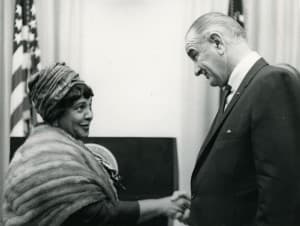
American · Activism · Literature
Ethel L. Payne
August 14, 1911 – May 28, 1991
Early Life and Background
Ethel Lois Payne was born on August 14, 1911, in Chicago, Illinois, the fifth of six children born to William A. Payne, a Pullman porter, and Bessie Austin Payne, a former schoolteacher. Growing up on Chicago's South Side, Payne was raised in a household that prized education and moral seriousness. Her father's work with the Pullman Company connected the family to one of the most important sources of stable employment and labor organizing available to Black Americans in the early twentieth century, while her mother instilled in her children a love of reading, language, and storytelling.
Payne attended Chicago public schools and went on to study at Crane Junior College and later at Garrett Biblical Institute (now Garrett-Evangelical Theological Seminary) in Evanston, Illinois. Despite her intellectual gifts and ambitions, she faced significant barriers pursuing a career in journalism, as journalism schools and mainstream newsrooms of the era routinely excluded Black students and reporters, particularly women. Unable to break directly into journalism as a young adult, Payne instead pursued library science and took various jobs, including work with the Chicago Public Library, all the while nurturing her writing skills and her deep interest in social justice.
Career Beginnings
Payne's path into journalism began in an unexpected way. In the late 1940s, she took a position with the American Red Cross and was posted to Japan, where she worked at a service club supporting Black American troops stationed there during the postwar occupation and, subsequently, the Korean War. During her time in Japan, Payne kept a detailed personal diary chronicling her observations of racial segregation and discrimination within the U.S. military — including instances of interracial relationships between Black soldiers and Japanese women, and the unequal treatment Black troops experienced compared to their white counterparts.
Her diary came to the attention of a visiting journalist, and excerpts were subsequently published, drawing significant attention from the Chicago Defender, one of the most prominent and influential African American newspapers in the country. The Defender recognized Payne's raw talent for vivid, honest reportage, and by 1950, her writing began appearing regularly in its pages. This set the stage for her formal hiring as a full-time reporter in 1951, at which point she became one of the paper's most important voices covering both international and domestic affairs affecting Black Americans.
Rise to National Prominence
Throughout the early 1950s, Payne continued to report on the experiences of Black troops during the Korean War, exposing segregation and discrimination within the U.S. armed forces at a time when official policy claimed the military had been desegregated following President Truman's 1948 executive order. Her firsthand, on-the-ground reporting provided crucial documentation of the gap between policy and practice.
In 1952, Payne received a first-place award from the Illinois Press Association for her reporting on child adoption and on African Americans working in industry — early recognition that helped establish her credibility as a serious journalist. By the mid-1950s, she had relocated to Washington, D.C., to serve as the Chicago Defender's Washington correspondent, a position she would hold for more than two decades.
It was in Washington that Payne achieved one of her most consequential milestones: gaining accreditation to the White House press corps. By 1955, she was one of only three Black journalists — and among a small handful of women of any race — credentialed to attend White House press briefings. She used this access assertively, famously pressing President Dwight D. Eisenhower directly on civil rights issues, including questions about the administration's commitment to desegregation. Her persistent, pointed questioning sometimes visibly irritated Eisenhower and drew criticism from some in the press corps who felt she was overstepping the norms of White House journalism, but her questions forced the administration to address civil rights issues on the record in ways it might otherwise have avoided.
Covering the Civil Rights Movement
From the mid-1950s through the 1960s, Payne emerged as one of the most important journalistic chroniclers of the Civil Rights Movement. She traveled extensively throughout the American South, reporting on the Montgomery Bus Boycott, the Birmingham campaign, the Selma voting rights protests, and countless other flashpoints in the struggle for racial justice. Unlike many white reporters covering the movement from a distance, Payne brought both professional rigor and personal understanding to her reporting, having experienced racial discrimination firsthand throughout her life.
On August 28, 1963, she covered the historic March on Washington for Jobs and Freedom, witnessing Dr. Martin Luther King Jr.'s "I Have a Dream" speech and the massive gathering of hundreds of thousands of demonstrators on the National Mall. Her coverage for the Defender helped bring the scale and emotional power of the event to Black readers nationwide. She would go on to cover President Lyndon B. Johnson's signing of the Civil Rights Act of 1964, witnessing firsthand the culmination of years of activism she had chronicled.
Payne's reporting during this period was not limited to domestic civil rights coverage. She also reported on international affairs, including trips to Africa and Asia, examining decolonization movements and the global dimensions of racial justice struggles. Her international reporting reflected her belief that the fight against racism in America was linked to broader global struggles against colonialism and oppression.
Transition to Broadcast Journalism
By the late 1960s and into the 1970s, Payne's reputation as one of the most respected journalists covering race, politics, and civil rights in America led to opportunities in broadcast media. Around 1970, she is credited by several biographical sources as becoming the first African American woman to appear as a radio and television commentator on a national network, though the exact date of this milestone is not precisely documented.
This early broadcast work culminated in a more formal and well-documented role in 1972, when Payne was hired by CBS News to serve as a commentator on the network's opinion program, "Spectrum." This appointment made her the first African American woman to serve as a national network radio and television commentator and the first to host network news commentary in American broadcasting history. She continued in this role through 1978, offering incisive political analysis informed by her decades of firsthand reporting experience.
Her transition into broadcasting represented a significant breakthrough not just for Payne personally, but for the broader landscape of American media, which had almost entirely excluded Black women from positions of on-air authority and commentary. Payne's presence on national television helped normalize the idea that Black women's perspectives on politics and society were not only valid but essential to a complete national conversation.
Awards, Honors, and Recognition
Over the course of her career, Ethel Payne received more than eighty honors and awards recognizing her contributions to journalism and civil rights advocacy, though specific presentation dates for many of these awards are not consistently documented in available records. She was widely known by the honorific "First Lady of the Black Press," a title that reflected both her seniority and her outsized influence within African American journalism.
Her papers and archival materials are preserved at several major institutions, including the Smithsonian's Anacostia Community Museum, the Howard University archives, and other repositories dedicated to preserving the history of the Black press and the Civil Rights Movement. In 2002, the United States Postal Service honored her memory with a commemorative postage stamp as part of a series recognizing distinguished American journalists. In 2021, she was posthumously inducted into the Chicago Literary Hall of Fame, recognizing her enduring contributions to journalism and American letters.
Personal Life
Ethel Payne never married and had no children, dedicating her life fully to her journalism career and to the causes of civil rights and racial justice she covered so extensively. She was known among colleagues for her tireless work ethic, her sharp wit, and her unwavering moral clarity on issues of race and justice. She maintained close professional relationships with many leading figures of the Civil Rights Movement and was respected as both a journalist and, at times, a participant-observer deeply invested in the outcomes of the struggles she documented.
Legacy and Impact
Ethel Payne's career represents one of the most significant bodies of work in twentieth-century American journalism. She broke barriers at nearly every stage of her career: as a Black woman gaining access to the White House press corps during the height of segregation-era America; as a journalist willing to directly challenge a sitting president on civil rights; as a chronicler who brought unparalleled depth and firsthand understanding to her coverage of the Civil Rights Movement; and as a broadcast pioneer who became the first African American woman to serve as a national network commentator.
Her legacy continues to influence journalism today, particularly in conversations about representation in newsrooms and on-air talent, the role of the Black press in American history, and the responsibilities of journalists covering movements for social justice. Biographies, including "Eye on the Struggle: Ethel Payne, the First Lady of the Black Press" by James McGrath Morris, have helped introduce her remarkable story to new generations of readers and journalism students.
Later Life and Death
Payne continued to work as a journalist, commentator, and advocate throughout the 1980s, remaining an active voice in discussions of civil rights and American politics until her final years. She died on May 28, 1991, in Washington, D.C., of a heart attack, at the age of 79. (Some sources, including BlackPast and the Chicago Literary Hall of Fame, list her date of death as May 29, 1991.) Her death was mourned across the journalism profession and within the civil rights community, with tributes emphasizing her fearlessness, integrity, and the trail she blazed for generations of Black journalists — particularly Black women — who followed in her footsteps.
Dated achievements
8 indexed.
- Aug141911Activism
Birth of Ethel L. Payne in Chicago
Ethel Lois Payne was born in Chicago, Illinois, to William A. Payne and Bessie Austin.
View details Wikipedia - Ethel L. Payne - Jan011950Literature
First articles published in the Chicago Defender
In 1950, Ethel Payne's career launched with her first articles in the Chicago Defender.