← All women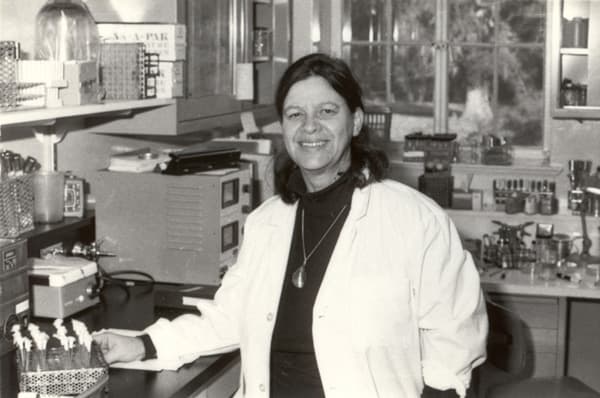
American · Science
Esther Lederberg
December 18, 1922 – November 11, 2006
Early life and education
Esther Miriam Zimmer Lederberg was born on 18 December 1922 in the Bronx, New York, into a working-class Jewish family.[1][3] She grew up during the Great Depression, a period that shaped the ambitions and constraints of her early life. Biographical accounts describe a childhood in which formal scientific opportunities for women were limited, yet her interest in study and laboratory work developed early enough to guide her toward an academic career in biology and genetics.[1][3][8]
She attended Hunter College, where she initially studied French and literature before switching to science and completing a bachelor’s degree in genetics in 1942.[1][3] Her move into genetics placed her in a field that was still defining itself as a modern experimental discipline. In the years after the rediscovery of Mendelian heredity, genetics was becoming increasingly tied to microbiology, biochemistry, and molecular biology. Lederberg’s training at this stage gave her the background needed to work at the intersection of those fields.
After graduating, she continued advanced study in genetics and later worked in research environments that connected her to some of the most important figures in mid-century biology. Sources differ in the exact framing of her post-baccalaureate study, but they consistently place her in graduate-level genetics work by the mid-1940s and in the orbit of Stanford and later Wisconsin research communities.[1][4][5][10] Her early professional path required persistence in an academic world where women were frequently expected to support, rather than lead, major scientific programs.
Marriage and graduate training
On 13 December 1946, Esther Zimmer married Joshua Lederberg in New York City.[2] The marriage linked two scientists whose careers would become deeply intertwined. It also occurred at a time when women in science often found their work interpreted through the prominence of their husbands, a pattern that would later affect Esther Lederberg’s public recognition.
That same period coincided with the beginning of her most important research collaborations. Accounts of her career place her in graduate genetics work at Stanford and later at the University of Wisconsin–Madison, where she studied bacterial genetics under the broader influence of investigators such as George Beadle and Edward Tatum.[3][5][10] This was a formative moment for the field: bacterial genetics was emerging as a way to study heredity with unusual speed and precision because microbes could be grown and tested in large numbers.
By 1950, she had completed and defended her PhD at the University of Wisconsin–Madison.[5][10] During this period she isolated bacteriophage lambda, a discovery that would soon become one of her signature contributions to biology.[5][17][18] Her doctorate thus coincided with a major scientific breakthrough, showing how closely her training and research were linked.
Discovery of lambda phage and work on lysogeny
In 1951, Esther Lederberg’s first report describing bacteriophage lambda was published in the Microbial Genetics Bulletin.[17][18] Lambda phage, a virus that infects bacteria, became one of the most important tools in molecular biology because of its temperate behavior and its usefulness in studying gene regulation and recombination.[1][17][18]
She followed this with a more detailed description in Genetics in 1953, helping establish the biology of lambda as a central model for bacterial heredity and lysogeny.[17] This work mattered because the mechanisms by which bacterial viruses integrate into and later exit from host cells offered a new way to understand genetic control. In an era before the molecular architecture of DNA was fully understood, studies like hers provided concrete experimental systems that could reveal how genes behaved in living cells.
Lambda phage became a foundational organism in microbiology and molecular genetics. Its role in later discoveries of gene regulation, recombination, and specialized transduction gave Lederberg’s early work a lasting influence. The fact that her discovery remained indispensable for decades reflects both the originality of the observation and the strategic value of the model system she introduced.[1][17][18]
Replica plating and bacterial genetics
One of Esther Lederberg’s most consequential achievements was the development of replica plating, first successfully published in 1952 in Genetics.[2][17] The technique allowed bacterial colonies to be copied from one plate to another while preserving their arrangement, enabling scientists to screen for mutants and compare growth on different media. Because colonies retained their positions, researchers could determine which strains carried particular heritable traits without disrupting the original culture.
This was an especially powerful innovation for studying nutritional mutants and antibiotic resistance. In the postwar decades, as medicine began to confront resistant infections and microbiology became more experimental, replica plating gave scientists a reliable way to identify rare variants among thousands of colonies. The method became a standard laboratory tool and remains widely used.[1][2][17]
Replica plating was also historically important because it represented a new kind of reproducible microbial experimentation. Rather than relying on chance or laborious single-colony testing, it created an efficient way to detect inherited differences. Lederberg’s contribution to this method stands as one of the clearest examples of how a technique can transform an entire discipline.
F factor, conjugation, and plasmids
In 1956, Esther Lederberg, Joshua Lederberg, and Luigi Luca Cavalli-Sforza published work on the F fertility factor in Escherichia coli.[2][17] This study demonstrated that a transmissible element could mediate bacterial conjugation, helping establish the concept of the plasmid and opening new ways of thinking about gene transfer in microbes.[2][4][17]
The discovery was significant because it showed that bacterial heredity was not limited to vertical inheritance from parent to offspring. Instead, bacteria could exchange genetic information directly, reshaping the understanding of evolution, adaptation, and the spread of traits such as antibiotic resistance. In later years the F factor came to be recognized as the first plasmid described, and its study became central to molecular genetics and microbial ecology.[2][4][17]
Esther Lederberg’s role in this work also illustrates a broader pattern in twentieth-century science: women often contributed essential experimental insight while public recognition flowed elsewhere. The historical record now places her among the foundational figures of bacterial genetics, not as a supporting participant but as a co-creator of key concepts and methods.
Stanford career and the Plasmid Reference Center
During the 1960s, Lederberg continued research on bacterial genetics and bacteriophages and became associated with Stanford University School of Medicine.[5][10] Her career increasingly centered on plasmids and gene transfer, areas that were rapidly expanding as molecular biology matured. She worked in a period when the practical circulation of biological materials was becoming as important as published papers for advancing science.
In 1972, she founded and directed the Plasmid Reference Center at Stanford.[2][3] The center collected, characterized, named, and distributed plasmids to laboratories worldwide, including elements linked to antibiotic resistance, virulence, conjugation, colicins, and transposons.[2][7] This was a major scientific infrastructure project. By creating a curated repository, Lederberg gave researchers a shared resource that improved reproducibility and accelerated discovery across microbiology.
The center’s importance extended beyond her own research program. It supported the broader international community at a time when the exchange of biological materials was slower and more fragmented than it is today. Lederberg’s work as curator and organizer was therefore as consequential as her experimental discoveries, because it made the field itself more connected and systematic.
Recognition, marginalization, and later life
Despite the centrality of her discoveries, Esther Lederberg’s recognition was often overshadowed by the fame of her husband, Joshua Lederberg, who received the 1958 Nobel Prize in Physiology or Medicine for work that included research in bacterial genetics. Later biographical accounts and institutional tributes have emphasized that Esther Lederberg’s own contributions were essential to the field’s development and should be understood on their own terms.[5][8][18]
In later life she became a symbol of both scientific achievement and the under-acknowledged labor of women in research. Biographical sources note her continued association with Stanford, her role in maintaining plasmid collections, and her influence on younger scientists who benefited from her work and example.[3][5][7][8] She remained a reference point for studies of lambda phage, bacterial gene transfer, and laboratory methods in microbiology.
She retired in 1985 and later married engineer Matthew Simon in 1993.[5] Her later years were marked by increasing public recognition of her scientific legacy, including articles and memorial essays that reframed her as a pioneer in microbial genetics rather than simply as the spouse of a Nobel laureate.[8][11][14][18]
Death and legacy
Esther Lederberg died on 11 November 2006 at Stanford, California, at the age of 83.[1][2][5][10] Her death prompted renewed attention to the breadth of her contributions: the isolation of lambda phage, the development of replica plating, the elucidation of the F factor, and the creation of a global plasmid reference center.[1][2][17][18]
Her legacy is now understood as foundational to bacterial genetics and molecular biology. The experimental systems and laboratory methods she helped establish continue to shape research on gene regulation, recombination, conjugation, and antibiotic resistance. Just as important, her career has become part of a larger historical effort to recover women scientists whose work was essential but under-credited in their own time.
Today, Esther Lederberg is remembered not only for what she discovered, but also for the infrastructure, methods, and intellectual possibilities she created for generations of scientists.
Dated achievements
8 indexed.
- Dec181922Science
Birth of Esther Miriam Zimmer (Esther Lederberg)
Esther Miriam Zimmer (later Lederberg) was born in the Bronx, New York, United States.
View details Esther Lederberg - Wikipedia - Dec131946Science
Marriage to Joshua Lederberg
Marriage of Esther Zimmer to Joshua Lederberg in New York City.
View details