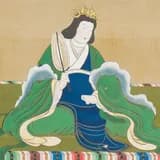
The regnal beginning of Suiko’s long reign in 593, a key turning point in early Japanese state formation.
On 19 May 593, Suiko’s reign began after the political settlement that followed Emperor Sushun’s death, and she became the central sovereign of the Yamato court. The precise formalities of enthronement are preserved unevenly in later tradition, but 593 is the standard regnal year used for the start of her rule.
This date matters because it marks the opening of a reign that lasted more than three decades, making Suiko not only Japan’s first reigning empress but also one of its longest-ruling early sovereigns. Her accession was especially significant in a period when succession was not governed by a rigid modern-style constitution; instead, legitimacy depended on a mix of descent, ritual, and clan consensus. Suiko’s elevation reflected the influence of the Soga family and the need for a politically acceptable ruler amid factional rivalry.
Her reign provided continuity during a formative stage of Japanese state development. It created the institutional setting for the spread of Buddhism, the reception of Chinese cultural forms, and early administrative standardization. For these reasons, the beginning of her reign is regarded as a sentinel moment in the emergence of the early Japanese polity.