← All women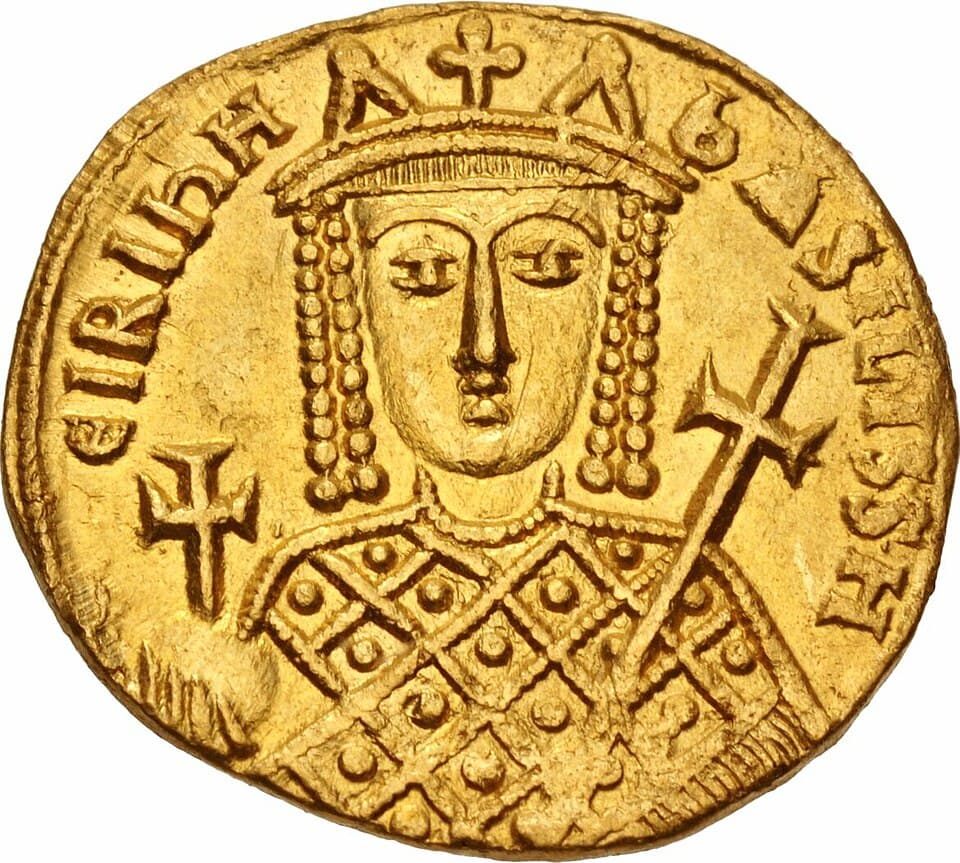
Byzantine · Politics
Empress Irene
752 – August 9, 803
Early Life and Background
Irene of Athens, also known as Irene Sarantapechaina, was born around 752 in Athens, then part of the Byzantine Empire.[1][5][7] Her exact birth date is unknown, but most modern reference works agree on the approximate year. She is described as coming from an obscure yet noble Athenian family, probably connected to the local aristocracy, although the names of her parents are not preserved in surviving sources.[6][7] Later tradition often presents her as an orphan, suggesting that she may have lost her parents at a young age and been raised within a broader kin network.[6]
Little direct evidence survives about Irene’s education, but her later political and ecclesiastical activities indicate familiarity with court protocol, theology, and administrative practice. As Athens was a provincial city compared to Constantinople, Irene’s selection for the imperial marriage market demonstrates that provincial noble families could still supply brides of sufficient status and perceived virtue for the ruling dynasty.[6][16] Her early life thus reflects the broader patterns of aristocratic upbringing in mid-8th-century Byzantium, where young women from provincial elites could be drawn into imperial politics through dynastic marriages.
Entrance into Imperial Politics and Marriage to Leo IV
Irene entered the center of Byzantine power in the late 760s when Emperor Constantine V chose her as a bride for his son, the future Emperor Leo IV.[1][5][7] According to later accounts, she was brought from Athens to Constantinople in 769 for a formal bride-show and marriage ceremony.[1][14] The union linked a provincial Greek noblewoman to the Isaurian imperial house, which had ruled since the reign of Leo III.
Leo IV became emperor in 775, and Irene served as empress consort from 775 to 780.[1][3] Their only known child, Constantine VI, was born in 771 and designated as heir.[1][7] During Leo’s reign, imperial policy continued the iconoclastic stance of his father, Constantine V, who had opposed the religious veneration of icons. Irene, however, is described in later sources as an iconodule, a supporter of icons.[4] This ideological difference between consort and emperor would become central to her own rule.
As consort, Irene’s public role was shaped by ceremonial duties and patronage rather than direct governance. Nevertheless, her presence at court allowed her to cultivate relationships with palace officials, clergy, and members of the urban elite. These networks would later underpin her ability to exercise power after Leo IV’s death.
Regency for Constantine VI (780–790)
In 780, Emperor Leo IV died, leaving his nine-year-old son Constantine VI as heir.[1][5] On 8 April 780, Irene assumed the role of regent for her minor son, effectively becoming the central decision-maker in the empire.[1] Although her authority was theoretically exercised on behalf of the child emperor, in practice she controlled the imperial administration, presided over the court, and directed foreign and ecclesiastical policy.
The regency was contested from its outset. Elements of the army and court remained loyal to the broader Isaurian family and were suspicious of Irene, both as a woman and as an avowed supporter of icons.[4][6] Nonetheless, she successfully navigated several challenges, including a conspiracy led by her in-laws and military commanders. According to several accounts, Irene uncovered and suppressed plots aiming to replace her with male relatives of the dynasty, demonstrating her early capacity for political survival.[1][7]
Religiously, Irene used her regency to shift imperial doctrine away from iconoclasm. She recalled bishops and monks exiled for defending icons and cultivated alliances with influential clerics who favored the restoration of image veneration.[4][12] Her policies brought her into tension with deeply entrenched iconoclast elements, especially in the army, but they also positioned her as a champion of orthodoxy in the eyes of iconophile church leaders.
The Second Council of Nicaea (787) and the End of First Iconoclasm
One of Irene’s most significant acts as regent was the convocation of the Second Council of Nicaea, held in 787
Under her authority and that of Constantine VI, the council debated the theological status of icons and ultimately endorsed their veneration, distinguishing between the worship due to God alone and the honor given to images of Christ, the Virgin, and the saints.[3] The council concluded on 24 August 787 with decrees that condemned iconoclasm as heresy and restored icons to churches and devotional practice.[3] This settlement is recognized as the Seventh Ecumenical Council by both the Eastern Orthodox and Roman Catholic Churches.[3][4] Irene’s role in initiating and protecting the council has made her a central figure in the history of Christian doctrine. By ending the First Iconoclasm, she reshaped Byzantine religious culture, strengthened ties with Rome, and helped define the visual and liturgical character of Eastern Christianity for centuries. Later hagiographical and historical traditions credit her as a key defender of orthodoxy and venerator of icons.[4][12] As Constantine VI reached adolescence and early adulthood, tensions grew between mother and son. Many aristocrats and military leaders expected Constantine to assume full authority and resented Irene’s continued dominance.[1][7] A period of conflict culminated around 790, when Constantine and his supporters attempted to assert his sole rule, briefly sidelining Irene. However, Irene remained a formidable political actor. In 792, she was restored as co-ruler alongside Constantine VI.[1] Although the exact day of this restoration is not firmly documented in the sources, chronicles and modern historians agree that she re-entered the formal hierarchy as an emperor in her own right, appearing on coinage and in official documents.[1][6] This joint rule did little to resolve underlying tensions; instead, it highlighted the unusual situation of a reigning emperor sharing power with his mother, who was also styled as an emperor. During this period, Irene’s influence remained strong in ecclesiastical affairs and court politics. She continued to support iconophile clergy and patronize religious institutions, reinforcing her image as a pious ruler despite criticism from those who saw her as overreaching. The co-regency set the stage for the dramatic events of 797, when Irene would seize sole power. In 797, escalating conflict and dissatisfaction with Constantine VI’s leadership culminated in a palace coup. On 18 August 797, Constantine was deposed and blinded, a brutal practice not uncommon in Byzantine succession struggles.[1][3] Irene emerged from this crisis as the sole ruler of the Byzantine Empire, assuming the title of basileus (emperor) rather than the more conventional feminine title basilissa.[3][6][7] Modern scholars and reference works widely recognize Irene as the first woman to rule the Byzantine Empire alone, as autokrator.[3][6][7] Her reign from 797 to 802 therefore occupies a unique place in the history of female rulership. She appears in official acts, coinage, and ceremonial texts as the primary sovereign, with no male co-emperor. Some church sources and later historians praised her as a just and orthodox ruler; others criticized her harsh treatment of her son and viewed her accession as legally dubious. Irene’s sole rule coincided with major developments in Western Europe, most notably the rise of Charlemagne and the coronation of the Frankish king as "Emperor" by Pope Leo III in 800.[1][15] Some medieval chronicles relate rumors of a proposed marriage between Irene and Charlemagne, which, if realized, might have united the eastern and western imperial titles.[1][11] While most modern historians treat such accounts cautiously, they underscore the geopolitical significance of Irene’s position as a female emperor at a moment when the idea of a unified Roman Empire was being reimagined. Irene’s government faced substantial fiscal and military challenges. Sources describe her reign as marked by heavy taxation and controversial monetary policies, including adjustments to the gold coinage.[1][3] These measures aimed to stabilize state finances and support the army but generated resentment among landowners, urban elites, and sections of the bureaucracy. In foreign policy, Irene inherited long-standing conflicts with the Abbasid Caliphate and frontier pressures in the Balkans.[1][3][15] She negotiated truces and managed military campaigns with mixed success. Some historians argue that her focus on religious policy and court politics left the empire vulnerable to external threats; others emphasize the structural difficulties facing any ruler in this period. Within the church, Irene continued to uphold the decisions of the Second Council of Nicaea. She patronized monasteries, supported iconophile clergy, and promoted doctrinal unity.[4][12] Over time, these actions reinforced her image as a ruler whose primary legacy lay in religious rather than military achievements. By the early 802, dissatisfaction with Irene’s rule had hardened among segments of the court and army. Critics objected to her fiscal policies, questioned her ability to manage external threats, and remained uneasy about a woman holding the imperial title of basileus.[1][3][7] On 31 October 802, a coalition of officials and military leaders orchestrated a palace coup.[1] The conspirators proclaimed Nikephoros I, the logothetes of the genikon (a senior financial official), as emperor. Irene was seized, her household reorganized, and she was removed from the capital. Contemporary and later accounts suggest that she was first exiled to the Princes’ Islands in the Sea of Marmara and then sent further away to Lesbos.[1][4] Her deposition ended her five-year experiment in sole female sovereignty and returned the empire to more conventional male rule. In exile, Irene lived under constrained conditions, separated from the court and stripped of political authority. The details of her daily life on Lesbos are sparsely documented, but sources agree that she remained there until her death.[1][4][5] Modern reference works, including Encyclopaedia Britannica and major historical encyclopedias, record her death as occurring on 9 August 803 on Lesbos.[5][8][12] This date has become standard in scholarly literature. With her passing, the life of a woman who had risen from provincial nobility to the pinnacle of imperial power came to an end. While the Byzantine Empire did not confer "awards" in the modern sense, Irene received posthumous recognition in several traditions. In the Eastern Orthodox Church, she has been honored as a saint, particularly for her role in ending iconoclasm and restoring the veneration of icons.[4][12][16] Hagiographical texts and ecclesiastical commemorations portray her as a pious empress who defended the true faith against heretical opposition. Modern scholarly works and reference encyclopedias consistently recognize Irene as the first woman to rule Byzantium as sole emperor and emphasize her central role in convening the Seventh Ecumenical Council.[3][6][7][12] She appears in numerous compendia of women’s history and church history as a barrier-breaking figure whose reign redefined the possibilities of female leadership in a medieval Christian empire. Irene’s personal life, apart from her political role, is only partially visible in the sources. Her marriage to Leo IV appears to have been primarily dynastic, aimed at securing continuity for the Isaurian house.[1][6] They had one documented child, Constantine VI, whose relationship with his mother became deeply strained as he attempted to assert his independence and later suffered deposition and blinding in the coup that brought Irene to sole power.[1][3][7] Beyond her nuclear family, Irene maintained complex relations with in-laws, including other members of the Isaurian dynasty, some of whom participated in conspiracies against her. She also developed close ties with iconophile bishops and monastic leaders, who served both as spiritual allies and political supporters.[4][12] Her personal piety is frequently emphasized in ecclesiastical sources, which report her participation in liturgical life, patronage of monasteries, and concern for doctrinal orthodoxy. Irene’s legacy is multifaceted and contested. Politically, she is remembered as the first woman to rule the Byzantine Empire as sole autocrat, an achievement that required overcoming entrenched patriarchal norms and leveraged court alliances and ecclesiastical support.[3][6][7] Her reign provides an important case study in the gendered dynamics of power in medieval states, illustrating both the possibilities and limits of female sovereignty. Religiously, Irene’s role in convening and safeguarding the Second Council of Nicaea has had enduring consequences. By ending the First Iconoclasm and restoring the veneration of icons, she helped shape the visual, liturgical, and theological character of Eastern Christianity.[3][4][12] The council’s decisions influenced church art, devotional practice, and East–West relations for centuries, and Irene’s patronage of iconophile clergy made her a key figure in this transformation. From a broader historical perspective, Irene’s reign intersected with major developments in Western Europe, including the rise of Charlemagne and the reconfiguration of the "Roman" imperial title.[1][15] Her presence as a female emperor complicates later narratives that treat the imperial dignity as exclusively male and underscores the contingency of political arrangements in the post-Roman world. Modern historians debate Irene’s effectiveness as a ruler. Some emphasize her fiscal and military shortcomings and the violence of her treatment of Constantine VI; others highlight her religious achievements and the structural difficulties of her era.[1][3][16] Women’s history scholars and popular history projects, including podcasts and digital exhibits, often foreground her story as an example of a woman who navigated and reshaped the constraints of her time.[17][19] In sum, Irene of Athens remains a pivotal figure in Byzantine and women’s history: a provincial noblewoman who became empress consort, regent, co-ruler, and finally sole emperor; a defender of icons whose decisions changed the course of Christian doctrine; and a ruler whose life and legacy continue to inspire debate and reinterpretation.Conflict with Constantine VI and Co-Rulership
Sole Rule as Empress Regnant (797–802)
Policies, Administration, and Economic Challenges
Deposition and Exile
Later Life and Death
Awards, Honors, and Recognition
Personal Life and Relationships
Legacy and Historical Impact
Dated achievements
5 indexed.
- Apr08780Politics
Begins regency for Constantine VI
Irene began her regency for her son Constantine VI.
View details Wikipedia: Irene of Athens - Aug24787Politics
Second Council of Nicaea concludes
The Second Council of Nicaea concluded under Irene's regency restoring the veneration of icons.
View details