← All women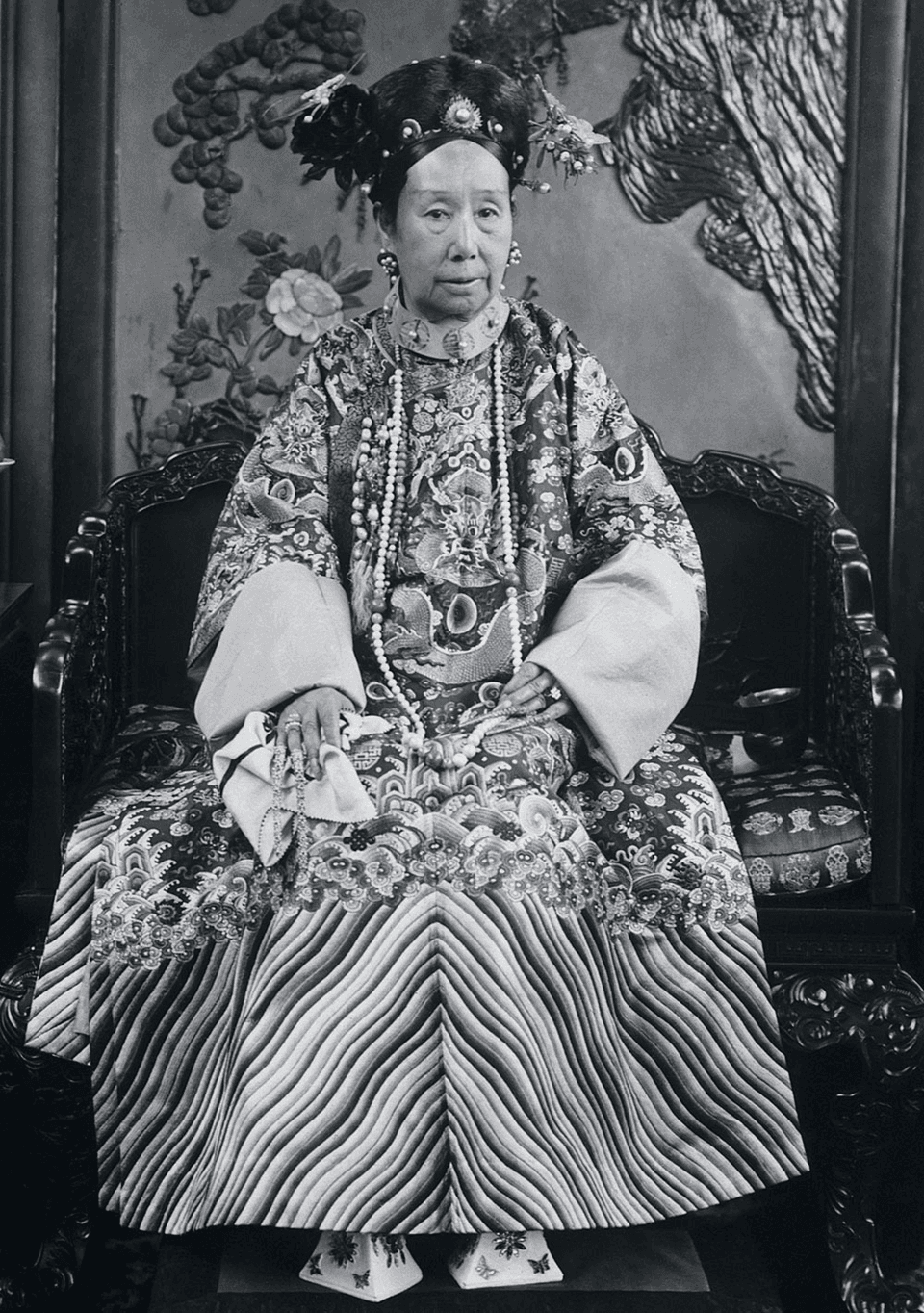
Chinese · Politics
Empress Dowager Cixi
November 29, 1835 – November 15, 1908
Early life and background
Empress Dowager Cixi was born Yehe Nara Xingzhen on 29 November 1835 in Beijing, into the Manchu Yehe Nara clan.[1][2][6][8][10][12] Sources describe her family as banner elite but not among the very highest ranks of the empire. Her father was a minor Manchu official, and her early life did not mark her out as someone destined for the center of state power.[8][10] Like many women of her class, she was shaped by the rigid hierarchies of the Qing court, where marriage alliances, ethnicity, and access to the imperial household determined social mobility.
Little is known with certainty about her formal education, but as a Manchu noblewoman she would have been trained in the expectations of elite court life, ritual propriety, and the gendered norms of the imperial household. She entered the court as a concubine of the Xianfeng Emperor in the early 1850s, a move that placed her within the palace system that would later transform her life.[1][2][8][10][16] In 1856, she gave birth to the emperor’s only surviving son, Zaichun, later the Tongzhi Emperor, a development that sharply improved her political standing.[1][2][11][12] That birth gave her a durable place in succession politics and made her a key figure in the dynastic future of the Qing.
Rise at court
Cixi’s ascent was inseparable from the succession crisis that followed the death of the Xianfeng Emperor on 22 August 1861.[1][2] The emperor’s death left the throne to a child, Zaichun, and created a power vacuum in which regency became essential. Cixi and the empress dowager Ci’an were soon able to position themselves as joint regents, and later the same year Cixi helped engineer the Xinyou Coup, which removed rival regents and secured her place at the center of Qing politics.[1][2][5] From this point onward, she was no longer simply a consort and mother; she was a ruler in practice.
Her early regency was a period of intense political adaptation. Although women were excluded from formal office in Qing political ideology, Cixi governed from behind the curtain and used palace authority to influence appointments, policy, and succession. The arrangement was both extraordinary and controversial. Critics later portrayed her as a schemer who manipulated child emperors for personal power, while other historians emphasize that she operated within a court system already fractured by rebellion, foreign pressure, and bureaucratic weakness.[3][4][7][11][13] Whatever the interpretation, her regency became one of the defining political realities of the late Qing era.
Government, reform, and consolidation of power
During the 1860s and 1870s, Cixi presided over a court that increasingly confronted the challenge of modernization. Britannica notes that under her regency the Qing state developed schools for foreign languages, consolidated a modern customs service under Robert Hart, built Western-style arsenals, and established the first Chinese foreign service office.[12] These reforms were part of the broader self-strengthening effort to integrate Western technology and administrative methods without abandoning imperial rule. Cixi’s supporters have seen her as a pragmatic modernizer; her detractors have argued that she tolerated reform only when it preserved her authority.
Her control endured after the death of the Tongzhi Emperor on 12 January 1875, when she arranged for her nephew Zaitian to become the Guangxu Emperor the next day and made herself his adoptive mother.[1][2][11][12] That arrangement allowed her to continue governing through another child emperor. Over time, her reputation became divided between those who admired her political skill and those who blamed her for delaying more radical reform. The historical record shows that she repeatedly balanced conservatism and adaptation, resisting some changes while endorsing others.
Accounts of the late 1870s and 1880s credit her government with encouraging railways, telegraphy, naval modernization, and industrial development, though many of these initiatives were uneven and often delayed by court resistance and fiscal weakness.[3][4][6] She is also associated with the creation of a modern navy, expanded arsenals, and the beginnings of new communications infrastructure.[4][6] These efforts did not make China fully modern, but they did help lay institutional foundations for later reforms. Her court increasingly confronted a global system in which imperial China had to respond to foreign military and commercial pressure or risk further subordination.
The Hundred Days’ Reform and political reversal
The most famous clash of Cixi’s career came in 1898, when reformers around the Guangxu Emperor launched the Hundred Days’ Reform. On 21 September 1898, Cixi staged a coup that ended the reform movement and placed the Guangxu Emperor under house arrest.[1][2] This act remains one of the most controversial episodes in modern Chinese political history. Reformers sought rapid institutional change, but Cixi and her allies regarded some of the proposals as threatening to the dynasty’s stability and to her own authority.
The coup did not simply represent reaction; it also demonstrated the structural limits of reform in a court system still dependent on personal power, factional alliances, and imperial prerogative. Cixi’s decision to intervene preserved her position, but it also damaged her reputation among later historians who viewed the suppression of the reform movement as a fatal blow to constitutional modernization. Others note that she later supported a new round of reforms, suggesting that her politics were more complex than a simple conservative-versus-reformer divide.[11][12][13][14]
Boxer crisis and final reforms
During the Boxer Rebellion, foreign troops entered Beijing on 14 August 1900, and Cixi fled the capital with the Guangxu Emperor, traveling to Xi’an in disguise.[1][2] The flight was a humiliating but politically revealing moment: the imperial court, once the center of East Asian power, was forced into exile by military defeat and foreign intervention. Yet Cixi continued to exercise authority from afar, preserving the fiction and reality of imperial command as the dynasty confronted diplomatic disaster.
She returned to Beijing on 7 January 1901 after negotiations with foreign powers.[1] The years that followed saw the final and most concentrated phase of her reform program. Sources describe major changes in law, education, administration, and the military during 1901–1908, including efforts to modernize legal codes and improve the state apparatus.[4][12] In this final period she also supported reforms touching women’s education, currency, and other institutions associated with modern statehood.[6] Whatever the limits of enforcement, the late Qing reform agenda under her direction marked a decisive shift from the earlier image of unyielding conservatism.
One of the most notable late measures was the anti-foot-binding edict of 21 January 1902, which discouraged the practice and has been interpreted by some later writers as the first state-level national attempt to ban foot-binding in China.[1][2][6] Although enforcement was incomplete and the reform could not instantly transform society, the edict symbolized state recognition of a long-standing form of gendered bodily constraint. In 1908, the Qing government also promulgated a timetable for constitutional reform, including a planned parliament, on 1 September 1908.[1][2] This signaled the dynasty’s final attempt to adapt to modern political expectations.
Personal life
Cixi’s personal life was deeply embedded in the political structure of the Qing palace. She married into the imperial household as a low-ranking concubine and rose within a competitive harem system in which rank, childbirth, and patronage mattered enormously.[1][8][10][16] Her son’s birth in 1856 changed her position at court, and the deaths and accessions that followed turned motherhood into statecraft.[1][2][11][12] She later became adoptive mother to the Guangxu Emperor, a politically crucial relationship that reinforced her authority and gave her a formal maternal role in dynastic succession.[1][2]
Because Qing court women lived within strict ritual and spatial boundaries, much of Cixi’s personal life is known through court records, later memoirs, and hostile or admiring retrospective accounts. She is often remembered through sharply polarized images: tyrant, modernizer, reactionary, manipulator, or nationalist realist. These images reflect not only her own actions but also the difficulties of interpreting a ruler who operated inside a court system that depended on secrecy and ceremonial control. The absence of ordinary private records makes her life especially vulnerable to legend, rumor, and political mythmaking.
Death and succession
Cixi died in Beijing on 15 November 1908.[1][2][12] The Guangxu Emperor had died the day before, on 14 November 1908, intensifying the atmosphere of suspicion around the end of the dynasty.[1][2] On the day of her death, she had also ensured the accession of the young Puyi, completing the final imperial succession of the Qing dynasty.[1] Her passing therefore marked both the end of her own era and the beginning of the last chapter of imperial rule in China.
Legacy
Cixi’s legacy remains intensely contested, but her historical importance is undisputed. Britannica describes her as a towering presence over the Chinese empire for almost half a century, and other modern accounts emphasize that she helped move China toward modern state institutions even while she resisted or redirected some reformist initiatives.[2][3][4][5][12][13][14] She oversaw or influenced developments in customs administration, foreign-language education, arsenals, communications, constitutional planning, women’s education, and anti-foot-binding policy.[4][6][12]
For women’s history, her significance lies in the scale of her power and the barriers she overcame. She operated in an imperial system that barred women from formal governance, yet she became the central political figure of the Qing dynasty through regency, succession management, and court strategy. For Chinese history, she represents both the persistence of palace politics and the difficult transition from empire to modern state. Her reputation has shifted over time, but she remains one of the most studied and debated women in modern world history.[1][2][3][4][5][12][13][14]
Dated achievements
14 indexed.
- Nov291835Politics
Birth of Empress Dowager Cixi
Birth of Yehe Nara Xingzhen in Beijing, China.
View details Cixi - 100 Women Britannica Profile - Apr271856Politics
Birth of Zaichun (Tongzhi Emperor)
Concubine Cixi gave birth to Zaichun, the future Tongzhi Emperor.
View details