← All women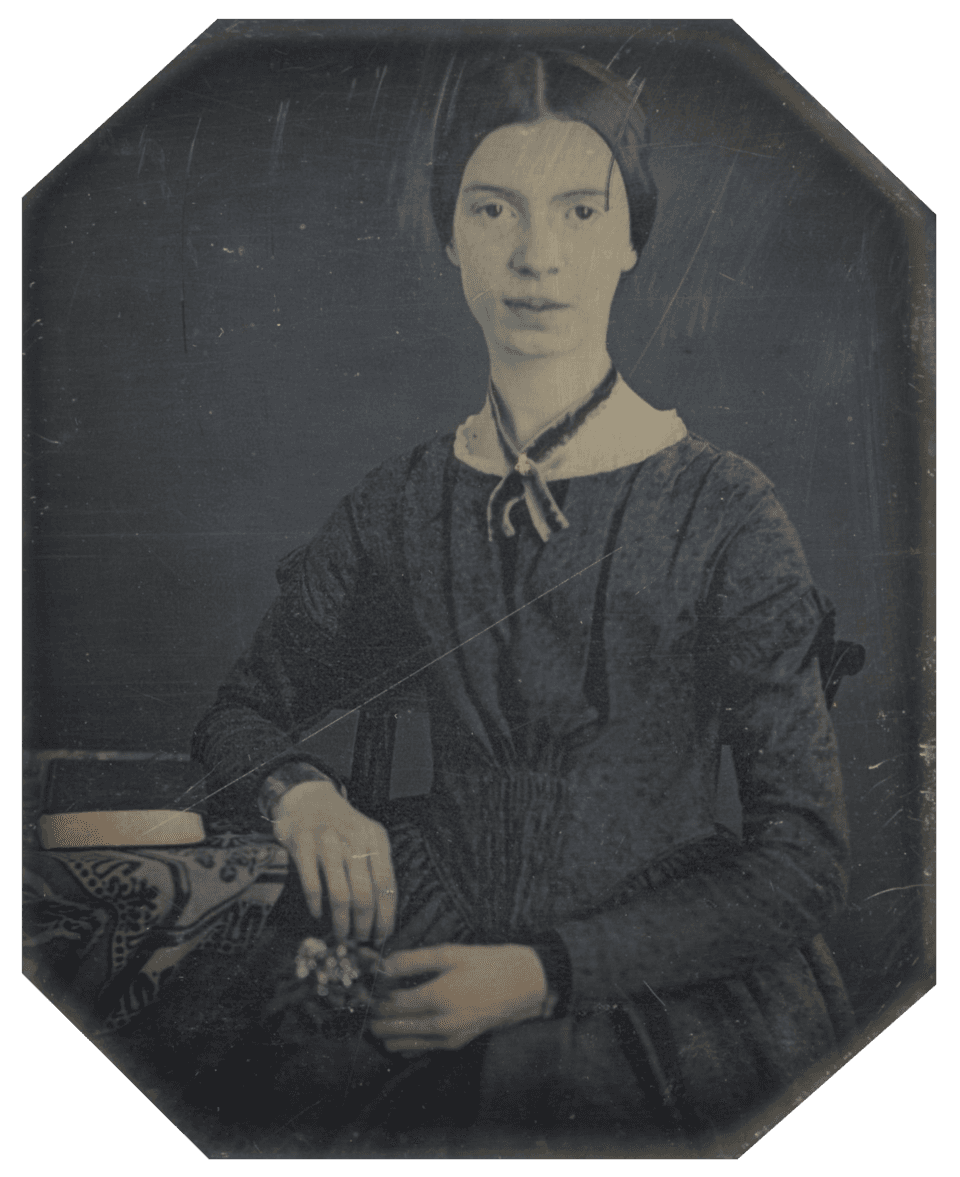
American · Literature
Emily Dickinson
December 10, 1830 – May 15, 1886
Early Life and Background
Emily Elizabeth Dickinson was born on December 10, 1830, in Amherst, Massachusetts, into a prominent New England family closely connected with the town’s civic and educational life.[1][7][8][11] Her grandfather, Samuel Fowler Dickinson, was one of the founders of Amherst College, while her father, Edward Dickinson, was a respected lawyer, Amherst’s treasurer, and a one-term member of the U.S. House of Representatives.[2][8][11] Her mother, Emily Norcross Dickinson, came from a neighboring town and was described as more reserved, contributing to the household’s emphasis on duty, piety, and order.[5][11]
Emily was the middle child of three siblings: an older brother, William Austin (“Austin”) Dickinson, and a younger sister, Lavinia (“Vinnie”) Dickinson.[7][11] The family lived in the Homestead on Main Street, a substantial house that would remain central to Dickinson’s life and later become part of the Emily Dickinson Museum. Growing up in Amherst, she was surrounded by the rhythms of a small but intellectually engaged town, shaped by the college, Congregational churches, and the local academy.
Dickinson’s early education followed the expectations for a girl in a prosperous, education-valuing family. She attended a primary school and then the Amherst Academy, where she studied subjects including English literature, botany, Latin, and possibly some science and mathematics.[5][11] Her teachers and classmates noted her academic seriousness and curiosity. In 1847 she enrolled at Mount Holyoke Female Seminary in South Hadley, one of the earliest higher-education institutions for women.[3][11] The seminary’s intense religious atmosphere, with pressure on students to undergo conversion experiences, may have contributed to her decision to leave after about a year. She returned to Amherst and did not pursue further formal schooling, but she continued a rigorous self-directed course of reading.
Dickinson read widely in the Bible, hymnals, and devotional literature, as well as in contemporary and older poetry and prose. Her influences included the Metaphysical poets of 17th-century England, such as John Donne and George Herbert, the Book of Revelation, and writers like Ralph Waldo Emerson and Henry David Thoreau
Dickinson’s "calling as a poet" began in her teens, but her most intense period of writing developed in the late 1850s and early 1860s.[14] Prior to this, she engaged in the local literary culture through letters and occasional verses. Her first known lifetime publication was a humorous valentine letter beginning "Magnum bonum, harem scarum" published anonymously in the Amherst College Indicator in February 1850.[3] She also wrote for friends and family, crafting poems, letters, and prose that circulated privately. By the mid-1850s, Dickinson’s life in Amherst began to narrow geographically even as her imagination expanded. She took increasing responsibility for domestic tasks and for caring for her ailing mother, and she gradually restricted her travel and social engagements.[5][11] Yet this physical seclusion coincided with extraordinary creative energy. Between roughly 1858 and 1865, she composed and carefully copied hundreds of poems onto small sheets, then bound many of them into fascicles—hand-sewn booklets that indicate a deliberate system of preservation and perhaps a vision of a self-curated body of work.[1][6][14] During these "writing years," Dickinson also entered into important correspondence with figures beyond her immediate family. One of the most significant was Thomas Wentworth Higginson, a minister, abolitionist, and literary critic. In 1862 she sent him a letter asking, "Are you too deeply occupied to say if my Verse is alive?" and enclosed four poems.[4][11] Higginson became her informal advisor, though he never fully grasped the originality of her work. Their exchange, lasting decades, reveals Dickinson’s acute awareness of contemporary literary standards and her simultaneous resistance to them. Over the course of her life, Dickinson wrote nearly 1,800 poems, though only about ten are known to have been published during her lifetime.[1][8][11] Her poems are typically short lyrics, often structured in quatrains using rhythms reminiscent of Protestant hymns, but marked by radical compression, startling metaphors, slant rhyme, and unconventional punctuation, especially her signature dashes.[1][2] Among her best-known pieces are poems first printed in newspapers in the early 1860s. "I taste a liquor never brewed –" appeared as "The May-Wine" in the Springfield Daily Republican on May 4, 1861, presenting an intoxication by nature rather than literal drink.[3] "Safe in their Alabaster Chambers –" was printed as "The Sleeping" in the same paper on March 1, 1862, offering a stark meditation on the dead lying in stillness while ages pass.[3] "Success is counted sweetest" appeared untitled in the Brooklyn Daily Union on April 27, 1862, arguing that those who lack success understand it best.[3] "A narrow Fellow in the Grass," an unsettling nature poem about a snake, was published in the Springfield Daily Republican on February 14, 1864, according to the Emily Dickinson Museum’s record of her lifetime publications.[3] Other important poems, though not published in her lifetime, have become central to her reputation: "Because I could not stop for Death –," "I heard a Fly buzz – when I died –," "There’s a certain Slant of light," and "This World is not Conclusion" among many others.[1][4] These works explore themes of death, immortality, doubt, nature, love, pain, and the limits of language. Critics emphasize her "epigrammatic compression" and "haunting personal voice," as well as the "enigmatic brilliance" that leaves many poems open to multiple interpretations.[2] Dickinson’s style challenged 19th-century norms. She often disrupted standard meters, used capitalization for emphasis rather than grammar, and favored slant rhymes—pairings of words that nearly but not quite rhyme. Her diction could oscillate between plainspoken and philosophically dense, and she frequently approached abstract questions through concrete, homely images: a loaded gun, a bird, a fly, a slant of light.[1][2] The tension between her simple formal scaffolding and complex, sometimes paradoxical content has led scholars to see her as a precursor to modernist and even postmodernist poetry. Dickinson’s relationship to publication was famously ambivalent. While she clearly cared about the fate of her poems, she did not pursue a conventional literary career. Only a handful of poems and prose pieces appeared in print while she lived, often anonymously or heavily edited, and sometimes without her direct consent.[1][6][8] In addition to the Amherst College Indicator valentine of 1850, several poems were printed in the 1850s and 1860s in regional and wartime newspapers. "Nobody knows this little Rose –" appeared as "To Mrs –, with a Rose" in the Springfield Daily Republican on August 2, 1858.[3] In 1862, several poems were published in the Brooklyn paper Drum Beat, which supported Union soldiers: "Blazing in Gold, and quenching in Purple" as "Sunset" on February 29; "Flowers – Well – if anybody" as "Flowers" on March 2; and "These are the days when Birds come back –" as "October" on March 11.[3] On March 12, 1862, "Some keep the Sabbath going to Church –" appeared as "My Sabbath" in the New York weekly Round Table, giving her unconventional religious views a public platform.[3] Editors such as Samuel Bowles of the Springfield Daily Republican and those associated with Drum Beat and Round Table usually supplied titles, standardized punctuation, and removed some of Dickinson’s most unconventional features.[5] These changes reflect both the constraints of newspaper layout and broader discomfort with her radical form. Dickinson reportedly refused some opportunities for publication and expressed distrust of editorial tampering. Her statement to Higginson that "Publication is the Auction of the Mind" encapsulates her sense that public circulation could cheapen or distort her work.[4][11] Despite this resistance, her limited presence in print during the Civil War era shows how a reclusive woman’s voice could nonetheless enter popular reading culture through intermediaries. These documented publications, preserved by the Emily Dickinson Museum and other scholars, provide crucial evidence for reconstructing her reception during her lifetime and for understanding how she negotiated the boundaries between private writing and public exposure. Emily Dickinson never married and remained in Amherst for almost her entire life.[4][11] Her personal relationships, largely conducted through letters and within a small social circle, profoundly shaped her emotional and intellectual world. Among the key figures were her siblings; her sister Lavinia, with whom she shared the family home, and her brother Austin, whose nearby house, the Evergreens, became an important social hub.[5] Dickinson formed close friendships with several women, including Susan Gilbert Dickinson, Austin’s wife, who lived next door and to whom Emily addressed many poems and letters.[5][14] Their relationship, intense and sometimes strained, has been interpreted by scholars as a central emotional bond in Dickinson’s life. Other important correspondents included Judge Otis P. Lord, with whom she exchanged deeply affectionate letters in later years, and Higginson, who served as a literary confidant.[4][11] Dickinson’s increasing seclusion became notable in Amherst. By the 1870s she reportedly dressed almost exclusively in white and gradually ceased to receive most visitors face to face, preferring to communicate from behind a door or through letters.[11][19] Various explanations have been offered—social anxiety, health issues, a chosen mode of concentration—but there is no definitive medical or psychological diagnosis supported by contemporary records. What is clear is that she cultivated a life centered on the Homestead, its gardens, and her writing desk. Religiously, Dickinson remained ambivalent. Although raised in a Calvinist environment and exposed to revivalist pressure at Mount Holyoke, she never joined the church, a notable departure in her context.[3][11] Her poems and letters wrestle continuously with faith, doubt, immortality, and the nature of God, often refusing easy resolutions. Her stance placed her at odds with community expectations but also allowed her to develop an independent spiritual voice. In her later years, Dickinson’s physical world narrowed further, even as she continued to write, though at a slower pace than during her most intense period. She dealt with recurring health problems, including eye trouble in the mid-1860s and later symptoms that have been retrospectively associated with kidney disease.[5][9] Family responsibilities, particularly care for her mother and later for other relatives, remained central. On May 15, 1886, Dickinson died at the Homestead in Amherst. Sources identify the cause as Bright’s disease, a historical term for chronic kidney disease, and related complications.[2][9][10] She was 55. Her death notice was modest, in keeping with her reclusive reputation, but the true significance of the event lay in the literary discovery that followed. After Dickinson’s death, her sister Lavinia found the cache of poems—about 1,800 in all—carefully preserved in fascicles and bundles.[1][6] Recognizing their importance, Lavinia sought help in bringing them to print. She enlisted Mabel Loomis Todd, who was involved with the Dickinson family, and T.W. Higginson as editors. They prepared a selection of poems for publication, introducing Dickinson’s work to a wider audience for the first time. The first volume of Dickinson’s poetry was published posthumously in 1890, edited by Todd and Higginson.[3][11][17] This collection, followed by additional volumes in the 1890s and early 20th century, brought Dickinson’s voice to public attention, though in highly mediated form. The editors regularized her punctuation, altered capitalization, and sometimes changed wording to align her poems with mainstream tastes. Despite these changes, readers responded strongly, and Dickinson gained a reputation as a distinctive, if eccentric, lyrical voice. Throughout the late 19th and early 20th centuries, her work attracted growing scholarly and popular interest. By the 1920s and 1930s, critics increasingly recognized her originality and placed her alongside Walt Whitman as one of the foremost 19th-century American poets.[2][8] The publication of more authoritative editions was a crucial step in this process. In 1955, editor Thomas H. Johnson released The Complete Poems of Emily Dickinson, presenting texts based closely on her manuscripts and restoring dashes, variant wordings, and other features previously suppressed.[11][17] This edition transformed the understanding of Dickinson’s style and solidified her central place in the canon. Subsequent scholarly work, including studies of her manuscripts by R. W. Franklin and others, has continued to refine the textual record. Dickinson’s letters, many of which display literary artistry comparable to her poems, have also been collected and studied.[11] Her reputation has steadily risen, and today she is widely regarded as one of the greatest American poets and a foundational figure in modern lyric. While Dickinson did not receive awards or formal honors during her lifetime—largely because she was virtually unpublished—her posthumous recognition includes extensive critical commentary, inclusion in major anthologies, and memorialization in educational curricula worldwide.[1][2][8] She is frequently studied in university courses and is the subject of innumerable biographies, critical monographs, and artistic adaptations, from plays and films to contemporary poetry and visual art. Emily Dickinson’s legacy is multifaceted. Artistically, she transformed the possibilities of the short lyric poem in English, demonstrating how compressed language, unconventional form, and ambiguous imagery could carry profound intellectual and emotional weight.[1][2] Her work helped pave the way for 20th-century modernism, even though she wrote decades earlier; poets such as Marianne Moore, Sylvia Plath, Elizabeth Bishop, and many others have acknowledged debts to her techniques and themes. In terms of women’s literary history, Dickinson stands as a crucial figure who created a major body of work largely outside the male-dominated publishing system of her time. She wrote from a domestic space in a small New England town, yet her poems engage universal questions with philosophical seriousness that challenges stereotypes about women’s writing in the 19th century.[8][11] Her refusal to conform to expectations—regarding church membership, marriage, and publicity—offers a powerful example of intellectual independence. Dickinson’s exploration of interiority, skepticism, and the limits of language has influenced not only poets but also thinkers in philosophy, theology, and literary theory. Her lines on death and immortality have entered common cultural vocabulary, and her image—often in a white dress, at a small desk—has become iconic. The preservation of her home in Amherst as the Emily Dickinson Museum allows visitors to connect with the physical environment in which she wrote, further cementing her place in cultural memory.[5][15] Her impact can also be measured by the ongoing debates her work generates: about gender and authorship, about the ethics of posthumous editing, and about the relationship between seclusion and creativity. The fact that nearly all her work was published only after her death raises enduring questions about the discovery and valuation of women’s voices, and about how editorial decisions shape literary history. Emily Dickinson’s life, outwardly quiet and geographically constrained, produced one of the most daring and influential bodies of poetry in American literature. Born into a prominent Amherst family on December 10, 1830, she received solid schooling but pursued an idiosyncratic, self-directed intellectual path, becoming increasingly reclusive even as her poetic creativity flourished.[1][7][11] She wrote nearly 1,800 poems, only a tiny fraction of which appeared in print during her lifetime, and she died on May 15, 1886, leaving her manuscripts to be discovered and championed by her sister and later editors.[2][9][10] Through posthumous publication and evolving scholarly editions, Dickinson’s work has become central to the study of poetry, influencing generations of writers, critics, and readers. Her innovations in form, voice, and thematic complexity, combined with her position as a woman who wrote largely outside public view, make her a key figure in both literary and women’s history. The ongoing engagement with her poems and letters ensures that Emily Dickinson remains a vital presence in contemporary culture, as enigmatic and compelling as ever.Emergence as a Writer
Major Works and Poetic Characteristics
Lifetime Publications and Relationship to Print Culture
Personal Life and Significant Relationships
Later Life and Death
Posthumous Publications, Reception, and Recognition
Legacy and Historical Impact
Conclusion
Dated achievements
13 indexed.
- Dec101830Science
Birth of Emily Dickinson in Amherst, Massachusetts
Emily Elizabeth Dickinson was born in Amherst, Massachusetts, on December 10, 1830, into a prominent New England family.
View details Britannica: Emily Dickinson - Feb011850Science
First known lifetime publication: a valentine letter
Dickinson's earliest known published work, a comic valentine letter, appeared in the Amherst College Indicator in February 1850.