← All women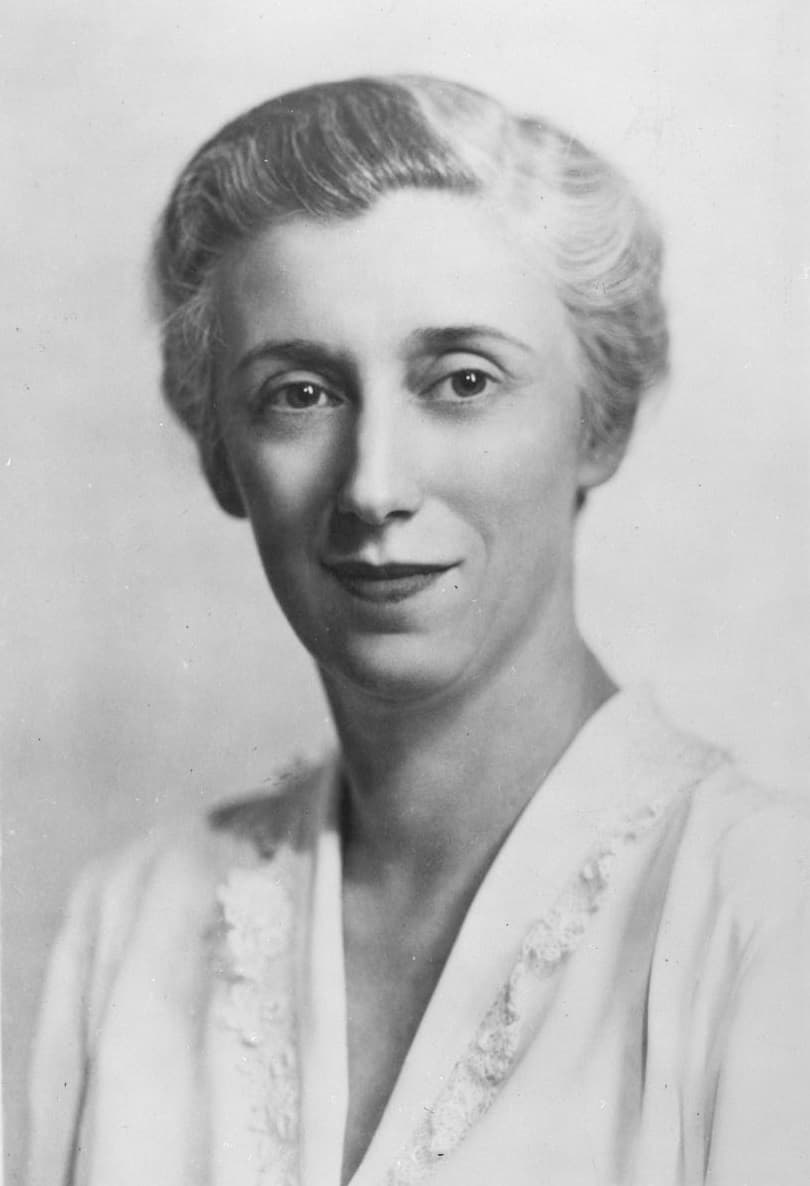
Canadian · Politics · Activism
Ellen Fairclough
January 28, 1905 – November 13, 2004
Early Life and Background
Ellen Louks Fairclough (née Cook) was born on 28 January 1905, in Hamilton, Ontario, Canada.[3][4] She was the third of five children of Norman Ellsworth Cook, a farmer who later struggled financially, and Nellie Bell (Loucks) Cook
Fairclough attended public schools in Hamilton, but her formal education was limited. One account notes that she left school around grade eight, entering the workforce at age twelve to help support her family.[1] Another source records that she attended school until age sixteen, leaving after her father’s farm failed.[4] Despite the discrepancy in exact schooling level, all sources agree that she did not complete high school and that her early departure from education reflected both economic necessity and the constraints faced by girls in the early 20th century.[1][4] Growing up in Hamilton at a time when women lacked federal voting rights—Canadian women would only gain the federal franchise in 1918—Fairclough experienced first‑hand the exclusion of women from formal political power.[1] This context, combined with her family’s financial challenges, contributed to her commitment to practical self‑reliance and later to her advocacy for equal opportunities for women and working people. After leaving school, Fairclough worked in a series of jobs, including clerical and office positions, reflecting the limited employment paths open to young women.[4] She eventually trained as an accountant, joining a brokerage firm as an accounting professional.[4] When her employer closed in 1935, she demonstrated entrepreneurial resolve by starting her own accounting and tax service in Hamilton.[4] Her success in founding and running an accounting firm was notable at a time when few women were recognized as professionals in finance. Sources from the Diefenbaker Canada Centre state that she became one of the first female certified accountants in Canada, highlighting the pioneering nature of her business career.[1][9] Her background in accounting would later underpin her credibility on fiscal and administrative issues in municipal and federal politics. Fairclough’s early civic engagement was extensive. Before entering federal politics, she held executive positions in organizations such as the Consumers’ Association of Canada, the Girl Guides, the Imperial Order Daughters of the Empire, and Zonta International, a professional women’s service organization.[1] These roles built her leadership skills, expanded her networks, and established her as a visible figure in community affairs. Her husband, David Henry Gordon Fairclough, owner of a printing business, played a significant role in introducing her to formal politics.[4] The pair married on 28 January 1931 in Hamilton, a date noted as coinciding with her 26th birthday.[4] They had one son, David Fairclough.[4] The family’s business connections to local industry and media contributed to her awareness of municipal issues and political processes. Fairclough entered municipal politics in the 1940s, beginning with service on the Hamilton City Council.[2] She later became deputy mayor of Hamilton, a role through which she gained experience in budgeting, urban planning, and public works.[2] Her presence on council and in the deputy mayor’s office was significant, as relatively few women held such roles in Canadian cities at the time. During her municipal tenure, she developed a reputation for attentiveness to social‑welfare concerns and for advocating the interests of ordinary citizens. Her work at the municipal level laid the groundwork for her transition to federal politics and demonstrated that women could successfully navigate local governance structures, which were often male‑dominated and resistant to change. Fairclough’s federal political career began when she joined the Progressive Conservative Party and stood for election in the riding of Hamilton West.[1][10] On 15 May 1950, she won a by‑election, becoming the Member of Parliament (MP) for Hamilton West.[1][2] Contemporary summaries and later assessments note that she was only the sixth woman ever elected to the House of Commons of Canada.[2] This placed her among the earliest cohort of female federal legislators. As an MP, Fairclough quickly distinguished herself as an active parliamentarian. Government and commemorative sources state that she averaged approximately 150 speeches per year, addressing issues such as housing, income tax, unemployment insurance, and the status of women.[8] She introduced private members’ bills advocating equal pay for work of equal value, positioning herself as a vocal proponent of gender equality.[8] Her speeches and legislative initiatives reflected both her accounting expertise and her social‑justice concerns. She approached policy with a focus on practical reforms to improve living standards, stabilize employment, and address inequities in taxation and social insurance. Her presence in the Commons also helped normalize the participation of women in national political debates. Fairclough’s most famous breakthrough came with the 1957 federal election, which brought John George Diefenbaker’s Progressive Conservative Party to power.[3][10] When the new government was sworn in on 21 June 1957, Diefenbaker appointed her Secretary of State, making her the first woman ever to serve in the Cabinet of Canada.[1][3][7][10] The Secretary of State portfolio involved responsibilities for various administrative and cultural functions of the federal government. Her appointment broke a barrier that had existed since Confederation: until Fairclough, Cabinet had been exclusively male.[1][3] The decision signalled Diefenbaker’s willingness to recognize women’s leadership and Fairclough’s strong reputation as a capable parliamentarian. In 1958, following a Progressive Conservative landslide victory, Diefenbaker reassigned Fairclough as Minister of Citizenship and Immigration, a portfolio central to shaping Canadian identity and demographic trends.[1][3][10] As minister, she became responsible for immigration policy, citizenship matters, and aspects of refugee policy during a period of significant international migration and decolonization. In February 1958, Fairclough reached another milestone. On 19–20 February 1958, she served as Acting Prime Minister of Canada while Diefenbaker was away, becoming the first woman ever to hold the role, even on an acting basis.[1][7] For two days, she oversaw routine government business and Cabinet operations from the Prime Minister’s position. Her service as Acting Prime Minister was brief but symbolically powerful. For a country where women had only recently entered Parliament and had never held the highest executive office, Fairclough’s assumption of the role demonstrated that women could be entrusted with the full responsibilities of national leadership.[7] It underscored her colleagues’ confidence in her judgment and administrative skill. Media retrospectives and later documentaries produced by institutions such as CBC have highlighted those two days as a pivotal moment in Canadian political history, showcasing Fairclough’s composure and capability in a role long presumed to be the preserve of men.[7] As Minister of Citizenship and Immigration, Fairclough oversaw significant policy changes. One of the most consequential occurred on 19 January 1962, when she introduced new immigration regulations that removed formal racial discrimination from Canada’s selection criteria.[1][10] These regulations dismantled key elements of the informal "white Canada" policy, which had historically favoured white immigrants from Britain, Western Europe, and the United States while restricting arrivals from Asia, Africa, and other regions. The 1962 reforms broadened admissibility for non‑European immigrants and refugees, shifted emphasis toward skills and family relationships, and made Canada’s immigration system more consistent with emerging international norms of non‑discrimination.[1][10] Fairclough also worked on policies to open Canada’s doors to certain American immigrants, to improve refugee treatment, and to extend the federal vote to Indigenous peoples, although specific legislative steps on Indigenous enfranchisement involved multiple actors and subsequent measures.[10] Historians and commentators credit her ministerial leadership with helping to transform Canada from a predominantly Eurocentric destination into a more diverse and pluralistic society. The regulations she introduced marked a decisive move towards a modern immigration framework that would later evolve into the points system and align with multiculturalism.[1][10] Following her tenure as Minister of Citizenship and Immigration, Fairclough later served as Postmaster General, expanding her experience across different areas of federal administration.[4][5] In this role, she oversaw aspects of Canada’s postal system during a period of modernization and expansion. Despite her accomplishments, Fairclough’s political career in Parliament came to an end after the 1963 federal election, when Diefenbaker’s Progressive Conservative government was defeated and she lost her seat.[4][10] Her parliamentary service had spanned thirteen years, from 1950 to 1963.[3] Although she no longer held elected office, she continued to engage vigorously in public life. After leaving Parliament, Fairclough returned to the private sector and resumed her business career. She joined the Hamilton Trust and Savings Corporation, where she eventually became vice‑president, director, and secretary‑treasurer
She also remained active in voluntary organizations and civic groups, continuing to advocate for women’s participation in politics and public service. According to later profiles, she maintained a strong interest in women’s issues long after her parliamentary career ended.[1][8] In 1986, the Ellen Fairclough Foundation was established to support female political candidates, further institutionalizing her commitment to women’s representation in public life.[10] The foundation reflected recognition of her role as a trailblazer and sought to ensure that future generations of women could follow her path into elected office. Fairclough documented her life and career in her memoir Saturday’s Child: Memoirs of Canada’s First Female Cabinet Minister, published in the 1990s.[12] In this work, she recounted her early life, her struggle to establish herself as a businesswoman, and her experiences as a Progressive Conservative MP for Hamilton West from 1950 to 1963.[12] The memoir has become an important primary source for historians studying women’s political history in Canada and provides insight into the personal dimensions of her public career. Over the course of her life, Fairclough received numerous honours. She was appointed an Officer of the Order of Canada and later promoted to Companion of the Order of Canada, with one parliamentary heritage source noting her appointment as Companion occurred two years after she received the "Right Honourable" title.[5][8] Although the exact date of her Companion appointment in 1994 is not specified in the available excerpt, it reflects recognition of her national significance. On 1 July 1992, Queen Elizabeth II formally granted Fairclough the honorific title "Right Honourable" in recognition of her service, including her time as Acting Prime Minister.[1][5][9] Traditionally reserved for prime ministers and a small number of distinguished Canadians, this title placed her symbolically among the country’s highest public figures. Government commemorations note that she also received a Governor General’s Award in Commemoration of the Persons Case, reflecting her contribution to advancing women’s legal and political equality.[8] She was further honoured through artistic and philatelic tributes, including a bust in the heritage collection of the House of Commons and commemorative philatelic items referencing her career.[5][14] Institutional profiles produced by the Government of Canada and other organizations consistently emphasize her pioneering status as the first woman in the federal Cabinet and first female Acting Prime Minister, highlighting her as one of Canada’s most prominent female politicians.[8] Fairclough’s personal life intertwined closely with her public career. Her marriage to David Henry Gordon Fairclough in 1931 provided both emotional support and political encouragement, as he was active in local business and helped introduce her to political networks.[4] Their son, David, grew up during the period when she was balancing business responsibilities, voluntary work, and eventually elected office. Despite the demands of politics, Fairclough maintained strong ties to Hamilton and the surrounding area, living there throughout her life. Her working‑class upbringing and ongoing residence in an industrial city contributed to her grounding in the everyday concerns of constituents and reinforced her orientation toward practical socioeconomic issues rather than purely ideological debates. Fairclough’s legacy rests on three interconnected pillars: gender equality in politics, modernization of immigration policy, and the expansion of women’s civic engagement. First, as Canada’s first female federal Cabinet minister and first female Acting Prime Minister, she broke institutional barriers and altered public perceptions of women’s leadership capacity.[1][3][7][10] Her presence at the Cabinet table and in the Prime Minister’s office demonstrated that women could occupy the highest executive roles, contributing to a gradual normalization of female ministers and, later, party leaders and premiers. Second, her 1962 immigration reforms helped dismantle racially discriminatory policies and opened the door to a more diverse Canada.[1][10] These changes have been recognized as foundational in the evolution of Canadian immigration policy toward non‑discrimination and pluralism, with lasting demographic and cultural consequences. Third, Fairclough’s ongoing advocacy for women’s participation in politics and her support for equal‑pay legislation underscored her commitment to substantive gender equality.[8] The establishment of the Ellen Fairclough Foundation and later commemorations by the Government of Canada and other institutions have reinforced her status as a role model for women seeking elected office.[8][10] Institutions such as the Diefenbaker Canada Centre, the House of Commons heritage program, and federal departments have produced exhibits and profiles highlighting her contributions, ensuring that her story remains part of Canada’s official historical narrative.[1][5][8][9] In her later years, Fairclough remained engaged with public affairs, writing, speaking, and participating in civic events. She lived long enough to witness dramatic changes in the political landscape she had helped shape, including the increased presence of women in Cabinet, in party leadership, and in provincial and territorial governments. Fairclough died on 13 November 2004 in the Hamilton area (reported as Hamilton or nearby Dundas), Ontario, at the age of ninety‑nine.[1][3][13] Her death occurred just weeks before her 100th birthday, and obituaries emphasized her pioneering role in national politics and her contributions to immigration reform and women’s equality. After her death, assessments of her career continued to underscore the significance of her achievements relative to the constraints of her time: limited education, pervasive gender bias, and a political culture initially skeptical of women’s leadership. By overcoming these obstacles, Fairclough left a lasting imprint on Canadian public life and became a central figure in the historiography of women in politics. Today, she is remembered as a trailblazing politician, a reform‑minded minister, and a symbol of the possibilities opened when women move from the margins to the centre of political power.[1][3][8][10]Career Beginnings and Development
Entry into Municipal Politics
Election to the House of Commons
First Woman in the Federal Cabinet
First Female Acting Prime Minister
Immigration and Citizenship Reforms
Later Cabinet Roles and Parliamentary Defeat
Post‑Political Career and Business Activities
Publications and Memoirs
Awards, Honours, and Recognition
Personal Life
Legacy and Historical Impact
Later Life and Death
Dated achievements
8 indexed.
- Jan281905Politics
Birth of Ellen Louks Fairclough
Ellen Louks Fairclough was born in Hamilton, Ontario, on January 28, 1905, the future first woman appointed to Canada's federal Cabinet.
View details The Canadian Encyclopedia: Ellen Fairclough - May151950Politics
Elected to the House of Commons
Fairclough won a Hamilton by-election on May 15, 1950, becoming just the sixth woman ever elected to the Canadian House of Commons.