← All women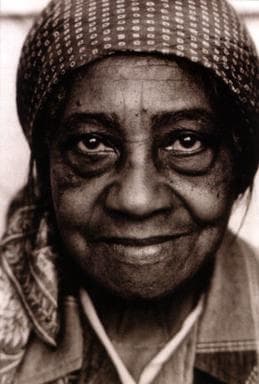
American · Arts
Elizabeth Cotton
January 5, 1893 – June 29, 1987
Early Life and Background
Elizabeth "Libba" Cotten was born on January 5, 1893, in Carrboro, near Chapel Hill, in Orange County, North Carolina. Some secondary sources give her birth year as 1892 or 1895, but January 5, 1893 is the most consistently documented date across reliable references. She was born into a working-class African American family in the rural post-Reconstruction South, a time and place marked by deep racial segregation, limited educational opportunity, and severe economic constraints for Black families.
Cotten's musical gift emerged early. She began playing her older brother's banjo as a young child, and by around age eight or nine had saved enough money from domestic work to purchase her own guitar for around 75 cents. Being left-handed, but having only access to guitars strung for right-handed players, Cotten developed a completely self-taught and highly unusual playing technique: she played the guitar upside down and backward, essentially playing bass lines with her fingers rather than her thumb, and melody with her thumb rather than fingers—the reverse of standard fingerstyle guitar technique. This method, later known as "Cotten picking," produced a syncopated, propulsive alternating bass sound that became instantly recognizable and enormously influential.
By the time she was a preteen, Cotten had already written what would become her most famous composition, "Freight Train," inspired by the sound of nearby trains. She received almost no formal education, having to leave school early to work, and her musical knowledge was entirely self-taught, absorbed from the sounds of her environment and community.
Early Adulthood and Withdrawal from Music
Cotten married young, around age fifteen, to Frank Cotten, and the couple had a daughter, Lily. Her responsibilities as a wife, mother, and domestic worker largely displaced music from her life for decades. Like many working-class Black women of her generation, she found her economic survival dependent on domestic labor—cooking, cleaning, and childcare work for white families—which left little room for a public musical career. She also became involved with a Baptist church community, and for a significant period she set aside secular music, considering it incompatible with her religious life.
For roughly 25 years, Cotten's guitar playing remained a private, largely unknown talent, confined to her home and community rather than any public stage. This extended period of musical silence makes her eventual rediscovery and later fame all the more extraordinary.
Rediscovery by the Seeger Family
Cotten's re-emergence as a musician came about through a now-famous chance encounter. In the early 1940s (some sources place the pivotal moment later, in the 1950s), Cotten was working as a domestic servant for the family of the folk-song collector Charles Seeger and his wife, composer Ruth Crawford Seeger, in Washington, D.C. Their children included Mike Seeger and Peggy Seeger, both of whom would go on to become significant folk musicians and collectors in their own right.
According to popular accounts, young Mike Seeger overheard Cotten playing guitar at home, immediately recognizing her exceptional and highly unusual technique. This "rediscovery" set in motion Cotten's return to public musicianship after decades away. The Seeger family encouraged her to perform and helped facilitate her entry into the burgeoning American folk music revival scene of the late 1950s.
Career Revival and Rise to Prominence
Cotten's first widely recognized commercial recording session took place around August 9, 1958, with members of the Seeger family, capturing her guitar playing and repertoire, including an early rendition of "Freight Train." She formally registered the copyright for "Freight Train" on November 3, 1958, an important act of self-advocacy at a time when the song had already begun to circulate—and be claimed by others—within folk revival circles without her credit or compensation.
Around April 11, 1959, recordings from these sessions were issued more widely, helping establish Cotten's reputation as a rediscovered elder master of American folk guitar. Her music reached new audiences hungry for what was perceived as "authentic" American folk tradition amid the burgeoning folk revival movement centered in cities like New York City and college towns across the country.
Cotten began performing publicly at folk clubs, coffeehouses, and festivals in her sixties—an extraordinarily late start for what would become a celebrated performing career spanning nearly three more decades. Her appearance at the Newport Folk Festival around October 31, 1960 was a significant milestone, placing her before one of the most prominent folk audiences in the country alongside emerging and established stars of the era.
On February 1, 1967, Cotten received recognition from the National Folk Festival, honoring her contribution as an important bearer of traditional American musical forms. Throughout the 1960s and 1970s, she toured extensively, performed at colleges and folk festivals nationwide, and became an important mentor and influence to younger folk and blues guitarists, who studied and adapted her unique fingerpicking style.
Major Works and Signature Song
"Freight Train" remains Cotten's best-known and most enduring composition. Written when she was a young teenager, the song traveled widely through folk circles in the 1950s and 1960s, recorded by numerous other artists including Peter, Paul and Mary, and adapted into different genres. Its instantly memorable melody and rolling, train-like guitar rhythm made it a folk standard, and Cotten's copyright registration ensured she received proper credit and royalties for a song that had nearly slipped from her control.
Beyond "Freight Train," Cotten's repertoire included a mix of original compositions, traditional songs, and blues and ragtime-influenced pieces, all filtered through her idiosyncratic guitar technique. Albums such as Freight Train and Other North Carolina Folk Songs and Tunes (1958) and later live recordings showcased both her musicianship and her warm, engaging stage presence as a storyteller and performer.
Awards and Honors
The pinnacle of Cotten's formal recognition came late in her life. On April 15, 1984, at the 26th Annual Grammy Awards, she won the Grammy Award for Best Ethnic or Traditional Recording for her album Elizabeth Cotten Live! She was 91 years old at the time, making this a remarkable late-career triumph that brought her music back into the national spotlight and validated a lifetime of self-taught musical artistry.
In subsequent decades, her legacy continued to be honored posthumously. She was inducted into the North Carolina Music Hall of Fame in 2019, recognizing her North Carolina roots and enduring contribution to American music. In 2022, she was inducted as an Early Influencer into the Rock and Roll Hall of Fame, a testament to her outsized influence on generations of guitarists across folk, blues, and rock genres, despite her music predating rock and roll itself.
Personal Life
Cotten married Frank Cotten as a teenager and had one daughter, Lily. Her family life and decades of domestic work shaped much of her early and middle adulthood, during which her musical talents remained largely private. She was known in her later years for her warmth, humility, and generosity as a mentor to younger musicians who sought her out to learn her distinctive playing style directly.
Legacy and Historical Impact
Elizabeth Cotten's influence on American guitar music is difficult to overstate. Her self-developed "Cotten picking" technique—playing a right-handed guitar upside down and backward as a left-handed player—produced a syncopated alternating bass style that has been studied, taught, and adapted by countless guitarists across folk, blues, bluegrass, and rock traditions. Her story also stands as a powerful example of overlooked and marginalized artistic talent, particularly among working-class Black women, finally receiving recognition after decades of obscurity.
Her rediscovery narrative—found while working as a domestic servant for a family that would help launch her to national acclaim—has become an emblematic story of the American folk revival's complex relationship with vernacular, often racially marginalized musical traditions. Cotten's life illustrates both the loss inflicted by systemic barriers that kept talented artists like her out of public view for decades, and the possibility of ultimate recognition and legacy against those very barriers.
Later Life and Death
Cotten continued performing into her nineties, remaining active in the folk music community until shortly before her death. She died on June 29, 1987, in Syracuse, New York, at the age of 94. Her death was mourned as the loss of a foundational link to older American vernacular guitar traditions, but her influence has only grown in the decades since, cementing her place as one of the most important and inspiring figures in the history of American folk music.
Dated achievements
9 indexed.
- Jan051893Arts
Birth of Elizabeth “Libba” Cotten
Elizabeth Cotten was born in Carrboro near Chapel Hill, North Carolina, on January 5, 1893.
View details Wikipedia - Aug091958Arts
First Commercial Recording Session
Cotten made her first commercial recording session with the folk group the Seegers on August 9, 1958.