← All women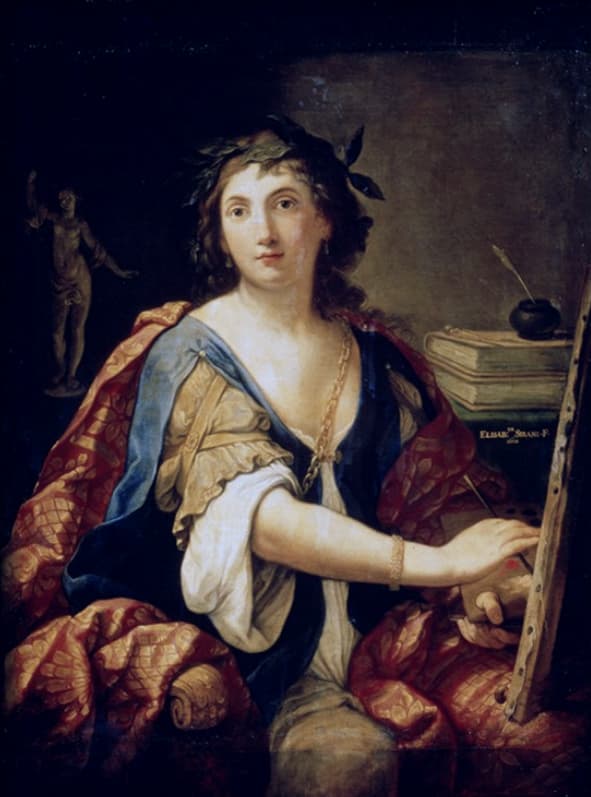
Italian · Arts
Elisabetta Siriani
January 8, 1638 – August 28, 1665
Early Life and Background
Elisabetta Sirani was born on 8 January 1638 in Bologna, then part of the Papal States, a city renowned for its university, intellectual life, and comparatively progressive attitudes toward women’s education.[1][7][14][16] She was the eldest of four children of Giovanni Andrea (Gian Andrea) Sirani, a painter and art dealer closely associated with the Bolognese school and the legacy of Guido Reni, and his wife Margherita.[1][9][19] Growing up in this environment meant that art was not an abstraction but a daily practice, with canvases, pigments, and clients forming the fabric of her childhood.
Giovanni Andrea had been a follower and popularizer of Guido Reni’s clear, luminous style, and he maintained a workshop that engaged with major trends in mid‑seventeenth‑century religious and historical painting.[2][9] Although women were generally excluded from formal academy training in the arts, the family workshop provided a rare pathway for a daughter to gain systematic instruction. Contemporary biographer Carlo Cesare Malvasia, in his compendium of Bolognese artists, emphasizes that Elisabetta began drawing very young and quickly displayed extraordinary skill, prompting her father to nurture her talent despite prevailing social norms.[18]
Bologna itself played a crucial role in shaping Sirani’s trajectory. The city had a long tradition of celebrated women—university professors such as Laura Bassi and artists such as Lavinia Fontana—who were exceptions within broader European patterns.[16][18] This local culture made it at least conceivable that a woman might pursue public artistic work. Within this context, Sirani’s early aptitude was more likely to be recognized and supported than in many other Italian centers.
Artistic Training and Formative Influences
Sirani’s artistic education took place largely within her father’s studio. She learned drawing, composition, and the handling of oil paint, as well as printmaking techniques such as etching.[1][10] Her style initially reflected the influence of Guido Reni, whose idealized, graceful figures and luminous coloring dominated Bolognese taste. Over time, however, she developed a more incisive line and richer chromatic range, distinguishing her work from her father’s and demonstrating an independent eye.[2]
Like other artists of the Bolognese school, she studied classical antiquity and the works of contemporary masters. Through her father’s connections as a painter and dealer, she had access to paintings, prints, and drawings circulating in Bologna, which exposed her to broader Italian trends.[2][9] Malvasia praises her diligence, noting that she constantly drew from life and from existing artworks, building a vast repertoire of figures and motifs.[18]
Despite lacking official academy training, Sirani acquired skills equal to those of her male peers. Her ability to master complex historical and religious subjects, manage large compositions, and execute them swiftly later impressed patrons and observers. The barriers she faced—especially exclusion from institutional teaching—make her technical proficiency and professional success particularly significant in the history of women’s art.
Career Beginnings and Development
Sirani began receiving commissions while still in her teens. Around the early 1650s, she painted a Baptism of Christ for the Campo Santo in Bologna, intended as a companion piece to a work by her father.[2] This commission is often cited as the starting point of her independent career, showing that patrons were willing to entrust important religious imagery to a young woman.
Throughout the 1650s she emerged as one of the first successful women artists in early modern Bologna, producing both public altarpieces and private devotional paintings despite not entering the formal art academy.[1][10] By her late teens she was already working with considerable autonomy, and written records indicate that by nineteen she functioned as an independent painter who effectively ran the family workshop.[4][16]
A key milestone came on 28 February 1657, when Sirani received her first major public commission from Daniele Granchi, prior of the Carthusian church of the Certosa di Bologna.[3] This commission for an important altarpiece signaled her acceptance into the highest levels of local patronage normally reserved for established male masters. It also consolidated her economic position, as she began to support her parents and siblings through her artistic income.[4]
Over roughly a decade of activity, from the mid‑1650s to her death in 1665, Sirani built a remarkably productive studio. Sources estimate that she created around 200 paintings, along with approximately 15–20 prints and hundreds of drawings.[1][4][16][18] Her workshop handled commissions from religious institutions, aristocratic patrons, and collectors in Bologna and beyond, giving her an international reputation while she was still very young.
Major Works and Artistic Themes
Sirani’s oeuvre spans religious, mythological, and allegorical subjects, as well as portraits. Her altarpieces and devotional works often depict scenes from the life of Christ, the Virgin, and saints, rendered with a blend of Reni‑inspired elegance and her own more robust drawing and color.
Among her notable works is Battesimo di Cristo (Baptism of Christ), dated 1658 in the Certosa of Bologna, which showcases her technical assurance and the influence of Reni’s serene style.[2] Later works, such as St. Francis (1664, Galleria Estense, Modena) and Madonna and Child (1664, Museo Civico, Pesaro), reveal a growing interest in luminous effects and a more complex treatment of light, influenced by artists like Francesco Torri and Carlo Cignani.[2]
Her portraits and mythological paintings display a sophisticated understanding of character and narrative. She frequently depicted strong female figures from scripture and classical mythology, such as Judith or Cleopatra, which later commentators have seen as resonant with her own position as a woman asserting authority in a male‑dominated field.[16] Her images of the Holy Family and the Virgin and Child were particularly admired and helped to secure her fame among religious patrons.[4]
Sirani was also a skilled printmaker. Her etchings and engravings allowed wider dissemination of her compositions and demonstrated her versatility across media. The combination of paintings, prints, and drawings contributed to a reputation for virtuosity; contemporaries described her as a "prodigy of art" and praised the speed with which she could execute complex works without sacrificing quality.[17][18]
Studio Leadership, Teaching, and Institutional Recognition
One of Sirani’s most significant contributions was her role as a teacher and mentor. During the 1650s and 1660s she established a form of academy or studio for girls and women in Bologna.[1][16][18] Within this space she trained female students, including family members such as Barbara Sirani, and other aspiring women artists. This initiative made her a pioneer in women’s artistic education, providing structured training at a time when formal academies barred women from joining life‑drawing classes and most professional instruction.
Sirani’s studio combined production and pedagogy. She supervised commissions while instructing students in drawing, painting, and printmaking, thereby creating a small but influential network of women artists who could share techniques and support each other’s careers. Her efforts expanded the number of professionally active women in Bologna and reinforced the city’s reputation as a haven for learned women.[16]
In addition to her local influence, Sirani is widely recognized as one of the first women admitted as a member of the Accademia di San Luca in Rome, one of Italy’s most prestigious artistic institutions.[5][18] Membership in the academy was a notable mark of status, and women’s inclusion was rare. Although surviving sources do not record the exact date of her admission, the fact itself testifies to her high standing among Italian artists and the respect she commanded beyond Bologna.
By the early 1660s, Sirani had achieved international renown as a leading figure of the Bolognese Baroque. Encyclopedic and museum sources emphasize that she was regarded as one of the foremost Bolognese artists of her time, with her portraits, mythological scenes, and Marian images attracting patrons from other Italian cities and abroad.[2][4][16]
Awards, Honors, and Contemporary Reception
While formal awards in the modern sense were uncommon in the 17th‑century art world, Sirani received substantial honor through critical acclaim and patronage. Carlo Cesare Malvasia famously described her as "la gloria del sesso donnesco"—"the glory of the female sex"—underscoring his view that she exemplified women’s potential in the arts.[18] Other contemporaries praised her as "the best brush in Bologna," a phrase that encapsulated her artistic preeminence in a city with many distinguished painters.[17]
Her commissions from major religious institutions and elite patrons functioned as de facto honors. Being chosen to paint altarpieces for prominent churches and to provide works for influential families signaled high esteem. Her admission to the Accademia di San Luca, as later reported by art‑historical sources, further confirmed her status within the broader Italian artistic community.[5]
After her death, the extensive public funeral and memorial service held on 13 September 1665 served as a civic honor.[1] Such ceremonies were typically reserved for figures of considerable importance. The presence of leading citizens and artists, and the commissioning of commemorative writings, demonstrate the magnitude of respect she commanded at only twenty‑seven.
Personal Life
Compared with the rich documentation of her artistic career, relatively little is known about Sirani’s private life. Sources agree that she never married and had no children, an unusual choice in a period when marriage was the expected path for women.[18] Remaining unmarried allowed her to devote herself fully to her art and to the management of her workshop, but it also meant that her economic security depended entirely on her professional success.
Her role within the family was distinctive. By her early twenties she had become the primary breadwinner, supporting her parents and siblings through the income from her commissions.[4][18] This reversal of conventional gender roles—where a daughter rather than a father or husband provided for the household—highlights both her commercial success and the weight of responsibility she carried.
Accounts of her character emphasize diligence, modesty, and piety, alongside an intense work ethic. Malvasia and later writers portray her as deeply committed to her craft, sometimes working to the point of physical exhaustion.[18] These traits contributed to her achievements but may also have played a role in the health problems that led to her early death.
Later Life and Mysterious Death
In her final years, Sirani continued to produce major works and to refine her style, incorporating more dramatic lighting and a broadened palette influenced by contemporaries such as Francesco Torri and Carlo Cignani.[2] She remained at the center of Bologna’s artistic life, with a steady flow of commissions and students.
On 28 August 1665, she died suddenly in Bologna at the age of twenty‑seven.[1][7][12][14] Her unexpected death provoked immediate rumors of poisoning and murder, reflecting both the shock of her loss and the broader fascination with dramatic causes of death among early modern observers.[17] An investigation and legal proceedings followed, eventually concluding that she had died from a ruptured gastric or peptic ulcer leading to peritonitis.[14][15]
Several sources emphasize that her intense workload and stress may have contributed to this condition. As she managed a bustling workshop, fulfilled numerous commissions, and supported her family, she worked long hours with little rest.[4][14][16] The trial’s final judgment, attributing her death to natural causes linked to ulceration rather than to poisoning, did not entirely dispel the aura of mystery, but it underscored the physical cost of relentless artistic labor.
Her death marked the abrupt end of an extraordinary career. Within about a decade, she had achieved a level of productivity and recognition that many artists only reach over much longer lifespans.
Public Funeral and Immediate Commemoration
Just over two weeks after her death, on 13 September 1665, Bologna honored Sirani with a lavish public funeral and memorial service.[1] The ceremony, attended by prominent citizens, clergy, and artists, took place in a major church and featured formal eulogies celebrating her virtues and talents.
This event signaled that the city recognized her loss as not merely personal or familial but civic and cultural. The scale of the funeral, unusual for a young woman, reflected her status as one of Bologna’s leading painters and as a symbol of the possibilities open to women in art.[1][17] The public mourning also prompted written tributes, including Malvasia’s account, which preserved details of her life, works, and teaching practice.
The 13 September memorial thus occupies a crucial place in her story: it ensured that her achievements would not vanish with her death but would be recorded, discussed, and transmitted to future generations. In this sense, the funeral was both an end and a beginning—the closure of her brief life and the start of her long posthumous presence in art history.
Legacy and Historical Impact
Elisabetta Sirani’s legacy operates on several levels: as a Baroque master, as a pioneer among women artists, and as a teacher who created space for women’s artistic training. Her body of work, numbering around 200 paintings and numerous prints and drawings, places her among the most productive artists of her generation, irrespective of gender.[1][4][16]
Art historically, she is recognized as a key figure in the later phase of the Bolognese school. Her synthesis of Guido Reni’s elegance with her own incisive drawing and evolving interest in light helped to carry the style forward into the later 17th century.[2] Works such as her Baptism of Christ, her altarpieces, and her luminous Marian images are now held in major collections and continue to attract scholarly attention.[2][15]
From the perspective of women’s history, Sirani’s career is particularly significant. She was one of the first women to achieve sustained professional success as a painter in early modern Bologna, securing public commissions, running a workshop, and gaining international renown at a time when institutional barriers severely restricted women’s participation in the arts.[1][10][16][18] Her role as head of the family workshop and primary breadwinner challenged conventional gender roles and demonstrated that a woman could be both artist and entrepreneur.
Her women‑only academy or studio further amplifies her importance. By training other women—among them Barbara Sirani and additional female pupils—she did not simply succeed individually; she actively expanded the opportunities available to others.[1][16][18] In this respect, she stands as a precursor to later initiatives aimed at creating educational institutions for women, and her example is frequently cited by modern museums and scholars highlighting neglected women artists.[4][15][16]
Institutionally, her reported admission to the Accademia di San Luca in Rome marks her as one of the first women to break into a prestigious male‑dominated artistic body.[5][18] Even though documentation of the exact date is incomplete, the recognition itself underscores her standing in the Italian art world.
Modern scholarship and exhibitions have helped restore Sirani to prominence. The Uffizi Galleries have organized exhibitions focusing on her talent and contributions to the Bolognese Baroque, while the National Museum of Women in the Arts and other institutions have featured her in publications and programs dedicated to women artists.[4][15] Articles, encyclopedic entries, and online resources now present her as a key figure in both Baroque art and women’s cultural history.
In contemporary discourse, Sirani exemplifies the challenges and possibilities faced by women in early modern Europe. Her life demonstrates that, even under substantial constraints, women could achieve artistic mastery, lead workshops, mentor others, and reshape professional norms. Her early death adds a note of tragedy, inviting reflection on the physical and emotional demands placed on artists, particularly those bearing heavy familial and economic responsibilities.
Today, her paintings, prints, and the story of her career continue to inspire scholars, curators, and artists interested in the intersections of gender, creativity, and institutional power. As a result, Elisabetta Sirani occupies a secure place in the editorial almanac of women’s history: a brilliant Bolognese virtuosa whose achievements and teaching helped widen the path for generations of women artists to follow.
Dated achievements
4 indexed.
- Jan081638Arts
Birth in Bologna
Elisabetta Sirani was born in Bologna, Papal States, into the family of painter Gian Andrea Sirani, beginning her path in Bolognese Baroque art.
View details Elisabetta Sirani - Wikipedia - Feb281657Arts
First major public commission in Bologna
At age nineteen, Sirani received her first major public commission in Bologna from Daniele Granchi, prior of the Certosa di Bologna, launching her professional reputation.