← All women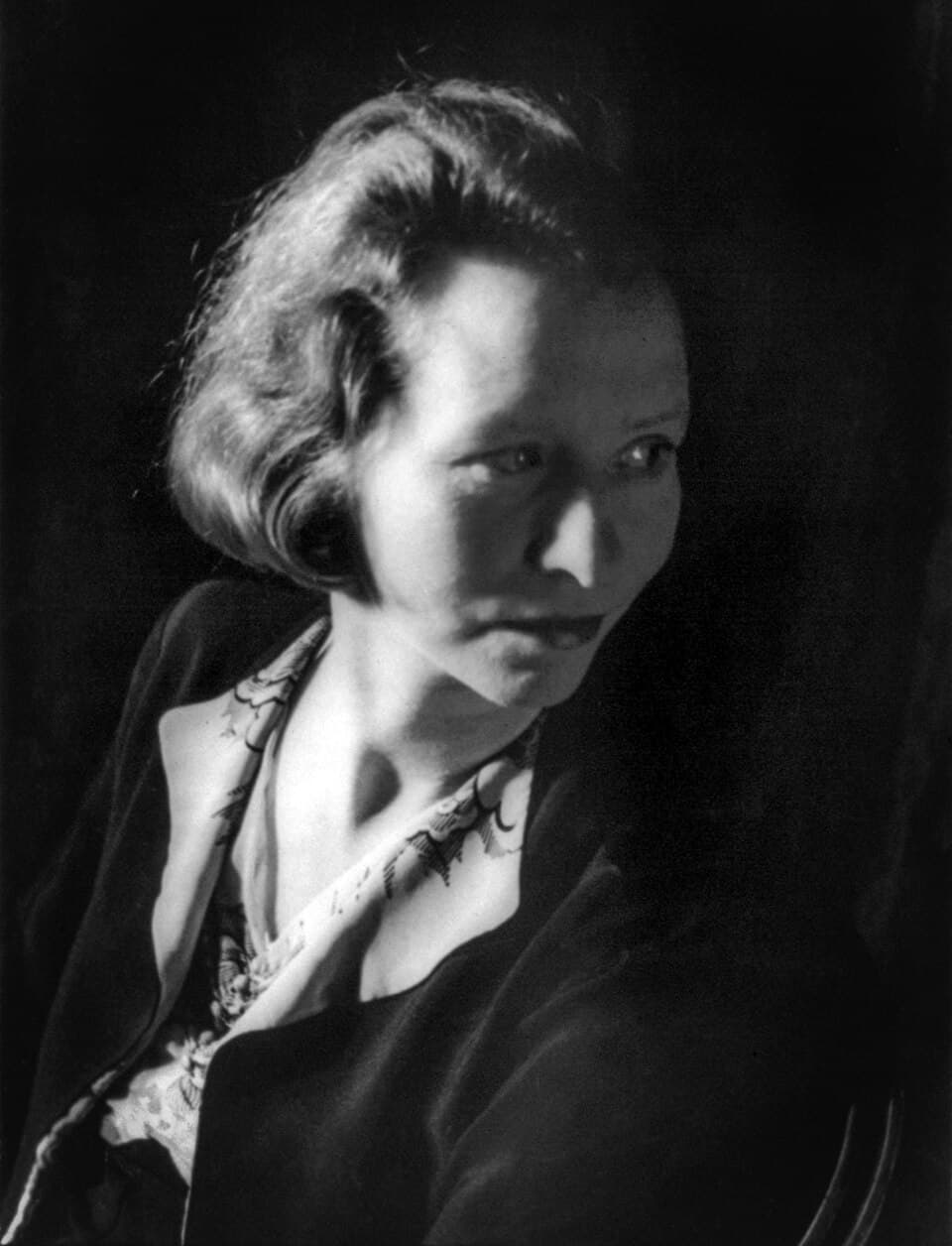
American · Literature · Arts
Edna St. Vincent Millay
February 22, 1892 – October 19, 1950
Early Life and Background
Edna St. Vincent Millay was born on 22 February 1892 in Rockland, a coastal town in Maine, United States.[2][3][11] She was the first of three daughters born to Cora Buzzell Millay, a nurse, and Henry Tolman Millay, a teacher and later an insurance worker.[1][11][15] The family’s financial circumstances were precarious and became more difficult after her parents’ troubled marriage ended in separation and eventual divorce around 1900, when Edna was still a child.[1][11][15] Cora largely raised Edna and her sisters, Norma and Kathleen, on her own in nearby Camden, Maine, working as a private duty nurse and sometimes traveling for employment.[1][7][11]
The poet’s distinctive middle name, St. Vincent, commemorated the St. Vincent Hospital in New York City where Cora’s brother had received life‑saving treatment, a fact that Millay herself sometimes cited as emblematic of her family’s sense of gratitude and drama.[3][11] From an early age she was called "Vincent," a gender‑ambiguous nickname that suited her later insistence on independence and unconventional presentation.[6][11]
Cora Millay played a central role in fostering her daughter’s literary talents. Despite poverty, she filled the home with books and encouraged Edna to read widely in the Bible, Shakespeare, the English romantics, and classical mythology.[7][11][13] Edna learned to play piano, participated in local theatricals, and began writing poetry in childhood, winning small local prizes by her teens.[7][12][19] She also took on substantial domestic responsibilities—keeping house and caring for her younger sisters—while experimenting with persona and performance in school and community productions.
Millay attended public schools in Camden and graduated from Camden High School in 1909.[11] During these years she began publishing poems in regional magazines and newspapers, developing an early reputation for precocious brilliance and a streak of rebellion that would characterize her life and work.[7][12] The rocky coast and changing seasons of mid‑coast Maine later provided the vivid natural imagery and sense of spiritual vastness that animate early masterpieces such as “Renascence.”[9][12]
Career Beginnings and Breakthrough with “Renascence”
Millay’s literary career effectively began in her late teens and early twenties, as she intensified her writing while the family continued to struggle economically. In 1912 she submitted the long poem “Renascence” to a national poetry contest sponsored by the anthology The Lyric Year.[3][9][13] Though the editors awarded it only fourth place, many readers and commentators regarded it as the strongest poem in the volume, and the controversy surrounding the contest brought Millay national attention.[3][9] The poem’s expansive treatment of spiritual crisis, death, and rebirth on a Maine hilltop showcased her technical skill with traditional meter and rhyme as well as her arresting lyric voice.
Among those impressed was the wealthy arts patron Caroline B. Dow, who helped secure Millay a scholarship to Vassar College
Immediately after Vassar, Millay moved to New York City, settling in Greenwich Village, which was emerging as a center of bohemian and radical culture in the 1910s and 1920s.[2][3][12] There she supported herself through writing, acting, and occasionally editing, while immersing herself in the city’s avant‑garde theater and political circles. She contributed poems and prose to magazines such as The Masses and performed in Provincetown Players productions, honing the dramatic instincts that would shape her later verse plays.[12][14][20] Millay’s first collection, Renascence and Other Poems, appeared in 1917, gathering her breakthrough poem with other lyrics and cementing her reputation as a major new voice.[9][12] Critics praised the youthful intensity and musicality of her verse, noting her ability to combine traditional forms with modern, emotionally frank subject matter.[2][9] Her second major volume, A Few Figs from Thistles (1920), became a cultural touchstone of the 1920s.[2][9] The collection’s witty, epigrammatic poems about love, desire, and female autonomy—epitomized by lines like “My candle burns at both ends” from “First Fig”—captured the mood of the postwar generation and helped define the image of the flapper and the “New Woman.”[2][12][15] Millay’s bold exploration of sexual freedom and her refusal to apologize for women’s desires sparked controversy but also thrilled many young readers, particularly women, who saw in her work a reflection of their own aspirations. In 1921, she published Second April, a more elegiac volume that responded in part to the losses of World War I and personal grief, showcasing her mastery of the sonnet form.[9][12] During this period she also expanded into drama, writing verse plays such as Aria da Capo (1919) and The Lamp and the Bell (1921), the latter commissioned by Vassar.[2][9][12] These works used stylized dialogue and allegory to explore themes of war, greed, and loyalty, and they enjoyed successful productions on college and professional stages. Millay’s major early‑1920s collection, The Harp-Weaver and Other Poems (1923), included the title poem “The Ballad of the Harp-Weaver,” a narrative about maternal sacrifice that resonated deeply with audiences and critics.[2][9][12] For this volume she received the Pulitzer Prize for Poetry in 1923, becoming the first woman to earn that distinction.[2][3][6][13] The award recognized both the emotional power of the book and Millay’s broader achievement in revitalizing traditional verse forms. Over the next decade, Millay’s work grew darker and more philosophically complex. The collection The Buck in the Snow (1928) introduced a more somber tone, with poems that grapple with mortality, disillusionment, and the limits of romantic love.[2][9] The sonnet sequence Fatal Interview (1931) is often considered one of her finest achievements, weaving an intricate narrative of passionate love and loss in impeccable sonnets.[9][12] In Wine from These Grapes (1934), she continued to explore themes of aging, memory, and political anxiety.[9] Millay’s talents extended to opera. In the mid‑1920s she wrote the libretto for The King’s Henchman, an opera with music by Deems Taylor that premiered at the Metropolitan Opera in 1927
Under the pseudonym Nancy Boyd, Millay also wrote short stories, essays, and other prose, choosing a pen name partly to keep this work separate from her poetry and partly to maintain a degree of privacy.[3][4][5] Her prose often carried the same wit, irony, and frank engagement with gender and sexuality that distinguished her verse. Millay’s public and critical recognition was exceptional for a poet in her era, and particularly striking for a woman writer. The pivotal honor of her career was the 1923 Pulitzer Prize for Poetry, awarded for The Harp-Weaver and Other Poems, which made her the first woman and only the second person overall to receive the prize in that category.[2][3][6][13] The award confirmed her status as the preeminent lyric poet of her generation and amplified her already considerable celebrity. In 1929, Millay was elected to the National Institute of Arts and Letters (later part of the American Academy of Arts and Letters), an honor society recognizing major contributions to American cultural life.[3][12] Her election signaled the institutional literary establishment’s acceptance of a writer whose work and lifestyle had sometimes been viewed as provocative or scandalous. Later in her career, in 1943, Millay received the Frost Medal (often called the Robert Frost Medal) for lifetime achievement in poetry from the Poetry Society of America.[3][13] She was only the sixth recipient of this distinction and the second woman to be so honored, underlining her long‑term influence on American verse. The award recognized both her early, groundbreaking lyrics and her later, more politically engaged and formally adventurous work. Beyond these formal honors, Millay’s fame in the 1920s and 1930s was extraordinary. She gave sold‑out readings, toured widely, and became something of a celebrity, often compared in the popular press to an actress or film star for the intensity of her performances and the romantic fascination she inspired.[2][12][16] Magazines profiled her, and her image—slim, red‑haired, with a dramatic sense of style—became closely associated with the era’s ideas of artistic modernity and female independence. Millay’s personal life was closely intertwined with her artistic persona. In Greenwich Village and other bohemian circles, she pursued an unconventional lifestyle that included multiple relationships with both men and women, a fact documented in her letters, diaries, and later biographies.[3][6][12][16] Scholars and contemporaries have described her as openly bisexual, and her willingness to write about desire from both perspectives challenged prevailing norms about gender and sexuality.[6][12][16] On 18 July 1923, shortly after learning of her Pulitzer win, Millay married Eugen Jan Boissevain, a Dutch‑born businessman and widower of feminist activist Inez Milholland.[3][15] Boissevain was a strong supporter of Millay’s career; he often managed household affairs and accompanied her on reading tours, encouraging her to conserve her energy and protect her health.[3][12] Their marriage, by most accounts, was affectionate but non‑monogamous, reflecting shared commitments to personal freedom.[3][6][15] The couple had no children and eventually settled at Steepletop, a former farm in Austerlitz, New York, which they purchased in the 1920s and developed into a working estate and retreat.[3][11][15] Millay’s close relationships with women—ranging from intense friendships to romantic affairs—also shaped her life and work. At Vassar and in Greenwich Village she formed deep bonds with female peers; some of these relationships informed the emotional textures of her poems and plays.[6][12][15] While the constraints of her time meant that her same‑sex relationships were not always named publicly, her work’s frank acknowledgment of women’s desire and its challenge to conventional gender roles have made her an important figure in queer literary history.[12][16] She struggled at various points with ill health and, later, with addiction to morphine and other medications following a serious automobile accident in the 1930s, which left her in chronic pain.[3][12][15] These difficulties contributed to periods of reduced productivity and withdrawal from public life, even as she continued to write and occasionally publish. Millay’s work and public statements reflected strong political convictions. In her early years in New York, she was associated with left‑leaning intellectual and artistic circles, contributing to radical magazines and opposing U.S. entry into World War I.[12][14][20] Over time, however, her positions shifted. In the 1930s and 1940s, increasingly concerned about the rise of fascism and the threat of Nazi Germany, she became a vocal advocate for Allied intervention. She wrote propagandistic poems and essays supporting the war effort, some commissioned by government‑linked organizations, and broadcast patriotic pieces on radio.[12][16] Collections such as Make Bright the Arrows (1940) and Collected Poems (1950) contain politically charged work that critics have alternately praised for its moral passion and criticized for its didacticism.[3][12] Her political evolution generated controversy. Former allies on the left accused her of abandoning pacifist and radical ideals, while more conservative commentators sometimes remained suspicious of her bohemian reputation. Nevertheless, Millay saw herself as responding to changing historical realities, and her wartime poems document the tensions many intellectuals felt as they navigated between earlier anti‑war commitments and the perceived necessity of resisting fascist aggression.[12][16][20] By the late 1930s and 1940s, Millay’s public profile had begun to wane, in part because of changing literary fashions that privileged more experimental forms of modernism over her intricate, formally traditional verse.[3][12][16] Some critics dismissed her as a relic of the 1920s or criticized what they saw as excessive emotionalism in her work. At the same time, her health was deteriorating, and she increasingly relied on alcohol and prescribed drugs to manage pain and anxiety.[3][12][15] Life at Steepletop, however, retained a measure of creative vitality. Millay continued to write poetry and prose, gardened extensively, and welcomed visitors, including younger writers and admirers.[11][16] The estate itself became a symbol of her hard‑won success: a rural refuge where she could work, walk, and reflect, far from the clamor of her earlier urban celebrity. The death of her husband, Eugen Boissevain, in 1949 was a severe emotional blow.[3][15] Friends and biographers have described her as deeply bereft in the months that followed, even as she attempted to maintain her routines and literary projects.[16][18] On 19 October 1950, she died suddenly of a heart attack at Steepletop, reportedly after working late into the night on new poems.[3][13][15] She was 58 years old. Edna St. Vincent Millay’s legacy is multifaceted, spanning literary innovation, cultural iconography, and feminist and queer history. During her lifetime, she was one of the most famous poets in America, celebrated for her charismatic readings and widely quoted for lines that entered the cultural lexicon, such as “My candle burns at both ends.”[2][9][12] Her technical mastery—particularly of the Petrarchan and Shakespearean sonnet forms—combined with a modern, often rebellious sensibility to create a body of work that is both formally traditional and thematically daring.[2][9][12] She played a key role in redefining the possibilities for women poets in the early twentieth century. As the first woman to win the Pulitzer Prize for Poetry, she broke an important barrier in the institutional recognition of women’s literature.[2][3][6][13] Her unapologetic exploration of women’s desire, her insistence on sexual and personal autonomy, and her public image as a bohemian, intellectually ambitious woman helped model new forms of female identity in the interwar period.[6][12][15] Biographer Nancy Milford famously described her as “the herald of the New Woman,” a figure whose influence extended beyond literature into social attitudes about gender and sexuality.[12][16] Millay’s reputation underwent significant shifts after her death. In the mid‑twentieth century, some critics marginalized her work in favor of more overtly experimental modernists, and her political verse from the war years was sometimes judged harshly.[3][12][16] Beginning in the 1970s and 1980s, however, feminist literary scholars and poets rediscovered her poetry and correspondence, emphasizing her importance as a pioneering woman writer and as an early, if not fully explicit, queer voice in American literature.[12][16][18] Biographies such as Nancy Milford’s Savage Beauty: The Life of Edna St. Vincent Millay, first published in 2001, and editions of her diaries and letters—such as Rapture and Melancholy: The Diaries of Edna St. Vincent Millay—have further illuminated her complex life, artistic struggles, and emotional intensity.[8][17][18] Contemporary critics and poets now view her as a central figure in the evolution of twentieth‑century lyric poetry, whose work engages deeply with questions of gender, power, and the costs of fame. Steepletop, her home in Austerlitz, has been preserved by the Edna St. Vincent Millay Society, which maintains the property, supports scholarship, and fosters public appreciation of her work.[7][11] Her birthplace in Rockland, Maine, has likewise been preserved as the Millay House Rockland, underscoring regional pride in a writer whose early landscapes shaped her imagination.[11] Her image has appeared on U.S. postage stamps and in educational curricula, and her poems continue to be widely anthologized and taught.[9][12] In sum, Edna St. Vincent Millay stands as a pivotal figure in women’s and literary history: a poet who made traditional verse newly urgent for a modern age; a woman who claimed public space, desire, and artistic authority at a time when such claims were still contested; and a cultural icon whose life story continues to resonate with readers navigating the intertwined demands of creativity, independence, and social expectation.Major Works and Artistic Development
Awards, Honors, and Recognition
Personal Life and Relationships
Political Engagement and Public Voice
Later Life and Decline
Legacy and Historical Impact
Dated achievements
4 indexed.
- Feb221892Literature
Edna St. Vincent Millay's Birth
Edna St. Vincent Millay was born on February 22, 1892, in Rockland, Maine.
View details Encyclopedia Britannica - Edna St. Vincent Millay - Apr301923Literature
Notification of Pulitzer Prize Win
Millay was notified on April 30, 1923, that she'd won the Pulitzer Prize in Poetry.