← All women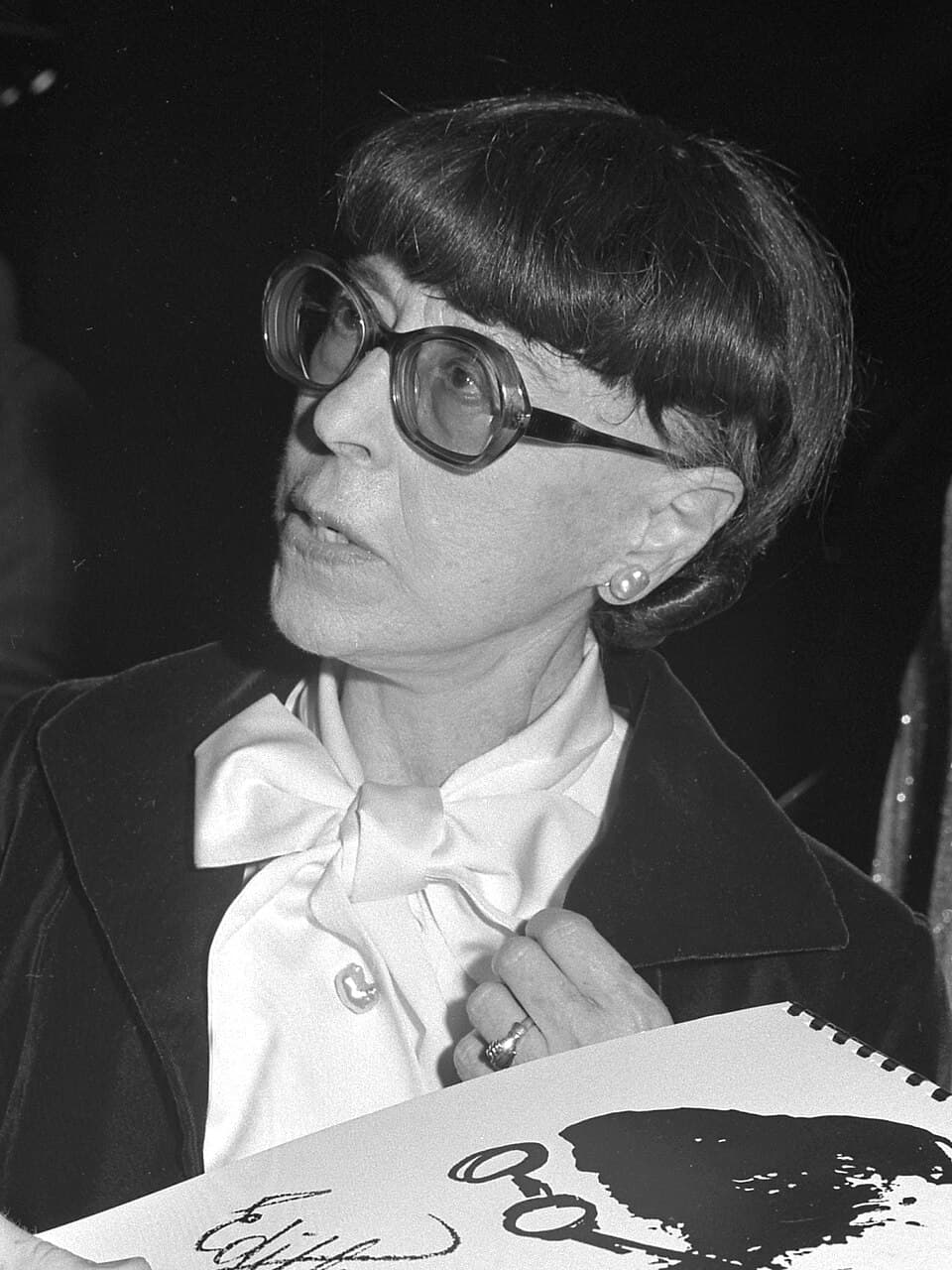
American · Arts
Edith Head
October 28, 1897 – October 24, 1981
Early Life and Background
Edith Claire Head (née Posener) was born on October 28, 1897, in San Bernardino, California, United States. She was the daughter of Max Posener, a mining engineer, and Anna E. Levy, and spent her early years in the American West at a time when the region was still being economically developed and culturally defined. Some sources note that, when she was very young, she adopted the surname of her stepfather, Spare, before later taking the name Head through marriage, reflecting the complex family dynamics that shaped her identity.
Head’s childhood and adolescence coincided with the rapid expansion of the motion picture industry in California. Although there is limited documentation about her formative artistic experiences, her later educational choices and professional trajectory suggest a strong aptitude for languages and visual expression. She attended the University of California, Berkeley, earning a Bachelor of Arts in letters and science with honors in FrenchMaster of Arts in romantic languages from Stanford University
Before entering the film industry, Head worked as a teacher of French, Spanish, and art at schools including the Bishop School for Girls in La Jolla and the Hollywood School for Girls. Teaching provided her with practical drawing experience and exposure to young women’s clothing and self-presentation, themes that would later inform her sensitivity to how wardrobe shapes identity. Her multilingual and artistic background made her a versatile candidate when she sought work beyond the classroom. Edith Head’s entry into filmmaking has often been described as a combination of ambition and audacity. In the early 1920s, she responded to an advertisement for a sketch artist position at Paramount Pictures, despite having limited formal training in fashion design. She reportedly presented borrowed sketches as her own at the interview, successfully securing employment as a sketch artist and costume illustrator. By 1923, she was working at Paramount in this capacity, beginning the studio career that would define her professional life. Initially, Head’s work involved translating designers’ ideas into drawings for directors and producers, as well as creating visual proposals for costumes. From 1924 to 1927, she continued to serve as a sketch artist, gradually learning the technical and logistical aspects of wardrobe production. In 1924, she received her first screen credit as a costume designer for the silent film Peter Pan, marking the moment when her contributions became visible to the public, even though the precise day of that recognition is not documented. A major turning point came in 1927, when Head was assigned to design costumes for Clara Bow in the film Wings. The scale and prestige of this project helped elevate her reputation within Paramount. Over the next decade, she worked closely with the studio’s leading designer, Travis Banton, acting as his assistant and learning how to manage complex productions, interact with stars, and balance artistry with budgetary constraints. By the late 1930s, Edith Head had become an indispensable figure in Paramount’s wardrobe department. Her aptitude for collaboration, reliability under pressure, and ability to satisfy both directors and stars made her a trusted professional in an industry defined by tight schedules and high expectations. In 1938, following the departure of Travis Banton, she achieved a landmark promotion: she became the head of design at Paramount, effectively leading the costume department. This appointment made her the first woman to head the costume design department of a major Hollywood studio. In that role, she supervised a large team of designers, cutters, seamstresses, and fitters, and had authority over the visual styling of dozens of annual film releases. The position required not only artistic vision but also managerial skill—allocating resources, negotiating with producers, and resolving conflicts between practical needs and creative ambitions. Head’s leadership coincided with Hollywood’s so-called Golden Age. She contributed in one way or another to hundreds of films, including genres ranging from romantic comedies and melodramas to epics, westerns, and thrillers. In 1940 alone, she reportedly supervised costumes for more than forty films, illustrating the intense workload demanded by the studio system. Her prominence within Paramount also meant that she had sustained contact with many of the era’s biggest stars, including Barbara Stanwyck, Veronica Lake, and Paulette Goddard. Edith Head’s career is best understood through her contributions to specific films and the recognition she received for them. Over the span of her working life, she secured a record 35 nominations for Academy Awards in costume design and won eight competitive Oscars. These achievements made her both the most nominated and most awarded woman in the history of the Academy Awards for much of the twentieth century. Her first Academy Award win occurred at the 22nd Academy Awards on March 23, 1950, when she received the Oscar for Best Costume Design (Black-and-White) for The Heiress. The film required detailed period costumes that conveyed class distinctions and emotional transformation, and Head’s designs were praised for their psychological nuance. This win officially validated her status as a creative leader in Hollywood, not just an efficient department head. At the 23rd Academy Awards on March 29, 1951, she won again, this time for the biblical epic Samson and Delilah in the Best Costume Design (Black-and-White) category. Her work on the film involved creating large-scale, stylized garments suited to mythic storytelling, while still accommodating the practical needs of actors and production. Head’s third Oscar came at the 24th Academy Awards on March 20, 1952, for All About Eve, a drama centered on theatre life and female ambition. The film’s costumes played a crucial role in communicating character and status, particularly for Bette Davis’s role as aging star Margo Channing. Head’s designs combined glamour with realism, helping to solidify the film’s enduring influence. She continued her winning streak at the 26th Academy Awards on March 25, 1954, when she received Best Costume Design (Black-and-White) for Roman Holiday. Collaborating with Audrey Hepburn, Head created a suite of costumes that visually charted a princess’s brief escape into ordinary life, contributing to the development of Hepburn’s iconic screen persona and influencing mid-century fashion trends. At the 27th Academy Awards on March 30, 1955, Head won another Oscar for Sabrina in the same category. The film’s narrative of social transformation relied heavily on costume to convey class and self-discovery. While Parisian designer Hubert de Givenchy also contributed to Hepburn’s wardrobe, Head’s role in integrating these designs into the broader visual framework of the film was central, and the Academy recognized the overall achievement under her department leadership. Her sixth Oscar came for A Place in the Sun (1951), recognized in the color category, further demonstrating her versatility in designing for both black-and-white and color cinematography. In 1961, at the 33rd Academy Awards on April 17, she won Best Costume Design (Black-and-White) for The Facts of Life, a contemporary film starring Lucille Ball and Bob Hope, which required subtle, character-driven wardrobes for middle-aged protagonists. Edith Head’s eighth and final Oscar was awarded at the 47th Academy Awards on April 8, 1975 for The Sting. This time, the category was not divided into color and black-and-white, reflecting changes in the industry. Her costumes for the 1930s-set caper film contributed significantly to its period atmosphere and visual coherence. With this win, she became the most decorated costume designer and, at the time, the woman with the highest number of Academy Awards in any category. Beyond the Oscars, Head designed costumes for a vast number of films, often cited as numbering in the hundreds, and sometimes more than a thousand when all credits and contributions are counted. Notable works include collaborations with directors such as Alfred Hitchcock on films like Rear Window and Vertigo, and with stars including Grace Kelly, Sophia Loren, Elizabeth Taylor, Kim Novak, and Marlene Dietrich. Her ability to adapt design strategies to different genres and personalities made her a preferred collaborator across the industry. Edith Head’s achievements extended beyond competitive awards to public honors and institutional recognition. On February 8, 1960, she was given a star on the Hollywood Walk of Fame at 6504 Hollywood Boulevard, an honor typically reserved for visible performers or directors. The star formally acknowledged her contributions as a costume designer and signaled an expansion of the kinds of film professionals recognized in public commemorative spaces. Head also became a prominent media personality. She appeared on television programs, gave interviews, and cultivated a recognizable personal style, often characterized by blunt bangs, round glasses, and tailored suits. This visual persona reinforced her authority in matters of fashion and design. She authored at least two books, The Dress Doctor and How to Dress for Success, where she translated her professional experience into advice on clothing and self-presentation for a general audience, further broadening her influence. Various organizations and publications honored Head during her lifetime. For example, she was selected as “Woman of the Year” by the Los Angeles Times, reflecting regional recognition of her achievements in a city defined by the film industry. Museums and archives, including the Academy of Motion Picture Arts and Sciences and university collections, later preserved her sketches, notes, and correspondence, acknowledging their historical and artistic value. Edith Head’s design style was shaped by her close collaboration with performers and her emphasis on character rather than strict adherence to fashion trends. She often described her work as serving the needs of the script and the actor, rather than imposing a designer’s ego. Her process typically began with careful script reading and discussions with directors to understand narrative requirements, followed by extensive consultations with stars about their preferences, insecurities, and public images. Head favored clean lines and silhouettes that flattered the body in motion and under studio lighting. In black-and-white films, she paid particular attention to texture and contrast, using fabrics that would register clearly on screen. In color productions, she coordinated palette choices with sets and cinematography to ensure visual harmony. Her designs could be lavish when required but were often characterized by disciplined simplicity that emphasized character rather than ornament. She was also known for her pragmatic approach to the realities of studio production. Budget limitations, shooting schedules, and censorship standards all influenced what could be designed and worn. Head’s reputation for reliability—delivering costumes on time, ready for set, and appropriate to narrative and technical constraints—made her invaluable in a system where delays could be costly. Edith Head’s personal life intersected with her professional world in several ways. In 1923, she married Charles Head, whose surname she eventually adopted as her public and professional name. The marriage ended in divorce in 1938, the same year she rose to the head of Paramount’s costume department. The reasons for their separation are not extensively documented, but the timing reflects a period of significant transition in her career and personal identity. In 1940, Head married Wiard Ihnen, an Academy Award–winning art and set designer whose credits included films such as Wilson and Blood on the Sun. Their marriage forged a partnership between two key behind-the-scenes creative figures in Hollywood. Ihnen’s experience in production design complemented Head’s costume work, and their household reflected the professional milieu of studio-era filmmaking. The couple remained together until Ihnen’s death in 1979. There is no widely accepted evidence that Edith Head had children, and most biographical accounts focus on her professional relationships rather than family life. Colleagues and actors often described her as disciplined, forthright, and intensely focused on work, characteristics that contributed to her longevity in a competitive industry. Edith Head’s career did not end with the decline of the classical studio system. In the mid-1960s, after decades at Paramount, she moved to Universal Studios, where she continued to serve as a chief costume designer. At Universal, she worked on both film and television productions, adapting her methods to new formats and evolving audience expectations. Her credits from this period include films such as Sweet Charity, which some accounts describe as the 1,130th film she worked on, underscoring the sheer volume of her output. She also designed for television specials and variety programs, sometimes appearing on camera or in promotional materials, which further reinforced her public persona as Hollywood’s resident expert on dressing for success. In her later years, Head continued to write and lecture about costume design and fashion, reaching audiences beyond the film world. She advised airlines and other corporate clients on uniform design, bringing cinematic principles of branding and visual coherence to commercial contexts. These projects extended her influence into everyday dress, linking the aesthetics of screen glamour to broader cultural norms. Edith Head’s legacy in women’s and film history is multifaceted. As a record-setting Oscar winner with eight trophies and 35 nominations, she demonstrated that a woman working behind the camera could achieve sustained, highly visible recognition in technical and design categories. Her leadership at Paramount from 1938 onward made her a pioneer as the first woman to head a major studio’s costume department. Head helped to define the visual style of classic Hollywood across multiple decades. Her work shaped the public images of stars such as Audrey Hepburn, Grace Kelly, and Elizabeth Taylor, influencing not only how audiences saw these actresses on screen but also how fashion magazines and ready-to-wear designers interpreted modern femininity. Through films like Roman Holiday and Sabrina, she contributed to a transnational dialogue between Paris couture, American studio design, and everyday women’s wardrobes. Historians and critics often credit Head with “inventing” or consolidating the idea of Hollywood glamour—an aesthetic in which clothes communicate character, desire, and aspiration. She remains a central figure in discussions of costume design as an art that bridges narrative cinema and fashion history. Her sketches and costume archives are preserved in institutions such as the Academy of Motion Picture Arts and Sciences and university collections, where they serve as primary sources for scholars. From a gender perspective, Head’s career illustrates both the possibilities and constraints for women in mid-twentieth-century Hollywood. She attained real authority and visibility, yet operated within systems that often undervalued female labor and rarely granted women equivalent power in directing or producing. Her success in a technical craft offers a case study of how women negotiated respect and influence in roles coded as supportive rather than central. In her final years, Edith Head remained professionally active. She continued to design costumes into the early 1980s, including work on Dead Men Don’t Wear Plaid, a film that lovingly parodied classic noir cinema and incorporated clips from older movies—many of which had originally featured her designs. This project symbolically linked her early work to new forms of cinematic nostalgia. Head’s health declined due to myelofibrosis, a serious bone marrow disorder. On October 24, 1981, she died in Los Angeles, California, just four days shy of her 84th birthday. Some sources have reported the date as October 26, but major film-history references and institutional accounts, including museum profiles and widely consulted encyclopedias, corroborate October 24 as the most reliable date. Her death prompted tributes in the press and retrospectives on her immense contribution to film. Friends and colleagues recalled her dedication, distinctive personal style, and unwavering commitment to helping actors feel confident in their roles. Over the decades since her passing, scholars have continued to reassess her work, situating her within broader narratives of women’s labor, visual culture, and the evolution of cinema. Today, Edith Head remains a touchstone for costume designers and a central figure in film studies. Courses, exhibitions, and biographies regularly revisit her career, and reproductions of her glasses-and-bangs look appear in popular culture as shorthand for the archetype of the expert, authoritative designer. Her story illustrates how one woman, working largely behind the scenes, helped shape much of what audiences think of as the classic Hollywood look.Career Beginnings in Hollywood
Rise to Department Leadership
Major Works and Accomplishments
Awards, Honors, and Public Recognition
Design Style and Working Methods
Personal Life
Later Career and Work at Universal
Legacy and Historical Impact
Later Life and Death
Dated achievements
12 indexed.
- Oct281897Science
Birth of Edith Head
Edith Claire Posener was born in San Bernardino, California, later becoming Hollywood's most celebrated costume designer.
View details Edith Head - Wikipedia - Jan011924Science
First screen credit as costume designer for 'Peter Pan'
Edith Head received her first screen credit as costume designer at Paramount Pictures for the silent film 'Peter Pan' (1924).